Some days, holiness can feel like a word for other people. You are trying to answer a difficult message, make peace with a mistake, care for someone you cannot protect from everything, or find an honest way to pray when certainty has gone quiet.
The saints meet us closer to that life than we sometimes imagine. Their stories contain courage and generosity, but also unfinished understanding, painful choices, and love that had to learn how to continue. Looking at them through art gives us time to notice those human details: a hand reaching across water, a woman waiting in a garden, two people sitting quietly together.
All Saints’ Day honors the saints, both those remembered by name and those known only to God. In 2026, the November 1 celebration falls on a Sunday. This Visio Divina collection brings together paintings, Scripture, and the lives of Mary Magdalene, Peter, Monica, Stephen, Thomas, and Sebastian. Choose a story that speaks to what you are carrying, and let one painting become a place to begin.
Sources: John Paul II on All Saints’ Day; USCCB 2026 liturgical calendar.
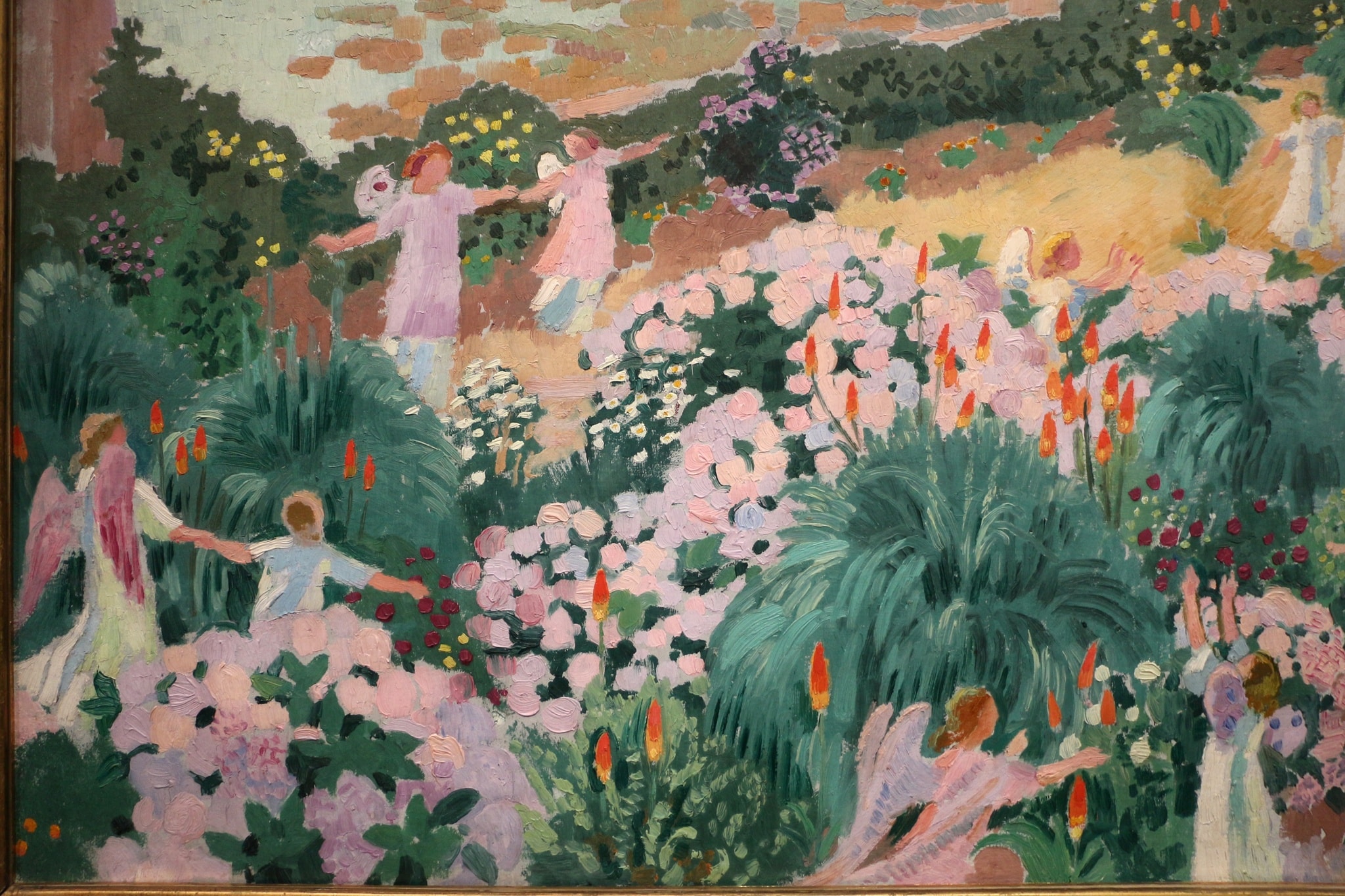
In Maurice Denis’s flower-filled vision of paradise, joy takes the shape of company. Hands meet among pink blossoms and deep green leaves. The painting gives this collection its opening mood: the possibility of belonging to a life larger than the worries that have narrowed our attention.
What All Saints’ Day invites us to remember
All Saints’ Day is a celebration of holiness shared across generations. Some of the people it honors have churches, paintings, and books bearing their names. Countless others lived without leaving a public record. The feast holds them together in the hope of life with God.
That breadth matters. A collection of famous paintings can make sainthood look reserved for extraordinary people at extraordinary moments. Yet the Gospel read at the Catholic celebration brings us to the Beatitudes: the poor in spirit, those who mourn, the merciful, the peacemakers. The words draw our attention toward the shape of a life, including its quiet and costly acts of love.
Blessed are the merciful, for they will be shown mercy.
Matthew 5:7, Berean Standard Bible
We may recognize the need for that mercy before we know how to offer it. We may come to the feast grieving, doubtful, tired, or aware of a failure we cannot undo. The saints’ stories give those experiences somewhere to go. They invite us to ask how faith might take form within the life we actually have.
The six journeys below bring together New Testament figures with Monica, whose life is known through Augustine’s writings, and Sebastian, whose detailed story comes from later Christian tradition. Each keeps Scripture, historical accounts, tradition, and artistic interpretation distinct, while making room for the questions a painting may awaken in us today.
Sources: All Saints and the Beatitudes; Matthew 5, BSB.
Find a place to begin
You do not have to read the collection in order. Begin with the experience that feels closest, or simply with the painting you want to spend more time looking at.
- When you feel defined by someone else’s judgment: Mary Magdalene — shame, dignity, and finding your voice.
- When you need to begin again after failure: Peter — forgiveness and the courage to return.
- When love for your family becomes constant worry: Monica — prayer, parenting, and the limits of control.
- When you are carrying hurt and struggling with forgiveness: Stephen — mercy without making injustice smaller.
- When your faith is full of questions: Thomas — doubt, honesty, and belonging.
- When suffering leaves you feeling alone: Sebastian — endurance and the people who come to help.
For prayers about protection and courage, begin with St. Michael and seven paintings.
Mary Magdalene: When you want to be seen as more than your past
Sometimes other people’s account of your life becomes louder than your own. Mary Magdalene’s story invites us to look again. The Gospels remember a woman who supported Jesus’s ministry, witnessed his death, and announced that she had seen the risen Lord. They do not identify her as a prostitute. That familiar label belongs to a later history of interpretation.
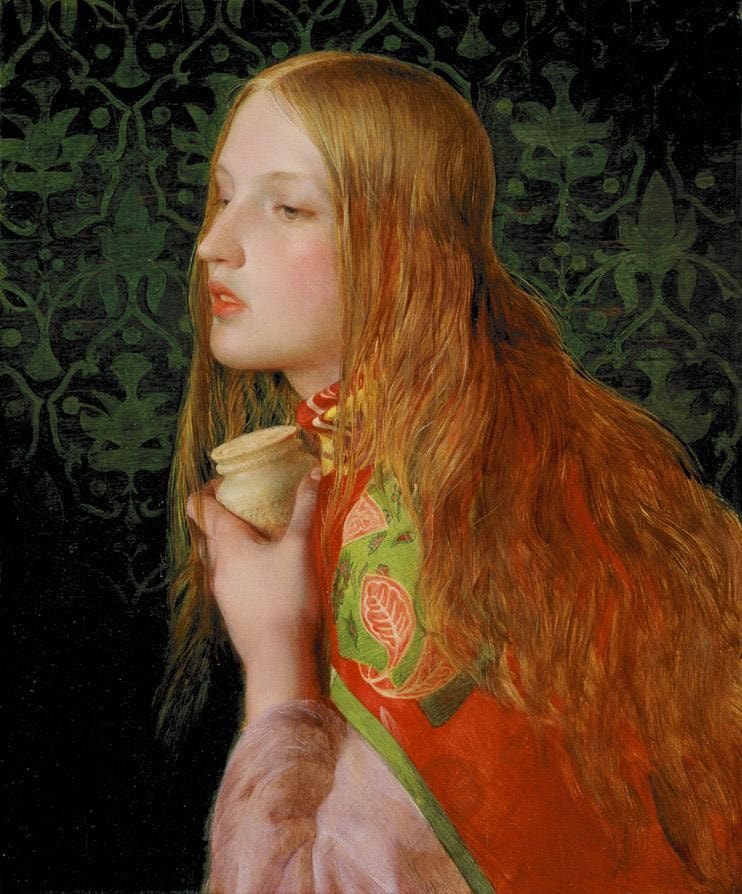
Frederick Sandys’s portrait offers a vivid entrance: copper-red hair, orange-red robes, a patterned green background, and a face that draws our attention before we have decided what story to tell about it. From here, the collection moves through candlelit rooms, scenes of grief, and gardens at dawn. The paintings reveal how differently artists have imagined Mary, and how carefully we need to distinguish their visions from the Gospel accounts.
Being misread can make it harder to speak. Mary’s story holds both experiences, alongside the work of staying with someone who suffers, facing uncertainty, and learning to let go.
Sources: Luke 8:1–3; John 19:25; John 20:11–18. The collection’s Mary Magdalene guide examines the later traditions in detail.
Peter: When failure makes it hard to trust yourself again
It can be difficult to receive trust when you are privately aware of your weaknesses. It can be harder still to return after you have let someone down. Peter’s life makes room for both experiences. The Gospels show a disciple who steps forward eagerly, speaks before he understands, retreats in fear, and is later entrusted with caring for others.
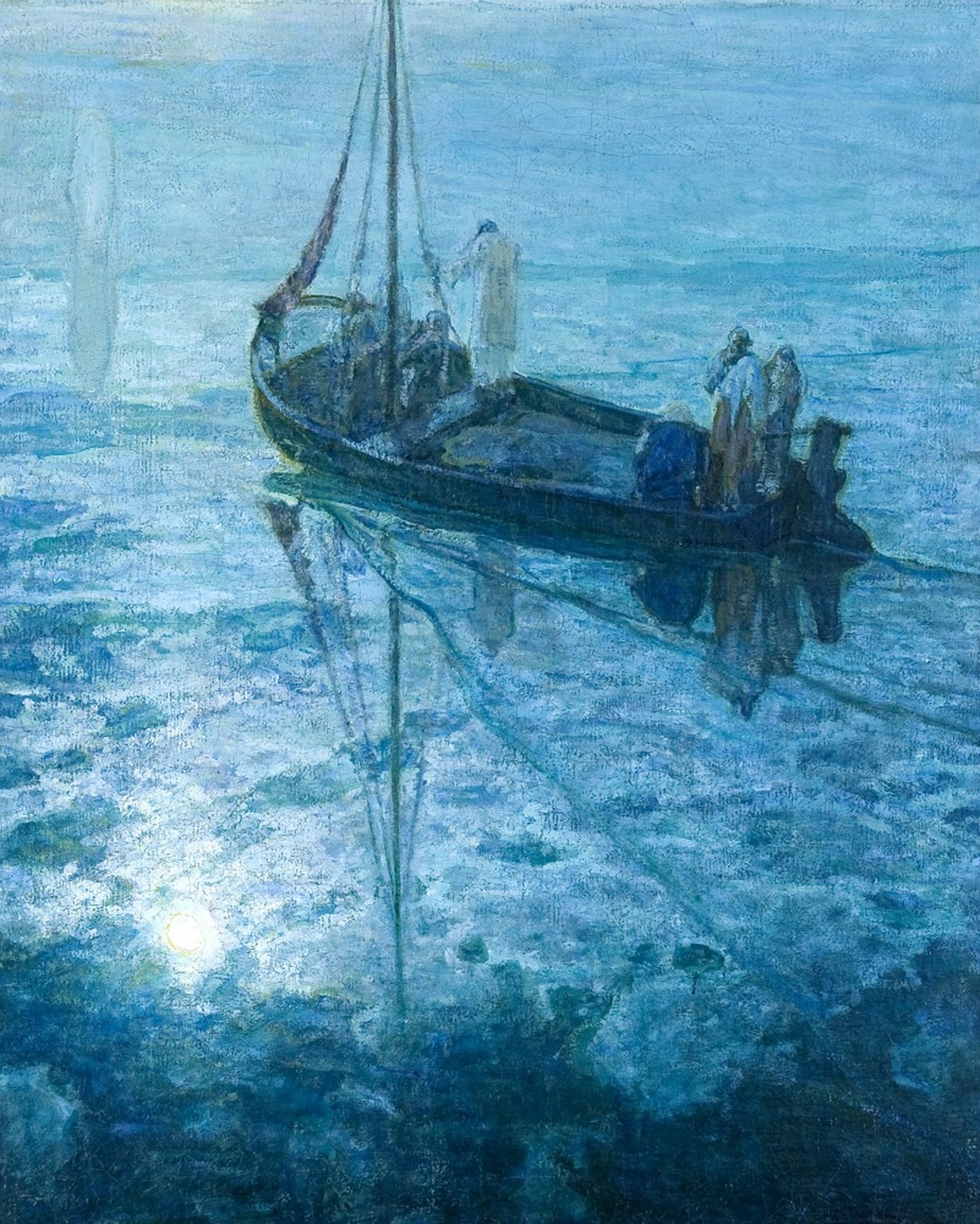
Henry Ossawa Tanner’s blue, luminous scene places us among the disciples as they see Christ on the water. The distance between the boat and the figure beyond it leaves room for the mixture of longing and fear with which a person may approach faith.
The overview follows Peter from the lake to the courtyard and the Easter shore, with five chapters exploring the struggles along the way. His story asks what can happen after regret: how we accept forgiveness, take responsibility, and begin to love with a clearer knowledge of ourselves. You do not have to turn remorse into confidence before entering this journey. You can begin with the wish to return.
Sources: Matthew 14:22–33; Luke 22:54–62; John 21:15–19.
Monica: When you love someone whose life you cannot control
A child’s independence does not switch off a parent’s concern. You may find yourself waiting for a message, rehearsing advice, or feeling guilty whenever your attention turns toward your own life. Monica’s story offers company in that uneasy space. In his Confessions, Augustine remembers a mother who loved and prayed for him, yet could not determine his choices.
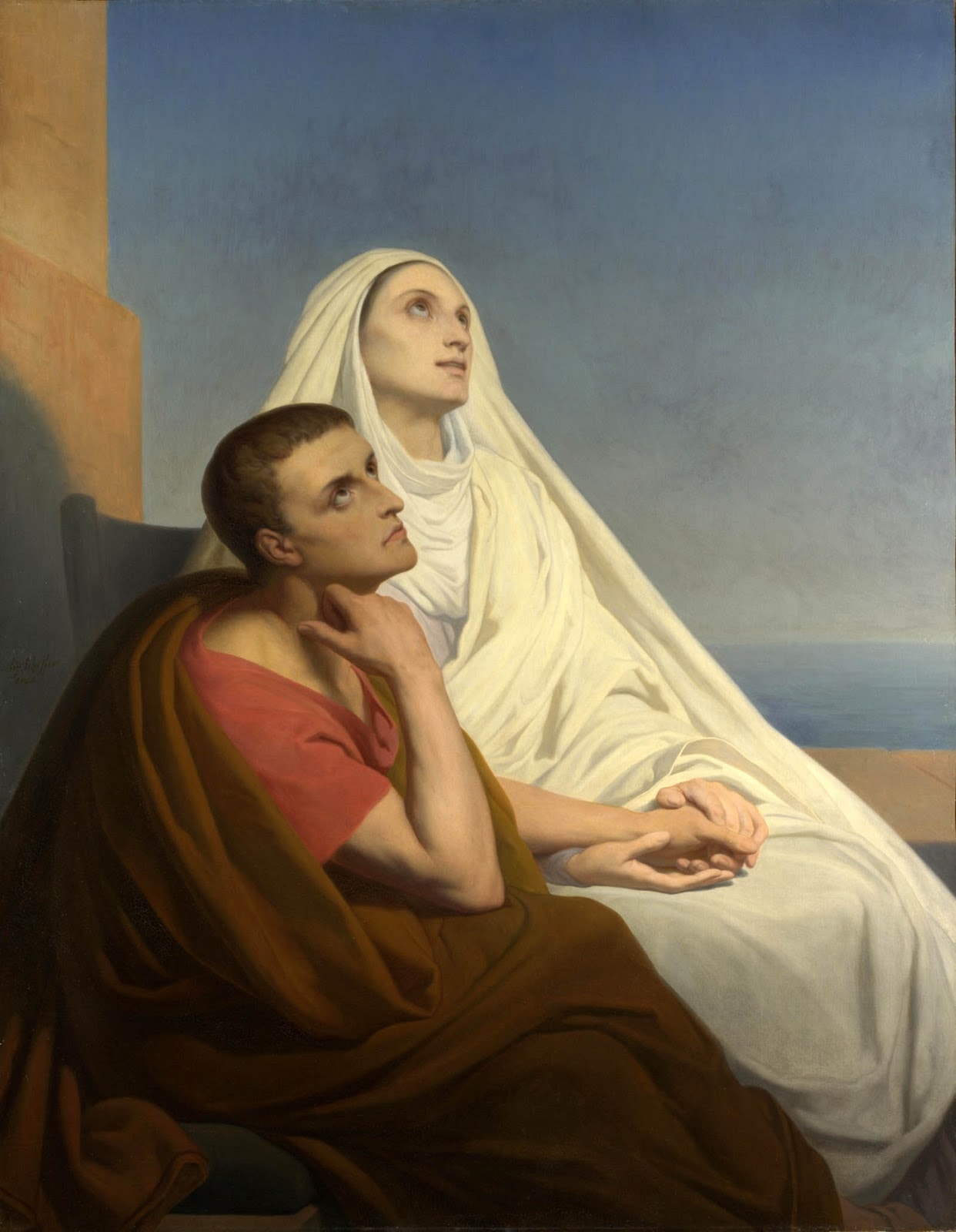
Ary Scheffer imagines Monica and Augustine seated together, their hands joined and their faces turned upward. The painting evokes the conversation at Ostia that Augustine recalls in his Confessions. Their shared attention offers another way to imagine closeness: being present together without directing the other person’s life.
Sources: Augustine, Confessions, Book IX, chapter 10.
The journey follows Monica from her son’s departure to their conversation at Ostia and her final request. Five paintings—images of Monica alongside clearly identified companion works—invite reflection on separation, the limits of influence, and closeness without an agenda. Augustine’s eventual conversion belongs to his particular history. It is not a test another family must pass to prove the strength of a parent’s prayer.
Sources: Augustine, Confessions, Book V, chapter 8; Benedict XVI on Monica.
Stephen: When forgiveness feels beyond your reach
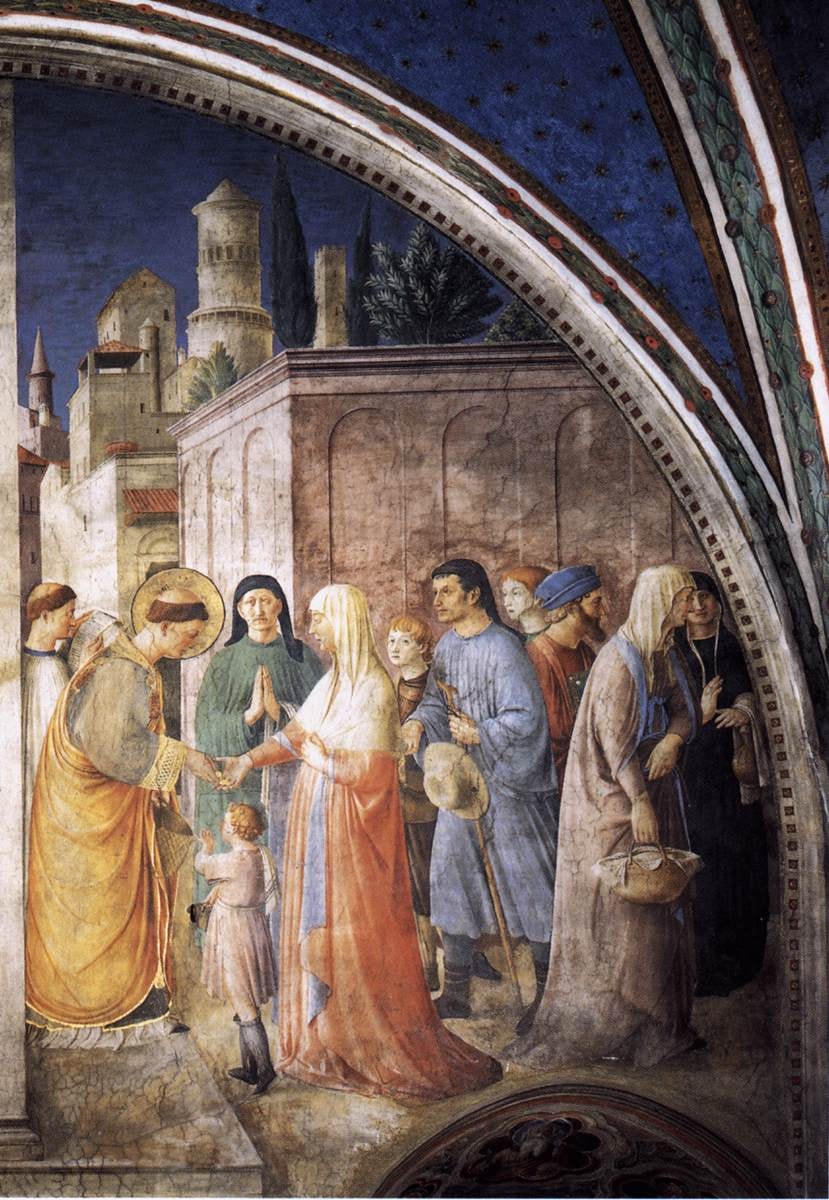
Forgiveness can sound like an impossible demand when the person who harmed you has offered neither an apology nor an explanation. Stephen’s story deserves to be approached without making that difficulty smaller. Acts introduces him among those chosen to serve a community troubled by the neglect of its widows. It later records his public witness, his killing, and his final prayer for those taking his life.
Fra Angelico offers a quieter beginning: Stephen bends toward a woman and child to give alms. Before the dramatic images of martyrdom, we encounter a life turned toward another person’s need.
The main article asks how to forgive someone who never said sorry, through six paintings of Stephen’s martyrdom and its aftermath. It treats Stephen’s death with gravity and leaves room for the grief of those who carried him away. Forgiveness does not require us to deny harm or return to an unsafe relationship. Here, art offers space to consider how truth, justice, and a prayer for mercy might exist together.
Sources: Acts 6:1–7; Acts 7:54–60; Acts 8:2.
Thomas: When you need room for honest questions
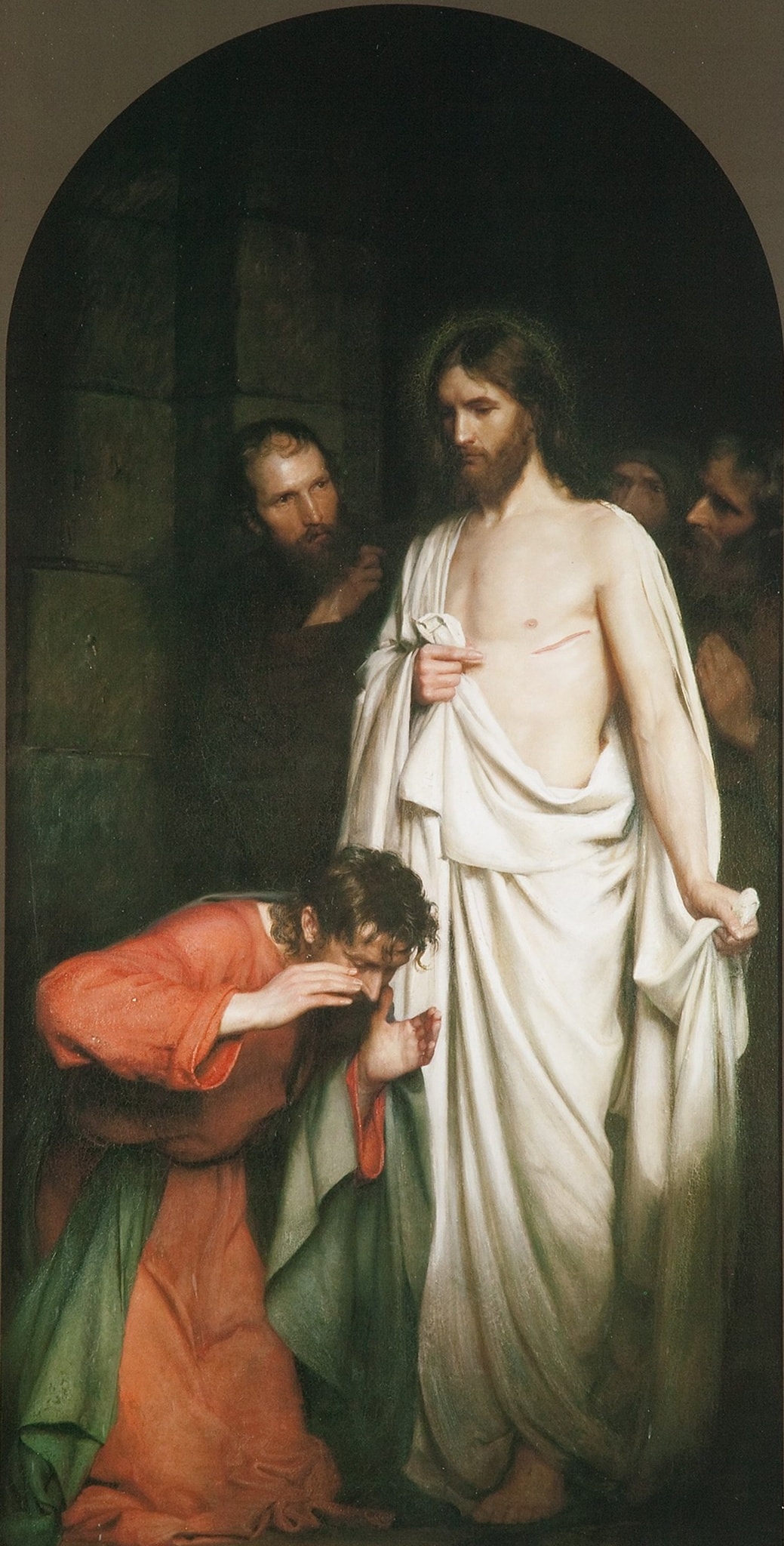
What happens when the answers you once trusted no longer feel sufficient? Thomas offers a place to begin without requiring you to settle that question first. John’s Gospel remembers his willingness to accompany Jesus into danger as well as his later demand for evidence. His familiar nickname cannot hold the whole person.
Carl Bloch places the encounter with the risen Christ close enough for us to notice posture, distance, and the vulnerability of an outstretched hand. We can linger with the scene before deciding what it means for our own questions.
This journey moves through loyalty, doubt, encounter, and hope, with paintings by Bloch and Caravaggio and a final contemplative companion by George Frederic Watts. If you are reconsidering inherited beliefs or trying to find your place in a community of faith, begin with an honest account of where you are. A question can be something you bring into prayer.
Sources: John 11:16; John 20:24–29.
Sebastian: When suffering leaves you feeling alone
Sebastian’s story goes beyond the arrows. In the later Christian account that artists inherited, Irene finds him alive, cares for him, and helps him recover. He then returns to confront the emperor’s persecution and is killed. The detailed story belongs to tradition, rather than Scripture, but the women reaching toward him give us a concrete image of care.
Across twenty-three paintings, the guide moves from the solitary figure to the hands that untie him, the light held close to his wounds, and the aftermath of his death. If you are enduring something painful, or trying to stay beside someone who is, begin with the moment another person comes to help.
Source: Vatican News: Sebastian’s story and its historical limits.
Michael: When you cannot protect everything you love
Alongside these six lives, paintings of the archangel Michael offer a different way to pray about fear, protection, and courage. The guide brings together the traditional St. Michael prayer and six original prayers for family, anger, sleep, difficult decisions, and the times when you need help to stand firm.
A simple Visio Divina practice for All Saints’ Day
Visio divina, often described as sacred seeing, is a way of praying with an image. In this collection, a painting becomes a point of attention alongside Scripture and the saint’s story. You do not need art-history expertise, and you do not need to produce a remarkable insight.
Set aside about five minutes. This is one suggested rhythm; you can stay longer wherever something invites your attention.
- Look before you explain. Let your eyes move across the whole painting. Notice its light, colors, and distances. Then return to one detail: a face, an empty space, or the way a hand rests against another.
- Read the story beside the image. Read the accompanying Bible passage or historical account slowly. Notice what the text says and what the artist has chosen to imagine. Let each deepen your attention without treating them as interchangeable.
- Answer honestly. Ask what rises in you: gratitude, resistance, grief, longing, or a question. Turn that response toward God in ordinary language. If words are difficult, remain with the detail that first caught your eye.
- Rest, then carry something into the day. Spend a little time without trying to resolve the experience. Before you leave, consider one small response: asking for forgiveness, giving someone your full attention, accepting help, or making room for rest.
For a family or small group, let each person choose a detail and describe what they see before inviting reflection. Different people may notice different things. No one has to disclose a personal story to participate.
A prayer for the day
God of mercy, thank you for the people through whom your love has become visible. As I look at these paintings and listen to these stories, help me receive the grace I need for this day. Give me courage to begin again, patience with what I cannot control, and attention to the person beside me. Teach me to follow Christ with the life I have. Amen.
Questions about All Saints’ Day
What is All Saints’ Day?
All Saints’ Day is a Christian celebration honoring the saints, including both those publicly remembered by name and those whose holiness is known only to God. It celebrates their life with God and invites the living to follow Christ in their own circumstances.
Source: John Paul II, All Saints’ Day, 2002.
When is All Saints’ Day in 2026?
All Saints’ Day falls on Sunday, November 1, 2026, in the Catholic and many Western Christian calendars. Eastern Orthodox churches observe All Saints on the Sunday after Pentecost, so November 1 is not a universal date across Christianity.
Sources: USCCB 2026 calendar; Orthodox Church in America.
What is the difference between All Saints’ Day and All Souls’ Day?
In the Catholic calendar, All Saints’ Day on November 1 honors the saints in heaven. All Souls’ Day on November 2 is dedicated to prayer for the faithful departed. The celebrations are closely related, but they have distinct purposes.
Source: Benedict XVI on All Saints and All Souls.
Is All Saints’ Day only a Catholic celebration?
No. It is also observed in Anglican and Eastern Orthodox traditions, among others, although dates and customs differ. This collection follows the November 1 observance and welcomes readers who want to explore the saints through art, Scripture, and reflection.
Sources: Church of England calendar; Orthodox Church in America.
Which Bible passages can I read for All Saints’ Day?
Begin with the Beatitudes in Matthew 5:1–12, the great multitude in Revelation 7:9–17, or the cloud of witnesses in Hebrews 12:1–2. For the Catholic celebration in 2026, the appointed readings are Revelation 7:2–4, 9–14; 1 John 3:1–3; and Matthew 5:1–12a, with Psalm 24 as the responsorial psalm. Hebrews is an additional suggestion for personal reflection.
Sources: USCCB readings for November 1, 2026; Hebrews 12, BSB.
How can I celebrate All Saints’ Day with art?
Choose one saint’s story and one painting from this collection. Look slowly, read the accompanying passage, and let your response become a brief prayer. You might also share a painting with your family or choose an act of mercy inspired by what you notice. A few attentive minutes are enough to begin.
Keep looking, one painting at a time
All Saints’ Day gives us a date to gather these stories. Their company can stay with us through the rest of the year. Return to a familiar painting when your circumstances change; something you passed over before may become the detail you need to see.
Continue with one of the six journeys above, or explore the Visio Divina art gallery for more paintings and Scripture. If you would like a hands-on way to slow down with sacred art, discover the Visio Divina app and its contemplative art puzzles.
Scripture quotation: Berean Standard Bible. The reflections and suggested prayer practice are written for this collection; they are not quotations from the saints.