There is a particular helplessness in loving someone who is suffering. You can drive them to the appointment, remember the questions, bring clean clothes, and manage the hundred small arrangements that keep a hard day moving. You become an expert in logistics.
Then there comes a moment when there is nothing useful left to do. The diagnosis cannot be argued with. The grief cannot be fixed. You are still there, with all your love and nowhere obvious to put it.
The Gospels—the Bible’s four accounts of Jesus’ life—remember Mary Magdalene as someone who knew that moment well. This piece follows her through it with four paintings. It is the second of five in our guide to Mary Magdalene’s life in art.
The Women Who Stayed
On the night Jesus was arrested, Mark’s Gospel says of his disciples, “Then everyone deserted Him and fled” (Mark 14:50). By the next afternoon he is dying on a Roman cross outside Jerusalem, and the people the Gospels place there are mostly women who had followed him down from Galilee.
And there were also women watching from a distance. Among them were Mary Magdalene, Mary the mother of James the younger and of Joses, and Salome.
Mark 15:40 (BSB)
John’s Gospel brings them closer, “near the cross.” Either way, they have no part to play. They cannot appeal the sentence, and they cannot shorten it. They stay until it is over.
Then they stay longer. A man named Joseph of Arimathea, a member of the ruling council who had quietly become a follower, takes the body down and lays it in a tomb cut into rock. Mary follows. “Mary Magdalene and the other Mary were sitting there opposite the tomb,” Matthew says (Matthew 27:61), and it is hard to think of a plainer sentence about grief. At sunset the Sabbath begins, the weekly Jewish day of rest on which no work may be done, and they go home to wait.
From Friday afternoon until Sunday morning, the Gospels do not record a single word she says. Everything she contributes is presence. The four paintings here move from the cross and the carrying of the body to an inward image of grief, and then to the road home.
Sources: Mark 15:40–47; John 19:25; Matthew 27:57–61.
When There Is Nothing Left to Do
Near the cross of Jesus stood His mother and her sister, as well as Mary the wife of Clopas and Mary Magdalene.
John 19:25 (BSB)
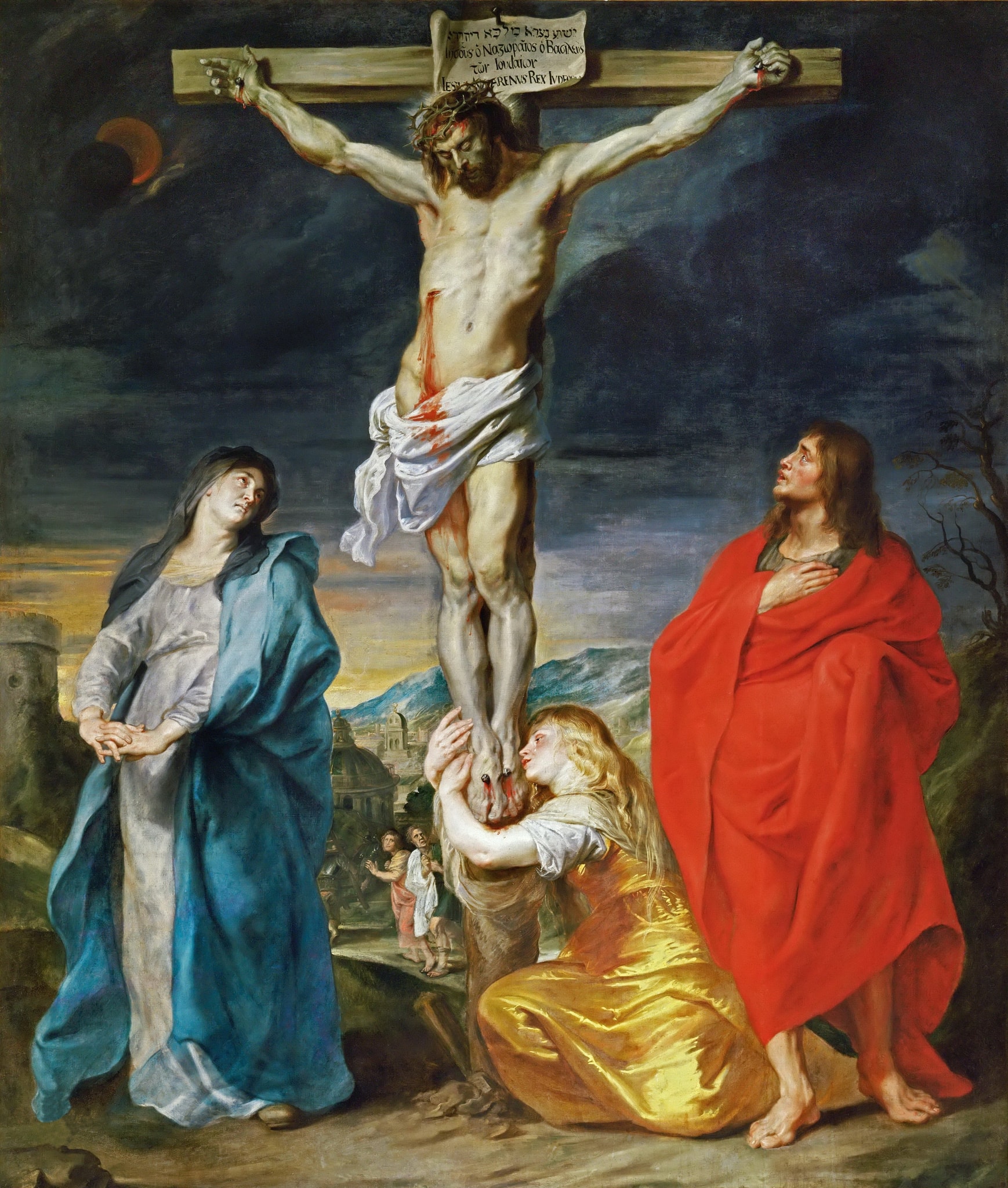
Anthony van Dyck was about twenty when he painted this crucifixion. Under a sky so dark that the sun has gone into eclipse, the mother of Jesus stands at the left in blue with her hands clasped, and the disciple John stands at the right in red with a hand on his chest. Mary Magdalene kneels at the base of the cross in a gold satin dress. She has wrapped her arms around the foot of the cross, her hands resting against his lower legs. Her face is close to his feet, and her tearful eyes are lifted. She is the only figure in the foreground who is touching him.
She cannot pull out the nails, and she cannot stop the execution. She refuses to let go anyway.
If you are caring for someone whose suffering is beyond your control, this painting gives a shape to what that feels like. You want to intervene, to fix it, to bargain with reality. Van Dyck does not ask you to accept anything yet. He paints the raw wish to hold on to the person you love while the situation slips out of your hands, and he treats that wish as love, which it is.
Visio Divina Prompt: Look at her arms around the wood. What situation, or what person, are you trying to hold together right now with nothing but your own strength?
Keep Hold of a Hand
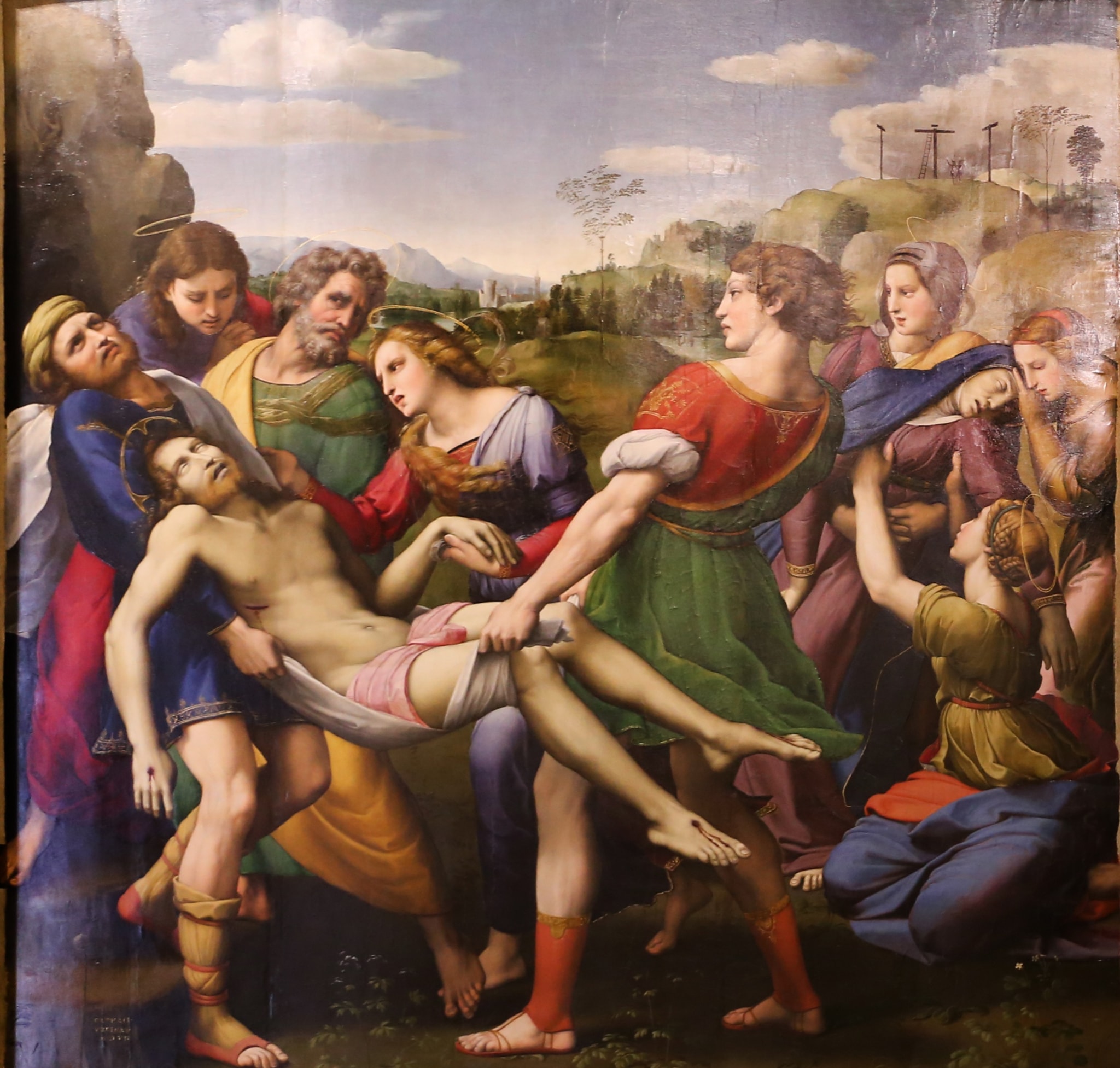
Raphael painted this in 1507 for a mother. Atalanta Baglioni, of Perugia, had lost her son Grifonetto to a family feud, and she commissioned an altarpiece of the dead Christ being carried to his tomb.
The painting is full of effort. Two men lean backward under the weight of the body, which hangs in a linen sling between them. At the right, a group of women catches the mother of Jesus as she faints. Between those two urgent jobs is Mary Magdalene, her hair flying as she hurries alongside. She is not carrying anything. She has taken hold of his left hand, and she is looking into his face.
It is a small gesture, easy to miss in all that movement. Once you have seen it, it becomes the center of the picture.
In a crisis there are usually people handling the heavy lifting: the doctors, the organizers, the ones who know what to do. If you are not one of them, your work may simply be contact. Holding a hand, sitting in the room, or sending the message that needs no reply can feel painfully small beside the size of the disaster. Raphael, painting for a woman who knew, puts it at the heart of the scene. Keeping a connection alive in the middle of chaos is a deep kind of care, and sometimes it is the only kind available.
Visio Divina Prompt: Find the two joined hands. What is one small way you can stay in contact with someone who is suffering, without trying to solve anything?
Let Them Hide
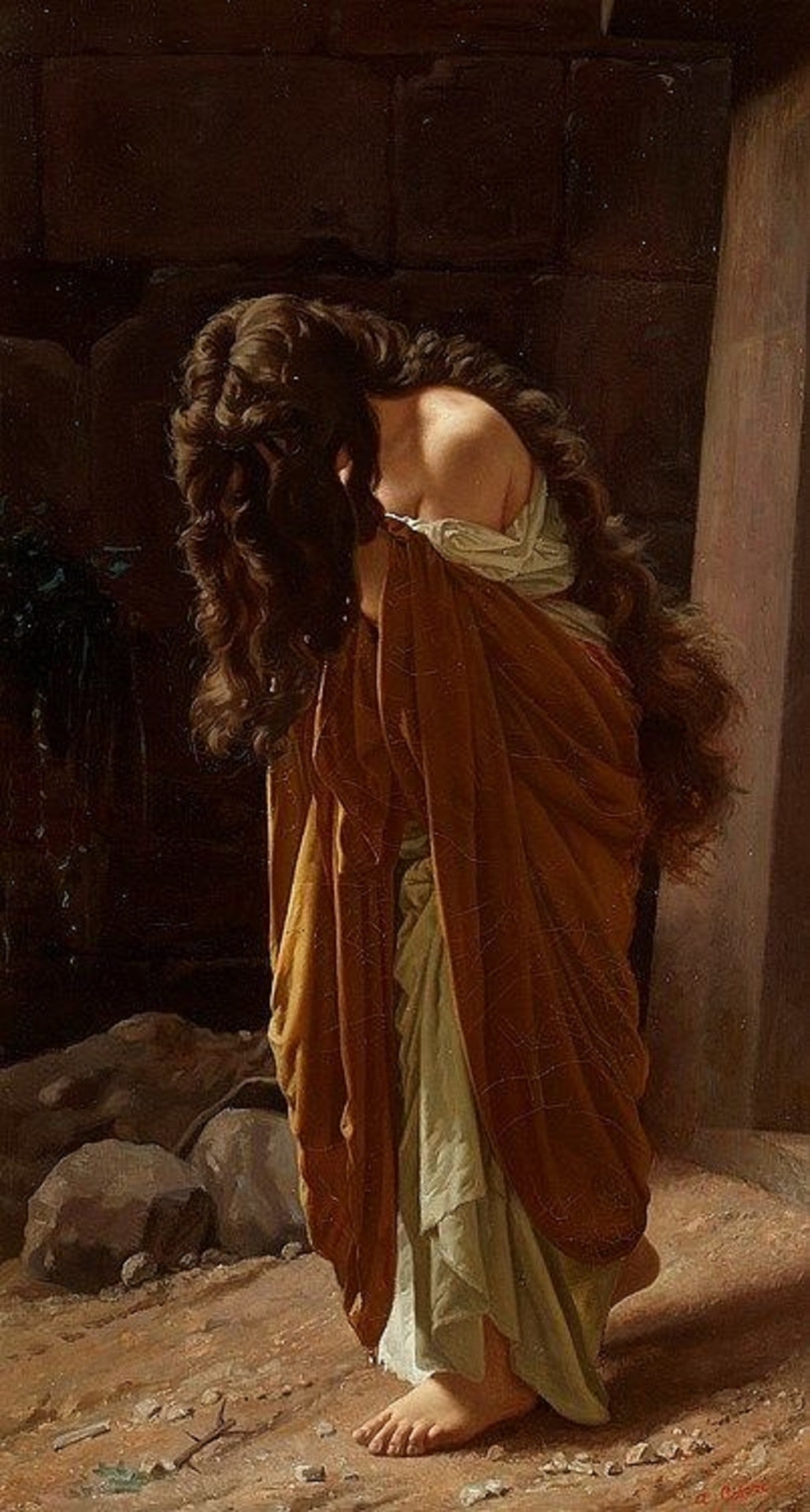
Antonio Ciseri gives almost the whole canvas to a woman whose face we never see. She stands bent forward, with her face buried in her hands and in a mass of dark hair. One shoulder has slipped bare. A rust-colored mantle hangs over her pale dress, her feet are bare on broken stone, and a wall of heavy blocks closes the space behind her. The heritage office of Ciseri’s native Ticino connects this figure with his large painting of Christ being carried to the tomb: she is one of the mourners, taken aside and given a picture to herself.
We are often told that grief should be shared, that people need to “talk about it.” Sometimes they do. But some sorrow is so heavy that a person needs to go inside it for a while, with no eye contact, no brave face, and no obligation to reassure anyone that they will be all right.
The Bible’s best picture of this comes from the book of Job, when Job’s friends first arrive after he has lost everything:
Then they sat on the ground with him for seven days and seven nights, but no one spoke a word to him because they saw how intense his suffering was.
Job 2:13 (BSB)
It is the wisest thing his friends do. Their trouble begins when they start talking. If you are keeping company with someone in deep sorrow, one of the kindest things you can do is stop asking them to look up. You can stay close without demanding conversation, and without needing proof that your comfort is working.
Visio Divina Prompt: Notice that she is turned away from everyone, including you. Is there someone in your life, or some part of yourself, that needs permission to hide and be silent today?
Walk Them Home
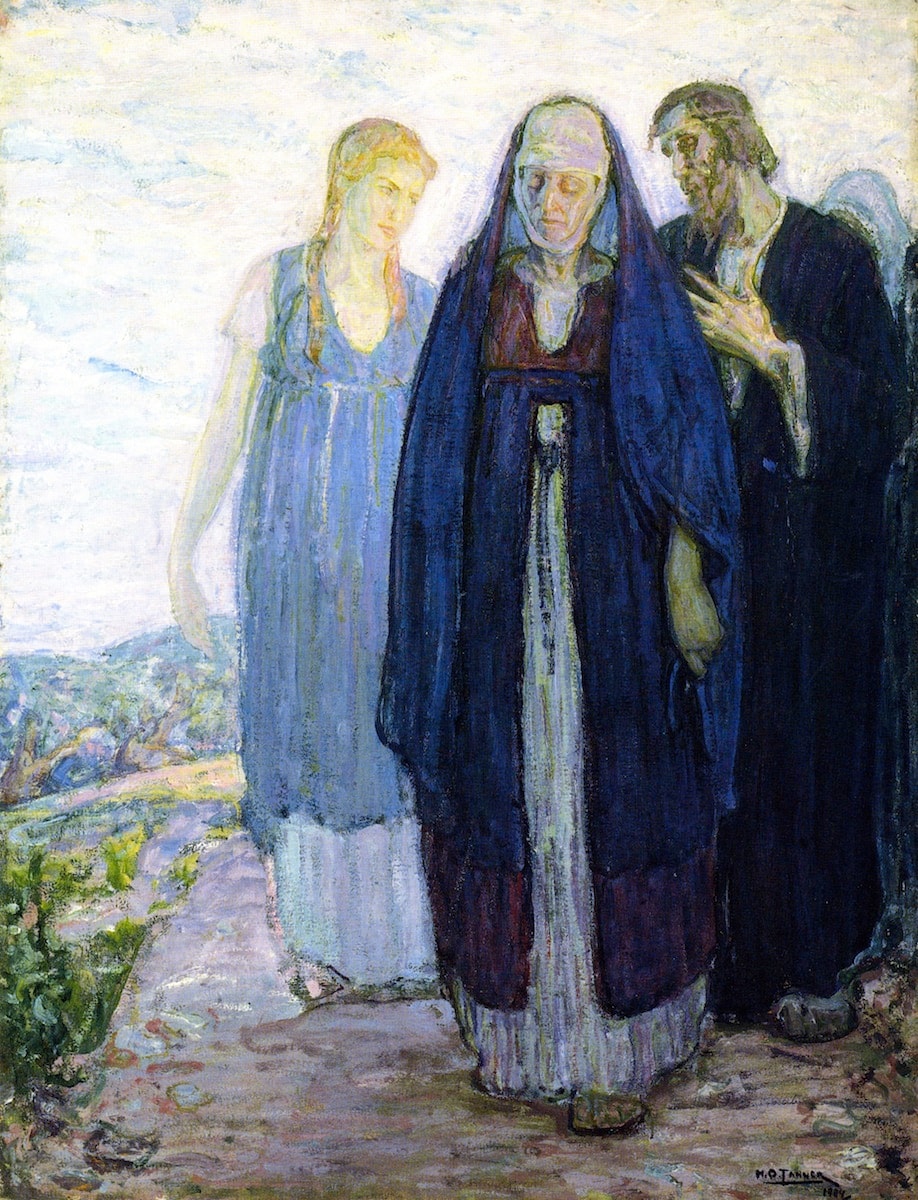
Eventually the crisis ends. The funeral is over, the visitors leave, and the casseroles stop arriving. The American painter Henry Ossawa Tanner, in 1904, painted what comes next. Three figures fill the foreground, walking toward us along a path under a pale sky, and a fourth veiled companion is partly hidden at the far right. In the middle is an older woman wrapped in deep blue, with her eyes on the ground. At her shoulder a bearded man presses a hand to his chest. On the left, a younger woman in lighter blue, with a long fair braid, keeps pace with her own eyes lowered. They are usually read as the mother of Jesus, the disciple John, and Mary Magdalene, walking back from the hill of the crucifixion.
The painting can be read beside John’s account of Jesus entrusting his mother to the beloved disciple: “from that hour, this disciple took her into his home” (John 19:27).
Nobody in the painting is talking, and nobody is asking anyone else how they feel. They are simply not letting one another make the walk alone. This is the quiet that follows a loss, when you have to go back into a world that looks the same and is not. Being a companion in that stretch does not take eloquence. It takes someone willing to match your pace.
Visio Divina Prompt: Notice how closely the companions keep together. Who is walking beside you right now? Or whom do you need to ask?
Sources: Philadelphia Museum of Art, Henry Ossawa Tanner (1991), pp. 184–186; Cedar Rapids Museum of Art: discussion of Tanner’s painting; contemporary exhibition commentary in The International Studio.
A Word to the One Who Stays
Staying does not mean never resting. Luke notes that after the burial the women went home, prepared their spices, “and they rested on the Sabbath, according to the commandment” (Luke 23:56). On the worst weekend of their lives they took the day of rest they had been given. If you are the one keeping watch beside someone, you are allowed a Sabbath too: an hour, an afternoon, or a night when someone else sits in the chair.
A 4-Step Visio Divina Practice for Caregivers
Visio Divina—Latin for “divine seeing”—is a simple way of praying with a picture instead of a passage. Return to the painting that best matches where you are today, and take three unhurried minutes:
- Look (Visio): Let your eyes settle on one gesture of care: the arms around the wood, the held hand, the hidden face, the shared road.
- Meditate (Meditatio): Name the person you love who is suffering, and admit what you cannot change. This is who I love. This is what I cannot fix.
- Pray (Oratio): God, when my love has nowhere obvious to go, help me to stay. Release me from needing to fix what cannot be fixed. Make me a quiet, steady presence, and send someone to be that for me. Amen.
- Contemplate (Contemplatio): Rest in silence for one minute. Let your shoulders drop. For this minute, being here is enough.
All Saints’ Day Makes Room for Mourners
The Catholic Gospel reading for All Saints’ Day is the Beatitudes, the opening of Jesus’ best-known sermon. At the heart of a day that celebrates holiness is a blessing spoken over people who are grieving:
Blessed are those who mourn, for they will be comforted.
Matthew 5:4 (BSB)
Source for the liturgical reading: USCCB: Solemnity of All Saints, November 1, 2026.
Mary Magdalene helps us hear that blessing as addressed to real people, with companions, memories, and tears. Remembering the saints does not have to make your own unfinished grief feel out of place. Their stories can keep you company inside it.
Frequently asked questions
Was Mary Magdalene present at the crucifixion?
Yes. John 19:25 names her near the cross, and Mark 15:40 and Matthew 27:56 name her among the women watching. Painters add the gestures, clothing, and arrangements that the texts leave out; her place at the foot of the cross is an artistic tradition, not a detail from the Gospels.
Does Tanner’s Return of the Holy Women show Easter morning?
No. It shows the walk back from the crucifixion. Commentary from the time of its first exhibition describes the hill of Calvary behind the returning group. It is a different picture from Tanner’s The Three Marys, which shows the women arriving at the tomb on Easter morning.
How can a caregiver pray with these paintings?
Start with one image and a few minutes. Notice a single gesture of care, name the person you are accompanying, and ask what support you need as well. The practice gives you a way to pray about an experience that is hard to put into words. You do not need to feel peaceful, or reach a resolution, before you stop.
Stay with the painting
If you want to sit with one of these images a little longer, you can restore it yourself: open Raphael’s Deposition as a puzzle, piece by piece, with its verse waiting at the end. Or get the app for a new painting, a new verse, and a new reflection every morning.
Continue the journey
Next in Mary’s story: When the Future Is Unclear: Mary Magdalene at the Empty Tomb. Before this: Healing from Shame. Or return to Mary Magdalene’s life and paintings.