When researchers timed visitors at the Art Institute of Chicago, the average look at a work of art lasted just under half a minute. The most common look lasted ten seconds.
Visio Divina asks for about ten minutes, and it gives those minutes a purpose. You stay with one image and one passage of Scripture, and you let slow looking turn into prayer.
Visio Divina is Latin for “divine seeing.” It is a way of praying with an image, usually a painting of a Bible scene, in four steps: look, meditate, pray and contemplate. It grew out of lectio divina, the monastic practice of praying slowly with Scripture. You don’t need to know anything about art to do it.

Visio Divina at a glance
- Meaning: Latin for “divine seeing,” also translated “sacred seeing”
- Pronunciation: VEE-zee-oh dee-VEE-nah
- What it is: a way of praying with an image and a passage of Scripture
- The four steps: look, meditate, pray, contemplate
- What you need: one image, one Bible passage and ten to twenty quiet minutes
- Where it comes from: lectio divina, the monastic practice of slow, prayerful reading
- Who practices it: Christians in many traditions, including Catholic, Methodist, Presbyterian, Reformed and evangelical communities
- Bible text quoted here: Berean Standard Bible (BSB)
What does Visio Divina mean?
Visio means “seeing” and divina means “divine,” so the phrase is usually translated “divine seeing” or “sacred seeing.” It is pronounced VEE-zee-oh dee-VEE-nah.
The name is borrowed from an older one. Lectio divina, or “divine reading,” is the monastic habit of reading a short passage of Scripture slowly and prayerfully. Visio Divina does the same with a picture. You’ll see it written with and without capital letters, and both are fine.
Where does Visio Divina come from?
The name is recent, and the habit behind it is very old.
Slow reading came first. In the sixth century the Rule of Saint Benedict set aside parts of the monastic day for prayerful reading. In the twelfth century a Carthusian prior named Guigo II described that reading as a ladder with four rungs: reading, meditation, prayer and contemplation. His short book is called The Ladder of Monks. Change one word on the first rung and you have the four steps of Visio Divina.
Christians were already learning from pictures. Around the year 600 the bishop of Marseilles broke the images in his churches to stop people adoring them. Pope Gregory the Great wrote to him, praised the concern and blamed the breaking. “For to adore a picture is one thing,” Gregory wrote, “but to learn through the story of a picture what is to be adored is another.” A picture, he said, does for people who cannot read what a book does for people who can: “in it the illiterate read.”
The Latin name arrived much later. The Calvin Institute of Christian Worship calls Visio Divina “a relatively recent term” for a habit Christians have kept “for millennia.” One program, Seeing the Word, teaches it with The Saint John’s Bible, a handwritten and illuminated Bible that the Benedictine monks of Saint John’s in Minnesota commissioned in 1998 and saw completed in 2011.
How to practice Visio Divina: the four steps
Before you begin, choose one image and one Bible passage that belongs with it. Turn off your notifications, since the image is probably on your phone. Then ask for help in one line. Psalm 119 has a good one: “Open my eyes that I may see wondrous things from Your law.”
Step 1. Look (visio)
Give the image a full minute or two before you decide what it means. Let your eye travel. Notice where it lands first and where it keeps going back. Notice the light, the faces, the hands and the empty spaces. You don’t need to explain anything yet.
Step 2. Meditate (meditatio)
Read the passage slowly, then look again. Ask what connects the words and the picture. Where would you stand in this scene? Which figure are you most like today? Which word of the passage does the image make louder?
Step 3. Pray (oratio)
Turn what you noticed into conversation with God. Use plain words. Thank him, ask him, and tell him what unsettled you. If one line of the passage stayed with you, pray that line.
Step 4. Contemplate (contemplatio)
Let the words stop. Rest in God’s presence for a few minutes with the image still in front of you. Your mind will wander. When it does, look at the painting again and come back.
There is no single correct way to do this, and guides differ. Some count five steps. The Calvin Institute’s version ends by asking God “how you should respond,” which is a good question to carry into the rest of the day.
Visio Divina examples: four paintings to begin with
Each example gives you a painting, a passage, a place to start looking and one question. All four paintings are free to open in our gallery.
1. The Return of the Prodigal Son: Visio Divina for any day

So he got up and went to his father. But while he was still in the distance, his father saw him and was filled with compassion. He ran to his son, embraced him, and kissed him.
Luke 15:20 · BSB
Where to start: Begin with the father’s hands, then find the son’s feet.
One question: Where are you in this room today? You might be the one kneeling, the one embracing, or one of the people watching from the side.
This painting has a famous student. In 1986 the Dutch priest Henri Nouwen went to the Hermitage Museum and sat with it for hours. In 1992 he published a whole book about what he saw, The Return of the Prodigal Son: A Story of Homecoming.
2. The Annunciation: Visio Divina for Advent

“I am the Lord’s servant,” Mary answered. “May it happen to me according to your word.” Then the angel left her.
Luke 1:38 · BSB
Where to start: Notice where the light is, where Mary is, and the space between them.
One question: What is God asking you to trust him with before you can see how it will turn out?
3. Christ in the Wilderness: Visio Divina for Lent

Then Jesus was led by the Spirit into the wilderness to be tempted by the devil. After fasting forty days and forty nights, He was hungry.
Matthew 4:1–2 · BSB
Where to start: Look at his hands, then at the ground around him.
One question: What are you hungry for at the moment, and have you told him?
4. Supper at Emmaus: Visio Divina for Easter
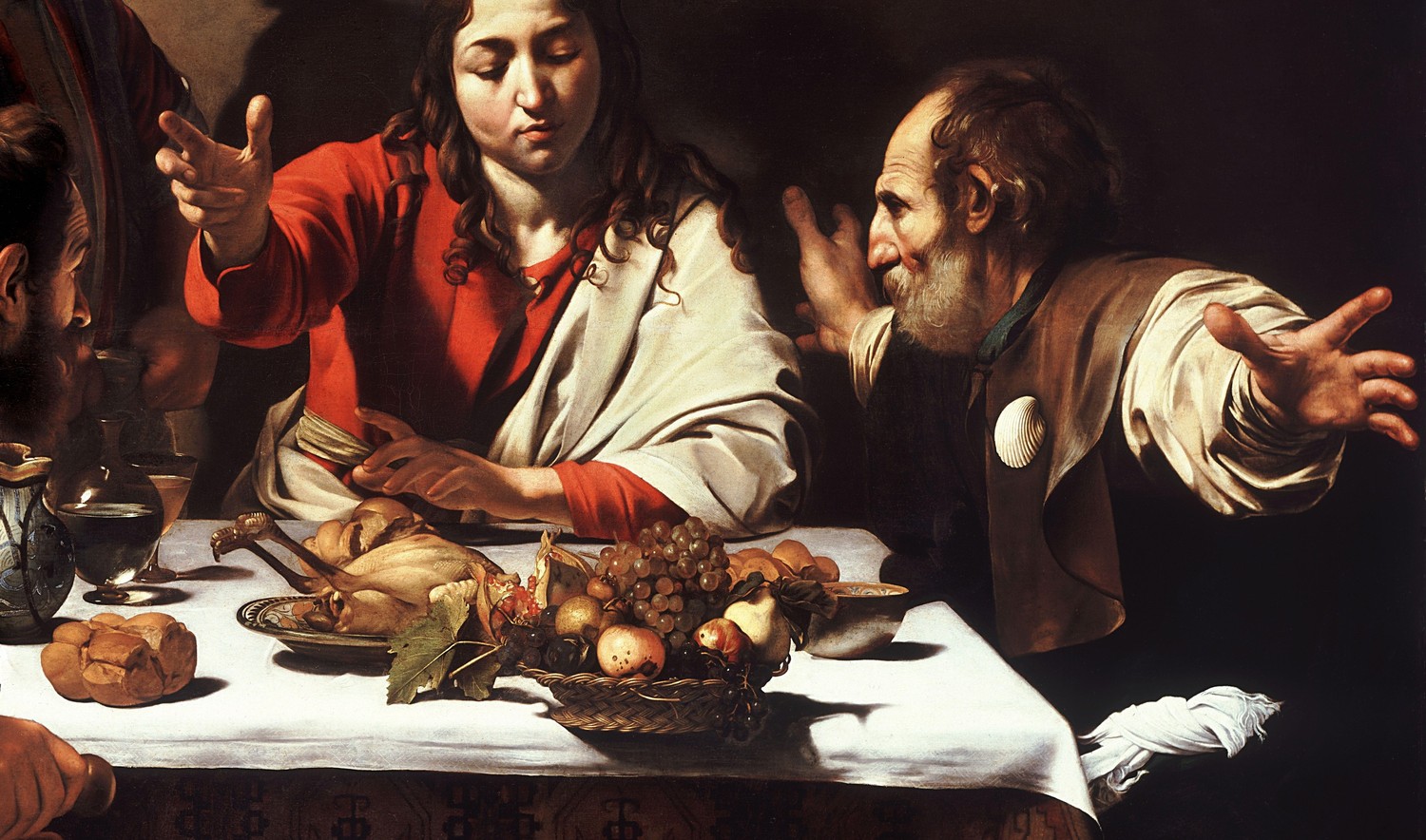
While He was reclining at the table with them, He took bread, spoke a blessing and broke it, and gave it to them. Then their eyes were opened and they recognized Jesus—and He disappeared from their sight.
Luke 24:30–31 · BSB
Where to start: Look at the hands around the table. Each pair is doing a different thing.
One question: When has an ordinary moment, like a meal, turned out to hold more than you saw at first?
“Then their eyes were opened” is as good a summary of Visio Divina as you will find.
Visio Divina questions to ask any painting
Keep this list for the days when your mind is blank. Two or three questions are plenty for one sitting.
While you look
- Where does my eye land first, and where does it keep returning?
- Where is the light coming from, and what does it leave in shadow?
- What would I hear if I were standing in this scene?
- What did I miss in the first ten seconds?
While you meditate
- Which word or line of the passage does this image bring out?
- Which figure am I most like today, and which one would I prefer to be?
- What in this picture comforts me, and what bothers me?
- What does this image show me about God that I tend to forget?
While you pray and rest
- What do I want to say to God now that I have seen this?
- What might he be inviting me to receive, to let go of, or to do?
- Which single detail will I carry with me today?
Lectio Divina vs Visio Divina
They are the same prayer entered through different doors.
| Lectio Divina | Visio Divina | |
|---|---|---|
| Meaning | “divine reading” | “divine seeing” |
| You begin with | a short passage of Scripture | an image, with a passage beside it |
| First step | read | look |
| Remaining steps | meditate, pray, contemplate | meditate, pray, contemplate |
| Helps most when | you want to slow your reading down | words feel worn out, or a story has become too familiar to see |
Many people use both together. They read the passage, pray with the painting, and then read the passage once more.
Is Visio Divina biblical?
The phrase does not appear in the Bible. It names a method of prayer, and a method is only as sound as the thing it directs your attention to.
Scripture often tells people to look. Jesus says, “Look at the birds of the air.” David wants “to gaze on the beauty of the LORD.” Paul prays that “the eyes of your heart may be enlightened.” Christians who welcome sacred images also point to the Incarnation, because Paul calls the Son “the image of the invisible God.”
Scripture also forbids making an idol, and says, “You shall not bow down to them or worship them.” Visio Divina has to stay on the right side of that command. You are not praying to a painting. You are praying to God with the Bible open, and the painting helps you stay with the passage. That is the distinction Gregory drew fourteen centuries ago.
If praying with images troubles your conscience, leave the image out. The same slow attention, given to the text alone, is lectio divina.
Is Visio Divina Catholic?
Its roots are monastic and many Catholics practice it, but it is not only Catholic. Guides to Visio Divina are published by Busted Halo, a Catholic ministry, by the Reformed Calvin Institute of Christian Worship, and by the evangelical campus ministry InterVarsity. The Calvin Institute’s own list adds Methodist, Presbyterian and Benedictine sources.
Orthodox Christians have prayed with icons for many centuries. That is a tradition of its own, with its own theology, and it should not be folded into Visio Divina.
How to lead Visio Divina in a small group
Twenty minutes is enough. Show one image where everyone can see it, and resist the urge to explain it first.
- Open (1 minute). Say what you are about to do, and pray one line together.
- Look in silence (2 minutes). Nobody speaks.
- Name what you see (3 minutes). Invite single sentences that begin “I notice.” Ask people to describe and not to interpret yet.
- Read the passage aloud (1 minute). Read slowly, and let a different voice read it a second time.
- Meditate in silence (4 minutes). Offer one question from the list above.
- Share (5 minutes). Anyone may pass, and nobody corrects anyone else’s answer.
- Pray and rest (4 minutes). Pray briefly, keep two minutes of silence, and close with the verse.
With children, shorten every step and keep the questions concrete. Ask what they can see, what they wonder about, and what they would like to say to Jesus about it. One sentence of prayer each is enough.
How to choose an image for Visio Divina
- Pick a picture that belongs to a passage. A painting of a Bible scene gives you the text to pray with.
- Pick a picture that rewards a long look. Faces, hands and light give your attention somewhere to go.
- Pick a real artwork you can see clearly. A good reproduction on a phone is fine.
- Pick one. Scrolling through twenty images is the opposite of the exercise.
Our Open Gallery has more than 500 paintings, each paired with a passage of Scripture, and every one is free to open. For the church year, the Sacred Calendar gathers paintings by feast.
Why our app is called Visio Divina
We named the app after the practice because the app is built to slow your looking down. You restore a painting piece by piece, which keeps your eyes on it far longer than half a minute. When the last piece settles, the verse appears, followed by a reflection written for that painting.
You can try it in your browser with today’s painting, or get the app for a new painting, a new verse and a new reflection every morning.
Frequently asked questions
- How do you pronounce Visio Divina?
- Say VEE-zee-oh dee-VEE-nah. That follows church Latin, in which the letter v sounds as it does in English.
- What are the steps of Visio Divina?
- There are four: look, meditate, pray and contemplate. They follow the four steps of lectio divina, with looking in place of reading. Some guides add a fifth step about how you will respond.
- How long does Visio Divina take?
- Ten to twenty minutes is typical. If you have five, spend two of them looking, two praying and one in silence.
- Do I need to know about art?
- No. You are not being asked to identify a style or a date. You are being asked to notice, and anybody with a few minutes can do that.
- Can I practice Visio Divina with a photograph or in nature?
- Yes. One Catholic guide describes the practice as the slow contemplation of “a picture, photo, work of art, or really anything visual.” Beginners usually find it easier to start with a painting of a Bible scene, because the passage is already chosen.
- Is Visio Divina a kind of meditation?
- It is Christian meditation. It is addressed to God, it stays close to a passage of Scripture, and it ends in prayer and rest.
- What is the difference between lectio divina and Visio Divina?
- Lectio divina begins by reading a passage, and Visio Divina begins by looking at an image. The remaining steps are the same.
- Is there a Visio Divina app?
- Yes. Ours is called Visio Divina, and it pairs a painting with a verse and a reflection every morning.
Keep going
- Choose a painting and begin: the Open Gallery.
- Pray with today’s painting.
- Read a whole chapter with paintings: Luke 1 in Art · Luke 2 in Art.
- Get to know a painter: Caravaggio’s Bible Paintings · Henry Ossawa Tanner’s Bible Paintings.
- Get the Visio Divina app.