If your first question is “where’s the angel?”, you’re looking at this painting correctly.
It shows the Annunciation, the moment the angel Gabriel tells Mary she will be the mother of Jesus. Painters had handled that scene in much the same way for centuries. Gabriel got wings and often a lily. Mary got a halo and a blue mantle, and the room tended to look like a very nice house in Florence or Bruges.
In 1898 Henry Ossawa Tanner kept the girl and the room and changed almost everything else.
Henry Ossawa Tanner’s The Annunciation (1898) shows the scene from Luke 1:26–38 in which the angel Gabriel tells Mary she will give birth to the Son of God. Tanner paints Gabriel as a tall column of golden light and Mary as a young woman in everyday clothes, with no halo. The painting belongs to the Philadelphia Museum of Art, which acquired it in 1899. It was the first of Tanner’s works to enter an American museum.

Tanner’s Annunciation at a glance
- Painting: The Annunciation (French title L’Annonciation)
- Artist: Henry Ossawa Tanner (1859–1937), an American painter who lived and worked in France from 1891
- Date: 1898, signed and dated at the lower left
- Medium and size: oil on canvas, about 1.45 × 1.8 metres (57 × 71 inches)
- Where it is now: Philadelphia Museum of Art, purchased with the W. P. Wilstach Fund in 1899 (accession number W1899-1-1)
- First shown: Paris Salon, 1898
- Bible passage: Luke 1:26–38
- Bible text quoted here: Berean Standard Bible (BSB)
Where is the angel in Tanner’s Annunciation?
He’s the light. The Philadelphia Museum of Art says it in one sentence: “Gabriel appears only as a shaft of light.”
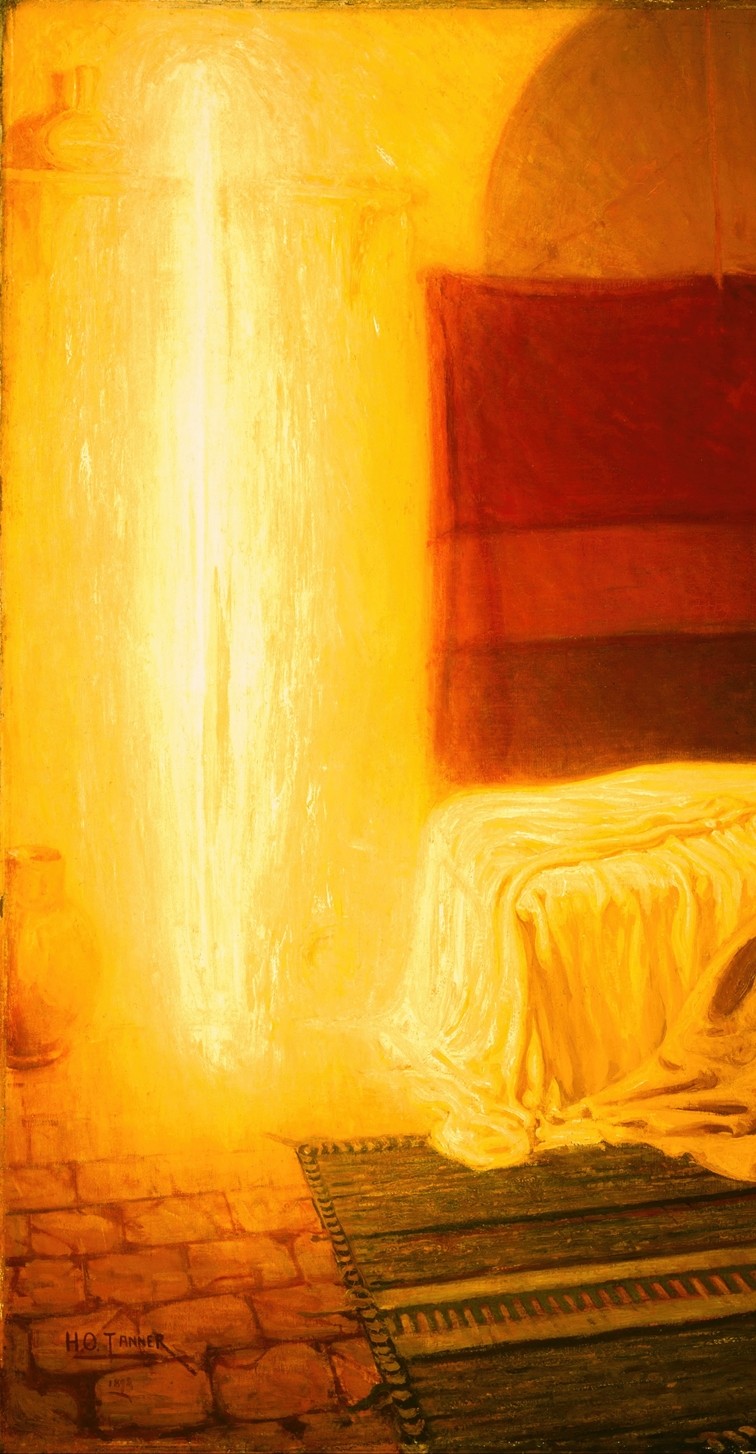
It helps to know what Luke tells us about Gabriel’s appearance, which is nothing at all. The Gospel reports that the angel came and what he said. It never mentions wings, a robe, a lily or a face. Those details belong to artistic tradition, built up by generations of painters who had to put a figure on the wall and gave him the best outfit they could think of.
Tanner leaves the outfit out. A critic named Helen Cole, writing in 1900, described Mary as having “no halo or celestial attributes about her, and only the flood of golden light to herald the approach of the angel.”
He had tried the idea small. The Smithsonian American Art Museum owns a little oil study on wood, about the size of a sheet of printer paper, and the museum’s note says “the vertical line of white paint on the left represents the divine presence of the angel.” The Philadelphia museum’s 1991 Tanner catalogue calls the finished canvas “very close to the small preliminary study.”
Another writer in 1900 was reminded of Dante Gabriel Rossetti’s Annunciation. The catalogue finds the comparison useful mainly for the contrast. Rossetti’s Gabriel is a human figure with a halo and, in the catalogue’s words, “small golden flames that lick at his heels.” Tanner’s Gabriel has no heels.
Why does Mary look so ordinary?
Tanner gives her a striped robe, clasped hands and a bed with the covers spilling onto the floor. A few toes show under the hem. There’s no halo, no blue mantle and nobody kneeling.
Part of the reason is a journey. In February 1897 Tanner saw Egypt and Palestine for the first time. The trip was paid for by a Philadelphia businessman he never names in his memoir, and historians identify him as Rodman Wanamaker, of the department-store family. Wanamaker’s view, quoted in the 1991 catalogue, was that in the East “the light, both interior and exterior, the mannerisms of the people, the costumes and habits of living, all are vastly different from anything that could be imagined in the West.”
Back in Paris, Tanner painted whitewashed walls, a stone floor, woven cloth and clay jars. Helen Cole recognised Mary’s robe as “the common striped cotton of the Eastern women of the poorer class.” The catalogue suspects he bought some of the furnishings as studio props, because the patterned carpet in front of the bed turns up again in Christ Learning to Read, a picture he painted more than ten years later.
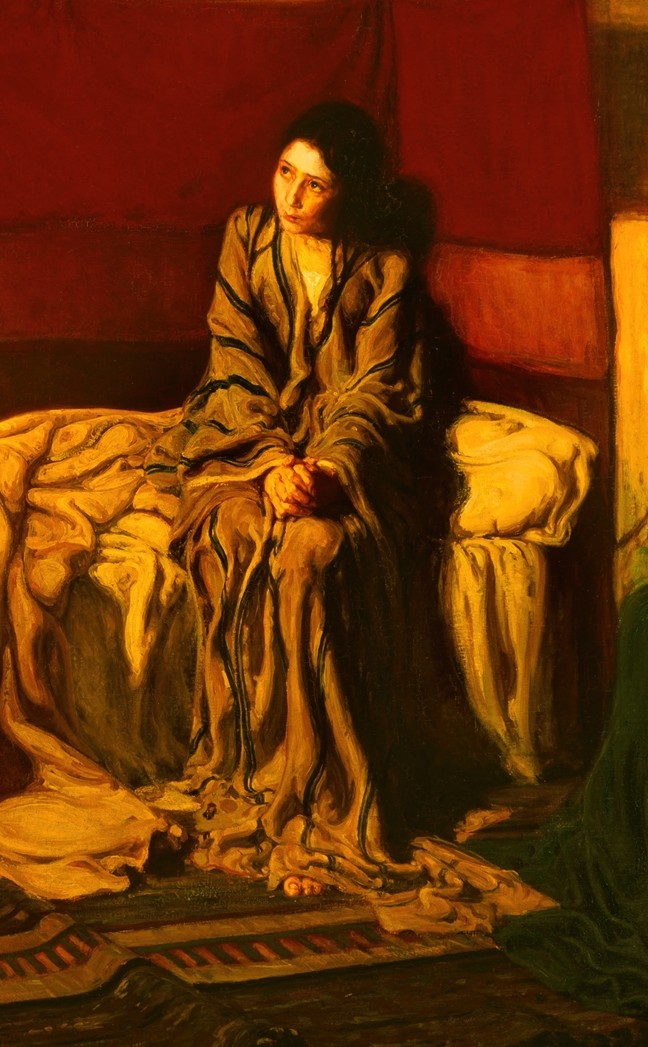
The other part of the reason is how Tanner read his Bible. In 1911 the editor of the Fine Arts Journal reported that Tanner “told me that one of his aims was to present the simple domestic side of biblical personages. He said that the Bible was full of suggested domesticity.” Tanner said that thirteen years after he painted this picture, and about his work in general, but it fits this room.
What is happening in the Bible story?
Luke sets the scene in Nazareth, a town in Galilee. Mary is pledged to be married to a man named Joseph. Gabriel greets her as “highly favored,” and her first reaction isn’t joy.
Mary was greatly troubled at his words and wondered what kind of greeting this might be.
Luke 1:29 · BSB
The first American critics saw that mixture in Tanner’s Mary. When the painting was shown in Philadelphia in January 1899, the Philadelphia Inquirer wrote that “the child-woman is divided between fear and exaltation.”
Gabriel tells her not to be afraid. She will have a son and name him Jesus, and he will be given the throne of David. Mary asks one practical question, and Luke records it this way: “How can this be,” Mary asked the angel, “since I am a virgin?”
Gabriel’s answer includes the verse our gallery pairs with this painting.
The angel replied, “The Holy Spirit will come upon you, and the power of the Most High will overshadow you. So the Holy One to be born will be called the Son of God. Look, even Elizabeth your relative has conceived a son in her old age, and she who was called barren is in her sixth month. For no word from God will ever fail.”
Luke 1:35–37 · BSB
“Overshadow” is a word with a history. In the ancient Greek translation of Exodus, the same verb describes the cloud settling on the tent of meeting when “the glory of the LORD filled the tabernacle.” Luke uses it again for the cloud at the Transfiguration. Cloud and fire are among the Bible’s oldest signs that God is present.
Tanner’s memoir gives this painting two sentences and says nothing about the light, so the connection is ours and not his. Still, it’s hard to look at that glowing column and not remember the God who led Israel “in a pillar of fire to give them light by night.”
Then Mary answers.
“I am the Lord’s servant,” Mary answered. “May it happen to me according to your word.” Then the angel left her.
Luke 1:38 · BSB
Notice what she has been given by this point: a promise, and one fact she can check, which is her relative Elizabeth’s pregnancy. She has not been given a plan. She says yes to God on the strength of his word, and Elizabeth will soon bless her for it: “Blessed is she who has believed that the Lord’s word to her will be fulfilled.”
Whether Tanner shows her before that answer or in the middle of it, the picture doesn’t say.
He painted it twice
Tanner’s first attempt didn’t survive his own opinion of it. In his memoir he says the first canvas “was so unsatisfactory that there seemed no other way out of the difficulty than to commence a new one,” which is a very polite way to describe starting over.
The second canvas went to the Paris Salon of 1898, where it was bound to be looked at closely. The year before, the French government had bought his Resurrection of Lazarus at the Salon for its museum of living artists.
No reviews from the 1898 Salon have been found. What survives is secondhand, and Helen Cole is honest about that. The painting “proved one of the great successes of the year,” she wrote, and then she added: “It is said that when this picture was brought before the jury of admission that a storm of ‘bravos’ burst forth.” Keep her “it is said” in mind.
Tanner’s fellow painters didn’t bother with caution. “Tanner has made another ten-strike,” said Alexander Harrison, borrowing from bowling. Walter Gay claimed that “not since Sargent’s early triumphs has there been anything like it.” Both remarks reached Tanner in a June 1898 letter from Harrison Morris, the managing director of the Pennsylvania Academy of the Fine Arts.
Morris wanted the painting for Philadelphia. He had spent the previous year trying and failing to borrow Lazarus for his annual exhibition, and that May he had written to Tanner: “after our abortive efforts of last year, you should let us have it without fail.”
He got it. The painting was shown in Chicago in October 1898 and at the Pennsylvania Academy in early 1899, where the Inquirer called it a “brilliant masterpiece.” By then Rodman Wanamaker had bought it, mainly, according to the catalogue, to give Tanner some income.
On April 5, 1899, Philadelphia’s Wilstach Collection bought the painting from Wanamaker for $1,750. The collection had been set up to buy art for the city, and it was the forerunner of today’s Philadelphia Museum of Art. Tanner was 39 and living in Paris, and for the first time an American museum owned one of his pictures.
Who was the model for Mary?
You’ll often read that Mary is Jessie Olssen, the American singer Tanner married in 1899. The 1991 catalogue doubts it. Tanner probably didn’t meet Jessie until the summer after the painting was shown at the Salon, so he “more likely used a professional model.” The catalogue doesn’t name her.
Pray with the painting: a 4-step Visio Divina
Visio Divina is Latin for “divine seeing.” It means praying with a picture the way you might pray with a passage of Scripture, slowly and without hurrying to a conclusion. Here is one way to do it with Tanner’s Annunciation.
- Look. Give the painting a full minute before you decide what it means. Notice where your eye goes first and where it keeps returning.
- Meditate. Read Luke 1:29 and then Luke 1:37. Mary is “greatly troubled,” and she is told that “no word from God will ever fail.” Which of those two lines is closer to where you are today?
- Pray. Tell God plainly about the thing you have been asked to carry and did not choose. Ask Mary’s question in your own words if you need to. She asked it and was answered.
- Contemplate. Sit quietly in front of the light a little longer. You don’t need to produce an answer today. In Luke’s telling, Mary’s question comes before her yes, and the angel stays to hear both.
Questions people ask about Tanner’s Annunciation
- What is the meaning of Henry Ossawa Tanner’s The Annunciation?
- It shows the angel Gabriel telling Mary that she will bear the Son of God (Luke 1:26–38), set in a plain room with no halo and no winged figure. In our reading, Tanner puts the holiness of the scene in the meeting itself: a young woman, a light, and a word from God that she chooses to trust.
- Where is Tanner’s Annunciation today?
- It belongs to the Philadelphia Museum of Art, which acquired it in 1899 with the W. P. Wilstach Fund (accession number W1899-1-1). Paintings move on and off view, so check the museum’s website before you travel.
- Why is there no angel in the painting?
- There is one. The column of golden light at the left is Gabriel, and the museum describes him as appearing “only as a shaft of light.” Luke’s Gospel never says what Gabriel looked like, and Tanner chose light where earlier painters chose a winged figure.
- When did Tanner paint The Annunciation?
- He painted it in Paris after his first trip to Egypt and Palestine in 1897, and he signed and dated the canvas 1898. It was his entry for the Paris Salon that year.
- How big is the painting?
- It is about 1.45 metres tall and 1.8 metres wide, or roughly five feet by six. The 1991 catalogue calls it one of the biggest canvases of Tanner’s career.
- Who posed for Mary?
- Probably a professional model. The popular claim that she is Tanner’s future wife, Jessie Olssen, is doubted by the 1991 catalogue, because he probably hadn’t met her yet.
- Which Bible verse goes with the painting?
- The scene is Luke 1:26–38. Our gallery pairs the painting with Luke 1:35, where Gabriel tells Mary that “the power of the Most High will overshadow you.”
Keep going
- Restore this painting yourself, piece by piece: open Tanner’s Annunciation as a puzzle.
- Meet the rest of his work: Henry Ossawa Tanner’s Bible Paintings, including his later Visitation.
- Read the whole chapter: Luke 1 in Art.
- Follow Mary’s story: The Life of the Virgin Mary in Paintings.
- Compare three other Annunciations: Leonardo da Vinci · Caravaggio · Carl Bloch.
- Get the Visio Divina app for a new painting, a new verse and a new reflection every morning.