Luke 1 is the long chapter people skip to get to Christmas. That is a shame, because it contains the best structural joke in the New Testament: the same angel shows up twice, two people ask him what sounds like the same question, and only one walks away able to speak.
Here is the whole chapter in plain language, with ten paintings. The verses worth remembering are set apart.
What Is Luke 1 About?
Luke 1 sets up everything that follows: Luke explains how he did his research, an angel tells an old priest he will have a son and then strikes him silent, the same angel tells a young woman in Nazareth she will bear the Son of God, she goes to visit her pregnant relative Elizabeth, and sings the song we call the Magnificat. Then Elizabeth's baby is born and named John, and the priest gets his voice back and sings too.
Tap any part to jump to it, with the paintings and the verses.
Luke Explains Himself First (Luke 1:1–4)
Before anything happens, Luke does something no other Gospel writer does: he tells you his method.
Therefore, having carefully investigated everything from the beginning, it seemed good also to me to write an orderly account for you, most excellent Theophilus, so that you may know the certainty of the things you have been taught.
Luke 1:3–4 · BSB
Other people have written accounts, he says; these came from "the initial eyewitnesses" (1:2); he has looked into all of it and wants to set it down in order. It reads less like a sacred text opening and more like the first page of a report.
Who was Theophilus?
We do not know. The name means "friend of God" or "lover of God," and it could be a real patron who paid for the work, a Roman official, or a way of addressing any reader who fits the description. "Most excellent" is the kind of address used for someone of rank, which is why many readers take him for a real person. Luke never says. He also dedicates his second book, Acts, to the same man (Acts 1:1).
The Priest Who Went Silent (Luke 1:5–25)
Zechariah is a priest — not the high priest, one of many, from the division of Abijah — and he and his wife Elizabeth are old and have no children. One day the lot falls to him to go into the temple and burn incense while the crowd prays outside. An angel is standing there.
“Do not be afraid, Zechariah, because your prayer has been heard. Your wife Elizabeth will bear you a son, and you are to give him the name John.”
Luke 1:13 · BSB (excerpt)
Zechariah's reply is the hinge of the whole chapter:
“How can I be sure of this?” Zechariah asked the angel. “I am an old man, and my wife is well along in years.”
Luke 1:18 · BSB
The angel introduces himself — Gabriel — and then does something startling.
“And now you will be silent and unable to speak until the day this comes to pass, because you did not believe my words, which will be fulfilled at their proper time.”
Luke 1:20 · BSB
He walks out unable to talk, and stays that way until his son is named. Outside, the crowd works out that he has seen something.
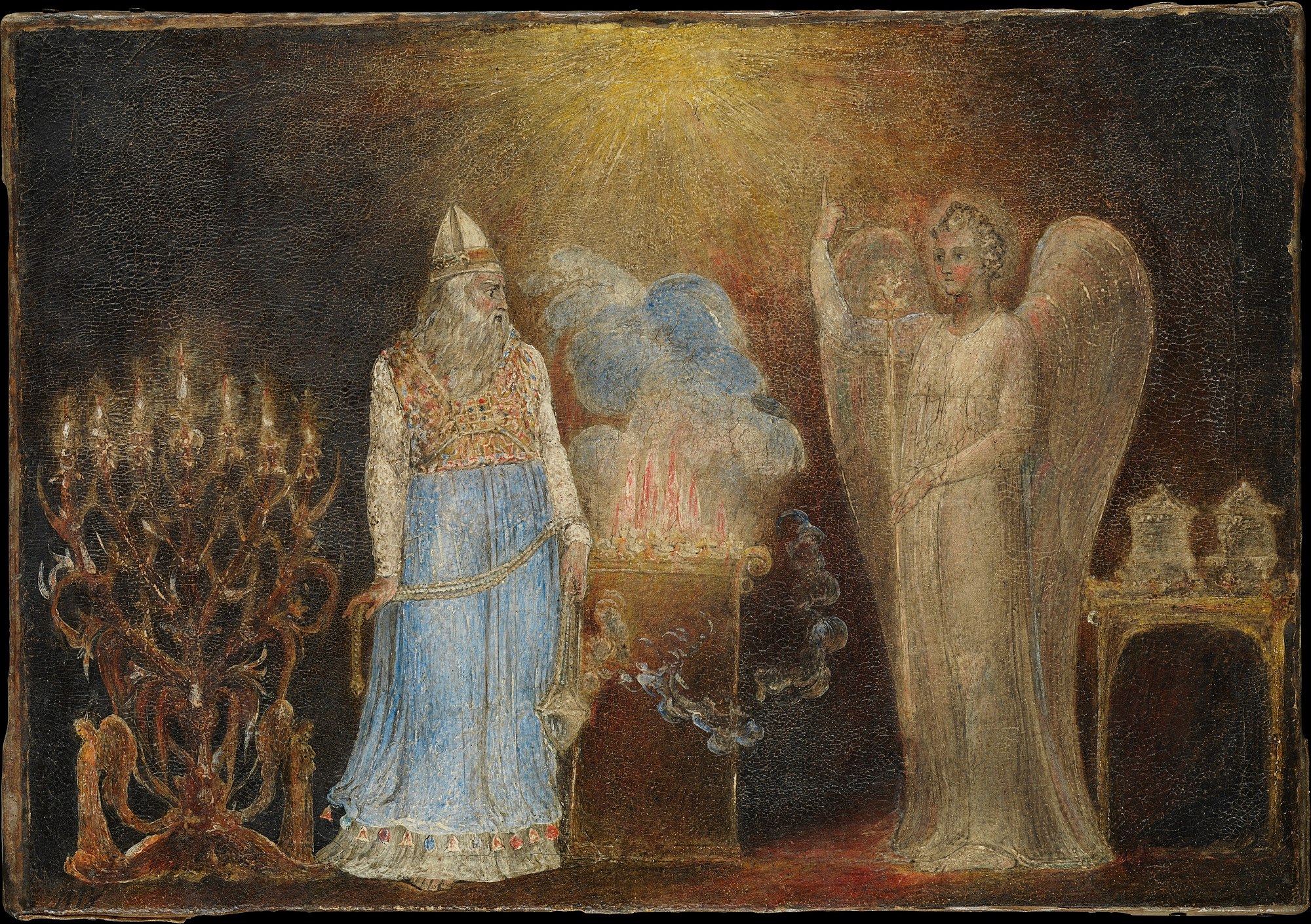
Blake made this as one of a set of fifty biblical subjects for his patron Thomas Butts. Only about thirty have been traced; the rest were painted with materials fragile enough that some are thought simply not to have survived.
Hold on to Zechariah's question. Mary asks her own question sixteen verses later.
Gabriel Comes to Mary (Luke 1:26–38)
In Elizabeth’s sixth month of pregnancy, the same angel is sent to Nazareth, to a young woman pledged in marriage to Joseph.
The angel appeared to her and said, “Greetings, you who are highly favored! The Lord is with you.”
Luke 1:28 · BSB
Luke says she was "greatly troubled at his words and wondered what kind of greeting this might be" (1:29). Gabriel tells her not to be afraid, and then tells her what will happen. And Mary asks her question.
“How can this be,” Mary asked the angel, “since I am a virgin?”
Luke 1:34 · BSB
Why was Zechariah punished for asking and Mary was not?
Because Luke says they were not asking the same thing. Zechariah asks, "How can I be sure of this?" — a request for proof — and Gabriel's answer names the reason directly: "because you did not believe my words" (1:20). Mary asks, "How can this be…?" — a question about how, not whether. She does not get silenced. She gets an explanation, and then a fact she can go and check for herself: her relative Elizabeth, the one everyone called barren, is six months pregnant.
Two nearly identical-sounding questions, sixteen verses apart, with opposite outcomes. Luke almost certainly put them that close together on purpose.
“For no word from God will ever fail.”
Luke 1:37 · BSB
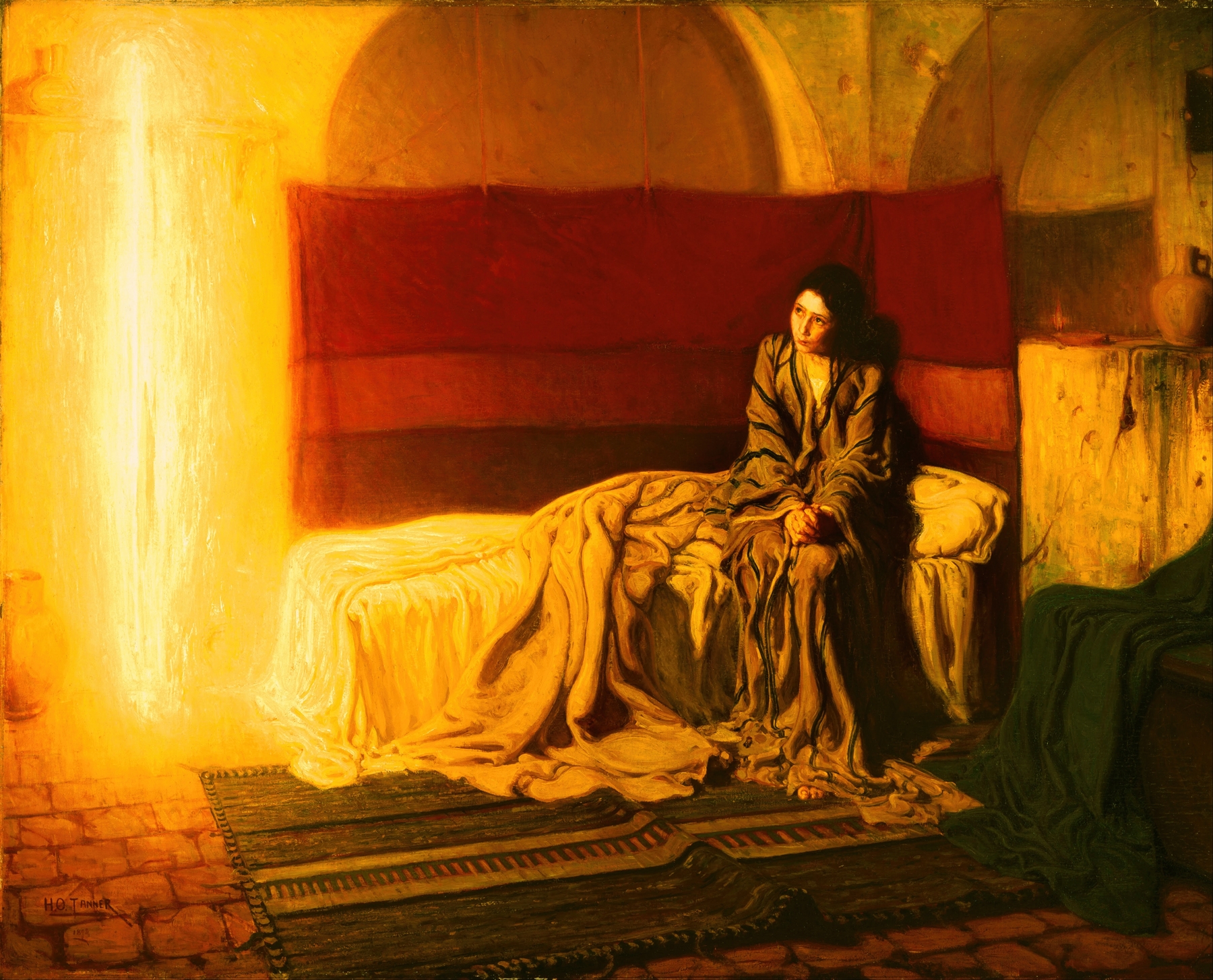
Henry Ossawa Tanner painted Gabriel as a shaft of light — no wings, no face, no body — and Mary as an ordinary adolescent girl with no halo. He had just come back from a trip to Egypt and Palestine to see the light and the buildings for himself. The Philadelphia Museum of Art bought it in 1899, making it the first Tanner to enter an American museum.
Set that beside the version everyone knows.
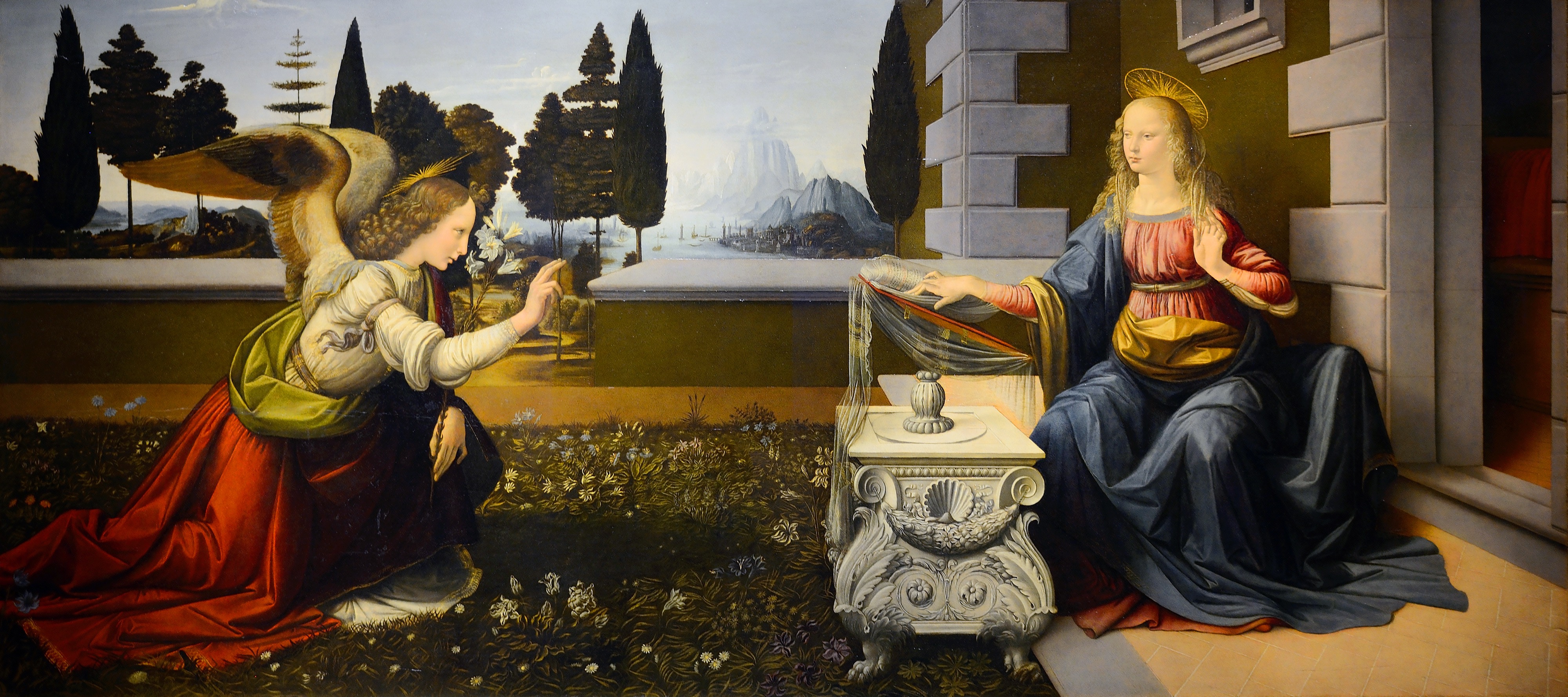
Leonardo was about twenty when he painted his, four hundred years before Tanner. It is one of the most painted scenes in Western art, and the range inside it is enormous.
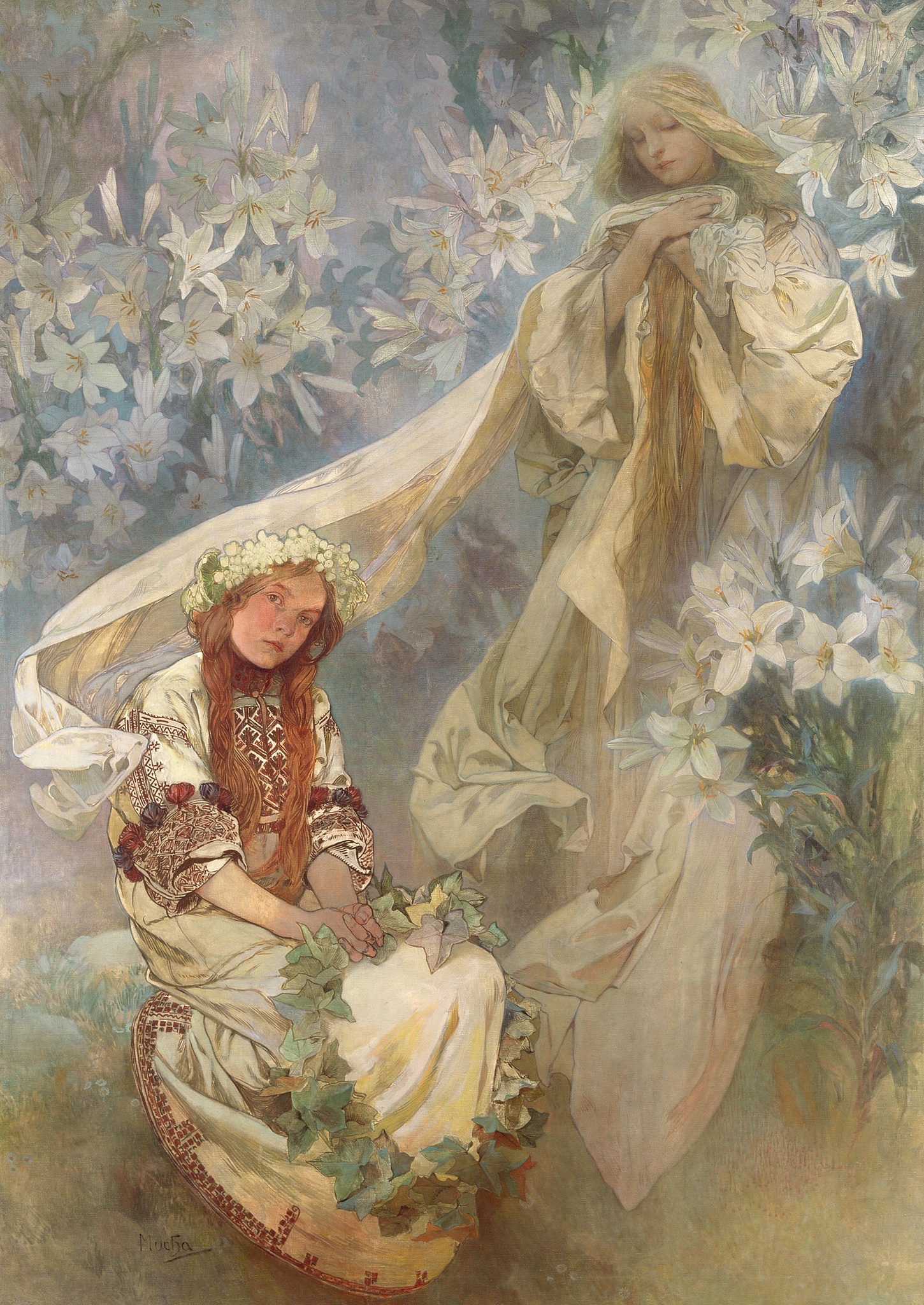
Alphonse Mucha — the Art Nouveau poster designer — is a thematic pairing here rather than a scene from the story: not the moment of the greeting, but an image of the woman being greeted.
Mary's answer is brief, and it ends the conversation.
“I am the Lord’s servant,” Mary answered. “May it happen to me according to your word.” Then the angel left her.
Luke 1:38 · BSB
Two Pregnant Women (Luke 1:39–45)
Mary does not stay home. She "got ready and hurried to a town in the hill country of Judah" (1:39) — Gabriel had just told her about Elizabeth, and she goes to see.
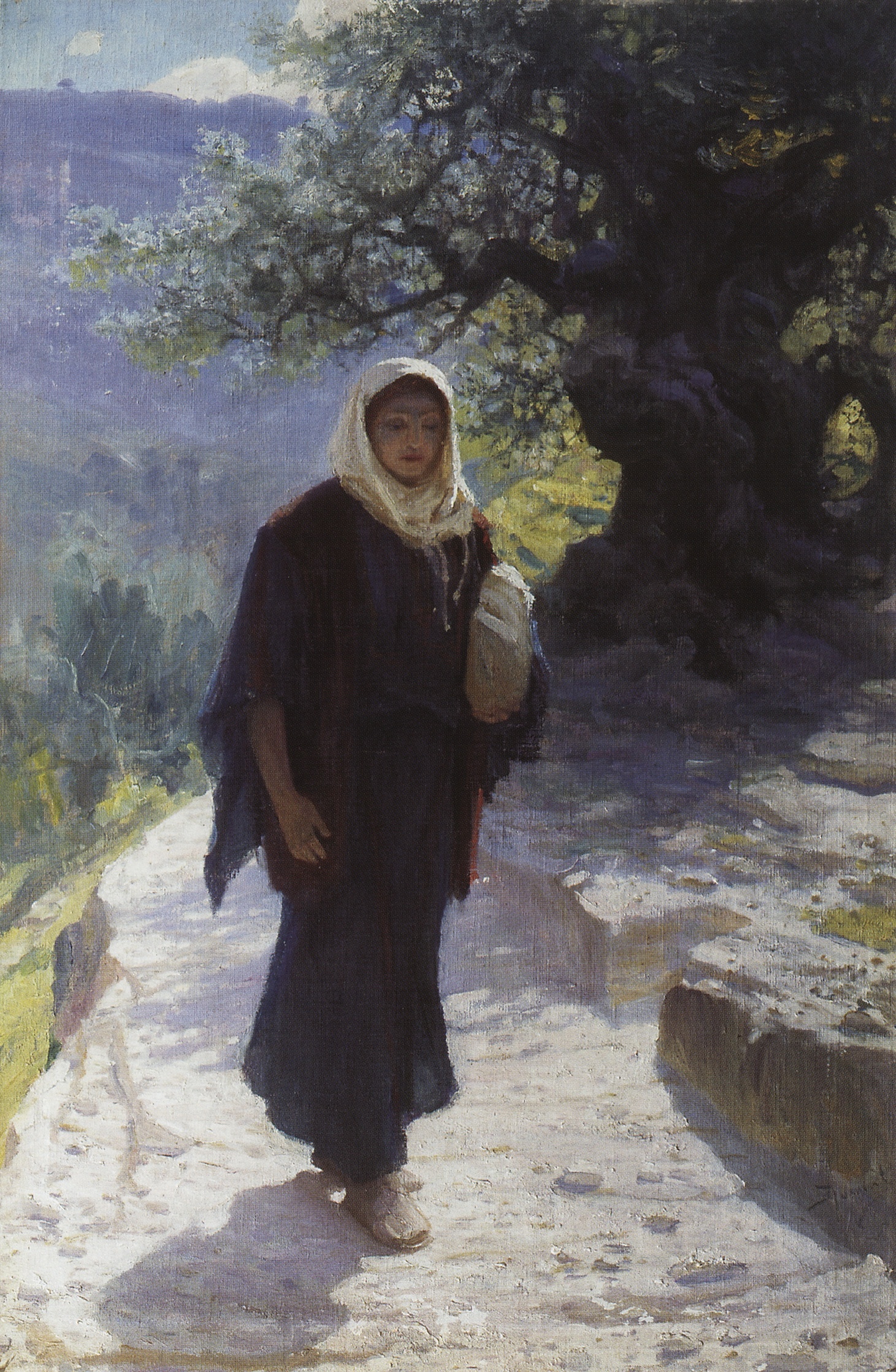
Vasily Polenov included this journey in his From the Life of Christ cycle. He returned to the Middle East in 1899 to gather material; the series was essentially complete in 1908.
What happens when she arrives is the warmest scene in the chapter, and there is not a man in it.
When Elizabeth heard Mary’s greeting, the baby leaped in her womb, and Elizabeth was filled with the Holy Spirit.
Luke 1:41 · BSB
“Blessed are you among women, and blessed is the fruit of your womb!”
Luke 1:42 · BSB (excerpt)
Where does the "Hail Mary" come from?
From this chapter, and from two different speakers. The first half of the prayer is Gabriel's greeting in 1:28 — "Greetings, you who are highly favored! The Lord is with you" — joined to Elizabeth's words in 1:42: "Blessed are you among women, and blessed is the fruit of your womb." An angel said one line, her pregnant relative said the other, and later tradition stitched them together into a single sentence. The name Jesus and the closing petition were added later still.
Elizabeth's last line is the one people miss, and it is the first beatitude in Luke's Gospel:
“Blessed is she who has believed that the Lord’s word to her will be fulfilled.”
Luke 1:45 · BSB
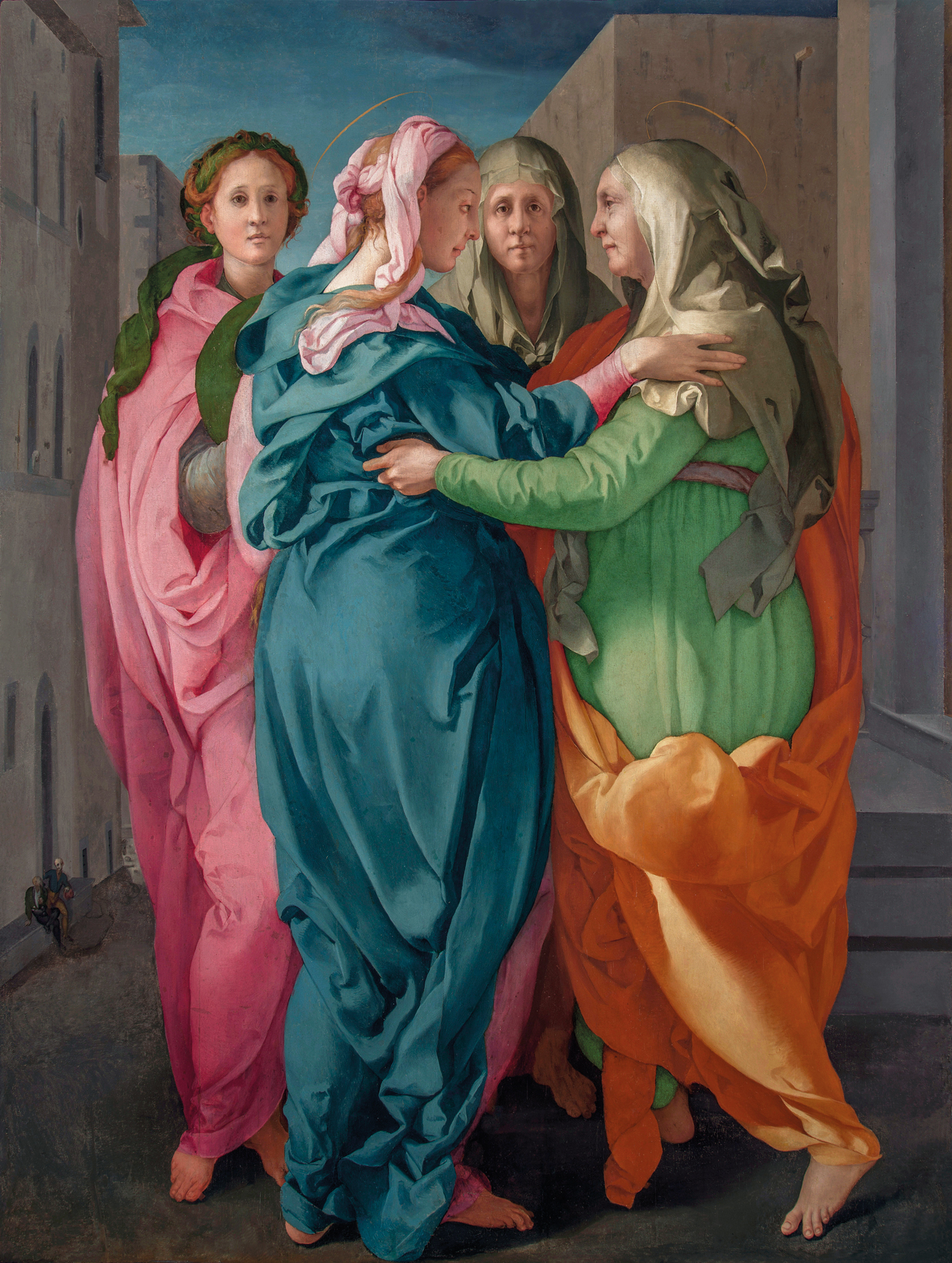
This one had an afterlife nobody could have predicted. In 1995 the video artist Bill Viola used Pontormo's painting of the two women greeting each other as the basis for The Greeting, shown at the Venice Biennale: a 45-second meeting filmed in a single take and slowed down to about ten minutes. A Mannerist altarpiece from the 1520s turned into contemporary video art.
Mary Sings (Luke 1:46–55)
Then Mary sings, and the chapter changes register completely.
“My soul magnifies the Lord, and my spirit rejoices in God my Savior!”
Luke 1:46–47 · BSB (excerpt)
It is called the Magnificat, after the first word of the Latin version, and it has been sung at evening prayer in Christian churches for centuries. It is also, for a song of praise, remarkably political.
“He has brought down rulers from their thrones, but has exalted the humble. He has filled the hungry with good things, but has sent the rich away empty.”
Luke 1:52–53 · BSB
Is the Magnificat based on an older song?
It closely tracks one. In 1 Samuel 2, Hannah — who had been unable to have children — sings a song that runs along the same lines. "My heart rejoices in the LORD… I rejoice in Your salvation" (1 Samuel 2:1) sits next to Mary's "my spirit rejoices in God my Savior." Hannah's "He humbles and He exalts. He raises the poor from the dust" (2:7–8) sits next to Mary's "He has brought down rulers from their thrones, but has exalted the humble." Hannah even has the hunger reversal: "The well-fed hire themselves out for food, but the starving hunger no more" (2:5).
Two women, centuries apart, both singing that God turns the order of things upside down.
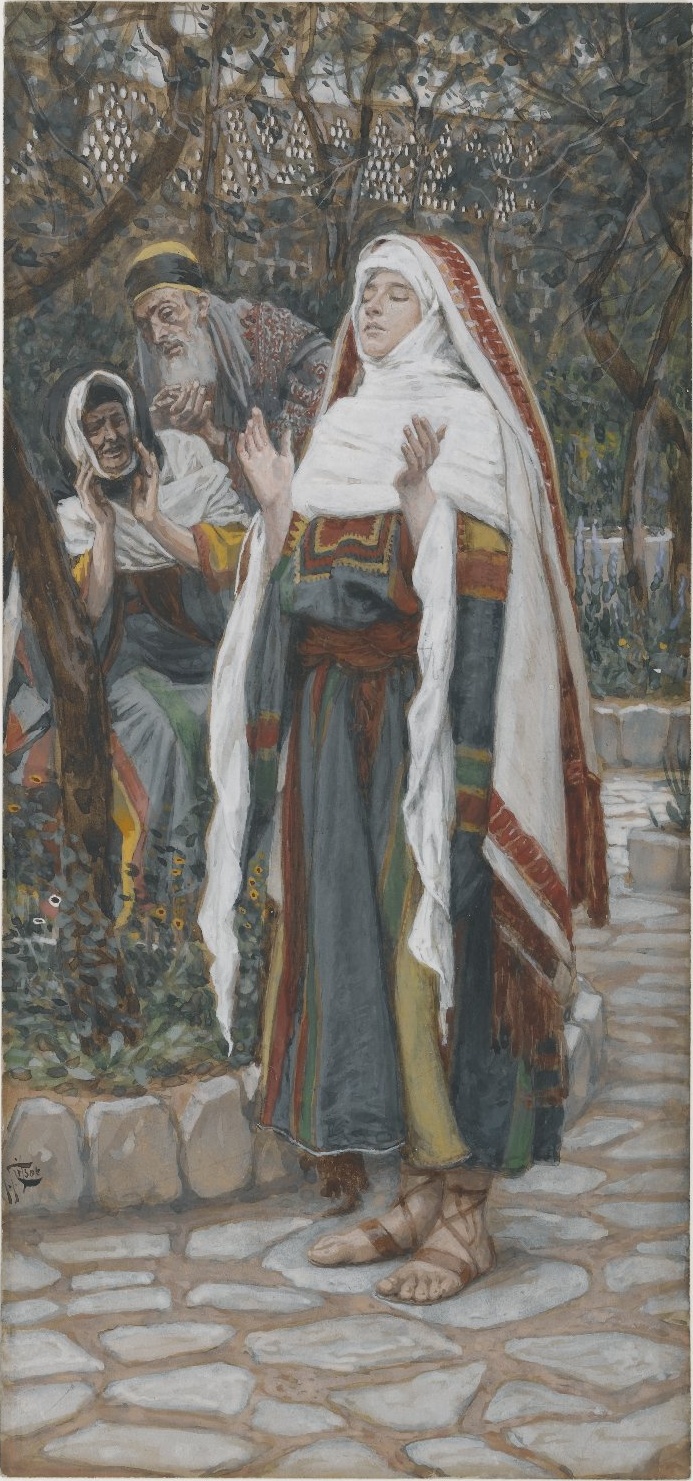
Mary stays about three months and then goes home (1:56).
"His Name Is John" (Luke 1:57–66)
Elizabeth has her baby. On the eighth day the relatives turn up for the circumcision, and they assume the boy will be named Zechariah after his father. Elizabeth says no.
But his mother replied, “No! He shall be called John.”
Luke 1:60 · BSB
The relatives point out that nobody in the family has that name, and they make signs to Zechariah to ask what he wants to name the child. He asks for a writing tablet.
Zechariah asked for a tablet and wrote, “His name is John.” And they were all amazed.
Luke 1:63 · BSB
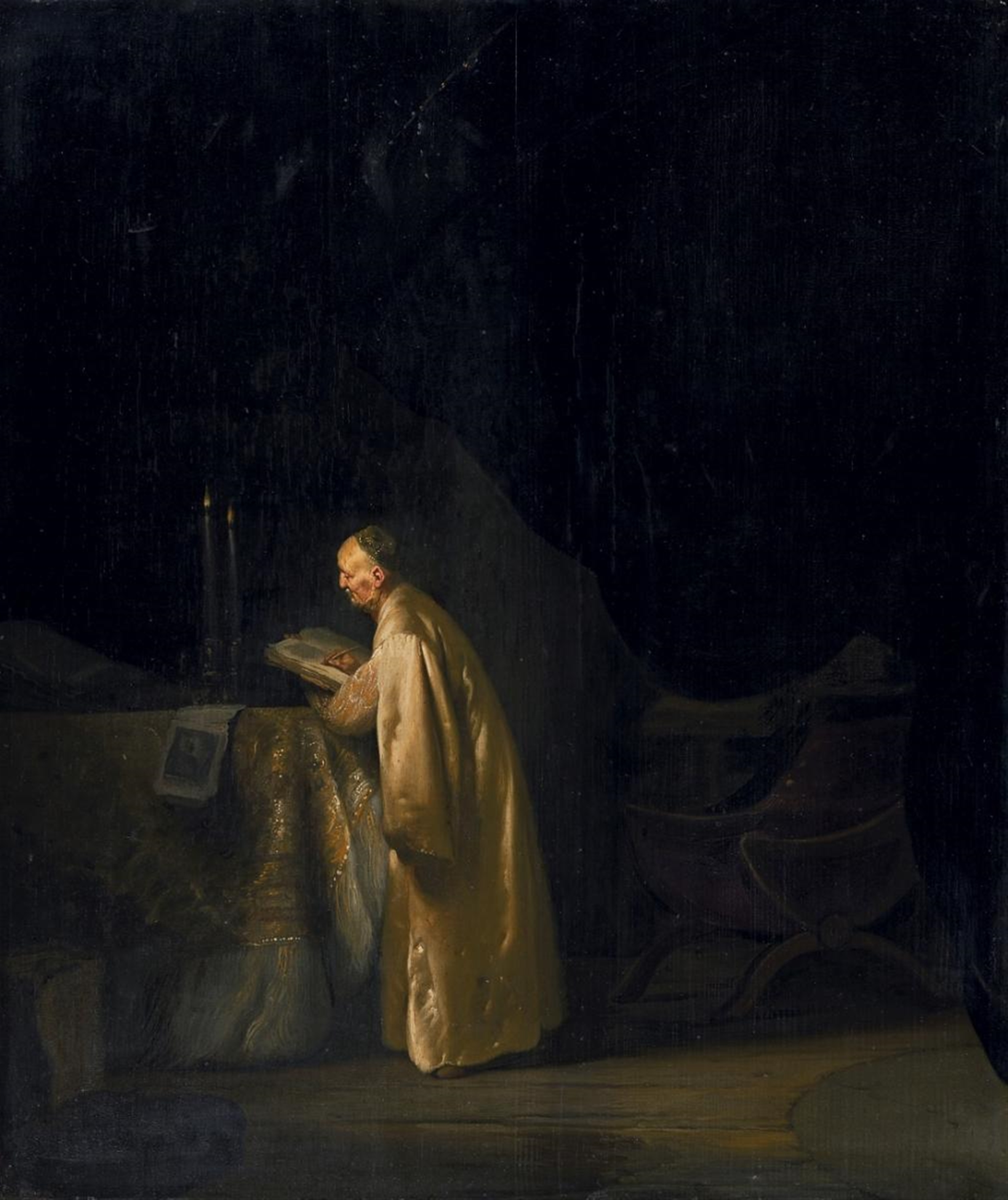
About nine months of silence end in the same instant: "Immediately Zechariah’s mouth was opened and his tongue was released, and he began to speak, praising God" (1:64). The first thing he had said since the temple, and it is praise.
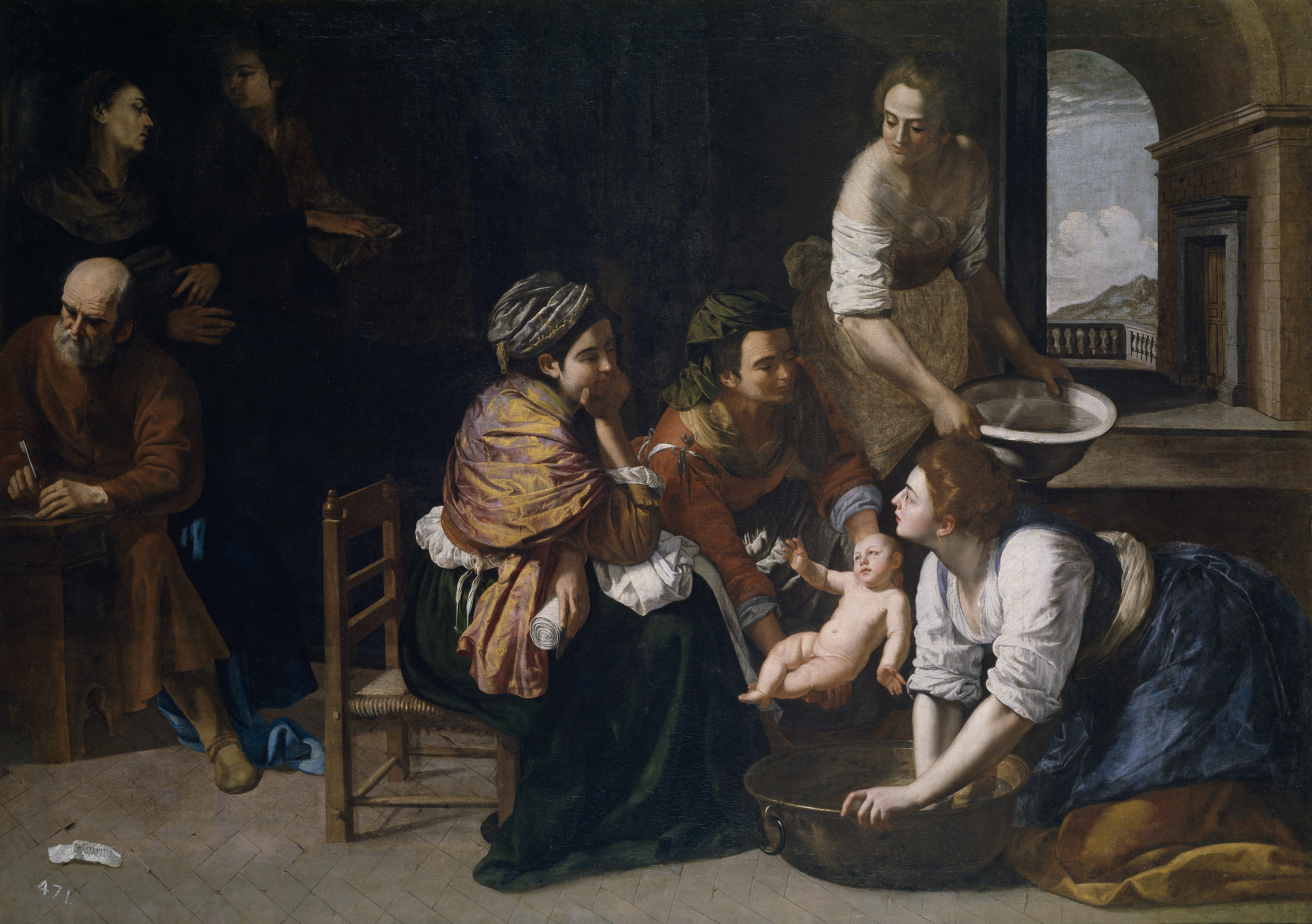
Artemisia Gentileschi painted this in Naples for a series on John's life commissioned for the Buen Retiro palace in Madrid. The painting is now in the Prado. In 1616 she had become the first woman admitted to Florence's Accademia delle Arti del Disegno. By 2019, the painting had returned from storage to the Prado's permanent display.
Zechariah Gets His Voice Back (Luke 1:67–80)
The man who was silenced for doubting an angel now prophesies. His song is called the Benedictus, again from its first word in Latin, and like the Magnificat it has been sung in churches for centuries — traditionally at morning prayer, where Mary's belongs to the evening.
“Blessed be the Lord, the God of Israel, because He has visited and redeemed His people.”
Luke 1:68 · BSB
Near the end he turns and speaks to his son, a few days old:
“And you, child, will be called a prophet of the Most High; for you will go on before the Lord to prepare the way for Him.”
Luke 1:76 · BSB (excerpt)
And then the last image of the chapter, which is one of the loveliest sentences in the Bible:
“because of the tender mercy of our God, by which the Dawn will visit us from on high, to shine on those who live in darkness and in the shadow of death, to guide our feet into the path of peace.”
Luke 1:78–79 · BSB
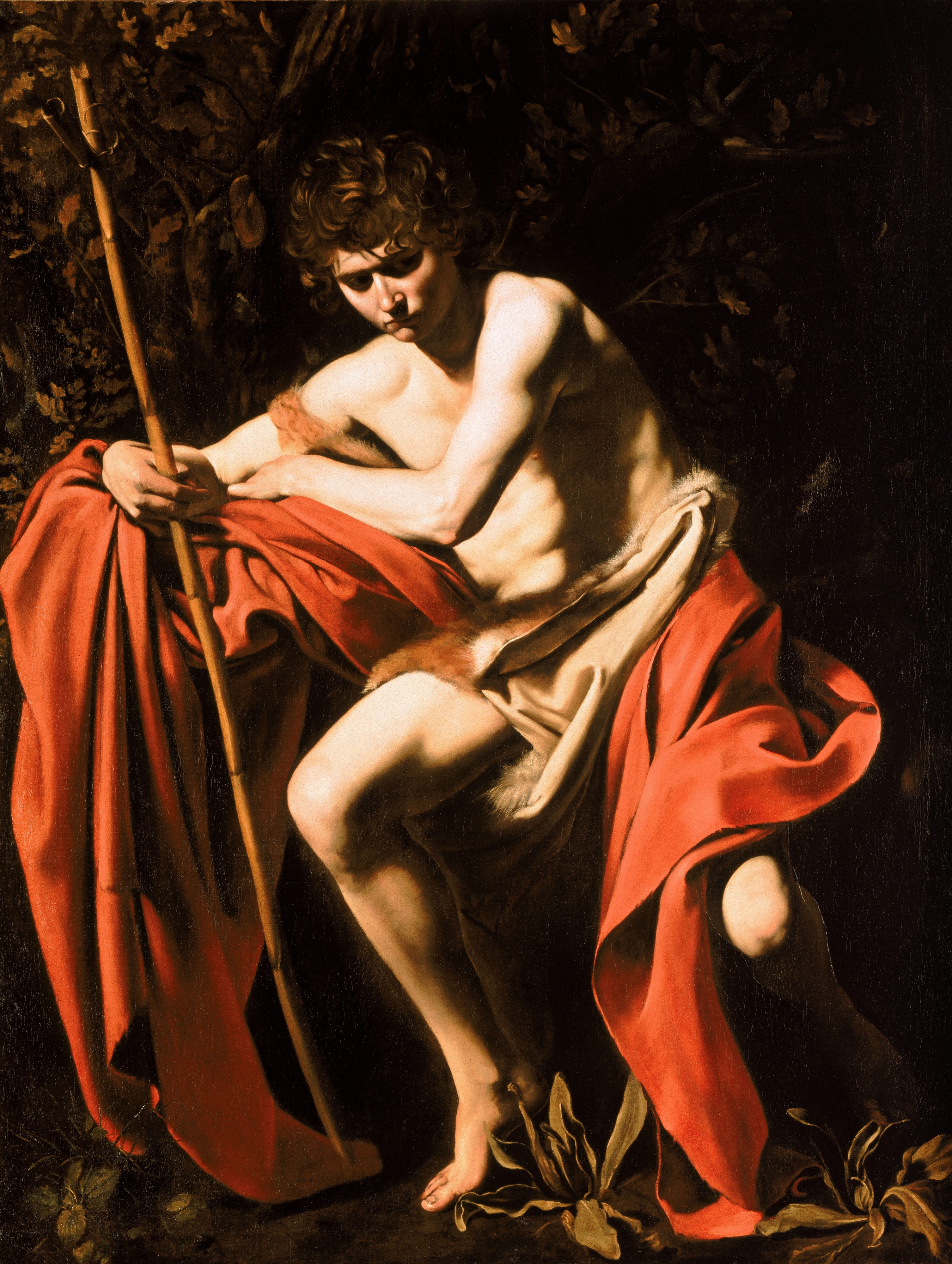
Luke closes the chapter by skipping ahead to John’s public ministry in one line: the child grew, became strong in spirit, and lived in the wilderness until the day he appeared publicly to Israel (1:80).
The Verses to Remember from Luke 1
Ten lines to keep.
- Luke's method: "having carefully investigated everything from the beginning… so that you may know the certainty of the things you have been taught." (1:3–4)
- To the old priest: "Do not be afraid, Zechariah, because your prayer has been heard." (1:13)
- The question that costs him: "How can I be sure of this?" (1:18)
- The greeting: "Greetings, you who are highly favored! The Lord is with you." (1:28)
- The promise: "For no word from God will ever fail." (1:37)
- The yes: "I am the Lord’s servant… May it happen to me according to your word." (1:38)
- Elizabeth: "Blessed are you among women, and blessed is the fruit of your womb!" (1:42)
- The first beatitude in Luke: "Blessed is she who has believed that the Lord’s word to her will be fulfilled." (1:45)
- The Magnificat's sharp edge: "He has brought down rulers from their thrones, but has exalted the humble." (1:52)
- The Dawn: "the Dawn will visit us from on high, to shine on those who live in darkness and in the shadow of death, to guide our feet into the path of peace." (1:78–79)
What Luke 1 Is Actually Doing
The chapter is built out of two songs and a silence. Mary sings. Zechariah cannot speak for about nine months, and the moment he can, he sings too. In between, God approaches an elderly couple without children and a young woman in Nazareth.
Luke, who has just told you he investigated all this carefully, moves from a priest’s work in the temple into women's conversations, a domestic argument about a baby's name, and two pieces of poetry — and gives the emperor almost nothing. That is a choice, and he makes it again and again for the next twenty-three chapters.
Luke 1 at a Glance
- Who is speaking: Luke, writing to a man named Theophilus, and saying up front that he researched it (1:1–4).
- The seven scenes: the preface (1:1–4) · Gabriel and Zechariah (1:5–25) · Gabriel and Mary (1:26–38) · the Visitation (1:39–45) · the Magnificat (1:46–56) · John's birth and naming (1:57–66) · the Benedictus (1:67–80).
- Who is new here: Zechariah, Elizabeth, Gabriel, Mary, and John.
- What survives in worship: the Magnificat (1:46–55), the Benedictus (1:68–79), and the first half of the Hail Mary (1:28 + 1:42).
- Famously not in the text: any description of what Gabriel looked like.
Read Luke 1 with a Painting: A 4-Step Visio Divina Practice
Visio Divina is Latin for "divine seeing" — praying with a picture instead of only a passage.
- Look (Visio): Pick one painting above and stay with whatever your eye goes to first. Let it be a slow look.
- Meditate (Meditatio): Read the verse beside it twice, slowly. Which word catches?
- Pray (Oratio): Say one honest sentence. Both of the chapter's big prayers start by naming what God has already done.
- Contemplate (Contemplatio): Sit quietly for one minute. Nothing has to happen.
Questions People Ask About Luke 1
- Why did Gabriel make Zechariah mute?
- Luke gives the reason in the angel's own words: "because you did not believe my words, which will be fulfilled at their proper time" (1:20). The silence lasts until the baby is named, about nine months later, and ends the instant Zechariah writes "His name is John" (1:63–64).
- What is the Magnificat?
- Mary's song in Luke 1:46–55, named after the first word of its Latin version. It praises God for looking at her "humble state," then widens into a reversal of the whole social order: the proud scattered, rulers brought down, the humble lifted, the hungry filled, the rich sent away empty. It has been sung at evening prayer in Christian churches for centuries.
- What is the Benedictus?
- Zechariah's prophecy in Luke 1:68–79, sung the moment he recovers his speech, and likewise named from its first Latin word. It blesses God for keeping the promise made to Abraham, then turns to address the newborn John as the prophet who will go ahead of the Lord. It is traditionally sung at morning prayer.
- Who were Zechariah and Elizabeth?
- A married couple, both from priestly families — Zechariah served in the division of Abijah, Elizabeth was descended from Aaron. Luke calls them both righteous and blameless (1:6), and says they were childless and old. They become the parents of John the Baptist. Elizabeth is also identified as a relative of Mary (1:36).
- How old was Mary?
- Luke does not say. He calls her a virgin pledged in marriage (1:27), which in that society usually meant a girl in her teens, but no age appears anywhere in the text. Painters have imagined her anywhere from about twelve to a grown woman, which is part of why Annunciations look so different from one another.
- What does "the Dawn will visit us from on high" mean?
- It is the closing image of Zechariah's song (1:78). The Greek word behind "Dawn" also carries the sense of a rising — of the sun, or of a branch shooting up — which is why you will see it translated as "dayspring," "rising sun," or "sunrise" in different Bibles. The sentence it belongs to is about light reaching people sitting in darkness.
Keep Going
Continue the story: Luke 2 in Art
If you want to sit with one of these images a little longer, you can restore it yourself. Open Tanner's Annunciation as a puzzle, piece by piece, with the verse and a reflection waiting at the end.
Or get the Visio Divina app for a new painting, a new verse, and a new reflection every morning.
Continue in the open gallery