You can prepare carefully for a future that never arrives. A career path closes. A relationship ends. A diagnosis changes everything. The routine around which you organized your days is gone, and small decisions become strangely hard. You still have the habits of your old life, but they no longer tell you where to go.
On the first Easter morning, Mary Magdalene and her friends arrived fully prepared for a day that did not happen. This piece stays with them there, through three paintings. It is the third of five in our guide to Mary Magdalene’s life in art.
The Most Practical Question in the Easter Story
On Friday evening the women had watched where the body of Jesus was laid. On Saturday, the Sabbath—the weekly Jewish day of rest—they could do nothing. When it ended at sundown they bought spices, because the burial had been hurried and they meant to finish it properly. Mark’s Gospel, one of the Bible’s four accounts of Jesus’ life, says that they set out “very early on the first day of the week, just after sunrise” (Mark 16:2).
They are doing what grieving people do, which is to find a task. They have a plan and one practical worry, and Mark lets us overhear it on the road:
They were asking one another, “Who will roll away the stone from the entrance of the tomb?”
Mark 16:3 (BSB)
It is such an ordinary question. A rock-cut tomb was closed with a heavy stone, and three women could not shift it. Then they look up and see that “the stone had been rolled away, even though it was extremely large” (Mark 16:4). The body is gone. So is the task they came to do, and so is the only plan they had.
In John’s Gospel, Mary runs to find Peter and says the one thing that makes sense to her: “They have taken the Lord out of the tomb, and we do not know where they have put Him!” (John 20:2). Mark says the women left “trembling and bewildered” (Mark 16:8). The Gospels allow them to be bewildered first. Joy does come, but it is not the first thing to arrive, and the story does not hurry them toward it.
Sources: Mark 16:1–8; John 20:1–2.
The Moment Before You Understand
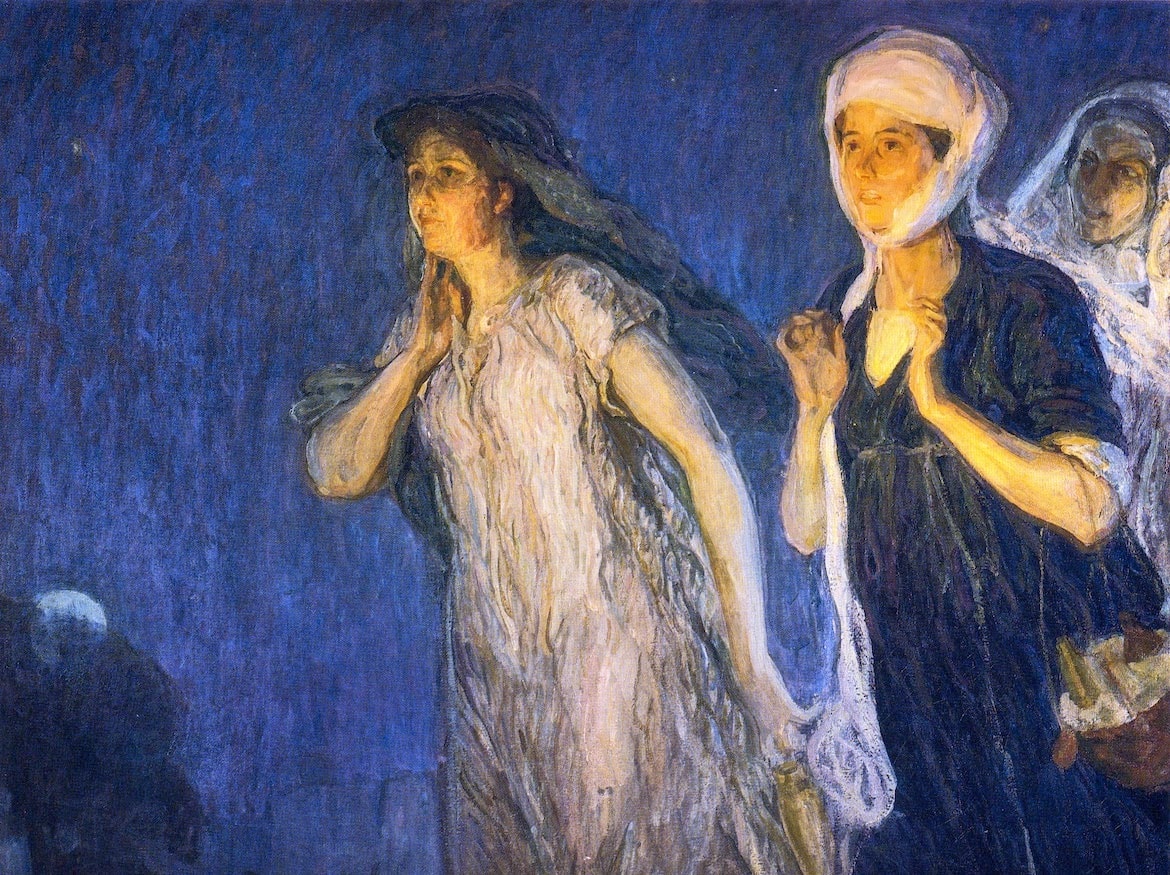
Henry Ossawa Tanner, an American painter and the son of a bishop, spent most of his working life in France painting scenes from the Bible. In this one, from 1910, he has left out nearly everything the subject is supposed to contain. There is no tomb, no angel, and no stone. Three women come out of a deep blue night, with a small pale moon low in one corner. From somewhere beyond the left edge of the canvas, a warm light falls across their faces.
The first woman has stopped with her hand against her cheek, her dark hair loose down her back. The second, in a white headscarf, has brought both hands up to her chest. The third is only a veiled face at the edge. Look at the first woman’s other hand: it hangs at her side, still holding the small jar she brought for the burial.
We are watching the second before astonishment becomes a thought. When the future you planned is suddenly gone, the mind cannot take in the new situation all at once, and Tanner lets that interval stay wide open. You do not have to understand what is happening yet. You do not have to find the bright side or draft a new five-year plan. For now it is enough to stand still and let the change be real.
Visio Divina Prompt: Look at the women’s hands reacting to a light we cannot see. What sudden change has recently left you standing still?
What You Brought with You
On the first day of the week, very early in the morning, the women came to the tomb, bringing the spices they had prepared.
Luke 24:1 (BSB)
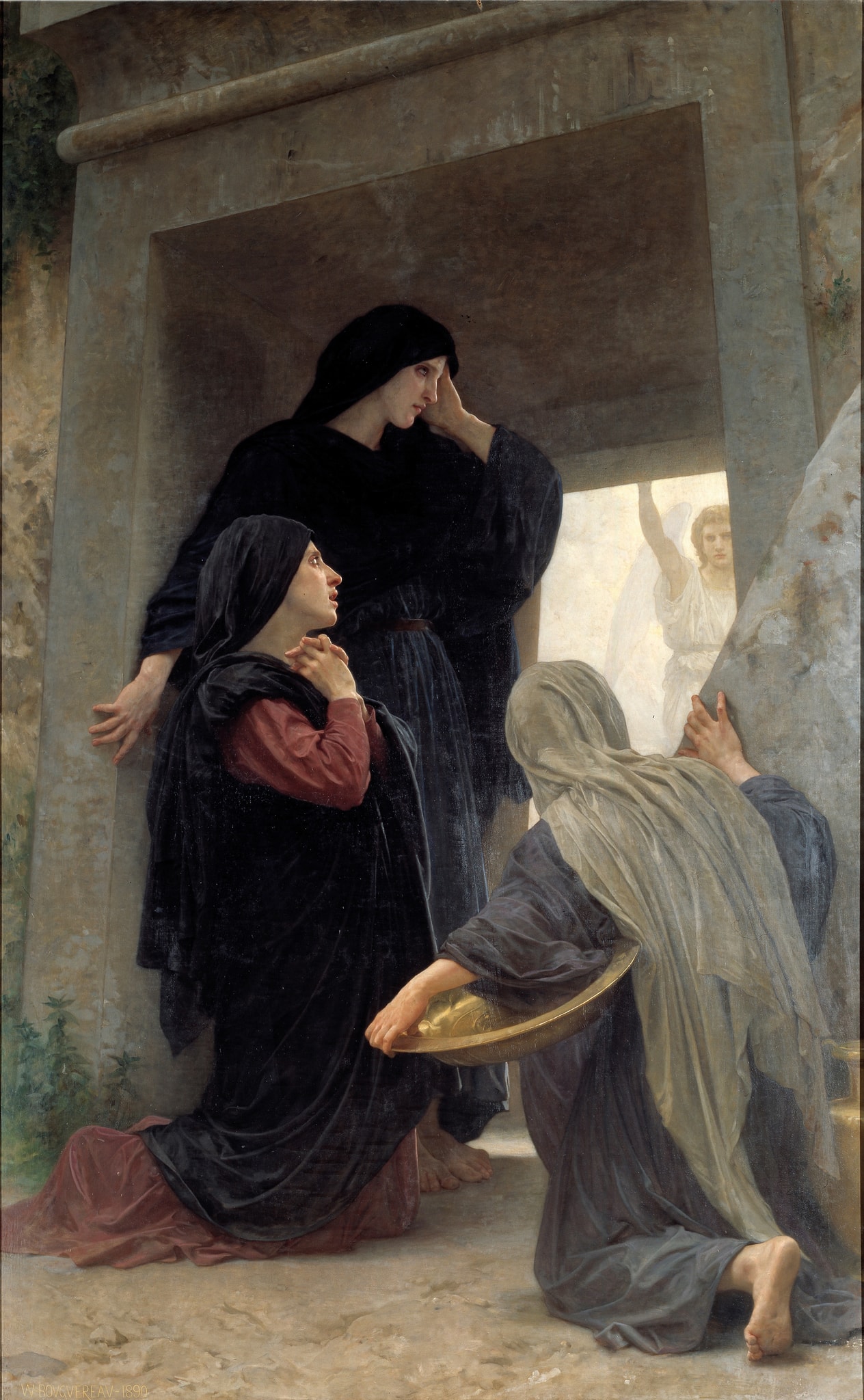
William Bouguereau, in 1890, stacks three women in dark robes against the stone doorway of the tomb. One stands, shading her eyes with one hand and steadying herself on the door frame with the other. One kneels with her hands clasped, looking up. Through the doorway there is a blaze of light, and in it an angel with a raised arm.
Now look at the woman nearest to us, kneeling with her back half turned. In her left hand, held low behind her as though she has forgotten it, is a shallow golden basin with a small vessel lying in it, brought for the burial. She carried it here faithfully, in the dark, and she has arrived at a place where events have changed what it means.
Most of us carry a basin like that into a future that has collapsed: the nursery that was made ready, the savings for the house that fell through, the daily habits of caring for someone who is no longer here. Bouguereau treats it tenderly. It was not foolish to bring it. Preparation was what love looked like on Saturday night. It is only that Sunday has turned out to be a different kind of day.
Visio Divina Prompt: Find the golden basin. What preparation or expectation are you still carrying for a life you are no longer going to live? You do not have to put it down yet. Just notice that you are holding it.
A Different Question
Why do you look for the living among the dead?
Luke 24:5, excerpt (BSB)
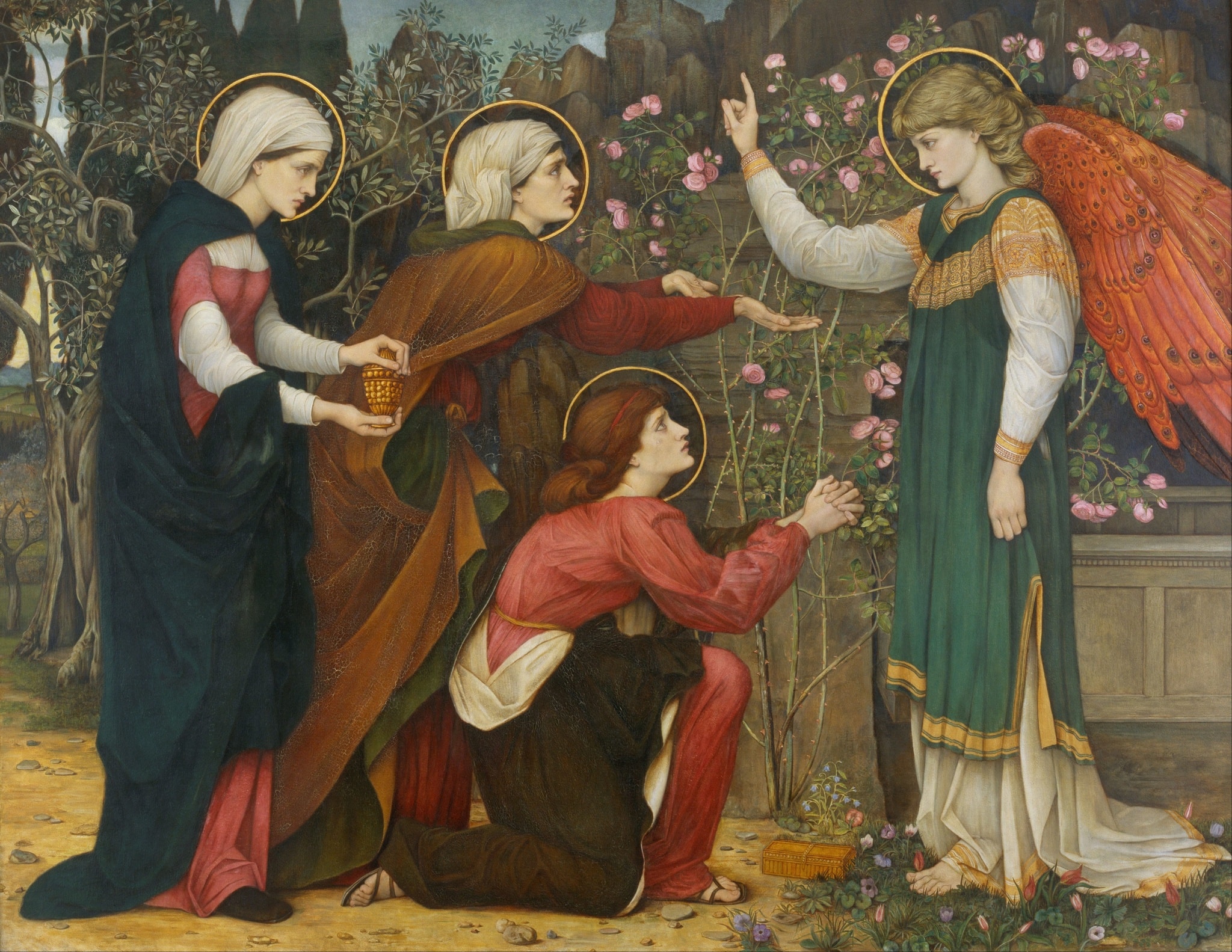
John Roddam Spencer Stanhope took his title straight from this verse and set the scene in a garden of climbing roses. Three women with halos approach from the left. One, in a dark cloak, holds up a small gold jar in both hands. One holds out her open palms, as if asking a question. The third has dropped to her knees with her hands lifted. Facing them stands an angel in green, with wings the color of flame, pointing one finger straight up. Luke’s account has two men in dazzling clothes; Stanhope paints a single angel, which is a painter’s choice and not a different story.
The women came with a question about logistics: who will move the stone? That question had been answered before they arrived. What meets them is another question altogether, and it turns them around: why are you looking here?
When a plan collapses, the questions we ask tend to face backward. How do I get things back to normal? How do I fix this? Sometimes the way forward begins when the question itself changes. The angel offers the women no plan and no explanation of what comes next. He tells them to remember what Jesus had already told them, back in Galilee, and Luke adds the next line with great simplicity: “Then they remembered His words” (Luke 24:8). What they are given first is not a map. They are given a memory of what they had already been told.
Visio Divina Prompt: Follow the line of the angel’s raised finger, then look at the woman still holding her jar. What backward-facing question might you need to stop asking?
Fear and Great Joy
Matthew describes how the women left the tomb, and he refuses to choose between two feelings:
So they hurried away from the tomb in fear and great joy, and ran to tell His disciples.
Matthew 28:8 (BSB)
They are still afraid, and they are already running. Nothing in this story promises that every loss leads to a better replacement, or that your second plan will outshine your first. What it shows is smaller and sturdier than that. The thing the women dreaded most on the road had been dealt with before they got there, and God was at work in the dark before anyone arrived to see it. They did not have to understand the morning in order to be met in it.
Source: Matthew 28:1–10.
A 4-Step Visio Divina Practice for Uncertainty
Visio Divina—Latin for “divine seeing”—is a simple way of praying with a picture instead of a passage. Return to the painting that best matches your own uncertainty, and take three unhurried minutes:
- Look (Visio): Let your eyes settle on a threshold: the edge of Tanner’s light, Bouguereau’s doorway, or the space between Stanhope’s women and the angel.
- Meditate (Meditatio): Name the specific uncertainty that is weighing on you. Do not try to solve it. Say plainly that you do not know what happens next.
- Pray (Oratio): God, I have brought the plans I made and the questions I cannot settle. Meet me where my understanding stops. Keep my heart open to hope, without asking me to pretend that I know the way. Amen.
- Contemplate (Contemplatio): Rest in silence for one minute. Picture yourself setting your basin down at the door of the tomb, and leaving it there.
An All Saints’ Day Hope with Room for Not Knowing
One of the Catholic readings for All Saints’ Day holds together a present belonging and a future that cannot yet be seen:
Beloved, we are now children of God, and what we will be has not yet been revealed. We know that when Christ appears, we will be like Him, for we will see Him as He is.
1 John 3:2 (BSB)
Source: USCCB: Solemnity of All Saints, November 1, 2026.
Mary’s Easter witness began with a morning she did not understand. The saints are remembered inside a hope larger than anything they could see in advance, and their stories have room for people whose faith includes questions.
Frequently asked questions
Why did Mary Magdalene go to the tomb?
To finish the burial. Mark 16:1 says that she and two other women bought spices “so they could go and anoint the body of Jesus.” He had been buried in haste on Friday, because the Sabbath was about to begin. Their visit was an act of grief and care, and none of them expected to find the tomb empty.
Why did Mary think the body of Jesus had been stolen?
Because it was the only explanation that made sense. In John 20:13 she tells the angels that “they have taken my Lord away,” and adds, “I do not know where they have put Him.” No one at the tomb was expecting a resurrection; John says plainly that the disciples “still did not understand” (John 20:9). Her first response to the empty tomb is distress, and the Gospel lets it stand.
How do I pray when I am afraid of the future?
Begin with what is true. You do not have to make yourself feel hopeful. Let a painting give your eyes a place to rest, tell God the specific thing you are afraid of, and ask only for enough light for the next step.
Stay with the painting
If you want to sit with one of these images a little longer, you can restore it yourself: open Tanner’s The Three Marys as a puzzle, piece by piece, with its verse waiting at the end. Or get the app for a new painting, a new verse, and a new reflection every morning.
Continue the journey
Next in Mary’s story: Noli Me Tangere: Mary Magdalene and the Pain of Letting Go. Before this: When You Cannot Take the Pain Away. Or return to Mary Magdalene’s life and paintings.