Most people meet Mary Magdalene as a rumor. Ask what she is known for and you will probably hear that she was a prostitute, or a great sinner who repented, or—from anyone who has read a certain thriller—the secret wife of Jesus. None of that is in the Bible.
What the Bible does say is plainer and, once you have heard it, more impressive. She came from Magdala, a fishing town on the Sea of Galilee. Jesus healed her. She joined the group that traveled with him, and she helped pay its way. When he was arrested and most of his friends ran, she stood near the cross. She watched where he was buried. She went back before sunrise on the third day. And in John’s account she became the first person to see him alive again, and the first person sent to tell anyone. The four Gospels—the Bible’s four accounts of Jesus’ life—name her in twelve verses, and in nearly every list of the women who followed him, her name comes first.
Painters have returned to her for the better part of a thousand years. Their pictures helped the rumor last, and they are also, if you look closely, one of the best ways back to the woman herself.
This guide follows her life through six paintings, each with the verse that belongs beside it. It then shows a short way to pray with a painting—the practice we call Visio Divina, Latin for “divine seeing,” which simply means praying with a picture instead of a passage—and answers the questions people most often ask about her. Each chapter of her story opens onto a longer piece written for a particular modern ache: a label you cannot shake, a loved one’s pain you cannot fix, a future that has gone blank, a goodbye you did not choose, and the fear that no one will believe you. If the Bible is new to you, you are welcome here; unfamiliar words are explained as they come up.
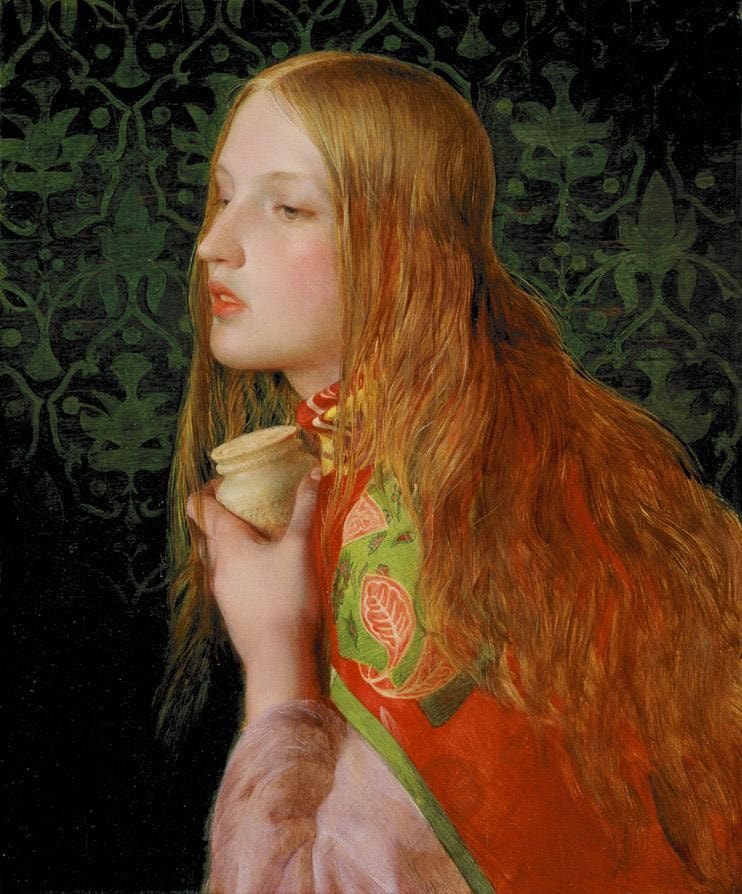
Begin with the portrait above. Frederick Sandys painted it around 1859: a young woman in profile against a dark green wall patterned like damask, copper hair falling loose past her shoulders, a small pale jar held up against her collarbone. The jar is how painters sign her name. Notice that she is looking past the edge of the frame, and that her lips are parted as if she is about to speak. Sandys has not painted a symbol. He has painted a person with a great deal on her mind.
Before the Rumor: A Disciple from Galilee
These women were ministering to them out of their own means.
Luke 8:3, excerpt (BSB)
The first time Luke mentions her, it is in a sentence about money. Jesus is walking from village to village with the twelve disciples—his inner circle of students—and with them travels a group of women he has healed. Luke names three: “Mary called Magdalene, from whom seven demons had gone out,” Joanna, whose husband managed Herod’s household, and Susanna. Then he says what these women do. They pay. The movement had patrons, and she was one of them.
Luke does not say what the seven demons were. He does not describe an illness, list any sins, or hint at her past. He says that she had been in the grip of a terrible affliction, that Jesus freed her from it, and that afterward she stayed.
So where did the rumor come from? From a sermon. Around the year 591, Pope Gregory the Great preached in Rome on a story from the chapter just before this one: an unnamed “sinful woman” who weeps at Jesus’ feet during a dinner party and dries them with her hair (Luke 7:36–50). Gregory told his listeners that this woman, and Mary of Bethany, who anoints Jesus’ feet in John’s Gospel, and Mary Magdalene were all one person. Three women became one, and the one inherited the first woman’s reputation. For nearly fourteen hundred years, Western painters painted that composite figure: the beautiful penitent with loose hair and a jar. The Eastern Orthodox churches kept the three women separate and honored Mary as a “myrrh-bearer” and “equal to the apostles.” The Catholic Church untangled them when it revised its calendar after the Second Vatican Council, and in 2016 Pope Francis raised her day to a feast, the same rank the apostles have.
Sources: Luke 8:1–3; Vatican: “Apostle of the Apostles”; National Gallery: Saint Mary Magdalene.
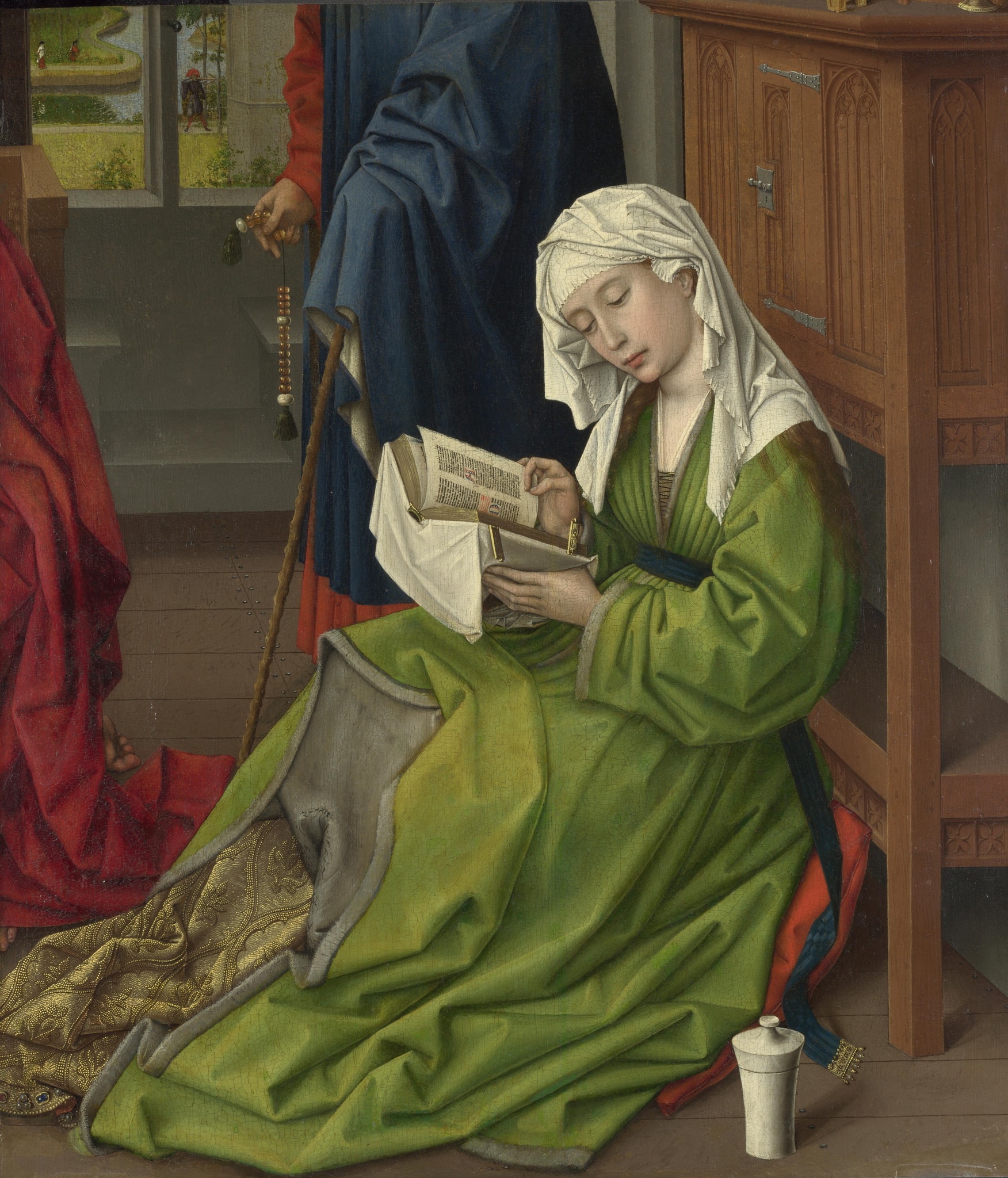
Rogier van der Weyden painted her about 1435, long before the famous weeping Magdalenes of Titian and Caravaggio, and he shows her doing what no rumor would predict. She sits on a red cushion on the floor, in a green gown and a white veil, reading. The book is wrapped in a white cloth to protect it, her eyes are lowered to the page, and her jar stands on the floorboards beside her hem. Behind her stands a figure we can see only from the chest down, holding a string of prayer beads, because this panel is a fragment sawn out of a much larger altarpiece. What survived the saw is a woman absorbed in a book. It makes a fine first portrait of her. The word disciple simply means student.
Visio Divina Prompt: Look at her lowered eyes and the hand keeping her place. What are you like when no one is describing you?
→ If a label has followed you around, read Healing from Shame: Seeing Mary Magdalene Beyond the Labels.
The Ones Who Stayed: The Cross and the Burial
Near the cross of Jesus stood His mother and her sister, as well as Mary the wife of Clopas and Mary Magdalene.
John 19:25 (BSB)
On the night Jesus was arrested, Mark’s Gospel has a blunt sentence about his disciples: “Then everyone deserted Him and fled” (Mark 14:50). The next afternoon, at the execution, the people the Gospels place near the cross are mostly women, and three of the four Gospels name Mary Magdalene among them.
She cannot do anything. She cannot stop what is happening or make it shorter. What she does is stay. When a man named Joseph of Arimathea takes the body down and lays it in a tomb cut into the rock, she follows and watches, and Matthew preserves a small, stubborn detail: “Mary Magdalene and the other Mary were sitting there opposite the tomb” (Matthew 27:61). Then the Sabbath begins—the weekly Jewish day of rest, when no work may be done, including the work of preparing a body for burial—and she goes home to wait.
Sources: John 19:25; Mark 15:40–47; Matthew 27:55–61.
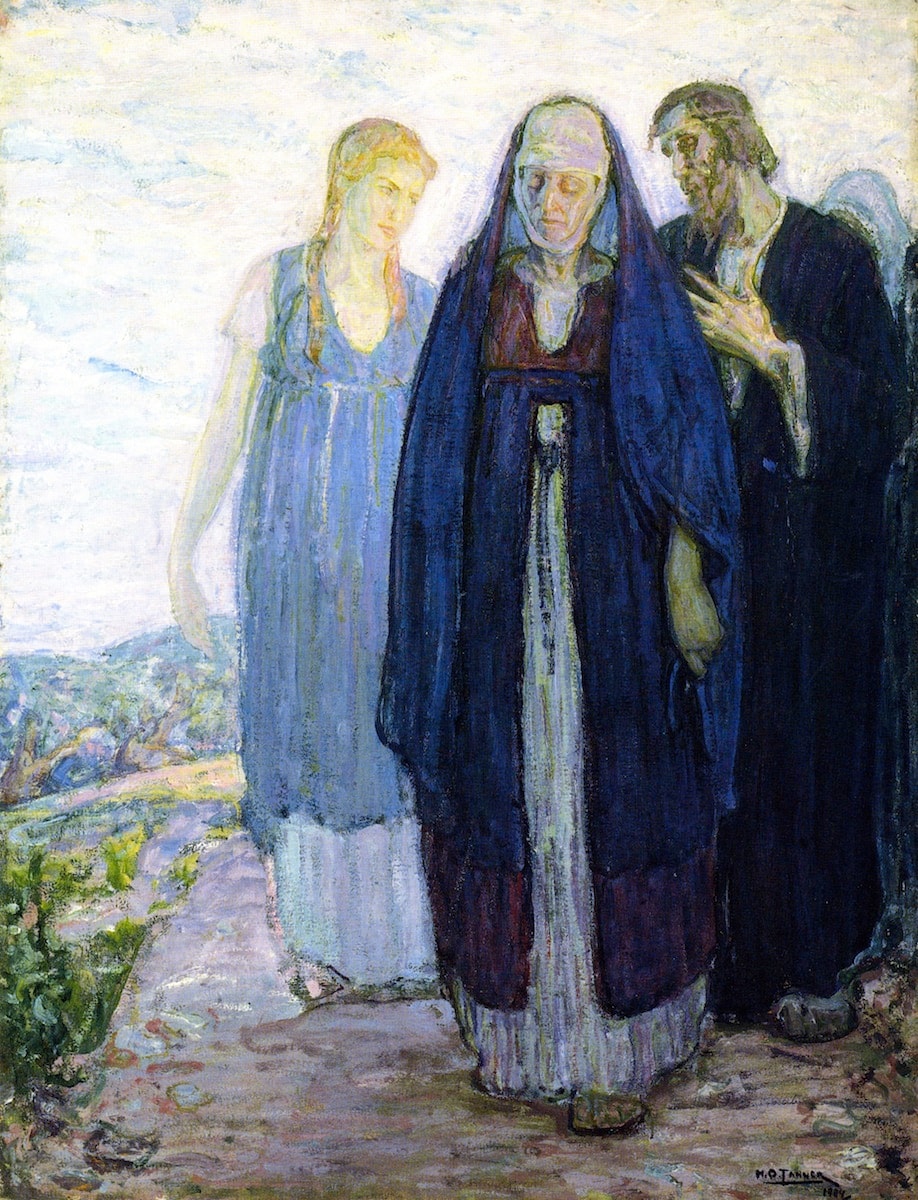
Henry Ossawa Tanner, an American painter who made his career in France, painted the walk home in 1904. Three figures fill the foreground, coming toward us along a path under a pale sky, and a fourth veiled companion is partly hidden at the far right. In the center is an older woman wrapped in deep blue, her eyes on the ground. At her shoulder, a bearded man presses one hand to his chest. On the left walks a younger woman in lighter blue, a long fair braid over her shoulder, her own eyes lowered. They are usually read as the mother of Jesus, the disciple John, and Mary Magdalene, coming back from the hill of the crucifixion. They are close enough to touch, and nobody is talking. Tanner understood that after the worst has happened, there is still the road home, and someone has to walk it with you.
Visio Divina Prompt: Notice how closely the companions keep together, and how quiet they are. Who has walked beside you like that?
→ If you are beside a suffering you cannot fix, read When You Cannot Take the Pain Away: Mary Magdalene and the Art of Staying.
The Morning Nothing Made Sense: The Empty Tomb
They were asking one another, “Who will roll away the stone from the entrance of the tomb?”
Mark 16:3 (BSB)
In Mark’s account, once the Sabbath is over, Mary Magdalene and two other women buy spices to anoint Jesus’ body. Very early on Sunday, just after sunrise, they go to the tomb. They have a plan and one practical worry, and Mark lets us overhear it: the stone is too heavy for them.
They arrive to find the stone already moved and the body gone. In John’s telling, Mary runs to find Peter and says the only thing that makes sense to her: “They have taken the Lord out of the tomb, and we do not know where they have put Him!” (John 20:2). Her first words on Easter morning are we do not know.
We usually tell this story at the speed of people who already know the ending. She did not know it. Mark says the women left the tomb “trembling and bewildered” (Mark 16:8). The first feeling of Easter, in the Gospels, is confusion.
Sources: Mark 16:1–8; John 20:1–2.
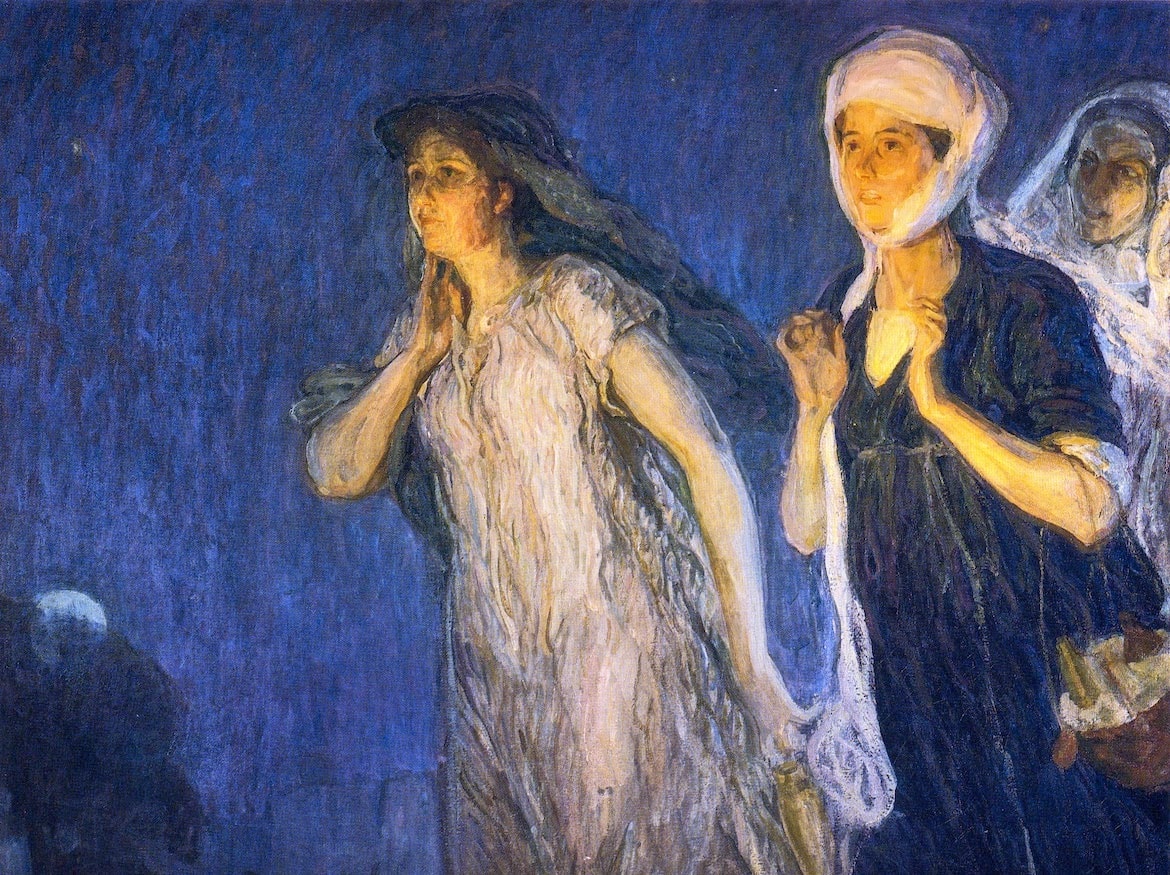
Tanner painted this morning too, in 1910, and he left out nearly everything a painter would be expected to include. There is no tomb, no angel, and no stone. Three women walk out of a deep blue night, and a warm light from beyond the left edge of the canvas falls across their faces. The first has stopped with her hand against her cheek. The second has brought both hands up to her chest. The third is a veiled face behind them. From the first woman’s lowered hand hangs the small jar she carried here for a burial. Tanner has painted the second before anyone has an explanation.
Visio Divina Prompt: Look at the jar still hanging from her hand. What are you still carrying for a day that did not go the way you planned?
→ If your own future has gone blank, read When the Future Is Unclear: Mary Magdalene at the Empty Tomb.
One Word in a Garden
Jesus said to her, “Mary.” She turned and said to Him in Hebrew, “Rabboni!” (which means “Teacher”).
John 20:16 (BSB)
Peter and another disciple come, look into the tomb, and go home. Mary stays outside, crying. When she bends to look in, two angels ask why she is weeping. She turns around and finds a man standing behind her, whom she takes for the gardener, and she makes him one of the most loyal and least practical offers in the Bible: “Sir, if you have carried Him off, tell me where you have put Him, and I will get Him” (John 20:15).
Then he says her name. She had not known his face, or his voice when it asked her a question. She knew the way he said Mary.
What follows has given its Latin name to hundreds of paintings: Noli me tangere, “Do not touch me,” or as most modern translations put it, “Do not cling to Me” (John 20:17). It is not a rebuff. He gives her a reason—he has not yet ascended to the Father—and then he gives her an errand.
Source: John 20:10–17.
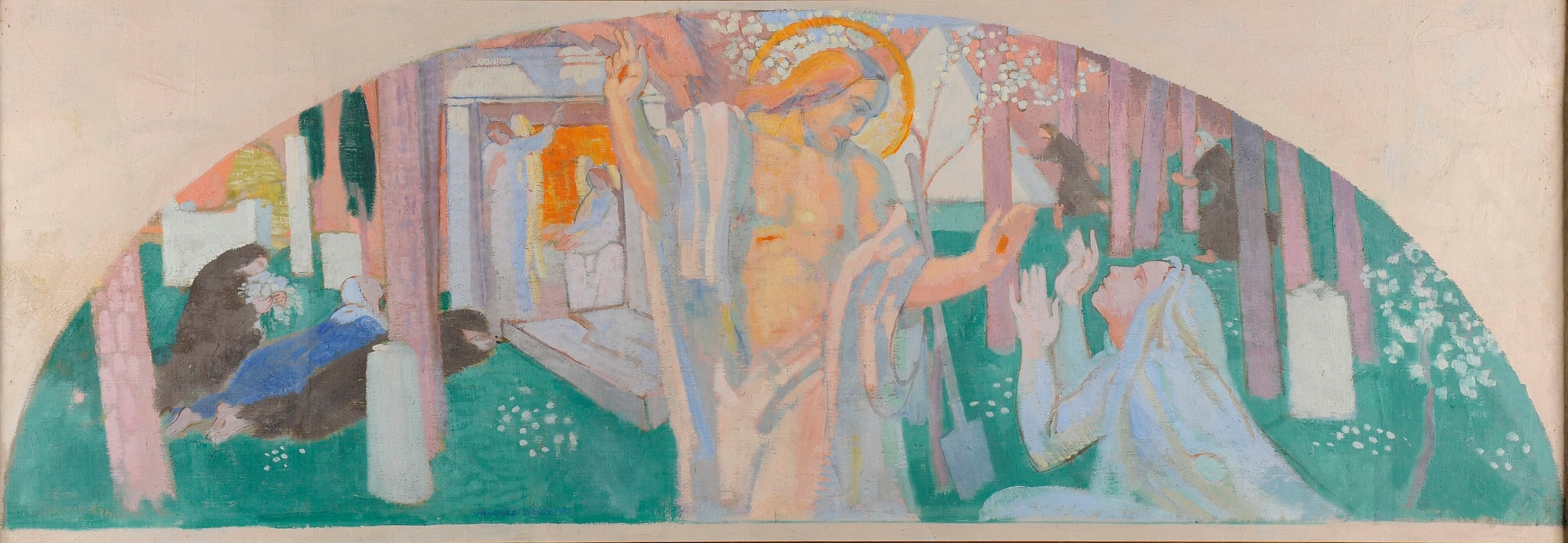
Maurice Denis set the meeting in a French spring. In this wide, half-moon-shaped sketch from 1920, pink tree trunks stand in turquoise grass under white blossom. Christ is at the center, golden and haloed, one hand raised. A spade stands in the ground at his side, which is Denis’s way of explaining her mistake. Mary kneels at the right in white, her face lifted and both hands open in the air between them. Denis has brought several moments of Easter morning into one garden. At the far left the holy women are gathered at the tomb with its angels, and in the background at the right Peter and John hurry through the trees toward it, while the meeting between Christ and Mary holds the center.
Visio Divina Prompt: Find the spade, then find Mary’s hands. What would it be like to hear your own name spoken by someone who knows all of you?
→ If you are trying to let go of someone, or of a season of your life, read Noli Me Tangere: Mary Magdalene and the Pain of Letting Go.
“I Have Seen the Lord”: The First to Tell
Mary Magdalene went and announced to the disciples, “I have seen the Lord!” And she told them what He had said to her.
John 20:18 (BSB)
For the length of a walk back into the city, in John’s telling, the news of the resurrection is in the keeping of one woman. She delivers it in five words.
Luke records how announcements like hers were received: “their words seemed like nonsense to them, and they did not believe the women” (Luke 24:11). She said it anyway, and the church has never forgotten who said it first. Apostle means “one who is sent,” and medieval writers, Thomas Aquinas among them, called her apostolorum apostola: the apostle sent to the apostles.
Matthew tells a version in which two Marys, running from the tomb “in fear and great joy,” meet Jesus on the road, fall down, and take hold of his feet. He says to them: “Do not be afraid. Go and tell My brothers” (Matthew 28:8–10).
Sources: John 20:17–18; Luke 24:9–11; Matthew 28:8–10; Vatican: “Apostle of the Apostles”.
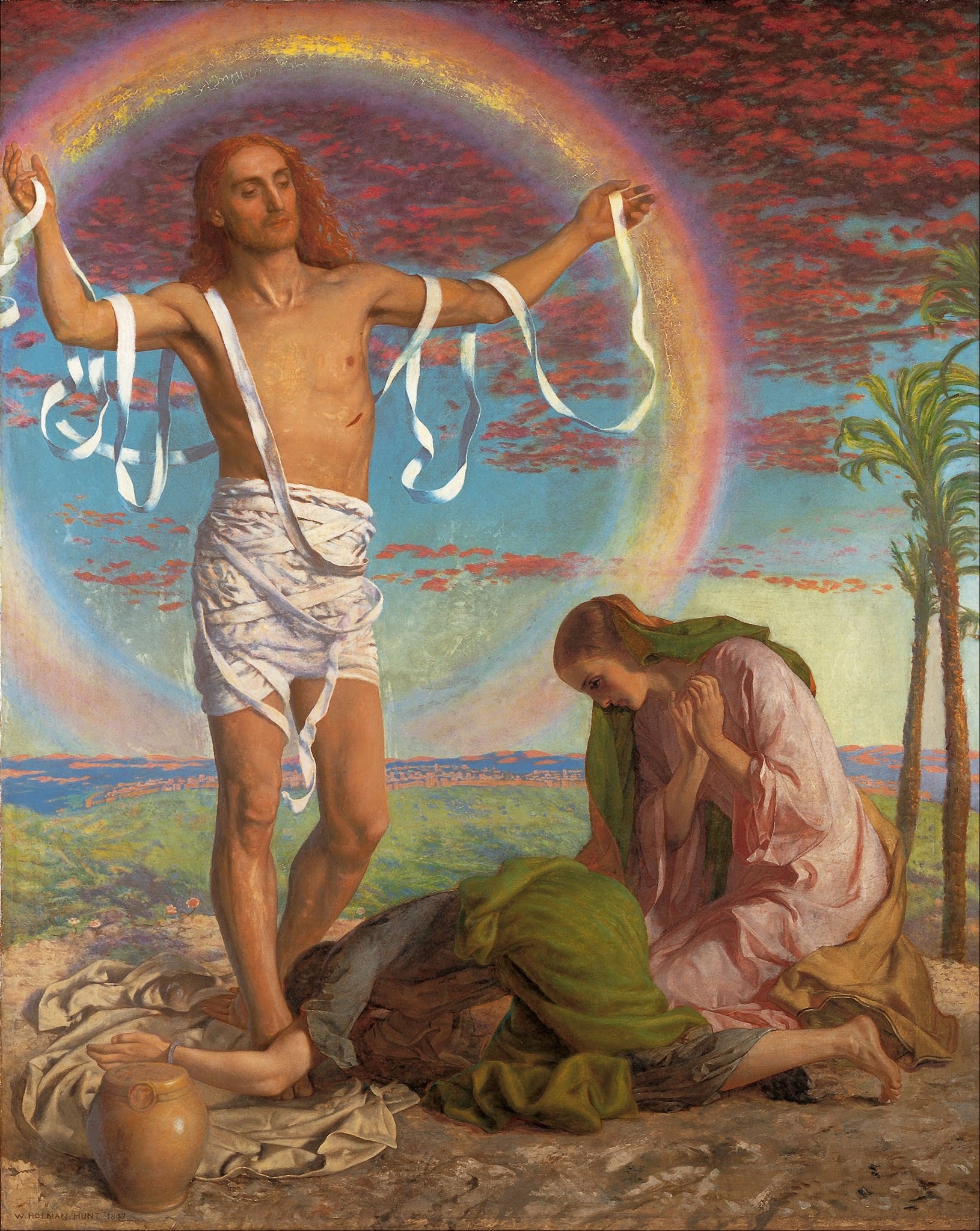
William Holman Hunt worked on this painting of Matthew’s scene in 1847 and again in 1897, fifty years later. Christ stands with his arms out, the unwound grave-cloths hanging from them in long white loops, inside a ring of rainbow light under a sky of red cloud. At his feet one woman bows to the ground, her arm curved around his ankles. The other kneels behind her with her head bowed and her hands clasped at her chest. Fear and great joy are both here, in two different bodies, and in a moment both women will be asked to stand up and go and speak.
Visio Divina Prompt: Look at the two women, one bowed to the ground and one kneeling with clasped hands. Which of them is closer to where you are today?
→ If you know what you have seen and doubt anyone will listen, read Finding Your Voice: Mary Magdalene and the Fear of Being Dismissed.
How to Recognize Her in a Painting
Once you know a few signs, you can find Mary Magdalene in almost any museum.
The jar. She went to the tomb carrying spices to anoint the body (Mark 16:1), and through the old mix-up she also inherited the alabaster jar of the woman in Luke 7. A woman holding a small lidded jar is almost always her.
The hair. It is long, loose, and often red or gold. This too comes from the woman in Luke 7, who dried Jesus’ feet with her hair. In the centuries when most of these pictures were made, grown women usually appear with their hair covered, so her loose hair was a way of pointing at her supposed past.
The red dress or cloak. It is common, though never a rule.
The skull, the cave, and the rough cross. These belong to a medieval legend, popular in France, that she ended her life as a hermit in a cave in Provence. The skull is a reminder that life is short. None of it is in the Bible.
Her place in the scene. At the crucifixion, she is usually the one at the foot of the cross, holding the wood or his feet. In a garden with a man carrying a spade or wearing a broad hat, she is the woman kneeling in front of him.
How to Pray with Mary Magdalene
Whether you are carrying a reputation you did not earn, sitting beside someone’s suffering, facing a future you cannot read, or working up the courage to say what you know, Mary Magdalene has stood where you are standing. Choose one painting from this guide and try a brief Visio Divina:
- Look (Visio): Let your eyes rest on one detail—the jar in a lowered hand, a hand pressed to a chest, two hands open in the air. Describe what is actually there before you decide what it means.
- Meditate (Meditatio): Ask where this moment in her life touches yours. Name the specific grief, confusion, or hope that it brings up.
- Pray (Oratio): Say one honest sentence to God about what you see and feel. Mary’s own prayers in the garden were short: a question, and then a single word.
- Contemplate (Contemplatio): Stay in silence for one minute. You are not trying to solve anything. You are keeping company with the painting, and letting it keep company with you.
Mary Magdalene and All Saints’ Day
Mary’s own feast is July 22. This collection also remembers her on November 1, All Saints’ Day, alongside the whole company of people the church calls saints. She belongs there for a reason worth remembering on that day: she is honored above all for staying, and for telling the truth about what she had seen.
Sources: Vatican: decree on the feast of Saint Mary Magdalene; All Saints’ Day.
Explore the Mary Magdalene collection
The five pieces follow her story in order, and each one reads a chapter of her life beside a modern struggle, with three to five paintings and a short practice at the end.
- Healing from Shame: Seeing Mary Magdalene Beyond the Labels — for when someone else’s version of you has started to feel true.
- When You Cannot Take the Pain Away: Mary Magdalene and the Art of Staying — for caregivers, and for anyone beside a suffering they cannot fix.
- When the Future Is Unclear: Mary Magdalene at the Empty Tomb — for the morning your plans stop making sense.
- Noli Me Tangere: Mary Magdalene and the Pain of Letting Go — for loving a person, or a season of life, that you cannot keep.
- Finding Your Voice: Mary Magdalene and the Fear of Being Dismissed — for when you know what you saw and doubt that anyone will listen.
Frequently asked questions
Was Mary Magdalene a prostitute?
No Gospel says so. The idea goes back to a sermon preached by Pope Gregory the Great around 591, which identified her with the unnamed “sinful woman” of Luke 7 and with Mary of Bethany. Most scholars today treat these as three separate women, and the Catholic Church’s calendar no longer combines them. Luke, for that matter, never says what the unnamed woman’s sin was.
Was she the same person as Mary of Bethany?
The Gospels never say so. Mary of Bethany is the sister of Martha and Lazarus and lives in a village near Jerusalem (John 11–12). Mary Magdalene comes from Magdala, in Galilee, several days’ walk to the north.
What were the “seven demons”?
Luke 8:2 says that seven demons had gone out of her, and gives no further detail. The text does not call them sins, and it does not describe her condition in medical terms. Seven is often a number of completeness in the Bible, so many readers take the phrase to mean that she had been badly afflicted and was completely freed.
Why is she called the “apostle of the apostles”?
Because in John 20:17–18 the risen Jesus sends her to tell the apostles that he is alive, and apostle means “one who is sent.” Medieval writers such as Rabanus Maurus and Thomas Aquinas used the title, and the Vatican cited it in 2016 when it raised her day to a feast.
What does Noli me tangere mean?
It is Latin for “Do not touch me,” the old Latin Bible’s version of Jesus’ words to Mary in John 20:17. The Greek suggests “stop holding on to me,” and the BSB reads “Do not cling to Me.” The phrase became the title of paintings of their meeting in the garden.
Why does she carry a jar in paintings?
Because she went to the tomb with spices to anoint Jesus’ body (Mark 16:1). Through the long confusion with the woman of Luke 7, she also inherited that woman’s alabaster jar of perfume. The jar became her signature in art.
Why did she mistake Jesus for the gardener?
John 20:15 says she thought he was the gardener and does not explain further. John does say that the tomb was in a garden (John 19:41). She was crying, the day had barely begun, and she was not expecting to meet a living man. Painters often give Jesus a spade or a broad hat to make her mistake understandable.
When is her feast day?
July 22, in both Western and Eastern calendars. In 2016 Pope Francis raised the day from a memorial to a feast in the Catholic calendar, the rank given to the apostles.
Did Mary Magdalene die in France?
The Bible does not say where or when she died. A medieval legend, much loved in Provence, says she sailed to Marseille, preached there, and spent her last years as a hermit in a cave at Sainte-Baume. An older Eastern tradition places her later life in Ephesus. Both are traditions, not Scripture.
Was she married to Jesus?
No ancient source says so. No Gospel in the Bible calls her his wife. A few later writings outside the Bible, such as the Gospel of Philip, call her Jesus’ “companion,” and modern novels have built a romance on that word.
Is she in Leonardo’s Last Supper?
No. The beardless figure beside Jesus is the apostle John, as the museum that cares for the painting explains. Renaissance painters usually showed John as a young man without a beard.
Source: Museo del Cenacolo Vinciano.
Where can I begin praying with her story?
Read John 20:11–18 slowly beside one painting of the garden. Our Called by Name reflection offers a longer place to begin.
Stay with the painting
If you want to sit with one of these images a little longer, you can restore it yourself. Every painting in this guide opens as a puzzle, piece by piece, with its verse waiting at the end; Sandys’s portrait is a good place to start. Or get the app for a new painting, a new verse, and a new reflection every morning.