You know what you saw. You were in the meeting, or the family, or the marriage, or the exam room, and you know what happened there. You can also hear, in advance, how it will be received. Are you sure? You’re overreacting. That doesn’t sound like him. So you trim the story down, or wait for a better moment, or say nothing. The fear is not really of speaking. It is of speaking and being waved away.
Mary Magdalene was given the most important news in the New Testament and sent to deliver it to people who were not ready to believe her. This piece follows her through four paintings. It is the last of five in our guide to Mary Magdalene’s life in art.
The First Easter Sermon Was Not Believed
In John’s Gospel, the risen Jesus meets Mary alone in the garden outside his tomb, calls her by name, and gives her an errand: “go and tell My brothers” (John 20:17). John reports how she carried it out.
Mary Magdalene went and announced to the disciples, “I have seen the Lord!” And she told them what He had said to her.
John 20:18 (BSB)
Her sermon is five words long, followed by a report of what she had heard. Luke, telling the story of the same morning, records how announcements like hers went over:
But their words seemed like nonsense to them, and they did not believe the women.
Luke 24:11 (BSB)
Later that day, two disciples walking out of the city are still turning it over. “Some of our women astounded us,” they tell a stranger on the road. The women had spoken of angels and of Jesus being alive, and some of the men had gone to check the tomb, “but Him they did not see” (Luke 24:22–24). By late afternoon the women’s report has been heard, discussed, partly verified, and still not accepted.
So Mary was sent before anyone was prepared to believe her. Her authority did not come from the agreement of her listeners. It came from what she had seen. The church took a while to say so, and then said it memorably. Apostle means “one who is sent,” and medieval teachers, Thomas Aquinas among them, gave her the title apostolorum apostola, the apostle to the apostles. The Eastern churches call her “equal to the apostles.” In 2016 the Vatican raised her feast day to the rank that the apostles’ days have.
Sources: John 20:17–18; Luke 24:9–24; Musées de Reims: Denis, Noli me tangere; Vatican: “Apostle of the Apostles”.
Sent Before Anyone Believed Her
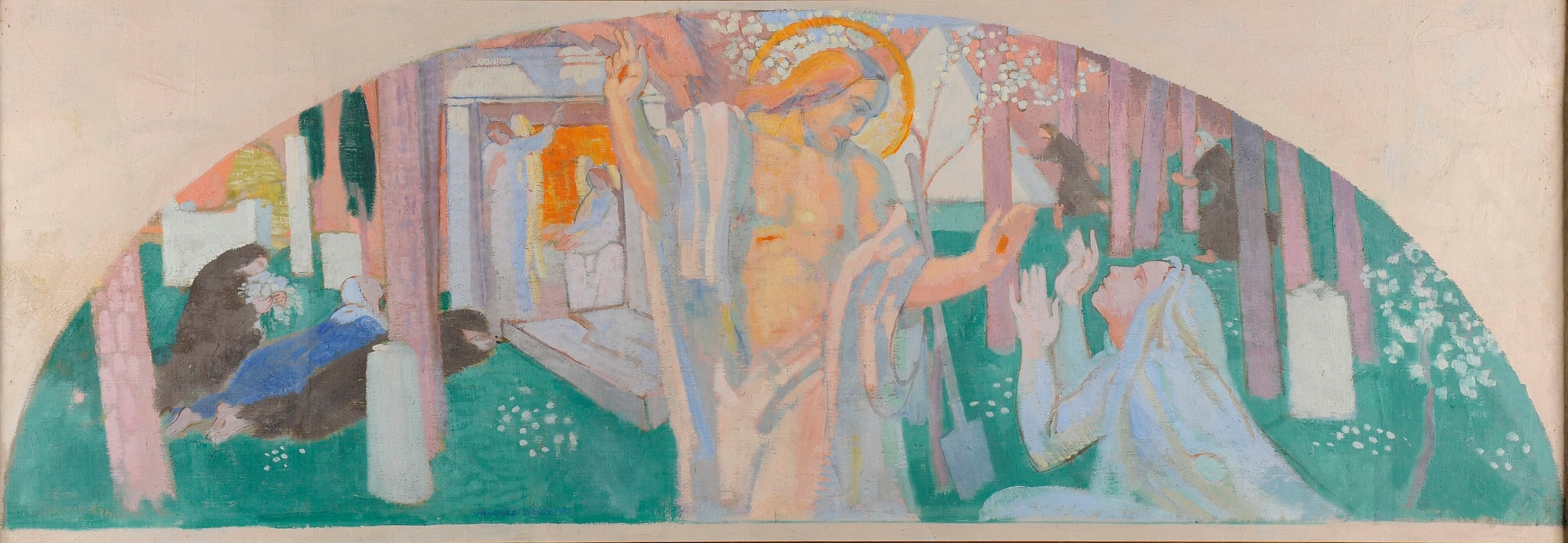
Maurice Denis set the commissioning in a French spring. In this wide, half-moon-shaped sketch from 1920, pink tree trunks stand in turquoise grass under white blossom. Christ is at the center, golden and haloed, with one hand raised and a gardener’s spade standing in the ground beside him. Mary kneels at the right in white, her face lifted and both hands open in the air.
Now look at the edges. At the far left, the holy women are gathered at the tomb. In the background at the upper right, Peter and John hurry through the trees toward it. Denis has brought several moments of Easter morning into one garden, and he gives the center of it to the moment when Mary is sent.
Notice what Jesus does not ask her. He does not ask what standing she has, or whether the others are likely to listen. A witness needs one qualification, and she has it: she was there. If you are holding back a true thing because you feel you lack the title, the degree, or the track record to say it, this painting is a gentle correction. What you have lived and seen is already a kind of authority.
Visio Divina Prompt: Look at Mary’s lifted hands. What true thing have you been given that you are holding back because you feel unqualified to say it?
Afraid and Going Anyway
“Do not be afraid,” said Jesus. “Go and tell My brothers to go to Galilee. There they will see Me.”
Matthew 28:10 (BSB)
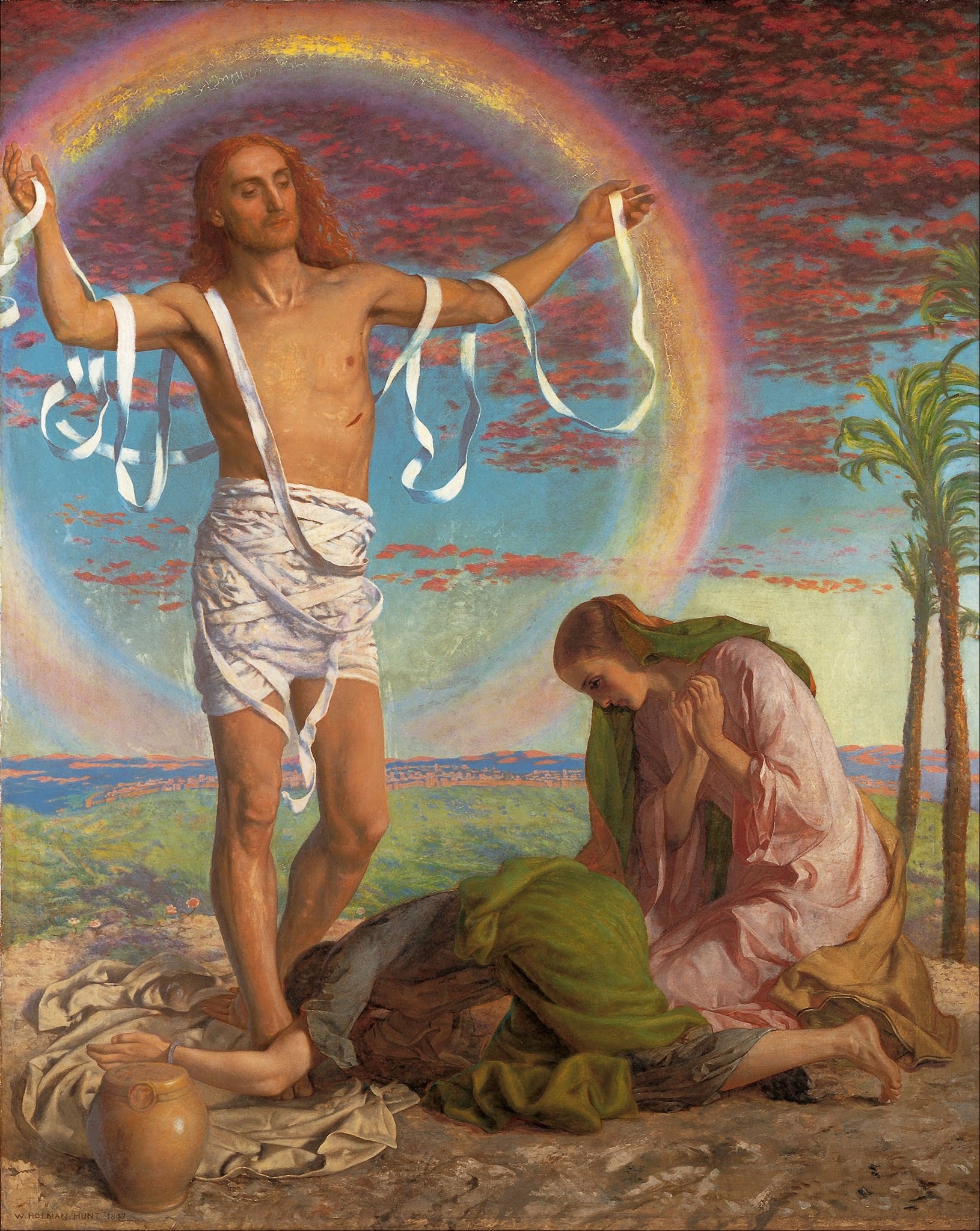
Matthew tells a version of the morning in which two Marys, running from the tomb, meet Jesus on the road, fall down, and take hold of his feet. William Holman Hunt worked on this scene in 1847 and again in 1897, fifty years later. Christ stands with his arms out, the unwound grave-cloths hanging from them in long white loops, inside a ring of rainbow light under a sky of red cloud. One woman bows to the ground at his feet, her arm curved around his ankles. The other kneels behind her with her head bowed and her hands clasped at her chest.
Matthew says that the women ran from the tomb “in fear and great joy” (Matthew 28:8). He does not say that the joy replaced the fear. They have both, and they are sent anyway. Hunt paints them still on the ground, in awe and hesitation.
Most of us wait to feel confident before we speak, as if a shaking voice made the words less true. These two women are told to go before they have stopped trembling. Courage, in this story, is delivering the message while your hands are still unsteady.
Visio Divina Prompt: Look at the kneeling woman’s bowed head and clasped hands. What conversation do you need to have even while you still feel afraid?
It Begins Quietly
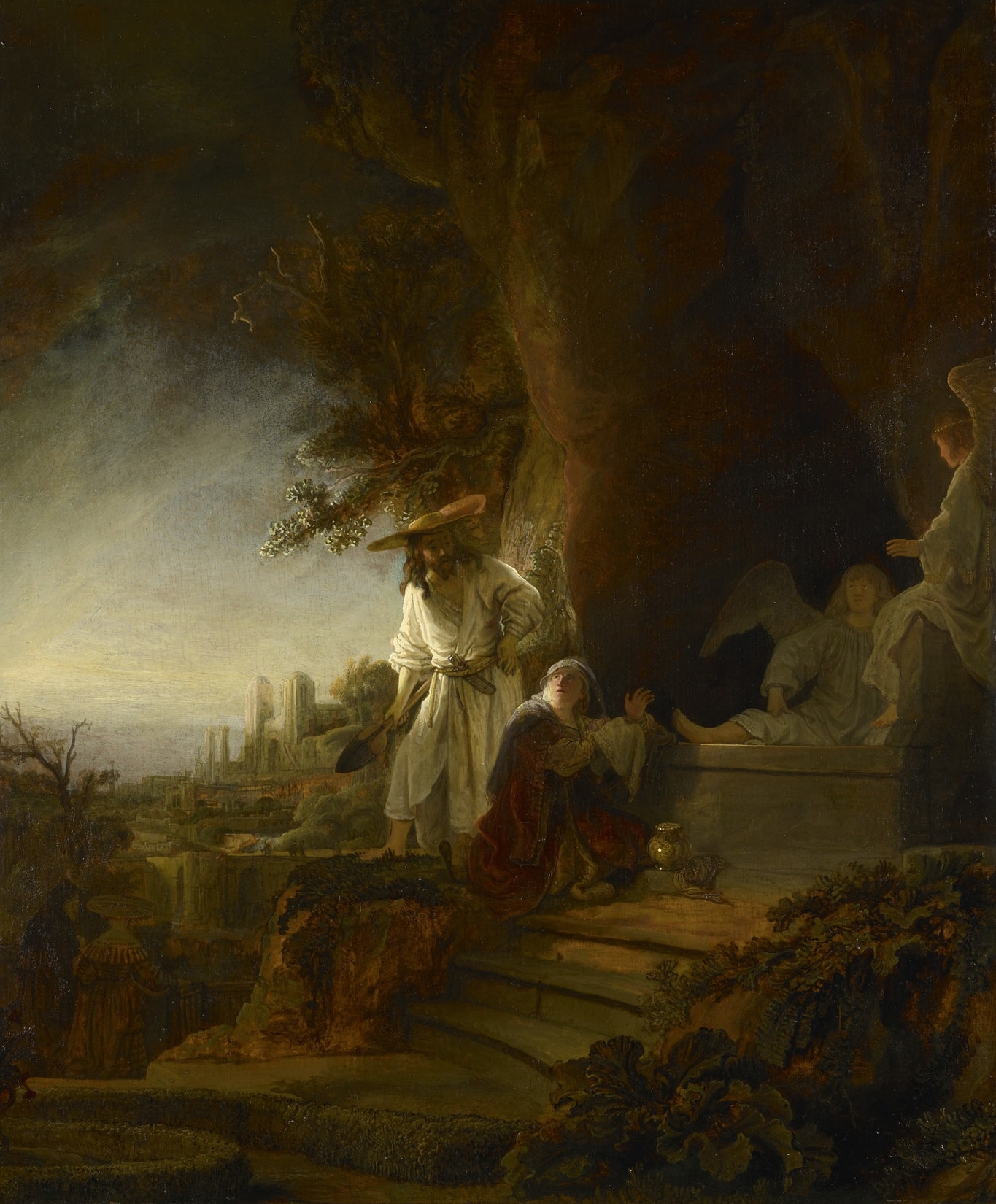
Rembrandt’s painting of 1638 is a reminder of how small this announcement was at the start. The whole scene is a dawn landscape. Jerusalem is waking in the distance at the left, the dark rock of the tomb fills the right, and the most important conversation in the picture is happening between two people in the middle: a man in a gardener’s straw hat, and a woman kneeling by her jar who has just turned her head toward him. At the lower left, two other figures are already going down the path toward the city, outside this quiet exchange.
Nothing here is loud. No one is addressing a crowd, and no one is arguing. We are often taught that to be heard we have to be forceful, polished, or a little angry. Mary’s commission begins in a private exchange, and when she delivers it, it is five plain words.
a time to be silent and a time to speak
Ecclesiastes 3:7, excerpt (BSB)
When your time to speak comes, you do not have to become someone else to do it. A plain sentence, said by a person who means it, carries a great deal: This is what I saw. I am not all right with this. I need help.
Visio Divina Prompt: Notice how small the two figures are inside that wide morning. How would you say what you need to say if you felt no pressure to sound impressive?
Say It, and Let It Go
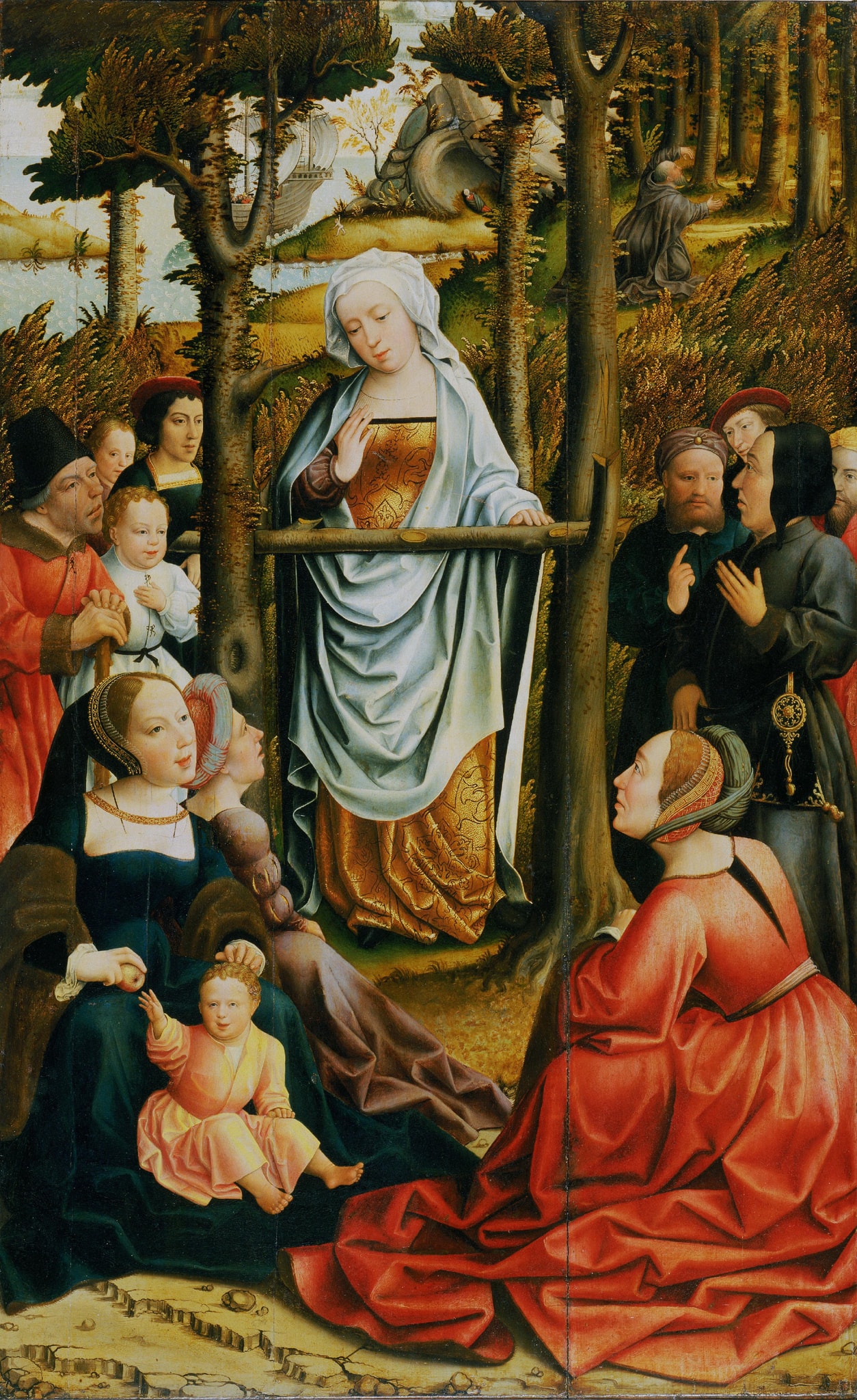
This last picture is not from the Bible. A medieval legend, much loved in France, held that Mary later sailed to Marseille and preached to the people of Provence, and around 1500–1520 a Netherlandish painter known only as the Master of the Magdalene Legend told that story on the panels of a large altarpiece. This is one of them.
She stands behind a rough wooden rail lashed between two trees, a pulpit made from what the forest offered. She wears a white headdress and a pale blue mantle over a dress of gold brocade, and one hand is raised in the middle of a sentence. Around her are the people of Marseille, dressed like the painter’s own neighbors. There are women seated on the grass, and an old man leaning with both hands on his cane, with a small child in white at his side. A toddler sits in one woman’s lap with an arm in the air, her hand resting on his head. At the right, two men gesture as if in discussion, one raising a finger and the other an open hand. Some faces are fixed on her. Some are looking elsewhere. Far behind them a ship comes in toward a rocky shore, and in the top right corner a monk kneels before a vision that was lost when the panel was later cut down.
Whether or not Mary ever saw France, the legend remembered something true about her: she was someone who spoke. The painter, for his part, is honest about audiences. When you finally say the true thing, you do not control how it lands. Some will listen and some will not, as the apostles at first did not. Your part is to say it clearly and kindly. What your hearers do with it is not yours to carry.
It is worth noticing how Luke’s story continues. In the verse after the apostles dismiss the women’s words as nonsense, “Peter, however, got up and ran to the tomb” (Luke 24:12). Words that seem to have been waved away often go on working.
Visio Divina Prompt: Look at the different faces in the crowd. Who is the person you need to speak honestly to this week, whatever their first response may be?
Source: Philadelphia Museum of Art: Saint Mary Magdalene Preaching.
A 4-Step Visio Divina Practice for Finding Your Voice
Visio Divina—Latin for “divine seeing”—is a simple way of praying with a picture instead of a passage. Return to the painting in which you most recognized yourself, and take three unhurried minutes:
- Look (Visio): Let your eyes rest on Mary’s posture in the painting you chose. Notice her hands and where she is looking.
- Meditate (Meditatio): Bring one real, pending conversation to mind. Write down the single most honest sentence you need to say in it.
- Pray (Oratio): Risen Christ, you trusted Mary with news that no one was ready to hear. Help me to speak truthfully and plainly. Take away my need to sound impressive. Give me the courage to say what I have seen, and the peace to leave the rest with you. Amen.
- Contemplate (Contemplatio): Sit in silence for one minute. Picture yourself saying that one sentence without apologizing for it.
Stay with the painting
If you want to sit with one of these images a little longer, you can restore it yourself: open Hunt’s Christ and the Two Marys as a puzzle, piece by piece, with its verse waiting at the end. Or get the app for a new painting, a new verse, and a new reflection every morning.
Continue the journey
This is the last chapter of Mary’s story. Before this: Noli Me Tangere: Mary Magdalene and the Pain of Letting Go. Return to Mary Magdalene’s life and paintings, or meet the other saints in our All Saints’ Day collection.