Letting go is often described as a peaceful release, like a leaf dropping from a tree. In practice it feels more like having something pulled out of your hands. You want the life you had before: before the loss, before the move, before the relationship changed, before a familiar chapter closed for good. Letting go can even feel like a betrayal, as if admitting that a thing is over were the same as admitting that you never loved it enough.
Mary Magdalene’s meeting with the risen Jesus is the Bible’s great scene of holding on and being asked to let go. Painters call it Noli me tangere, and this piece follows it through four of their pictures. It is the fourth of five in our guide to Mary Magdalene’s life in art.
The Garden
It is early on the first Easter morning. Mary has found the tomb open and empty and has run to tell Peter. He and another disciple come, look inside, and then, John’s Gospel says, “the disciples returned to their homes” (John 20:10). Mary does not go home. She stays outside the tomb, crying.
When she bends to look in, she sees two angels, who ask her why she is weeping. She turns around and finds a man standing behind her. He asks the same question. She takes him for the gardener, and she makes him an offer that is all love and no sense: “Sir, if you have carried Him off, tell me where you have put Him, and I will get Him” (John 20:15). She is proposing to carry a grown man’s body by herself.
Then he says her name, and she knows him. John does not describe her next movement. The words of Jesus suggest an impulse to hold on to him:
“Do not cling to Me,” Jesus said, “for I have not yet ascended to the Father. But go and tell My brothers, ‘I am ascending to My Father and your Father, to My God and your God.’”
John 20:17 (BSB)
The old Latin Bible translated his first words as Noli me tangere, “Do not touch me,” and the phrase became the title of hundreds of paintings. The Greek is closer to “stop holding on to me,” which is why most modern translations say cling or hold. He is not pushing her away. He has just called her by name. He gives her a reason, which is that he is going to the Father, and then he gives her an errand.
John is describing an event that happened once, to one woman, and it would be a mistake to turn it into a general rule about moving on. But it rhymes with an experience most of us will have: the person or the season we love cannot be kept in the form we knew, and love has to find out what it becomes next.
Source: John 20:10–18.
Reaching
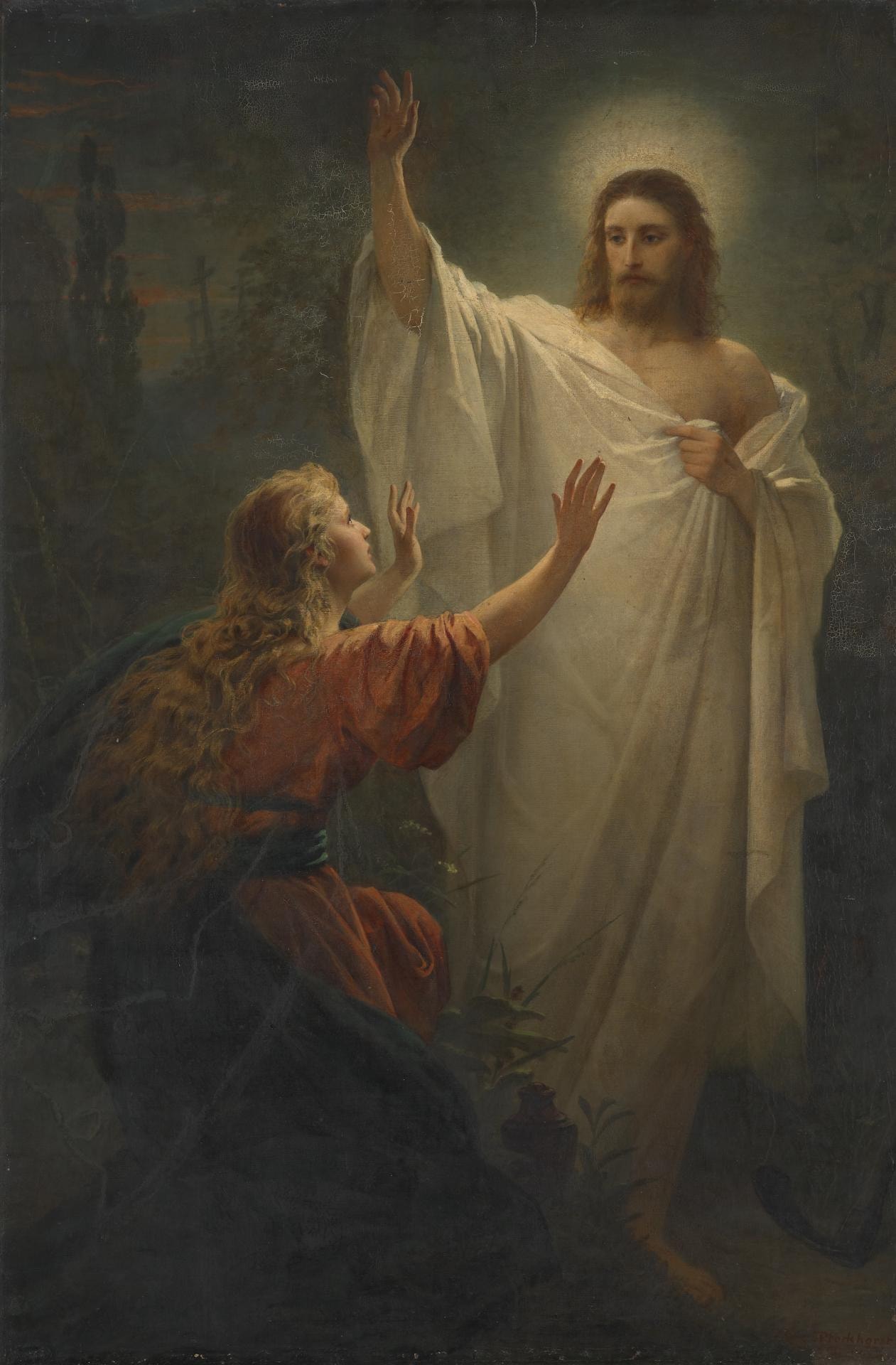
Bernhard Plockhorst, a German painter whose religious pictures hung as prints in many nineteenth-century homes, painted this in 1880. The garden is still dark. Mary kneels at the lower left in a red dress, with a deep green mantle fallen around her and her golden hair loose down her back. Both of her hands are lifted toward him, open. He stands over her in a white robe with a soft light around his head. One hand gathers the robe at his chest, and the other arm is raised high and points upward. Down among the plants between them stands her jar of spices, forgotten.
Before you can release a season of your life, it helps to admit how much you want to keep it. You do not have to be stoic. Missing a person, a home, or an earlier version of yourself is what deep attachment sounds like after the fact. Plockhorst gives that longing the dignity of a whole body leaning forward, and he does not make it look foolish.
Visio Divina Prompt: Look at her open hands in the space between them. What era, relationship, or identity are you reaching back toward right now?
Too Sad to Look Up
“Woman, why are you weeping?” Jesus asked. “Whom are you seeking?”
John 20:15, excerpt (BSB)
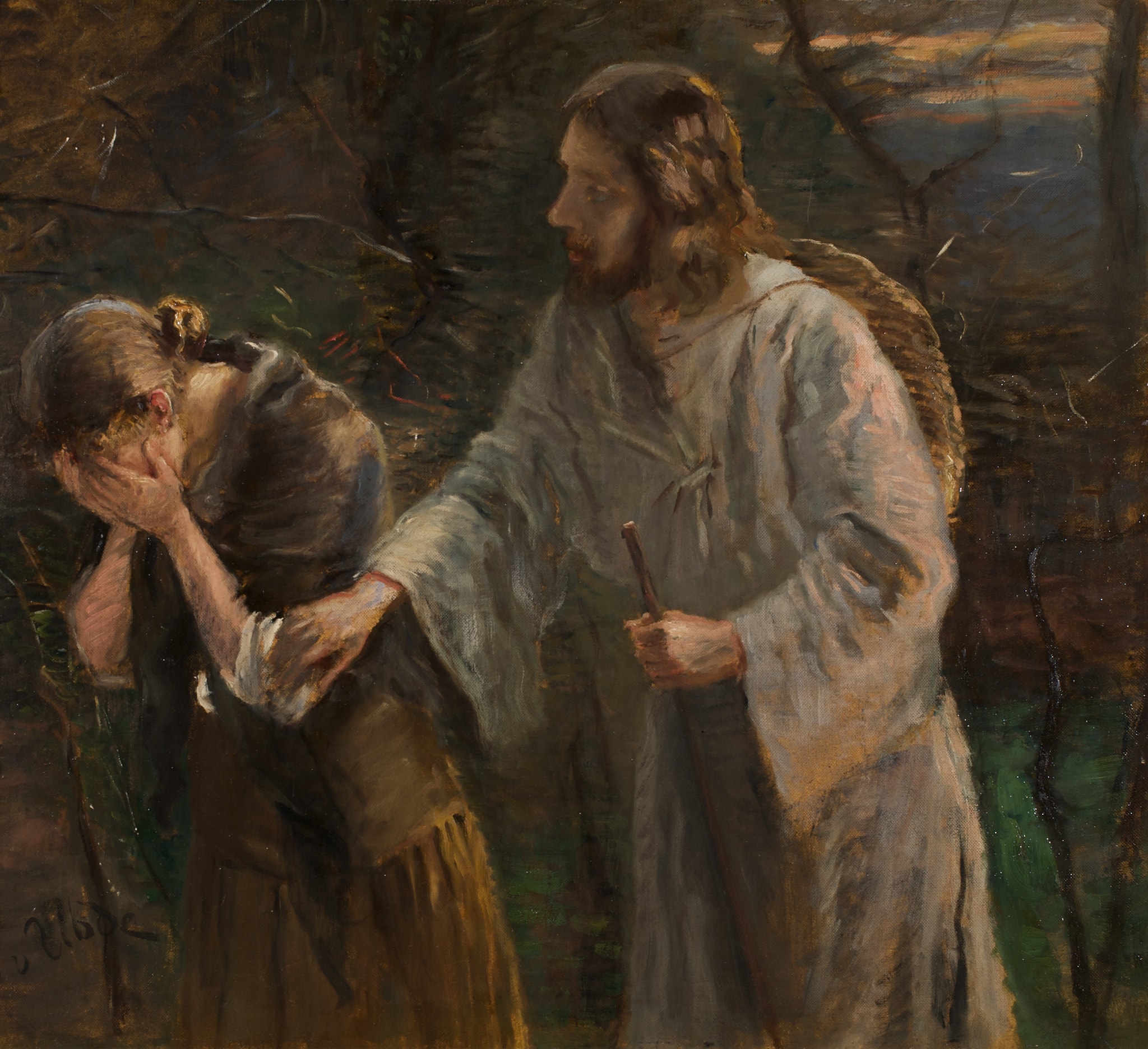
Fritz von Uhde was a German painter who liked to set Gospel scenes among the working people of his own day. His Mary wears a brown dress and a dark shawl, and she has buried her face in both hands. Beside her stands a man in a pale robe. He grips the wooden handle of a garden tool in one hand and carries a wicker basket on his back, which is why she will shortly take him for the gardener. His other hand is already resting on her arm.
She has not looked up. The painting holds the seconds in which comfort has arrived and has not yet been seen.
This is not a fault in her. Tears do this; grief narrows the world to the size of the loss. What is quietly consoling in Uhde’s picture is the order of events. He does not wait at a distance until she has composed herself. He comes close first and asks his question second, and the question is an open one: Why are you weeping? Whom are you seeking? If you cannot yet see what good could be standing near you, this painting suggests that it does not need your attention in order to stay.
Visio Divina Prompt: Notice his hand on her arm, and her hands over her eyes. Who, or what, may already be beside you that grief has made hard to see?
Called by Name
Jesus said to her, “Mary.” She turned and said to Him in Hebrew, “Rabboni!” (which means “Teacher”).
John 20:16 (BSB)
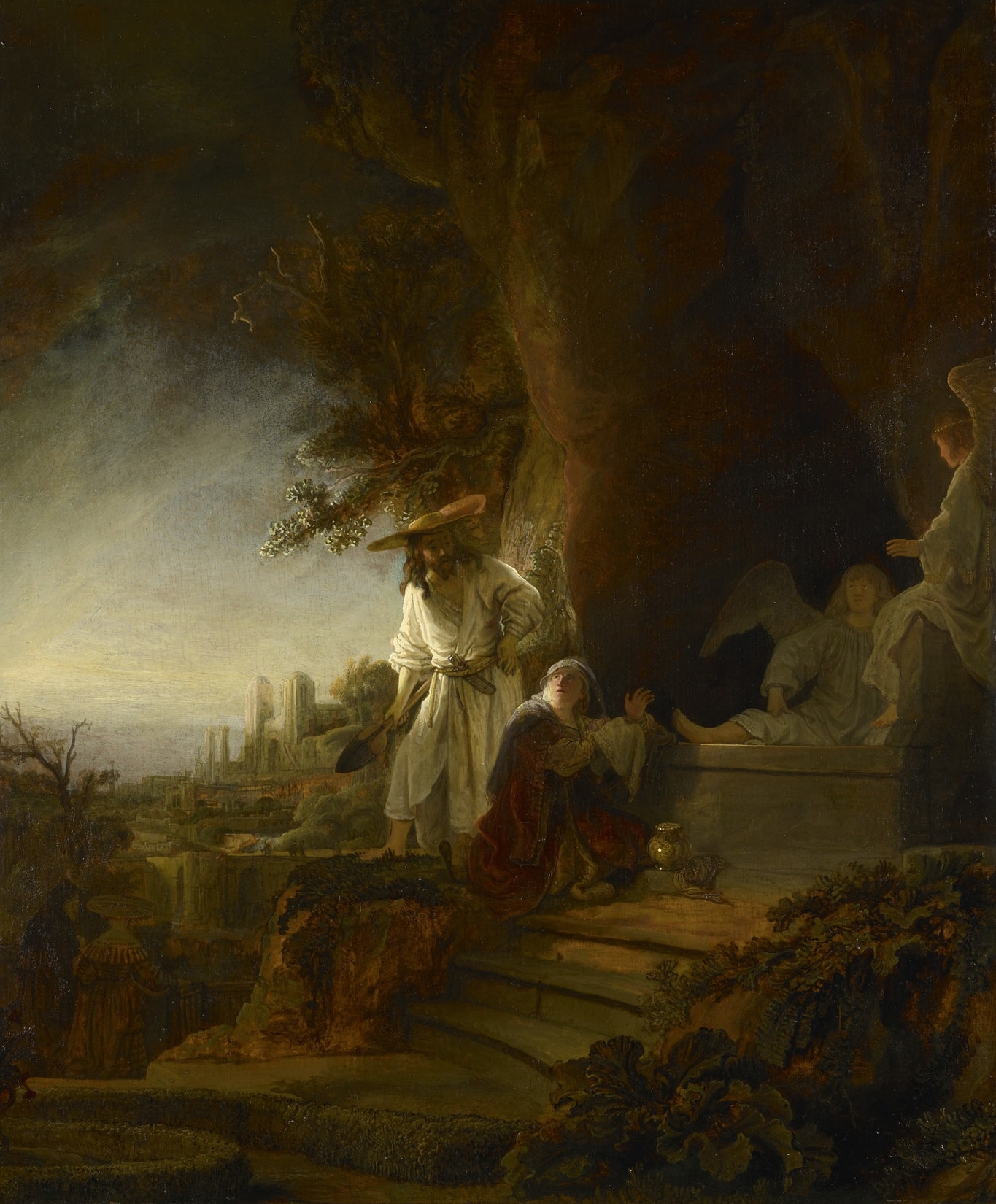
Rembrandt painted this in 1638, and he made the meeting small inside a very large morning. At the left, dawn is coming up over the towers of Jerusalem. At the right, the dark rock of the tomb shelters two angels, one of them sitting on the slab with his legs stretched out. Between the two, Christ stands in a broad straw hat with a spade in his hand and a pruning knife in his belt. Mary kneels beside her jar with her head turned sharply back over her shoulder toward him. Rembrandt has painted the turn itself: the half second between “Sir” and “Rabboni.”
A large change in your life tends to take your titles with it. When a job ends, or a marriage, or the years of hands-on parenting, you lose the word that used to tell you who you were. Notice what Jesus calls her. He does not say “disciple” or “witness,” and he does not mention anything she has done for him. He uses her name. Centuries earlier the prophet Isaiah had heard God say the same thing to a displaced and frightened people:
I have called you by your name; you are Mine!
Isaiah 43:1, excerpt (BSB)
You are known apart from your usefulness. You were known before the role, and you are known after it.
Visio Divina Prompt: Look at her turning head. Say your own name quietly, once. Can you trust that you are seen and known in this in-between place?
Let Go, and Go
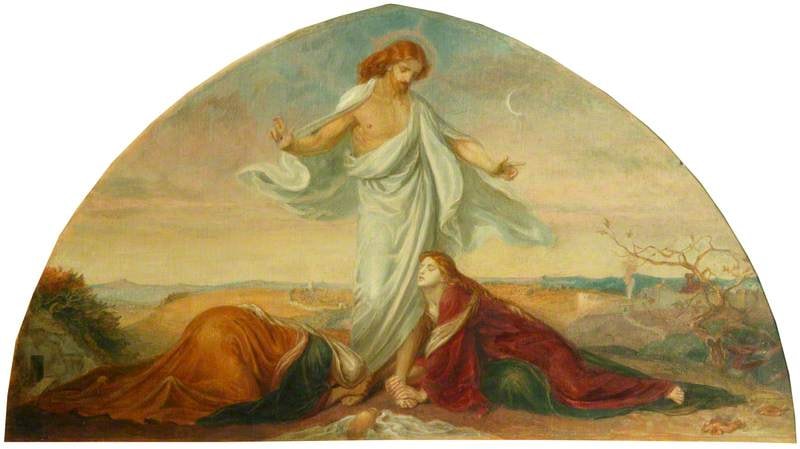
Frederic Shields fits his version into a half-moon shape. Under a dawn sky with a thin crescent moon, Christ stands in the center with his arms spread low and open, his white robe lifted by the wind. Two women are at his feet. One lies face down in an orange cloak. The other, red-haired and wrapped in red, lifts her face beside his robe while holding on to his foot.
Shields has blended John’s garden with Matthew’s account of the same morning, in which two Marys meet Jesus on the road and “grasped His feet” (Matthew 28:9). What he shows clearly is the clinging, and how understandable it is. She has him back, and she does not mean to let go.
“Do not cling to Me” is only half of his sentence. The other half is “but go and tell My brothers.” He does not end her love. He gives it a direction. She cannot keep him in the garden, but she can carry what she has seen into the city, and in the next verse she goes to tell the disciples. Letting go, in this story, is what makes the going possible. One way to honor a love that cannot continue in its old form is to let it shape the person you now are for other people.
Visio Divina Prompt: Look at his open arms and her hands holding on. What would it look like to carry the love you had in that earlier season into one thing you do today?
A 4-Step Visio Divina Practice for Letting Go
Visio Divina—Latin for “divine seeing”—is a simple way of praying with a picture instead of a passage. Return to the painting that is closest to where you are, and take three unhurried minutes:
- Look (Visio): Rest your eyes on the space between Mary and Christ. Notice whether she is reaching, hiding, turning, or holding on.
- Meditate (Meditatio): Name the thing you are afraid to let go of. Say what it gave you, and why it hurts to see it change.
- Pray (Oratio): Christ, you called Mary by name while she was still in tears. Help me loosen my grip on what is gone, so that my hands are open for what comes next. Let my love find its new form. Amen.
- Contemplate (Contemplatio): Rest in silence for one minute, with your hands open in your lap.
Questions about Noli me tangere
What does Noli me tangere mean?
It is Latin for “Do not touch me,” the old Latin Bible’s translation of Jesus’ words to Mary Magdalene in John 20:17. The Greek suggests “stop holding on to me,” and the BSB reads “Do not cling to Me.” The phrase is the traditional title for paintings of their meeting.
Was Jesus rejecting Mary?
No. He has just called her by name, and in the same sentence he trusts her with a message for the other disciples. His words belong with what follows them: he is ascending to the Father, and she is being sent.
Why does Jesus look like a gardener in Rembrandt’s painting?
Because John 20:15 says that Mary first took him for the gardener. Rembrandt gives him a broad hat and a spade so that her mistake makes sense to us. Many painters do the same; look for the spade in pictures of this scene.
Does letting go mean I should stop missing someone?
No. You can make room for the present and keep missing someone at the same time. This reflection offers a way to pray inside that tension. It does not set a timetable for grief.
Stay with the painting
If you want to sit with one of these images a little longer, you can restore it yourself: open Rembrandt’s Christ and St Mary Magdalen at the Tomb as a puzzle, piece by piece, with its verse waiting at the end. Or get the app for a new painting, a new verse, and a new reflection every morning.
Continue the journey
Next in Mary’s story: Finding Your Voice: Mary Magdalene and the Fear of Being Dismissed. Before this: When the Future Is Unclear. This reflection belongs to our Mary Magdalene All Saints’ Day collection.