Guilt says, I did something wrong. Shame says, I am something wrong. The first can be faced, confessed, and repaired. The second follows you into rooms. It is the feeling of walking in and sensing that everyone has already decided who you are—because of a mistake, a rumor, a family, a body, a bad year—and then the slower discovery that you have started to agree with them.
Mary Magdalene knows this from the inside of history. No one in the Bible has carried a label longer than she has, and it was never hers.
This piece is the first of five in our guide to Mary Magdalene’s life in art.
The Woman and the Label
Here is everything the Gospels—the Bible’s four accounts of Jesus’ life—say about who she was before the crucifixion. Jesus healed her; Luke’s phrase is that “seven demons had gone out” of her (Luke 8:2). After that she traveled with him, as one of a group of women who covered the group’s expenses:
These women were ministering to them out of their own means.
Luke 8:3, excerpt (BSB)
That is all. There is no list of sins and no scandal. Luke records a rescue and a loyalty.
The label came later. Around the year 591, Pope Gregory the Great preached a sermon about a different woman, the unnamed “sinful woman” of Luke 7 who weeps at Jesus’ feet during a dinner party, and told his congregation that she and Mary Magdalene were the same person. The idea stuck. For nearly fourteen hundred years, in sermons and in paint, Mary was the reformed sinner with loose hair and a jar. The Catholic Church withdrew the identification in the last century, and the Eastern Orthodox churches had never made it, but by then the museums were full.
That makes the five paintings in this piece unusual. None of them shows a scene from Mary Magdalene’s life as the Bible tells it. They show the legend. They are, quite literally, pictures of a label. Yet the painters who made them were honest about what carrying shame looks like: the hiding, the tiredness, the long quiet, the first step toward the door, and the day you can look at someone again. Pictures painted to illustrate her reputation can help us put down ours.
Sources: Luke 8:1–3; Vatican: “Apostle of the Apostles”; National Gallery: Saint Mary Magdalene.
Wanting to Hide
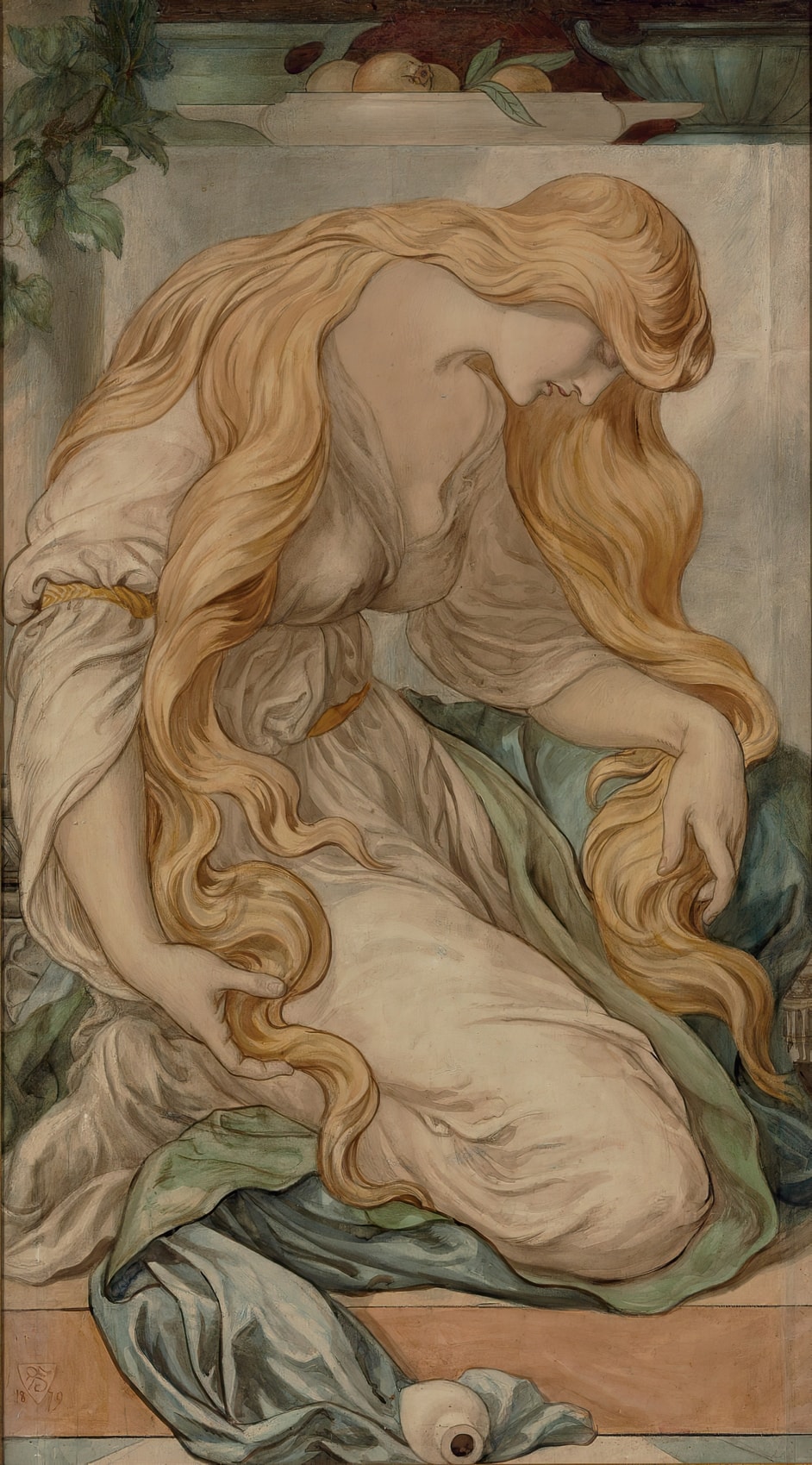
Frederic Shields painted this watercolor in 1879. A woman kneels with her head bowed, her profile framed by long golden hair that falls around her to the floor. Both hands are visible among its heavy strands: one gathers a lock beside her knee, and the other rests over the hair on the opposite side. Above her runs a ledge set with a dish of fruit and a bowl, like the edge of a laid table. At the very bottom of the picture a small jar lies tipped on its side, its open mouth toward us.
Shields appears to be painting the old mix-up directly. The tableware and the tipped ointment jar evoke the woman of Luke 7, on the floor at a dinner party. In Luke’s story the host looks down at her and sums her up in a phrase, “what kind of woman” she is (Luke 7:39). Jesus turns toward her and asks the host a question that is still worth asking:
Do you see this woman?
Luke 7:44, excerpt (BSB)
The host had not seen her. He had seen a category.
When one word has been said about you often enough—failure, difficult, too much, damaged—you begin to arrange your life so that no one can look at you directly. You stop applying, stop calling, stop showing up. Hiding is not weakness. It is what people do when being seen has hurt. Her bowed posture gives us a way to pray about that wish to withdraw, without hurrying past it.
Visio Divina Prompt: Notice her bowed head and the long hair falling around her. What word has made you want to withdraw from other people? Bring that one word to God, and say how heavy it has been.
Too Tired to Argue
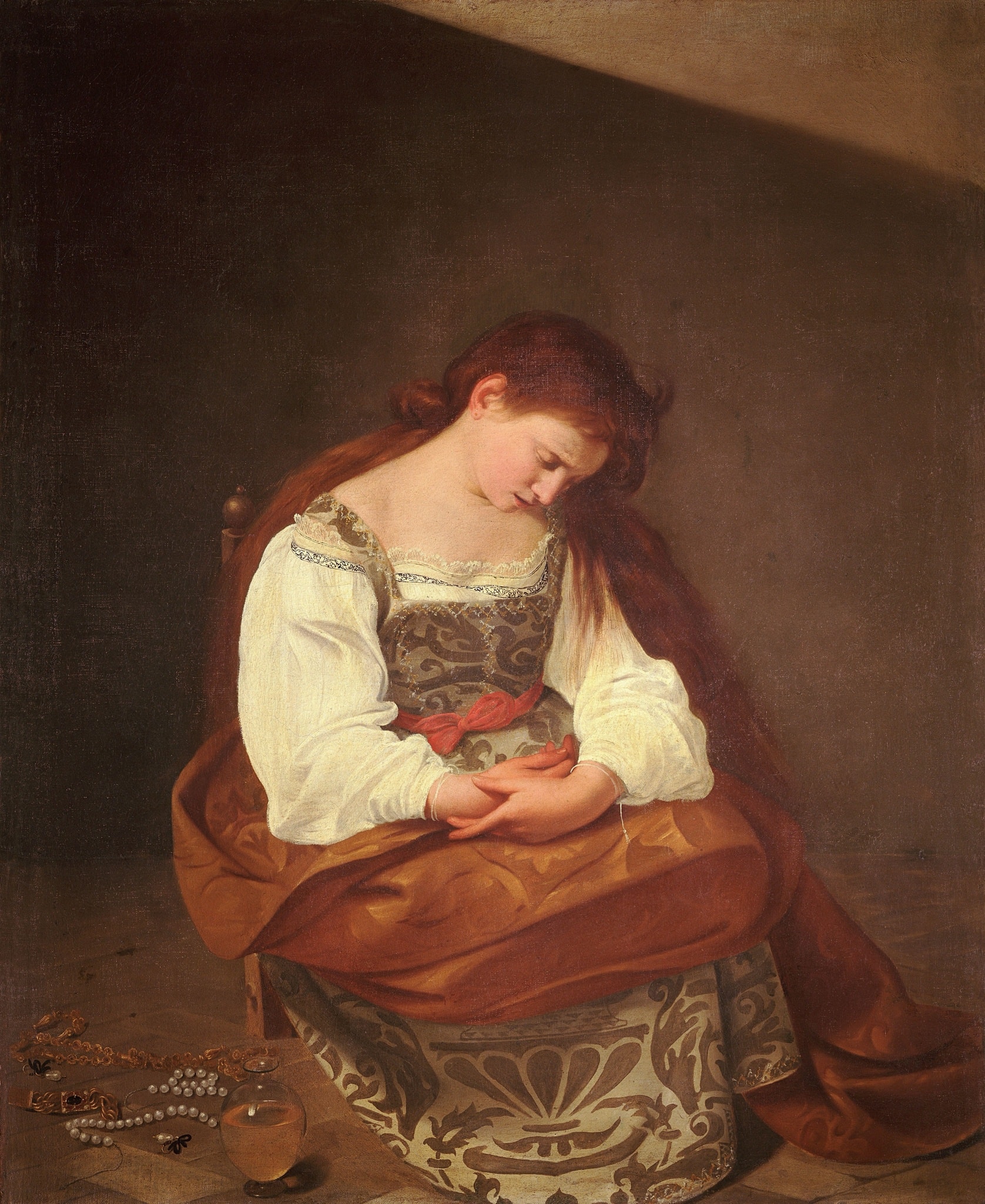
Caravaggio was in his early twenties when he painted this, around 1594–1595, and he left out everything painters usually gave her. There is no halo, no skull, no cave. A girl in a good damask dress sits on a chair so low that she seems to have sunk into it. Her head has dropped to one side. Her hands lie folded in her lap, holding nothing. On the floor beside her are the things she has taken off: a string of pearls, gold chains, earrings, and a stoppered glass jar. High on the wall a band of light slants across the room without touching her. If you look closely, there is a single tear at the side of her nose.
An early biographer grumbled that Caravaggio had simply painted a girl drying her hair, then added a jar and some jewels so that he could call her the Magdalene. That is the picture’s strength. She is not an emblem of sin. She is a tired girl in an ordinary room.
Shame turns the mind into a courtroom. You rehearse your defense in the shower and on the drive to work, drafting the explanation that will finally make everyone understand. This is a painting of someone who has stopped arguing the case. She has not lost it; she is simply too worn out to go on making it.
The LORD is near to the brokenhearted; He saves the contrite in spirit.
Psalm 34:18 (BSB)
Contrite is an old word that means crushed. The psalm does not say that God waits for crushed people to pull themselves together. It says that he is near them. You are allowed to come to prayer without a closing argument.
Visio Divina Prompt: Look at her empty hands. Where are you worn out from proving your worth? Let your own hands rest open for a minute, holding nothing.
A Room with No Audience
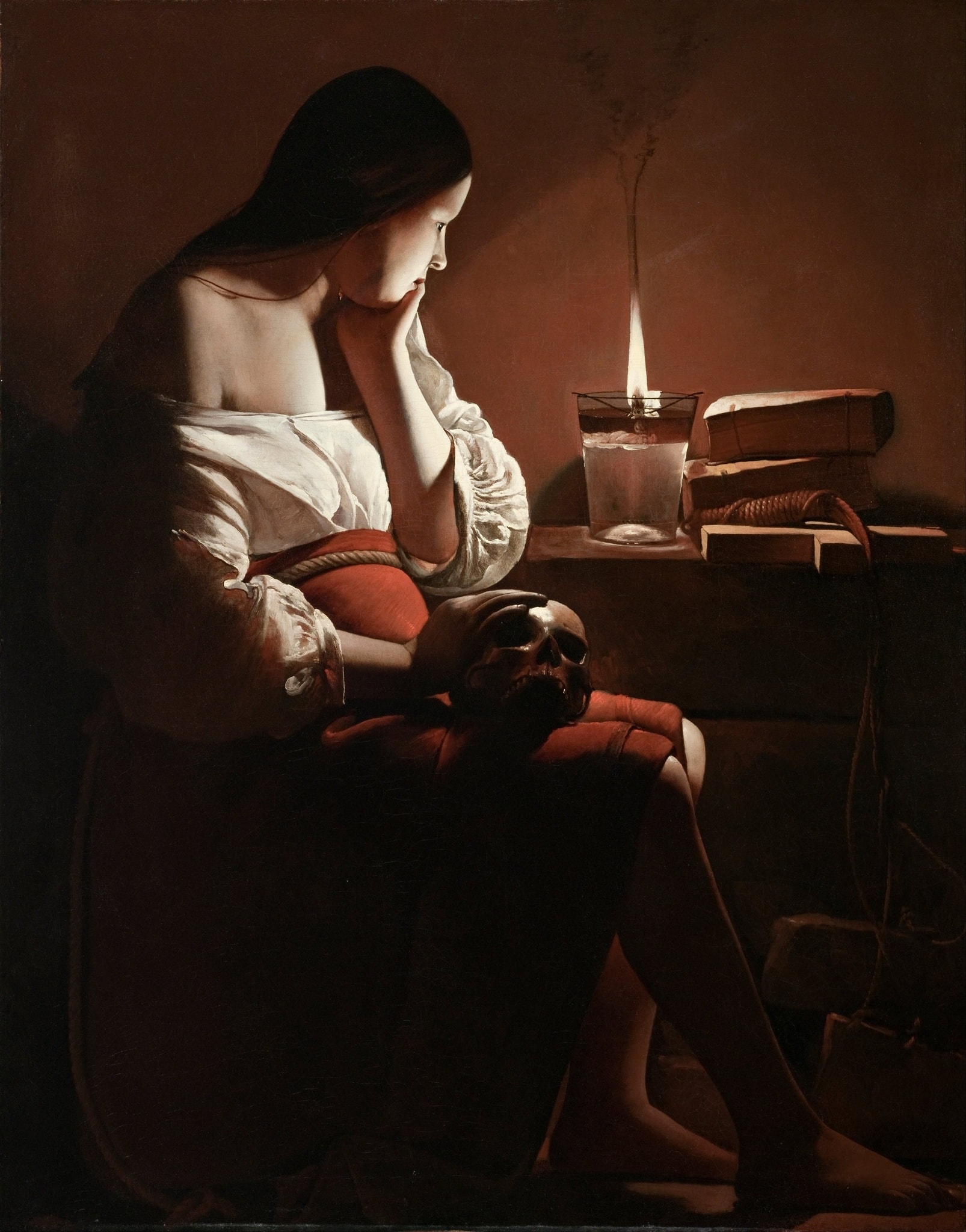
Georges de La Tour painted this in the 1630s, in a France that loved the legend of Mary the hermit. It is night. A young woman sits in profile with her chin in her hand, watching an oil lamp: a wick burning in a glass of oil, with a tall flame and a thread of smoke rising off it into the dark. On the table are two books, a wooden cross, and a knotted rope. In her lap, under her other hand, rests a skull, which in paintings of this period is a plain reminder that life is short.
What is missing from the room is other people. Shame needs an audience, real or imagined, and she has come to a place where there is none. No one here is forming an opinion. The skull makes its blunt point: the people whose judgment frightens you are as temporary as you are. The flame gives her eyes a place to rest.
O LORD, You have searched me and known me.
Psalm 139:1, excerpt (BSB)
To be known completely sounds like a threat until you notice who is doing the knowing. The God of this psalm has already seen all of it—what you did, what was done to you, what was only ever said about you—and has not left the room.
Visio Divina Prompt: Let your eyes rest on the flame and the thin line of smoke. Offer one plain sentence: God, I am tired of explaining myself. Then stay quiet for a little while.
Leaving While the Music Is Still Playing
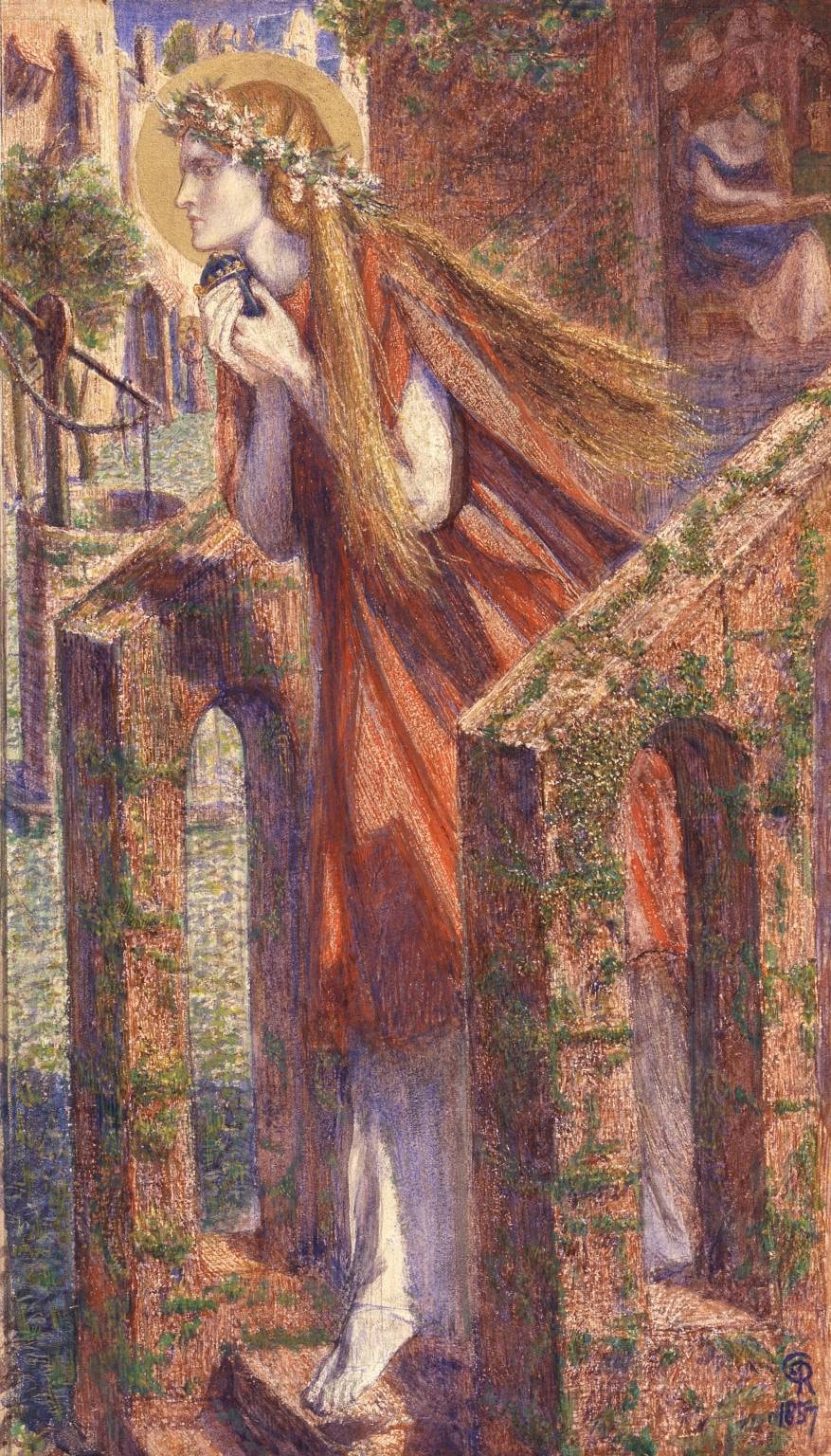
Dante Gabriel Rossetti painted this tall, narrow watercolor in 1857. A woman in a red-orange robe comes down a flight of steps between ivy-covered brick gateposts. She is barefoot. Her hair, improbably long, streams out behind her as if she were moving fast. There are flowers in it, and a gold halo behind them. She holds a small dark jar up close to her face. At the upper right, through an opening in the wall, you can just make out the party she has left, still going on around a musician in blue.
Rossetti draws on the tradition that connected Mary Magdalene with the woman of Luke 7. His picture gives us a woman moving decisively onward, away from the feast behind her, with her ointment jar held close.
Healing from shame is seldom a clean break. More often you have to start walking while the music is still playing and the people inside are still talking about you. You may make the apology, set the boundary, or tell the truth to a friend, and wake the next morning still flushed with embarrassment. That does not mean it failed. The woman in Luke’s story left that dinner with a last word spoken over her, and it was not the host’s:
And Jesus told the woman, “Your faith has saved you; go in peace.”
Luke 7:50 (BSB)
He tells her to go in peace. He does not tell her to go and explain herself.
Visio Divina Prompt: Look at how her hair and robe trail behind her. What is one small, concrete step you could take this week, away from the story that has held you?
Being Seen Again
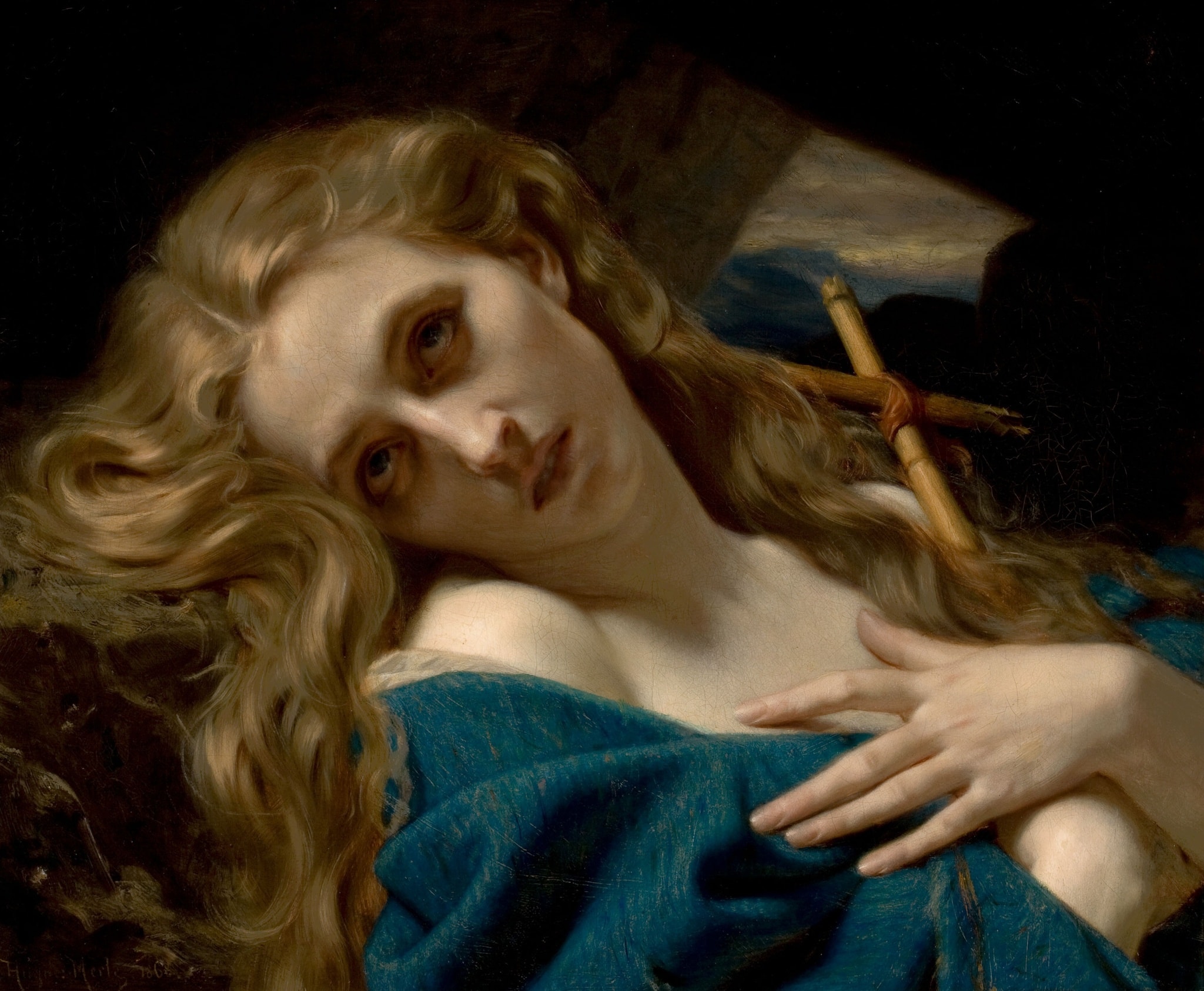
Hugues Merle, in 1868, makes a different kind of encounter possible: he turns her face toward us and brings it close. She is lying in the cave of the legend with her head against the rock and her cheek on her own shoulder. Her hair is loose, a blue wrap is pulled around her, and one hand is spread across her chest. Behind her stands a cross made of two reeds tied with cord, and beyond it a strip of evening sky. Her eyes are red-rimmed and tired, and they are looking straight at you.
She is not performing recovery, and she has not arranged her face. But unlike the women in the preceding paintings, she meets the viewer’s gaze, and we might read that direct look as a quiet image of becoming willing to be seen again. The far side of shame tends to be like this. It is rarely a triumph. It is the quiet return of the ability to meet someone’s eyes. You can acknowledge your past without introducing yourself through it.
Visio Divina Prompt: Meet her gaze and hold it for a few breaths. Then name one good thing in yourself that shame has made hard to see, and give thanks for it.
What the Gospel Calls Her
It is worth ending where the Bible does. On Easter morning, in a garden, the risen Jesus meets this woman, whom history would go on to call so many things. He does not use any of them.
Jesus said to her, “Mary.” She turned and said to Him in Hebrew, “Rabboni!” (which means “Teacher”).
John 20:16 (BSB)
He uses her name, and then he trusts her with the news of the resurrection. The Gospels never describe her by anything she did wrong. When they identify her at all, it is by where she came from and by what Jesus did for her.
If part of what you carry is real—if there is harm you did and need to make right—then make it right. That is the honest work of guilt, and it comes to an end. Shame does not end that way, because it was never about what you did. It is a name someone gave you. You are allowed to answer to a different one.
A 4-Step Visio Divina Practice for Shame
Visio Divina—Latin for “divine seeing”—is a simple way of praying with a picture instead of a passage. Return to the painting that held your attention most strongly, and take a few unhurried minutes with these four steps:
- Look (Visio): Stay with one physical detail—the tipped jar, the pearls on the floor, the small flame, the trailing hair. Describe what is there before you decide what it means.
- Meditate (Meditatio): Name the specific judgment you have been carrying. You do not have to fight it. Let it be in the room with the picture.
- Pray (Oratio): Christ, help me see myself truthfully and with mercy. Give me courage to repair what I can, release the labels that distort my life, and receive the love I cannot earn by explaining myself. Amen.
- Contemplate (Contemplatio): Rest in silence for one minute. You do not need to produce a feeling of peace. Simply keep company with the painting.
Stay with the painting
If you want to sit with one of these images a little longer, you can restore it yourself: open Caravaggio’s Penitent Magdalene as a puzzle, piece by piece, with its verse waiting at the end. Or get the app for a new painting, a new verse, and a new reflection every morning.
Continue the journey
Next in Mary’s story: When You Cannot Take the Pain Away: Mary Magdalene and the Art of Staying. Or return to Mary Magdalene’s life and paintings.