You know the feeling if you have had it. Someone trusts you with something—a promotion, a child, a secret, their love—and instead of joy you feel a cold drop in the stomach. They have made a mistake. If they really knew me, they would pick someone else. People call it imposter syndrome now, and there is a whole shelf of books about it. Peter had it two thousand years before it had a name.
The first time Peter fell at Jesus’ feet, it was to ask him to leave. He had just been handed an overwhelming catch by Jesus, who had borrowed his boat, and his response was not thank you. It was, “Go away from me, Lord, for I am a sinful man” (Luke 5:8).
Before we go further, one distinction, because everything else depends on it. Feeling unworthy is not the same as being guilty. Guilt is about something you did; it has a shape, and it can be confessed and repaired. Luke names no particular wrong that morning, but Peter calls himself sinful and is afraid. His public failure gets its own night later in his life, and its own piece in this series. This one is about the fear that arrives before you have done anything at all.
Four paintings follow that fear from the shore to the supper table: the ordinary boat he was found in, the morning good news felt like a mistake, the fact that the work did not stop, and the night he had to learn to be served. (If this is new to you: Visio Divina, Latin for “divine seeing,” just means praying with a picture instead of a passage. Look first; read second.)
The Boat He Was Found In
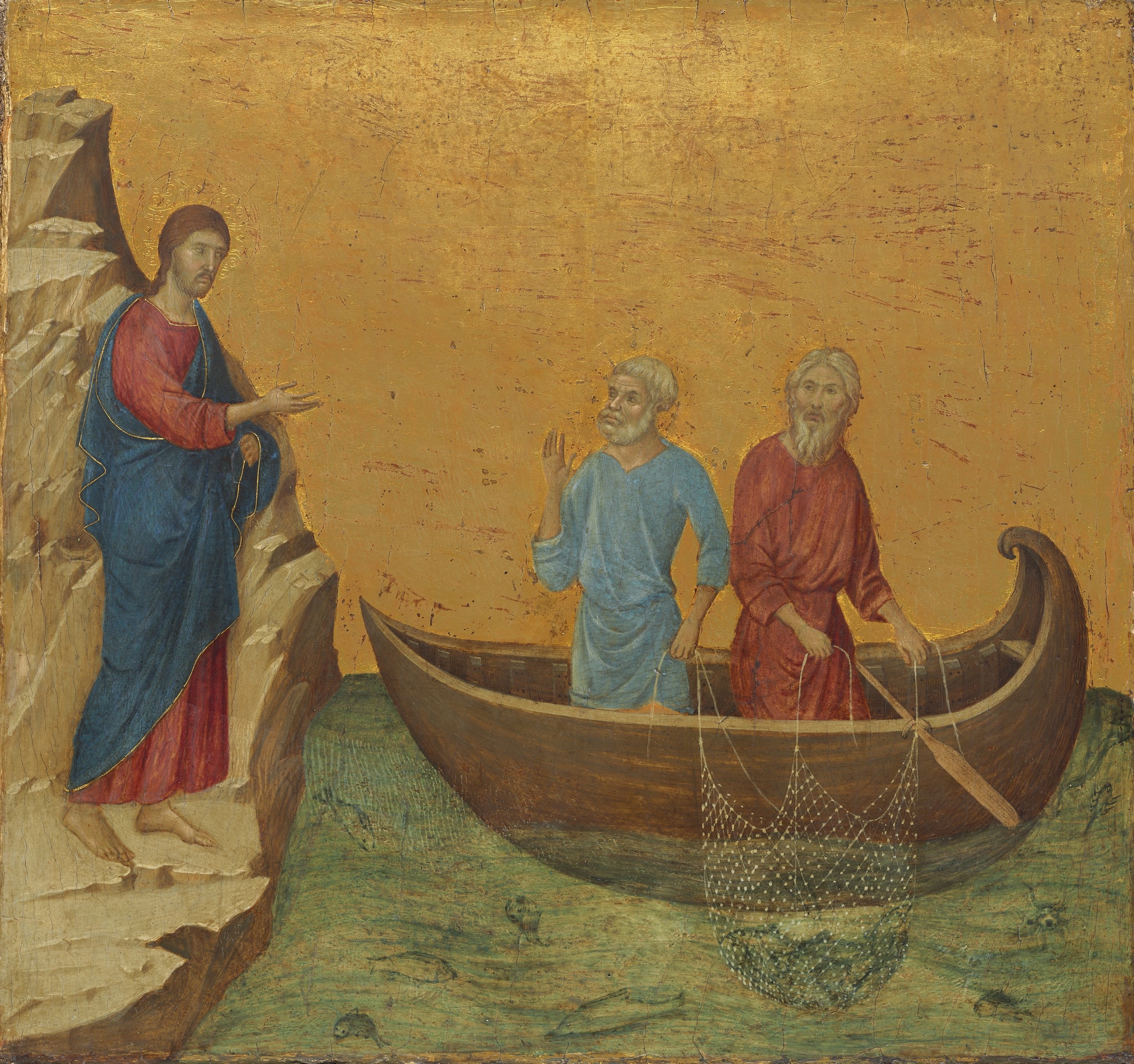
“Come, follow Me,” Jesus said, “and I will make you fishers of men.”
Mark 1:17 · BSB
Peter did not go looking for Jesus. His brother did. John’s Gospel says Andrew heard about Jesus first, and “first found his brother Simon” and brought him along (John 1:40–42). Mark tells it from the shore: Jesus, walking by the lake, sees two brothers casting a net—“for they were fishermen”—and says, “Come, follow Me” (Mark 1:16–17). Peter’s story begins with somebody else’s invitation and a job he already had.
Duccio painted the moment seven hundred years ago against a sky of solid gold. Christ stands on a rocky shore at the left with his hand out. In a small boat, Peter, in blue, raises one hand toward the voice; beside him Andrew, in red, is still hauling a net full of fish, and the green water swims with more. The net is the point. Duccio does not paint an empty man waiting to be filled. He paints two men in the middle of their work.
That is the first thing to know about being chosen: you were found in your actual life, with your nets in your hands. Whoever chose you saw the boat, the tiredness, the ordinary Tuesday—and asked anyway.
Visio Divina Prompt: Look at the net before you look at the gold. What were you in the middle of when the invitation came?
When Good News Feels Like a Mistake
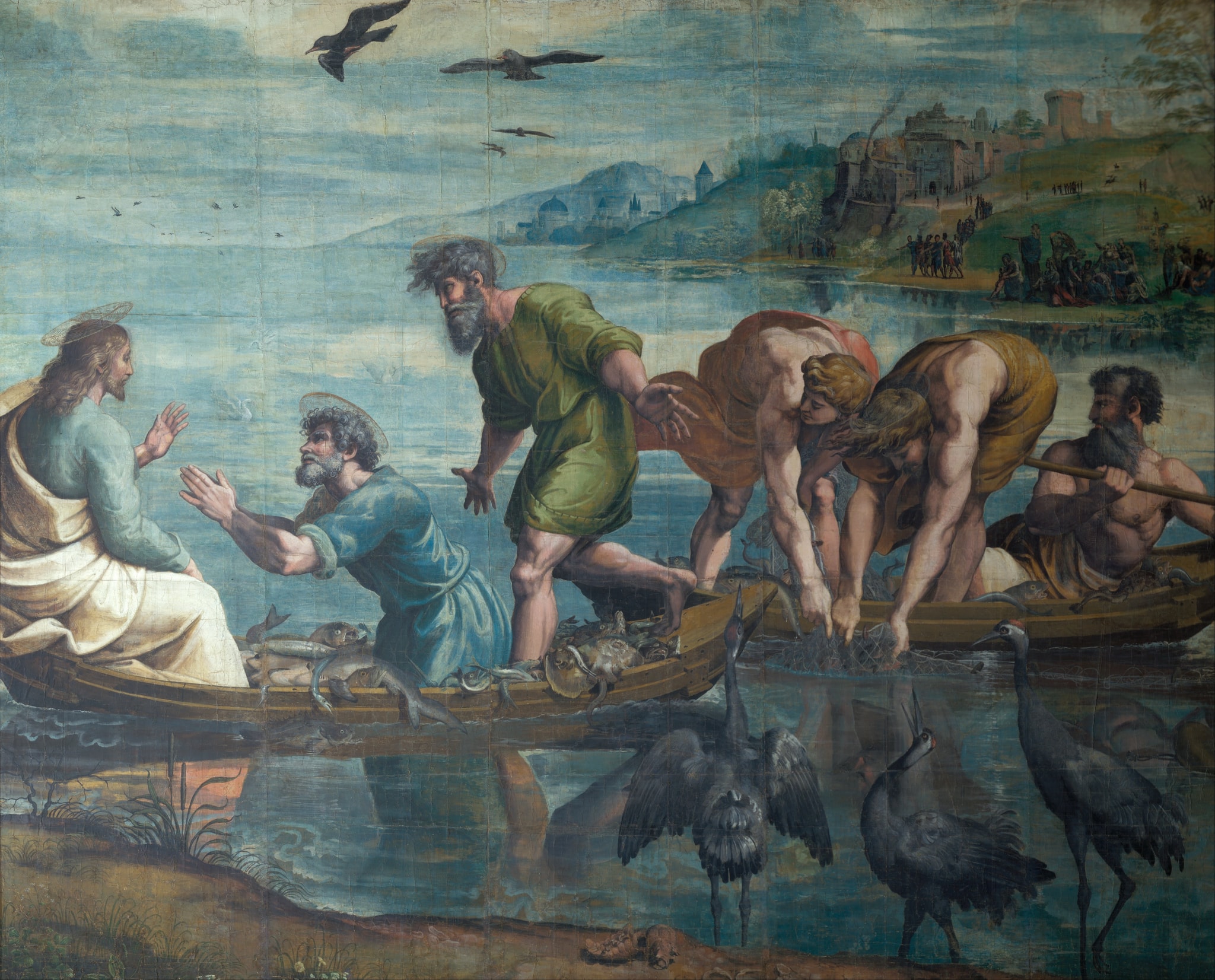
When Simon Peter saw this, he fell at Jesus’ knees. “Go away from me, Lord,” he said, “for I am a sinful man.”
Luke 5:8 · BSB
Why did Peter tell Jesus to go away?
Because the catch showed him something about himself he could not stand next to. Here is the morning as Luke tells it. Peter has fished all night and caught nothing. A teacher borrows his boat to speak to the crowd, then tells him to row out and drop the nets again. Peter’s answer has the tired politeness of a man humoring someone: “Master, we have worked hard all night without catching anything. But because You say so, I will let down the nets” (Luke 5:5). The nets fill until they tear. A second boat is called, and both begin to sink. And at the moment when anyone else would shout for joy, Peter falls at Jesus’ knees and asks him to leave.
He is not confessing a particular sin. He is saying what people say when goodness gets too close: you don’t know who you’re dealing with. It turns out to be the oldest reflex in the Bible. Moses: “Who am I?” (Exodus 3:11). Isaiah: “Woe is me … I am a man of unclean lips” (Isaiah 6:5). Jeremiah: “I am only a child” (Jeremiah 1:6). Gideon: “my clan is the weakest” (Judges 6:15). If your first response to being chosen is to explain why you should not be, you are in very old company.
Now listen to the reply. “Do not be afraid,” Jesus says to Simon. “From now on you will catch men” (Luke 5:10). He does not argue with Peter’s opinion of himself. He does not say you’re not that bad. He answers Peter’s fear and gives him something to do.
Raphael painted this on paper as a full-size design for a tapestry. Peter kneels in a boat riding low with fish, both hands pressed together, his whole body leaning toward the man he is asking to leave. Christ sits at the prow with one hand raised—the do not be afraid hand. Behind Peter, Andrew opens his arms as if the catch, or the moment, is too big to hold.
That is the second thing: do not wait for the feeling of unworthiness to pass before you take the work. Jesus did not wait. He gave Peter the job while Peter was still on his knees telling him to go.
Visio Divina Prompt: Look at Peter’s hands before anything else. Are they praying, or pushing away? Then look at the hand Christ is holding up, and hear the words that go with it.
The Work Does Not Stop
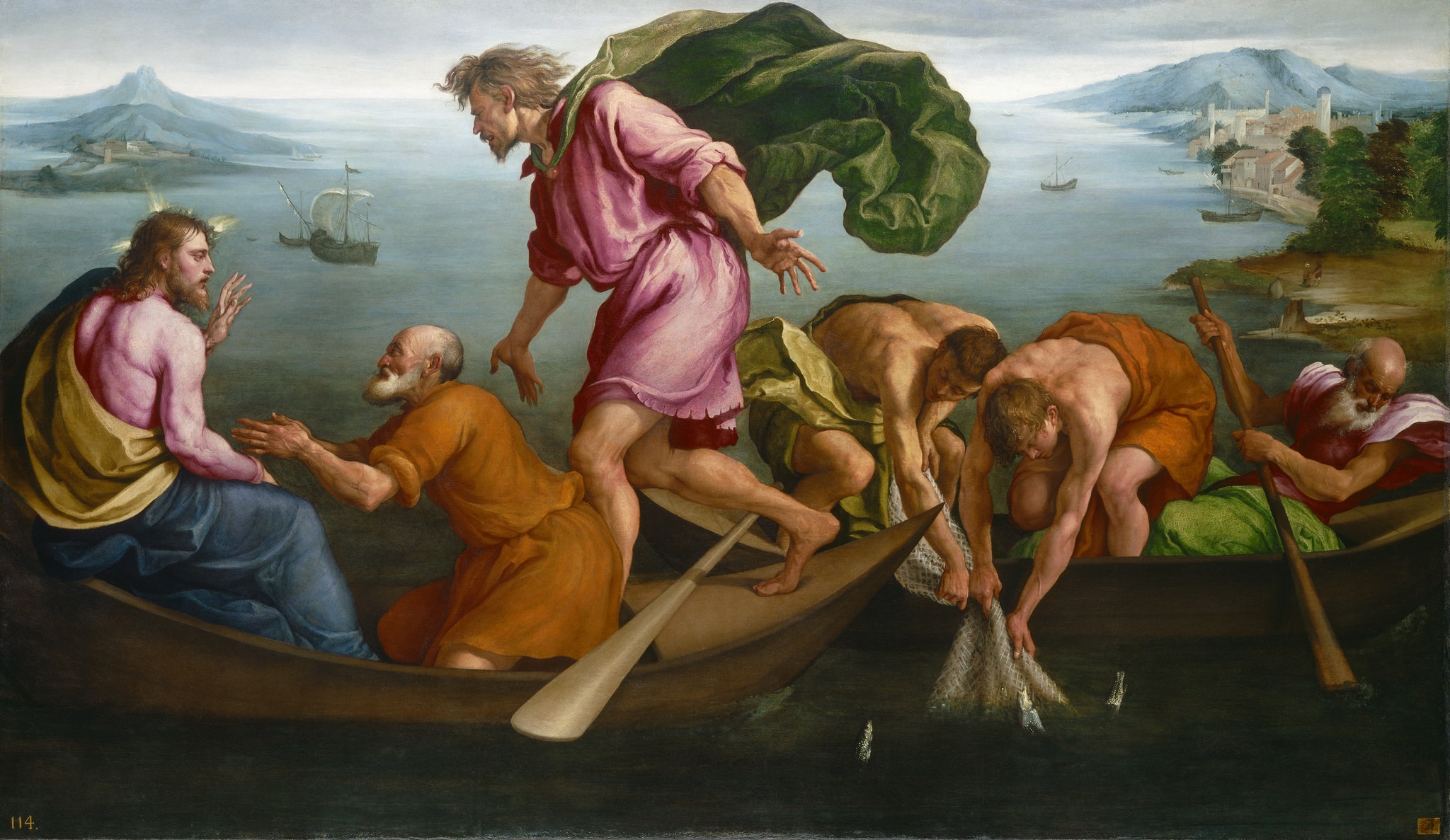
So they signaled to their partners in the other boat to come and help them, and they came and filled both boats so full that they began to sink.
Luke 5:7 · BSB
Bassano painted the same morning thirty years after Raphael and moved the camera. Christ, in rose, sits at the left of the boat; Peter kneels before him in orange, hands out. But the middle of the picture belongs to the labor. Andrew, in pink, his green cloak billowing behind him, strides toward Christ along the same boat; in the far boat, men bend double over a net so heavy it drags. There are ships on the horizon and hills behind them. The men in the far boat keep working. Peter has stopped.
That is the truth the imposter feeling never tells you. It says that people who are really chosen would be calm, composed, ready—that the moment would arrive with a hush. Bassano says the moment arrives in a boat full of flapping fish with somebody stepping over you. The most important conversation of Peter’s life happens while the catch still has to come in.
Notice, too, that he does not do it alone. The nets are too much for one boat, so “they signaled to their partners” (Luke 5:7), and Luke names them: James and John (5:10). Being chosen, in this story, is a crew sport from the first minute.
That is the third thing: let the work go on around you, and let other people haul with you. You do not have to feel ready. You have to be in the boat.
Visio Divina Prompt: Look from Peter’s outstretched hands to the men still pulling at the net. Who is hauling alongside you right now, whether or not you have noticed?
Learning to Be Served
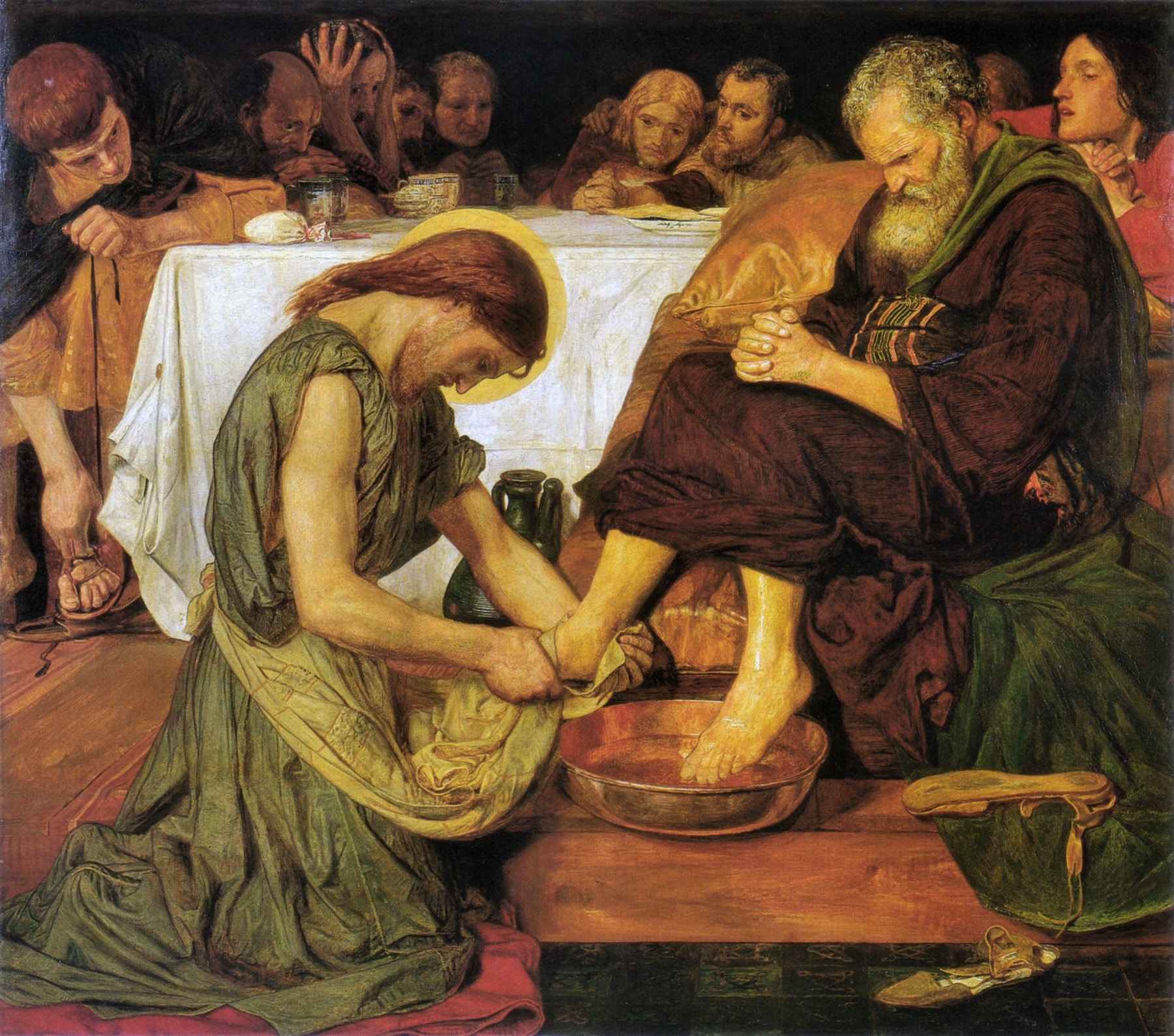
“Never shall You wash my feet!” Peter told Him. Jesus answered, “Unless I wash you, you have no part with Me.”
John 13:8 · BSB
Why didn’t Peter want Jesus to wash his feet?
For the same reason he asked him to leave earlier: he could not bear to be on the receiving end. On the last night before his arrest, Jesus gets up from supper, takes off his outer robe, ties a towel around his waist, and begins washing the disciples’ feet—a servant’s work (John 13:4–5). When he reaches Peter, Peter balks. “Lord, are You going to wash my feet?” Then, flatly: “Never shall You wash my feet!” Jesus answers, “Unless I wash you, you have no part with Me.” And Peter, in one line, swings from refusal to excess: “Then, Lord, not only my feet, but my hands and my head as well!” (John 13:6–9). That is him exactly.
Brown’s painting is the most physical version of this scene anyone has made. Christ kneels in a plain green tunic, drying Peter’s foot with a cloth; the other foot is lowered into a copper basin. Peter sits with his head bowed and his hands clasped tight in his lap, eyes down, every line of his body saying I cannot stand this. Around the table the others watch; one has his head in his hands. Brown first exhibited the painting in 1852, with Christ’s upper body uncovered, and later added the tunic. Even clothed, the point survives: the person Peter has been following is on the floor, holding his foot.
The fear of being chosen has a twin, and this is it: the fear of being served. Both come from the same place—a person who can only imagine being loved as a reward for being good enough. Jesus’ line cuts straight under that. “Unless I wash you, you have no part with Me.” You cannot earn your way into this. You can only let it be done. The letters of the New Testament say the same thing more plainly: “and this not from yourselves; it is the gift of God” (Ephesians 2:8); “We love because He first loved us” (1 John 4:19). Receiving comes before doing. And then, a few verses later, the receiving turns back into a job: “you also should wash one another’s feet” (John 13:14).
That is the fourth thing, and the hardest: let yourself be served. Being on the receiving end is not the humiliation you fear. It is the entrance.
Visio Divina Prompt: Look at Peter’s hands. Are they praying, or holding himself together? Now look at the foot in the basin—the one part of him he has stopped defending.
What to Do When You Are Afraid of Being Chosen
Peter’s calling, read as instructions:
- Remember where you were found. In your actual life, with your nets in your hands. Whoever chose you saw the boat. (Duccio)
- Say “not me” if you must. Moses, Isaiah, Jeremiah, and Gideon all said it first. Then notice that the reply is always the same: do not be afraid, and a job. (Raphael)
- Do not wait to feel worthy before taking the work. Peter got his while he was still on his knees telling Jesus to go.
- Let the work go on around you, and let others haul. Being chosen is a crew sport. You do not have to feel ready; you have to be in the boat. (Bassano)
- Let yourself be served. Receiving is the entrance, not the reward. Put your foot in the basin. (Brown)
- Keep the two feelings apart. Feeling unworthy is not the same as being guilty. When you do fail—and Peter will—that is a different story with a different remedy, and it has its own piece: Saint Peter and What to Do After a Public Moral Failure.
What happened next to the man who was afraid of being chosen? He was afraid of the wind. That is the next piece: Saint Peter and What to Do When You Start to Sink. For the whole of his life in paintings, start at the guide: St. Peter in Art.
A 4-Step Visio Divina Practice for When You Feel Like an Imposter
Return to whichever painting held you longest. Take a few unhurried minutes to move through these four steps:
- Look (Visio): Stay with one physical detail—the net in the water, Peter’s pressed hands, Andrew’s billowing green cloak, the foot in the basin. Describe what is actually there before you decide what it means.
- Meditate (Meditatio): Name the good thing you have been handed that you are secretly afraid was a mistake. Then name what you are afraid they will find out.
- Pray (Oratio): Jesus, Peter asked you to leave and you gave him a job instead. When I am afraid of the good you are giving me, do not go. Tell me not to be afraid, and show me the work. And when you kneel to serve me, help me put my foot in the basin. Amen.
- Contemplate (Contemplatio): Rest in silence for one minute. You are not trying to feel worthy. You are practicing being chosen anyway.
Stay with the painting
If you want to sit with one of these images a little longer, you can restore it yourself. Open Ford Madox Brown’s Jesus Washing Peter’s Feet as a puzzle—piece by piece, with the verse waiting at the end. Or get the app for a new painting, a new verse, and a new reflection every morning.
Continue in the open gallery