There is a kind of failure that is worse than the others: the one people saw. Not the private lapse you can quietly put right, but the thing you did in front of witnesses—a room, a group chat, a courtyard full of strangers. Afterward the failure has two lives. There is the thing itself, and there is the version that now exists in other people’s heads, which you cannot edit. Most advice about forgiving yourself is written for the first. This piece is about the second.
Peter’s failure was public. On the night Jesus was arrested, Peter followed “at a distance” into the high priest’s courtyard and sat down at the fire with the servants and guards (Luke 22:54–55). A servant girl looked at him in the firelight: “This man also was with Him.” “Woman, I do not know Him” (Luke 22:56–57). It happened twice more, with others listening—and the last person to challenge him was a relative of the man whose ear Peter had cut off a few hours earlier (John 18:26). Then a rooster crowed. And Luke, alone among the four Gospel writers, adds one sentence: “the Lord turned and looked at Peter” (Luke 22:61).
Painters have gone back to that courtyard for four hundred years, because everyone has stood in it. The six paintings below do not tell you to forgive yourself. They walk through what actually happens after a failure people saw—the promise you meant, the moment itself, the light you cannot get out of, the world that does not stop, the distance that opens—and then the tears, and what is already happening behind them. (If this is new to you: Visio Divina, Latin for “divine seeing,” just means praying with a picture instead of a passage. Look first; read second.)
One more thing before we start, because it changes how the whole night reads. Jesus prayed for Peter’s comeback before Peter had even failed.
The Promise You Meant
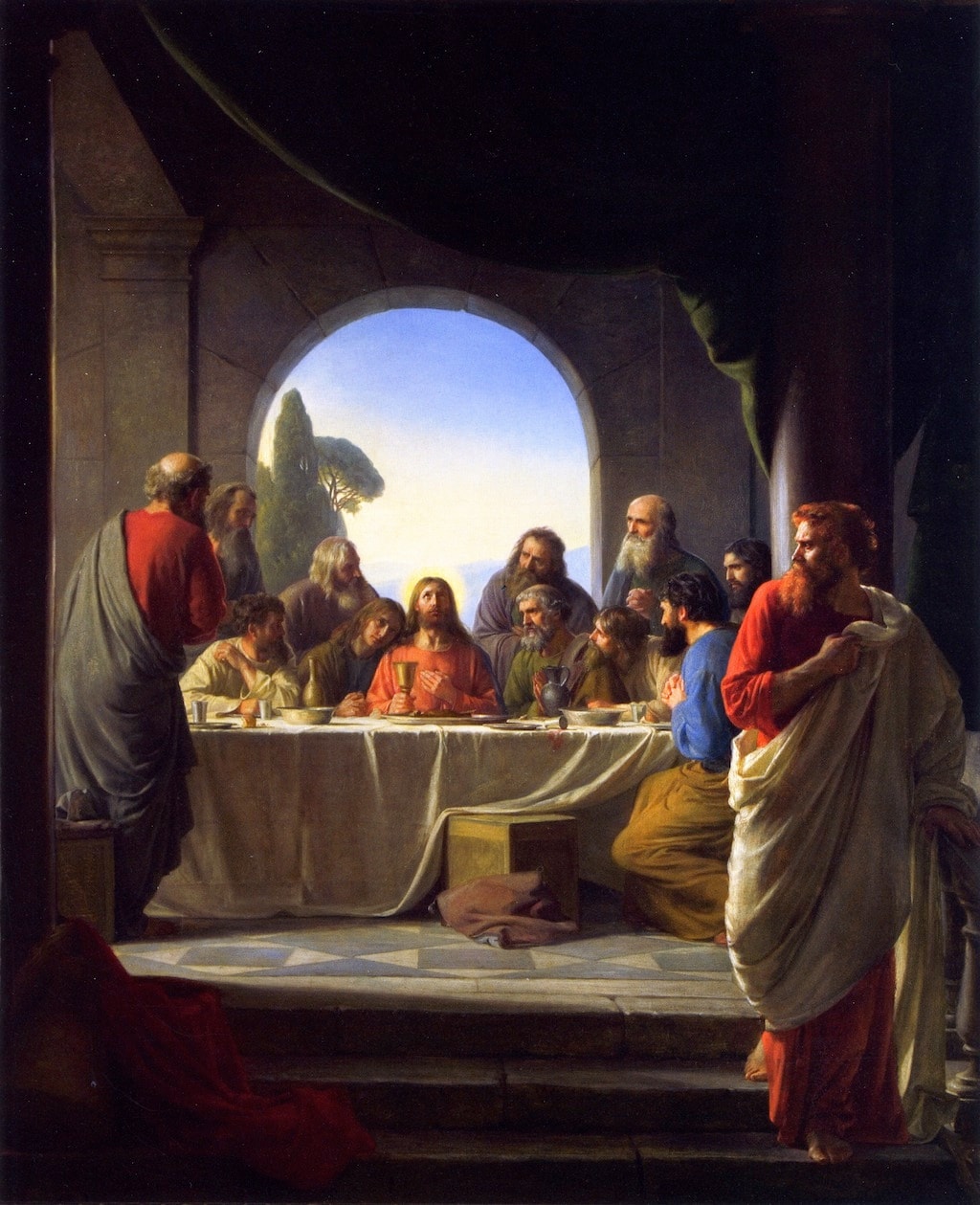
Simon, Simon, Satan has asked to sift all of you like wheat. But I have prayed for you, Simon, that your faith will not fail. And when you have turned back, strengthen your brothers.
Luke 22:31–32 · BSB
At the last meal before his arrest, Jesus turns to Peter and says the sentence above. Read it slowly. Not if you turn back. When. The failure and the return are both inside the same sentence, and the return already has a job attached to it.
Peter answers the way any of us would: “Lord, I am ready to go with You even to prison and to death” (Luke 22:33). He means it. That is the hard thing about promises—sincerity is completely real, and it still cannot predict what you will do when a servant girl looks at you across a fire. Jesus answers him with the rooster: before it crows, you will deny me three times.
Bloch painted the room warm and close. An arched window is going gold behind Jesus; the disciples gather close around the table; one man in red is already walking out of the picture into the dark. Read beside Peter’s promise, the crowded room makes the courtyard that is coming feel lonelier. A few hours later he will deny Jesus among strangers.
Visio Divina Prompt: Find the man leaving. Then find the ones staying. Remember a promise you meant with your whole chest, and ask what—besides sincerity—might have helped you keep it.
What Failure Actually Looks Like
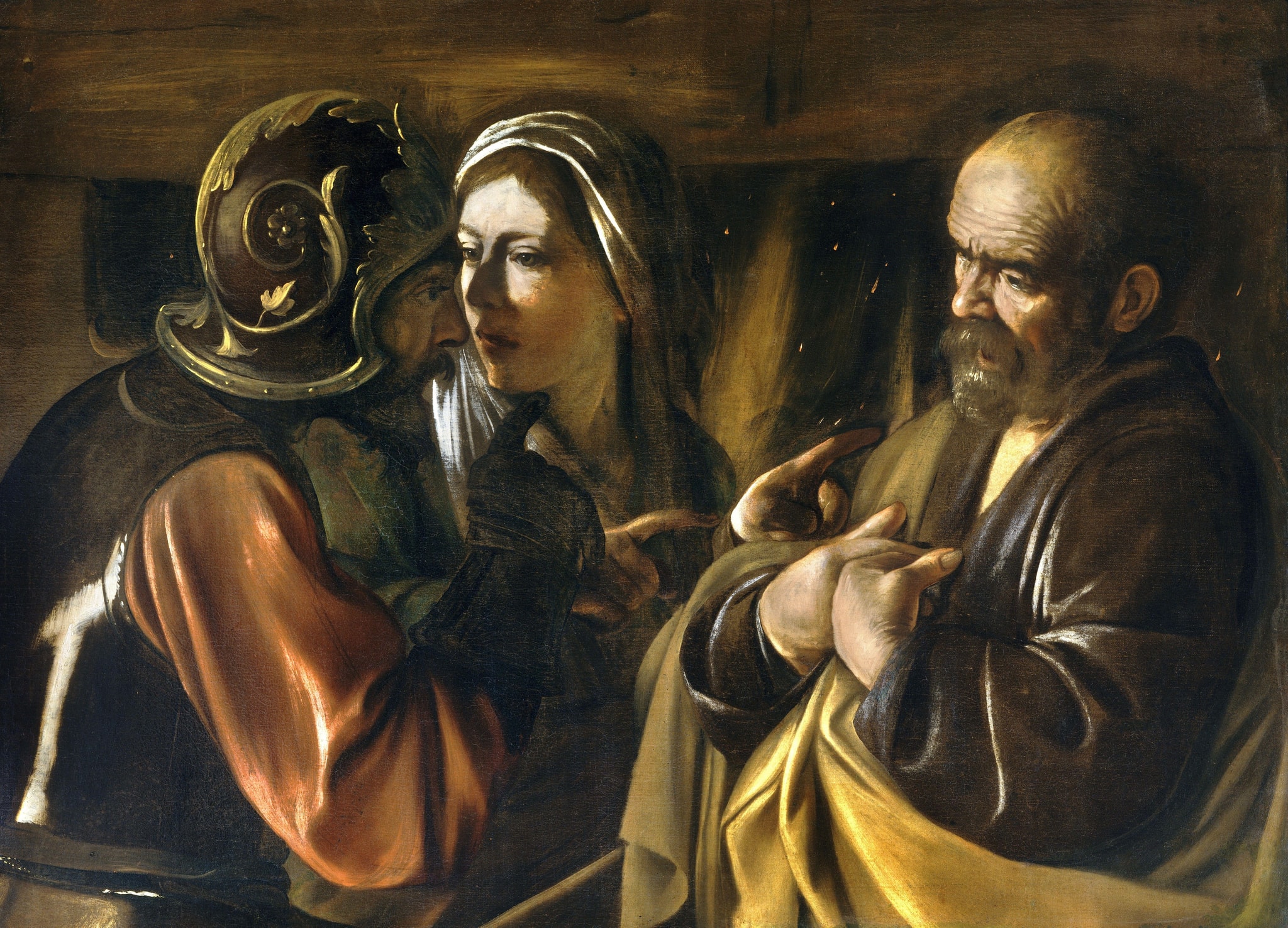
But Peter denied it. “Woman, I do not know Him,” he said.
Luke 22:57 · BSB
What do the three fingers in Caravaggio’s painting mean?
The Metropolitan Museum in New York, which owns the painting, counts three accusing fingers pointing at Peter—one for each of his three denials. That is the whole story, told by hands. Caravaggio narrows the courtyard to three figures in the dark, with a few sparks rising from a fire behind them. He painted it in the last months of his life. A soldier leans in under his helmet. The servant girl’s face is half-lit. And Peter’s own hands have turned back toward his chest, as if the question were absurd. Who, me?
This is what failure looks like from the inside: small, fast, and physical. Not a villain’s decision but a frightened man’s reflex, over in the time it takes to say five words. Caravaggio will not let you watch from a safe distance. You are standing exactly where a third accuser would stand.
So the first thing to do after a public failure is what this painting does: look at the specific act without dressing it up or blowing it up. Peter did not “betray everything he believed in.” He said, three times, that he did not know a man he loved. Name the actual thing. A specific wrong can be confessed and repaired. A verdict on your whole existence cannot.
How many times did Peter deny Jesus?
Three times, in a single night, and all four Gospels agree on the number. They differ in the details. Both Matthew and Mark say that by the third denial Peter “began to curse and swear” (Matthew 26:74; Mark 14:71); Mark alone remembers the rooster crowing twice (Mark 14:72). An early Christian tradition connects Mark’s Gospel with Peter’s own preaching. If so, Peter’s failure was not something the tradition around him tried to hide.
Visio Divina Prompt: Count the pointing fingers. Then look where Peter’s fingers point, and say out loud, in one plain sentence, the specific thing you did.
The Light You Cannot Get Out Of
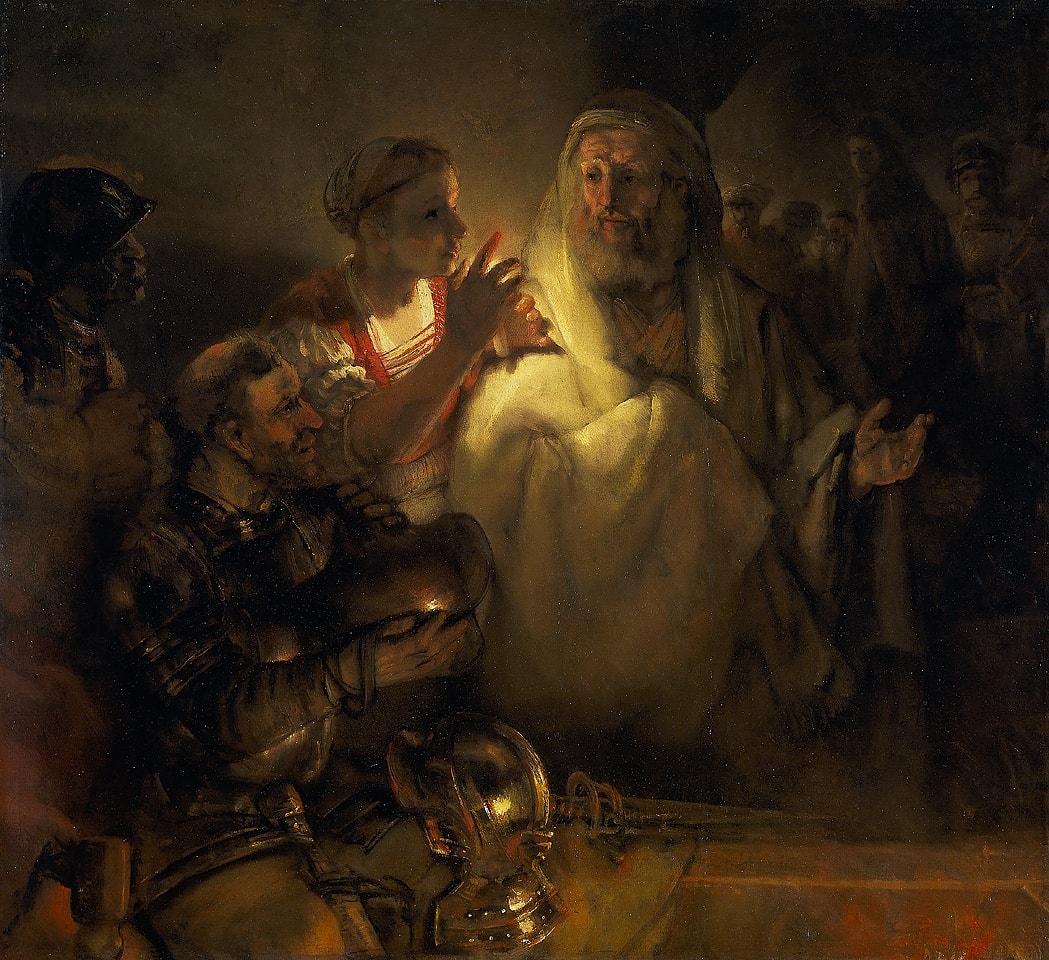
So they asked him, “Aren’t you also one of His disciples?” He denied it and said, “I am not.”
John 18:25 · BSB
Did Jesus see Peter deny him?
According to Luke, yes. As the rooster crowed, “the Lord turned and looked at Peter” (Luke 22:61). Luke is the only Gospel that records the look. Matthew and Mark go on to Peter’s tears; John ends the scene with the rooster. Rembrandt painted Luke’s version.
A servant girl holds a candle up to Peter’s face and shields the flame with her hand, so that the candle catches Peter’s white robe, her own face, and the armor of the men around him. Two soldiers in armor crowd in from the left. Peter, large and white-robed, has raised one hand as if to slow everything down. And far in the back, small and brown, Jesus is being led away—and has turned his head.
Being seen is the one thing Peter wants to avoid, and Rembrandt has built the whole painting out of seeing. This is where a bad reading can do real harm, so let’s rule it out plainly: the candle is not an interrogation lamp, and the figure in the background is not a God who waits for people to fail so he can watch. Peter’s problem was never that he was imperfect or frightened. Everyone in that courtyard was frightened. His problem was a specific denial of a specific relationship.
What the light does is tell the truth. And in Luke’s telling, the look is what breaks Peter open and sends him outside to weep—which is to say, it is the beginning of his return, not the end of him. After a public failure, the instinct is to get out of every light there is. The second thing to do is the opposite: let one trustworthy person see the actual you. Not the audience. One person.
Visio Divina Prompt: Notice what the candle shows and what it leaves in the dark. Ask for enough honesty to be seen, and enough mercy not to mistake being seen for being condemned.
While Everyone Else Plays Dice
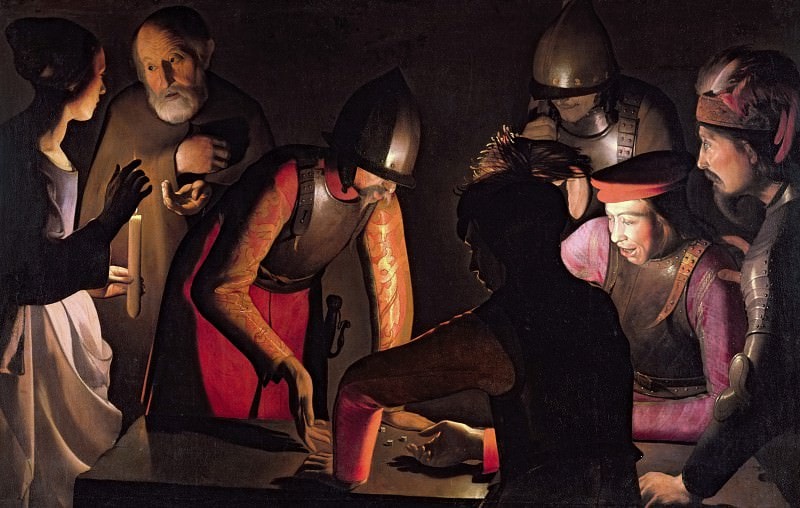
Because it was cold, the servants and officers were standing around a charcoal fire they had made to keep warm. And Peter was also standing with them, warming himself.
John 18:18 · BSB
Most of La Tour’s painting is not about Peter at all. Five soldiers fill the canvas, bent over a game of dice at a table, their faces lit from below; one has his back to us entirely. The denial happens at the far left edge, in a strip of the picture you could cover with your hand: a servant girl with a candle, and an old man with his palm turned up. Who, me?
Dated 1650, it is one of La Tour’s last works, and it may be the most honest picture of a public failure ever painted, because it gets the audience right. The moment that will define Peter’s life is, for everyone else in the room, background noise. The soldiers do not look up.
That is painful, and it is also a mercy. After a failure people saw, the mind builds a stadium: everyone is watching, everyone remembers, everyone is talking about it. La Tour says: they are playing dice. The third thing to do is let the world’s indifference work for you instead of against you. Most of the people whose opinion you dread are not thinking about you at all. The few who are, are the ones worth going back to.
Visio Divina Prompt: Let your eye go where the painter sends it first—the game—and only then find Peter. Ask who is actually watching you, and who only feels like they are.
The Distance That Opens
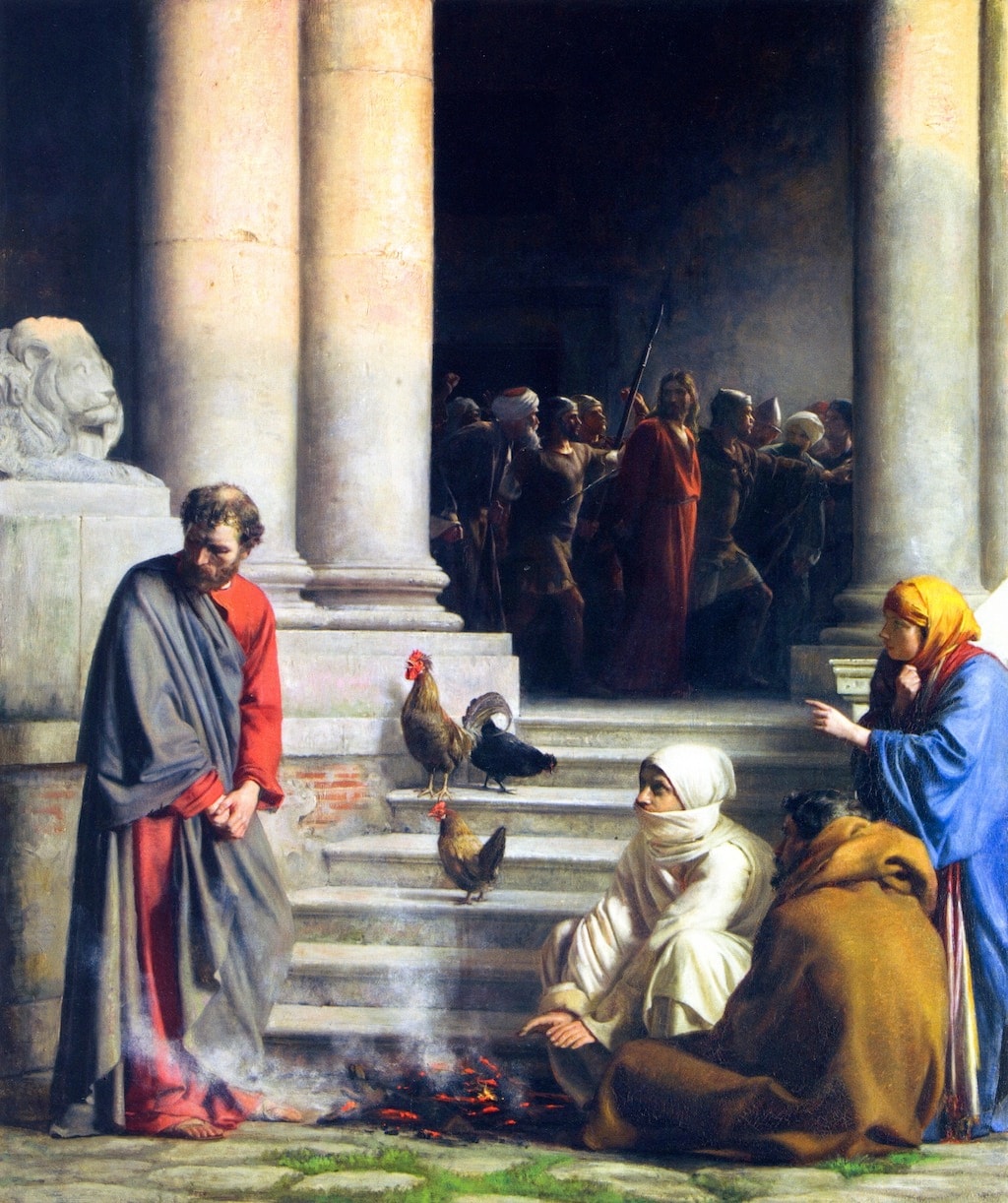
Then they seized Jesus, led Him away, and took Him into the house of the high priest. And Peter followed at a distance.
Luke 22:54 · BSB
Bloch paints the end of the night as a matter of space. Peter stands at the front left, a grey cloak pulled over his red robe, head down, hands held together low, sandaled feet beside a small fire of glowing embers and low flames. On the steps behind him, a rooster and two hens. A woman in a gold headscarf points at him; a servant in a white head-wrap looks up at his face. And through the columns, in the middle distance, Jesus stands in red among the soldiers who are leading him away—still visible, still in the picture.
“Peter followed at a distance,” Luke says on the way into the courtyard. Bloch shows what that distance has become by the end. Shame does this: it narrows the field of vision until the only thing left in it is your own failure. You stop seeing the person you failed as a person and see them only as the measure of your disgrace.
The painting refuses to let that happen. However far Peter turns away, the composition keeps Jesus in the frame. The fourth thing to do after a public failure is to keep the person you failed in the frame too—not as a judge, but as someone who is still there, and who may be more reachable than your shame is telling you. Where repair is possible, go toward it, not away from it.
Visio Divina Prompt: Let your eye travel from Peter, through the columns, to Jesus. Where has shame narrowed your attention until only your own failure was visible?
The Tears—and What Is Behind Them
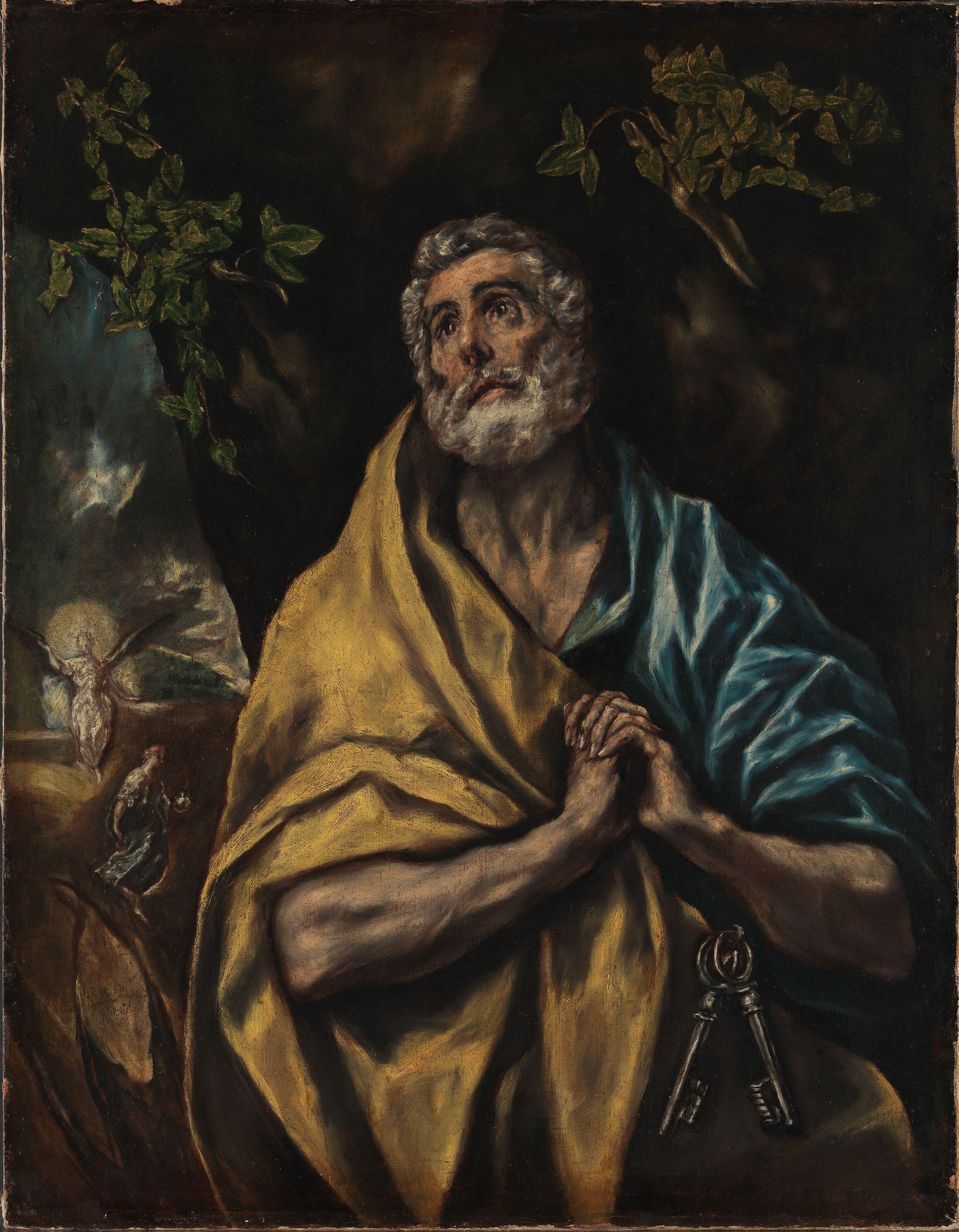
And he went outside and wept bitterly.
Luke 22:62 · BSB
The Gospels give the remorse one line. El Greco gave it much of his career; he painted this subject again and again. Peter alone, older, his hands knotted so hard the knuckles show, his eyes turned up and wet. Two keys hang below his clasped hands. Still his.
Now look past him, small, in the lower left. A luminous angel, wings spread, appears behind a woman carrying a jar, who is walking away from the tomb. That is Mary Magdalene on Easter morning, carrying the news that will end Peter’s night. El Greco has painted forgiveness already on its way, behind the back of a man who does not yet know it is coming.
The Bible does the same thing. When the women reach the tomb, the angel gives them a message with exactly one name in it: “go, tell His disciples and Peter” (Mark 16:7). And Peter. The man who failed in public is the only disciple named in the Easter announcement. By that evening the others are saying to one another, “The Lord has indeed risen and has appeared to Simon!” (Luke 24:34). What was said in that meeting, nobody wrote down.
Remorse is right. Peter should weep. But there is a difference between remorse and making shame your permanent address, and El Greco’s background is that difference. In this way of seeing, forgiving yourself does not mean deciding it didn’t matter. It means giving up the belief that endless self-punishment is the only honest response, and letting the tears move toward the person who is, it turns out, already walking toward you. Confession, repair where repair is possible, and a changed life give remorse somewhere to go.
Visio Divina Prompt: Look at Peter’s face until you have really seen it. Then find the woman with the jar. Hold both at once.
→ Meet the woman with the jar: Mary Magdalene in Art
What to Do After a Public Moral Failure
Peter’s night, read as instructions:
- Look at the specific thing. Not “I’m a fraud,” but “I said I did not know him.” A specific wrong can be confessed and repaired; a verdict on yourself cannot. (Caravaggio)
- Let one person see you. Not the audience. One trustworthy person, in the light. (Rembrandt)
- Let the world’s indifference help. Most people are playing dice. The few who are watching are the ones worth going back to. (La Tour)
- Keep the person you failed in the frame. Where repair is possible, go toward it. (Bloch)
- Do not leave the story. By Sunday morning Peter is running to the tomb before he understands anything (Luke 24:12). You do not have to turn remorse into confidence before you go back. You can begin with the wish to return.
- Let the tears move. Toward relationship, not into a permanent address. (El Greco) What happened when Peter got there—three questions on a beach, and a job—is the next piece: Saint Peter and What to Do With a Second Chance.
A 4-Step Visio Divina Practice for the Morning After
Return to whichever painting held you longest. Take a few unhurried minutes to move through these four steps:
- Look (Visio): Stay with one physical detail—the shielded candle, the dice on the table, the keys on their cord. Describe what is actually there before you decide what it means.
- Meditate (Meditatio): Name the specific thing, in one sentence, with no adjectives. Notice who actually saw it, and who you only feel saw it.
- Pray (Oratio): Jesus, you prayed for Peter before he failed, and I believe you have prayed for me. Give me the honesty to name what I did, the courage to be seen by one person, and the patience to make the repairs that are mine to make. Amen.
- Contemplate (Contemplatio): Rest in silence for one minute. You are not trying to produce a feeling. You are letting the one who turned and looked at Peter look at you. Luke does not say what was in that look; the rest of the story does.
Stay with the painting
If you want to sit with one of these images a little longer, you can restore it yourself. Open Bloch’s Peter’s Denial as a puzzle—piece by piece, with the verse waiting at the end. Or get the app for a new painting, a new verse, and a new reflection every morning.
Continue in the open gallery