It usually does not happen at the start. At the start you had the nerve: you took the job, said yes to the baby, made the move, opened the business, made the promise. The sinking comes in the middle, when you are already out of the boat and too far from it to climb back, and you notice, for the first time, the wind. Most of what you were told about being strong assumes you can keep walking. This story is about the moment you cannot.
Sinking is not the same as failing. Failing is something you did. Sinking is something happening to you—the ground you were counting on turning out to be water. The two feel similar from the inside, and the Bible is careful to keep them apart. Peter’s failure gets its own night, later. This is a different night.
Here is what happened. The disciples are in a boat, far from land, fighting a headwind in the dark (Matthew 14:24). Sometime before dawn they see a figure walking toward them across the water and scream that it is a ghost. A voice answers: “Take courage! It is I. Do not be afraid” (14:27). Peter—of course it is Peter—calls back: “Lord, if it is You, command me to come to You on the water.” One word: “Come.” Peter climbs out of the boat, walks on the water, and comes toward Jesus. Then he sees the strength of the wind, is afraid, and begins to go under. “Lord, save me!” (14:28–30).
Now the detail to hold on to, because it changes everything. Jesus grabbed Peter before the wind stopped. Read the verses in order: the hand comes in verse 31, and the weather changes in verse 32, after the two of them are back in the boat. Peter was not rescued because he calmed down. He was rescued because he shouted. The four paintings below move from an earlier storm to Peter’s rescue: the frightened crew, the moment help looked like a ghost, the grip, and the boat waiting nearby. (If this is new to you: Visio Divina, Latin for “divine seeing,” just means praying with a picture instead of a passage. Look first; read second.)
The Boat You Were Already In
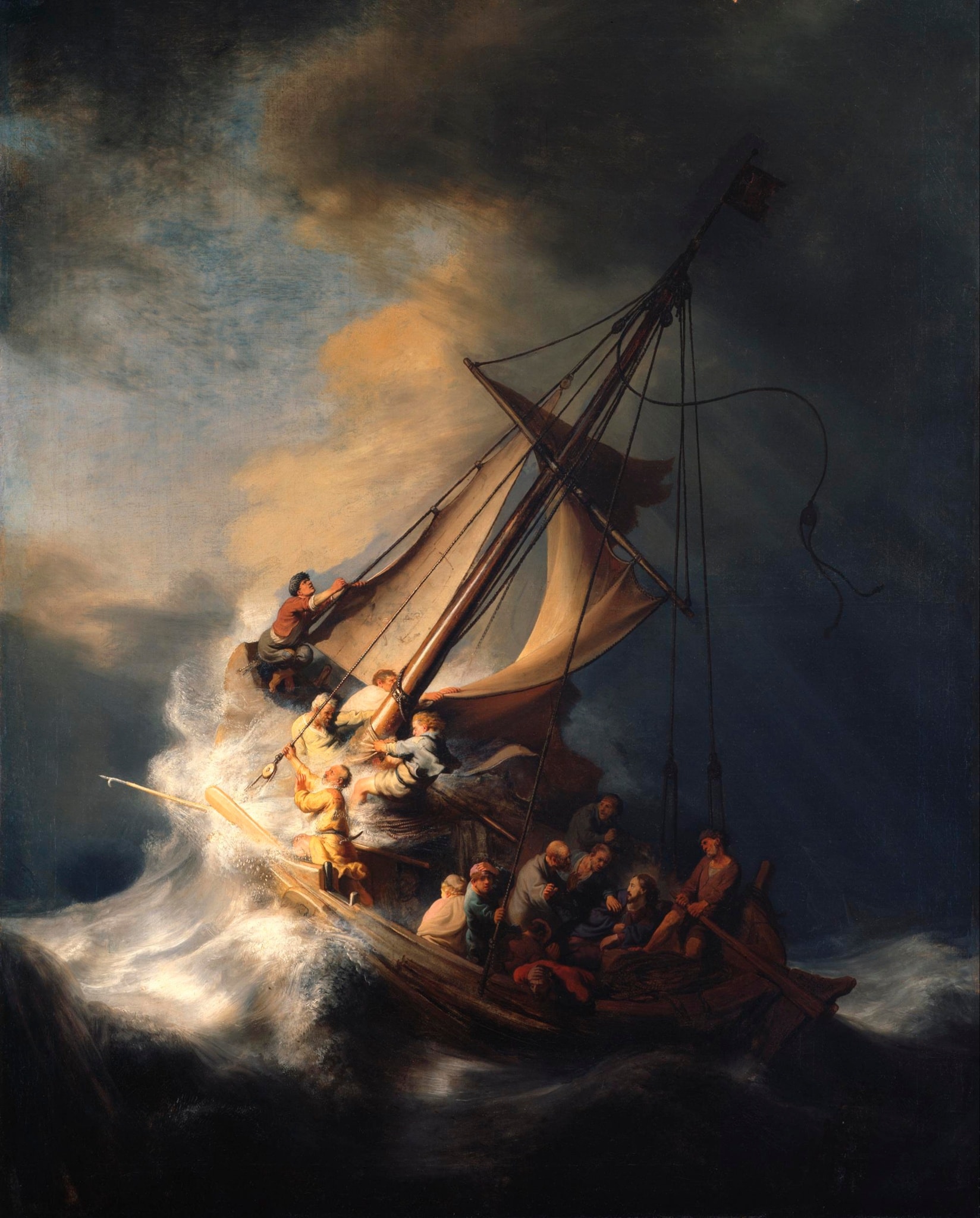
But Jesus was in the stern, sleeping on the cushion. So they woke Him and said, “Teacher, don’t You care that we are perishing?”
Mark 4:38 · BSB
Is Rembrandt’s Storm on the Sea of Galilee the walking-on-water story?
No. It shows an earlier storm, the one in Mark 4. In that story Jesus is already in the boat, asleep on a cushion in the stern, and the disciples have to wake him; Rembrandt paints the moment just after they have. The two stories are easy to confuse because both happen at night on the same lake with the same frightened crew. But they teach different things, and it helps to start here, because before Peter ever steps out of a boat he has already learned what it is to be terrified inside one.
Rembrandt painted it in 1633, when he was twenty-seven; it is his only seascape. The boat is pitched up the face of a wave, the sail torn loose, men hauling on lines at the bow while spray breaks over them. One man leans over the side, sick. In the stern the disciples crowd around Jesus, who is already awake and looking up at them. And in the middle of the boat one man, holding on to his cap, looks straight out of the picture at you—he is often identified as Rembrandt himself. The painting was stolen from the Isabella Stewart Gardner Museum in Boston in 1990 and has never been found; the museum still hangs its empty frame.
Look at what the disciples actually say when they wake him. Not please help. “Don’t You care that we are perishing?” It is an accusation. It is also, in the story, a prayer—and it is answered. The first thing to do when you start to sink is the thing they did: wake him up, and say the true thing, even if the true thing is rude.
Visio Divina Prompt: Find the man looking at you. Then find Jesus, awake among the frightened men. Say, in your own words, the sentence you have been too polite to pray.
When Help Looks Like a Ghost
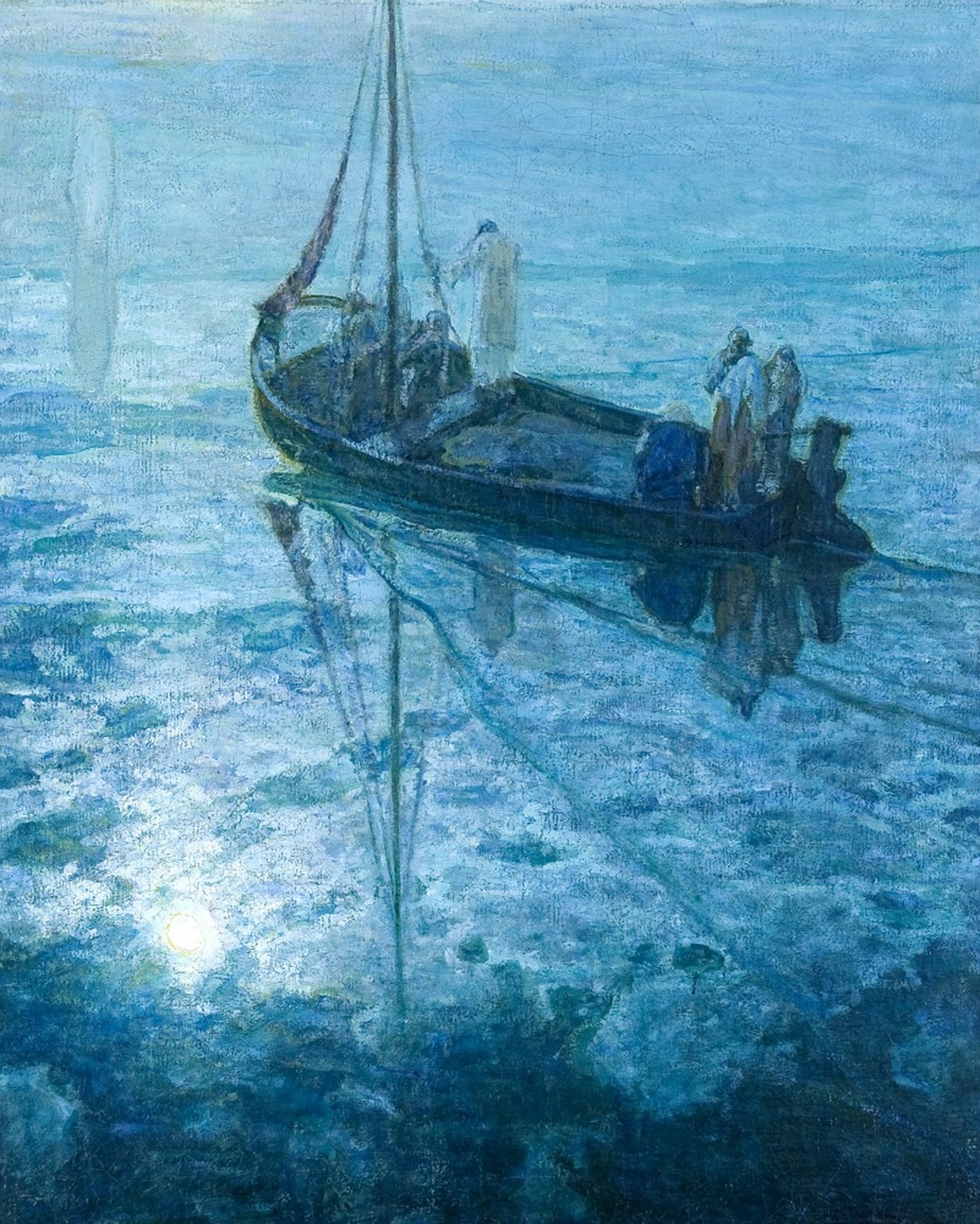
When the disciples saw Him walking on the sea, they were terrified. “It’s a ghost!” they said, and cried out in fear.
Matthew 14:26 · BSB
Blue fills Tanner’s painting. A long, dark boat carries disciples in pale and shadowed robes; the water is a field of moonlit ripples; and at the far left edge, hardly more than a pale vertical brightness, someone is standing on the sea. You could miss him. The disciples nearly did.
Their first reaction to Jesus was terror. That is worth sitting with. Help came across the very thing they were afraid of, and from a distance it looked like more of it. Tanner—an American painter who moved to Paris in 1891 and made the Bible his subject for the rest of his life—understood that recognition is slow. He lets the miracle emerge slowly, before the scene becomes easy to read.
When you are in over your head, the help that arrives rarely looks like help. It looks like an interruption, a stranger, a conversation you did not want, one more thing coming at you across the dark. The second thing to do is to give it a moment before you scream. “Take courage! It is I. Do not be afraid” (Matthew 14:27) was said to people who had just called him a ghost.
Visio Divina Prompt: Look at the boat first. Then let your eye drift left until you find the figure. How long did it take? What has been standing at the edge of your own situation that you have not yet looked at directly?
The Grip
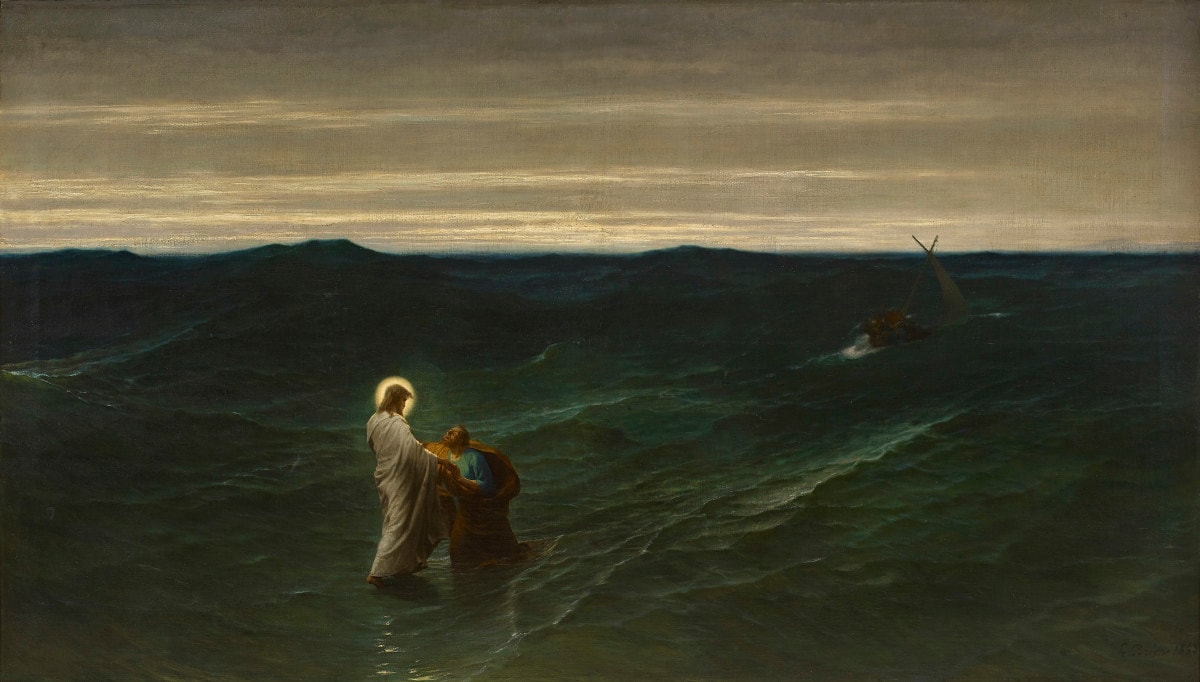
Immediately Jesus reached out His hand and took hold of Peter. “You of little faith,” He said, “why did you doubt?”
Matthew 14:31 · BSB
Why did Peter sink?
Matthew gives the reason in one clause: “when he saw the strength of the wind, he was afraid” (Matthew 14:30). The water did not change. Peter’s attention did. He was walking toward a person, and then he was looking at the weather, and the weather is always bigger than you. Most people who have been in over their head recognize the sequence: you were managing, and then you looked at the whole of it.
Brion’s painting is almost all sea. Dark green swells fill the canvas under a thin band of grey-gold sky; the boat is a small shape far off to the right, its mast tilted. Down in the left foreground, nearly lost in the swell, Jesus in white is holding Peter up. That is the whole event. Not a triumph, not a walk—a grip.
What did Jesus say to Peter when he sank?
“You of little faith, why did you doubt?”—and he said it while holding him up. Read the order again: the hand first, the question second. “You of little faith” sounds like a scolding until you notice where else Jesus uses it. In Matthew it is the phrase he uses for people who worry about what they will wear (Matthew 6:30) and for the same disciples in the earlier storm (8:26). It is not a word for enemies. It is the word he keeps for his own frightened people, and it is said while he is holding Peter up.
“Lord, save me!” is often called the shortest prayer in the Bible. It is certainly the most effective one in this story. Peter did not wait until he had a calm explanation of his fear. He shouted three words, and the answer came “immediately.” The psalm writers knew this prayer long before Peter did: “Save me, O God, for the waters are up to my neck” (Psalm 69:1)—and the answer: “He reached down from on high and took hold of me; He drew me out of deep waters” (Psalm 18:16). The third thing to do is the simplest: shout before you are all the way under. Three words is enough.
Visio Divina Prompt: Find the boat, then the two figures. Notice how far Peter is from anything solid except that hand. Say the three words.
The Way Back to the Boat
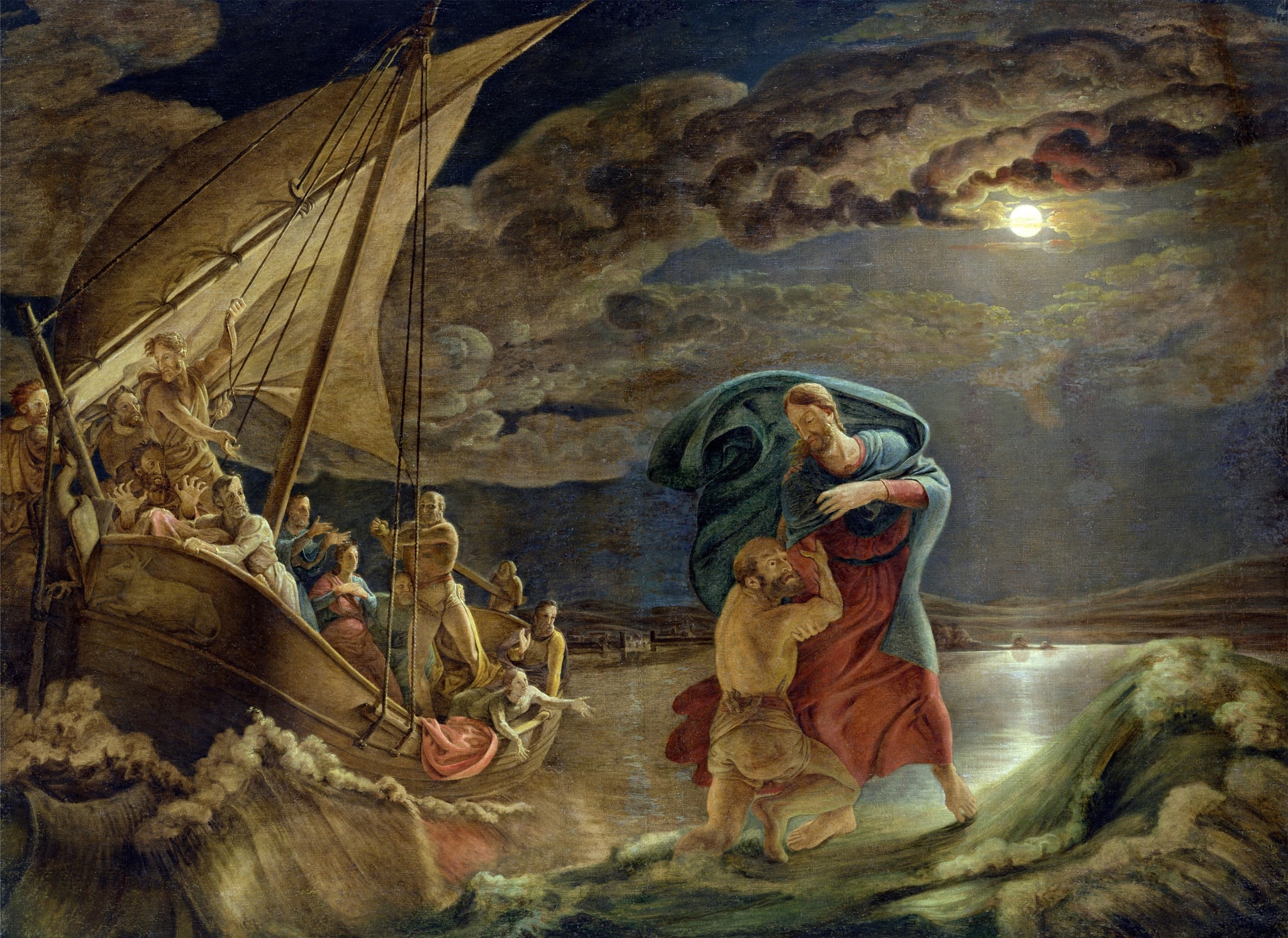
And when they had climbed back into the boat, the wind died down. Then those who were in the boat worshiped Him, saying, “Truly You are the Son of God!”
Matthew 14:32–33 · BSB
Runge, a German painter of the generation that fell in love with moonlight, brings the rescue right up against the hull. The boat is crowded with faces—hands raised, mouths open, one man leaning out over the side to reach—its sail whipping loose, the moon breaking through torn cloud. Beside it, on the water, Jesus stands in blue and red, holding Peter up by the arm while Peter, knees bent above the waves, clings to his sleeve. Runge leaves the two of them outside the boat; Matthew carries the story on to the moment they climb aboard.
The story does not end with Peter’s solo. It ends with the whole boat. The wind dies only when the two of them are back inside it, and the last line belongs to everyone: “those who were in the boat worshiped Him.” John, telling the same night, adds a small human detail: once they knew who it was, “they were willing to take Him into the boat” (John 6:21).
The fourth thing to do is get back in the boat. The rescue was personal; the recovery is not. The people who watched you go under are the people you climb back in beside, and it is with them, not alone on the water, that the weather finally changes.
Visio Divina Prompt: Count the hands reaching out of the boat. Who are the people in yours?
What to Do When You Start to Sink
Peter’s night, read as instructions:
- Wake him up. Say the true thing, even if it comes out as an accusation. “Don’t You care?” is a prayer, and it was answered. (Rembrandt)
- Give help a moment before you scream. It often arrives looking like more trouble. (Tanner)
- Shout before you are all the way under. Three words is enough. You do not need a calm explanation of your fear first. (Brion)
- Notice the order. The hand came before the calm. Do not measure whether God is near by whether the wind has dropped. (Brion)
- Hear “little faith” as tenderness. It is the word Jesus keeps for his own frightened people, and it is said while he is holding on to you.
- Get back in the boat. The rescue is personal; the recovery happens with other people. (Runge)
And when the night is over, do not be surprised if the same man who walked on water later loses his nerve at a fire in a courtyard. That is the next piece: Saint Peter and What to Do After a Public Moral Failure. The one before it is about why he got into the boat at all: Saint Peter and the Fear of Being Chosen.
A 4-Step Visio Divina Practice for When You Are Sinking
Return to whichever painting held you longest. Take a few unhurried minutes to move through these four steps:
- Look (Visio): Stay with one physical detail—Jesus’ calm face in the crowded stern, the pale figure at the edge, Jesus holding Peter up amid the waves, the hands reaching from the boat. Describe what is actually there before you decide what it means.
- Meditate (Meditatio): Name the wind. Not the whole situation—the one thing you looked at that made your footing go.
- Pray (Oratio): Peter’s prayer is three words. Use it. Lord, save me. Say it as many times as you need to; it does not get shorter or less true.
- Contemplate (Contemplatio): Rest in silence for one minute. You are not trying to make the wind drop. You are letting a hand close around your arm while it is still blowing.
Stay with the painting
If you want to sit with one of these images a little longer, you can restore it yourself. Open Rembrandt’s Storm on the Sea of Galilee as a puzzle—piece by piece, with the verse waiting at the end. Or get the app for a new painting, a new verse, and a new reflection every morning.
Continue in the open gallery