You have probably met St. Peter already. He is the man with the keys in every joke about the gates of heaven, checking names at the door. Here is who he actually was: a fisherman from a small lakeside town, the friend who confessed Jesus as the Christ, the one who walked on water and sank, who swore he would die for Jesus and then, a few hours later, denied three times that he knew him. And the one who was trusted with the whole thing anyway.
This guide follows his life through seven paintings, with the verse that belongs beside each one. Then it shows a short way to pray with a painting—the practice we call Visio Divina, Latin for “divine seeing,” which simply means praying with a picture instead of a passage—and answers the questions people actually type into a search bar. Each turning point links to a longer piece written for a particular modern struggle: feeling you don’t deserve good things, being in over your head, the morning after a public failure, what to do with a second chance, and leading when you know you are not perfect. If the Bible is new to you, you are in the right place; unfamiliar words are explained as they come up.
The Fisherman Who Asked Jesus to Leave
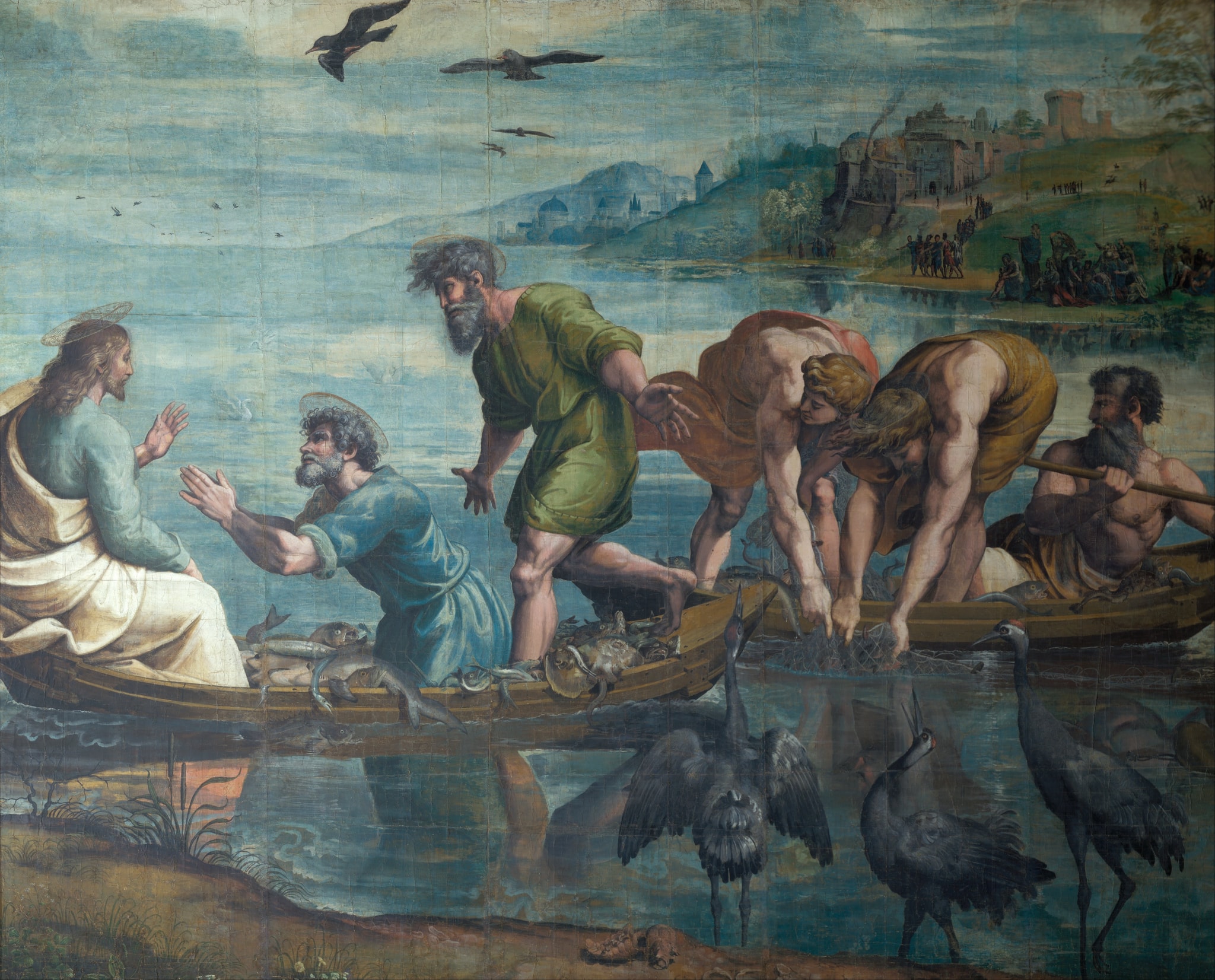
“Go away from me, Lord,” he said, “for I am a sinful man.”
Luke 5:8 · BSB
Peter’s story begins with a bad night at work. He and his partners have fished until dawn and caught nothing. A traveling teacher borrows his boat to speak to a crowd from the water, then tells him to row out and drop the nets again. Peter does it, probably to be polite. The nets come up so full they start to tear.
His reaction is the surprising part. He does not celebrate. He falls at Jesus’ knees and asks him to leave. Something about receiving that much good, from someone who plainly sees him, is more than he can stand. Jesus’ reply is short: “Do not be afraid” (Luke 5:10)—and then he gives Peter a job.
Raphael painted this scene on paper as a full-size design for a tapestry. Peter kneels in a boat riding low with fish, both hands pressed together and his whole body leaning toward the man he is asking to go away. Behind him his brother Andrew opens his arms as if the catch, or the moment, is too big to hold.
If you have ever been given trust, or love, or an opportunity, and your first feeling was panic rather than joy—if they really knew me, they would choose someone else—you already understand this painting. Feeling unworthy is not the same as being guilty. Luke names no particular wrong that morning. Peter is overwhelmed by his sinfulness and afraid.
Visio Divina Prompt: Look at Peter’s hands before you look at anything else. Are they praying, or pushing away?
→ Read the longer piece: Saint Peter and the Fear of Being Chosen
The Man Who Walked on Water, Then Sank
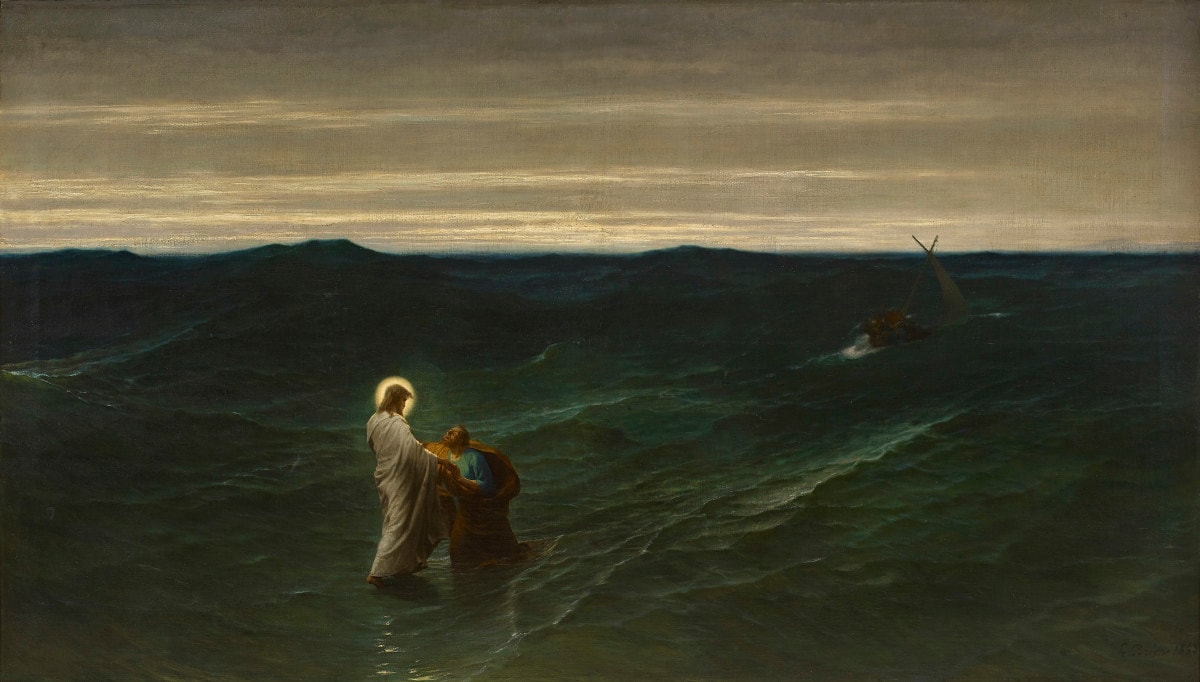
But when he saw the strength of the wind, he was afraid and, beginning to sink, cried out, “Lord, save me!”
Matthew 14:30 · BSB
This is the scene everyone half-remembers, so it is worth telling exactly. The disciples are in a boat at night, far from shore, fighting the wind. Jesus comes toward them walking on the sea. Peter—of course it is Peter—calls out: if it is really you, tell me to come to you on the water. Jesus says one word: “Come.” Peter climbs out of the boat and walks. Then he notices the wind, gets scared, and starts to go under.
Two details matter. First, he did walk. Only Matthew tells this part of the story, and he says Peter “walked on the water, and came toward Jesus” (Matthew 14:29). Second, the rescue comes before the weather changes. “Immediately Jesus reached out His hand and took hold of Peter” (14:31); only after they climb back into the boat does the wind die down (14:32). Peter is not saved because he calmed down. He is saved because he shouted.
Brion’s painting understands this. Nearly the whole canvas is dark, heaving water under a thin band of grey-gold sky. The boat is a small shape far off to the right. Down in the left foreground, almost lost in the swell, Jesus in white is holding Peter up. It is not a picture of triumph. It is a picture of a grip.
Visio Divina Prompt: Find the boat first, then the two figures. Notice how far Peter is from anything solid except that hand.
→ Read the longer piece: Saint Peter and What to Do When You Start to Sink
The Keys, the Rock, and “Get Behind Me”
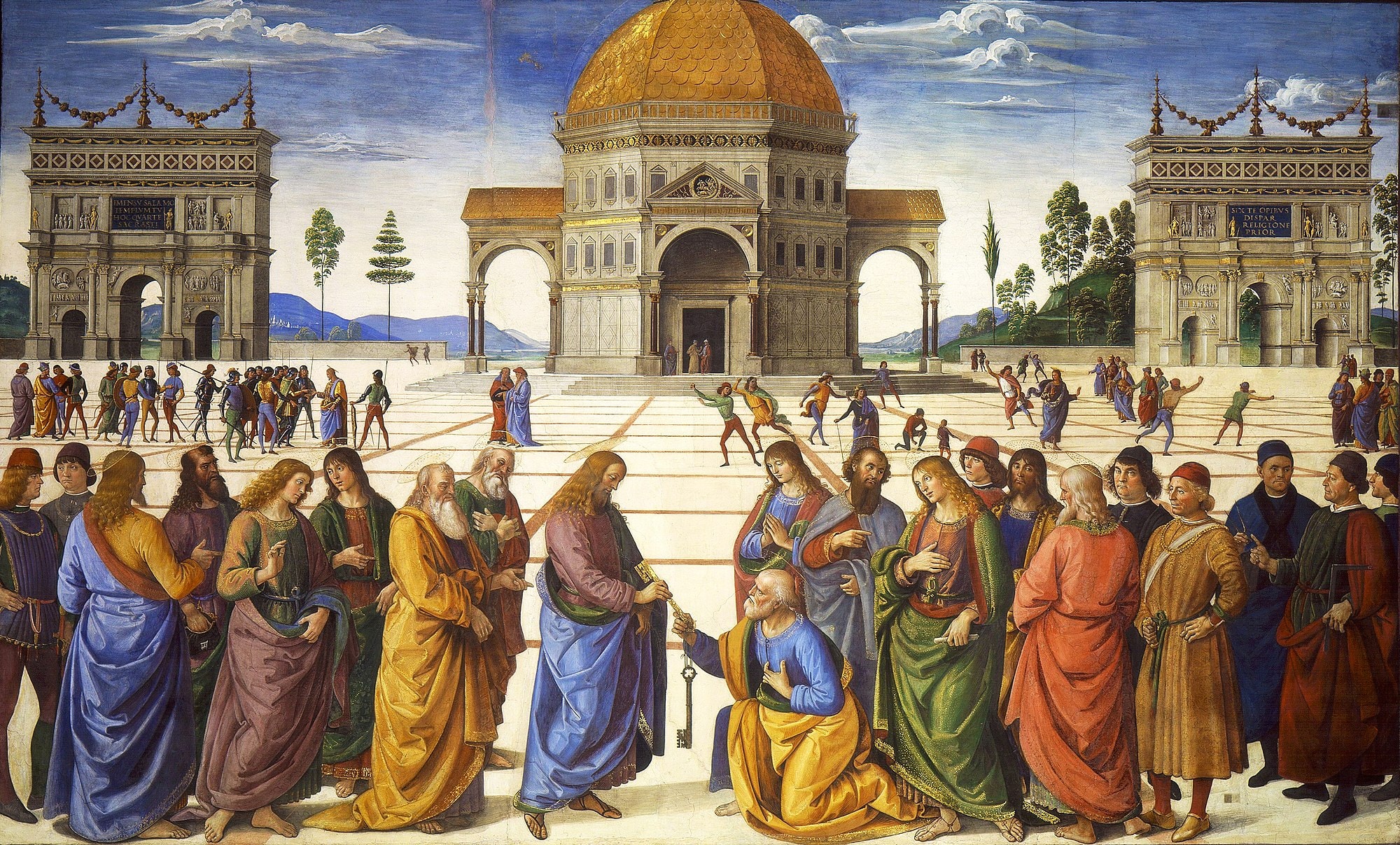
And I tell you that you are Peter, and on this rock I will build My church, and the gates of Hades will not prevail against it.
Matthew 16:18 · BSB
On a road in the far north of the country, Jesus asks his friends who people say he is, and then who they say he is. Peter answers first: “You are the Christ, the Son of the living God” (Matthew 16:16). Jesus tells him he is blessed, calls him Peter, the rock, and promises him keys.
Then, five verses later, he calls him Satan. Peter has just heard Jesus say that he must suffer and be killed, and he takes him aside to tell him this must never happen. “Get behind Me, Satan!” Jesus says. “You are a stumbling block to Me” (Matthew 16:23). The highest praise and the sharpest correction in Peter’s life sit on the same page of the Bible, only a few verses apart.
Perugino painted the keys on the wall of the Sistine Chapel in the Vatican, and he painted them enormous. In front of a vast paved square, an eight-sided temple, and two Roman arches, Jesus hands Peter two keys—one gold, one silver—while Peter kneels with his free hand on his chest, looking up as if to ask are you sure? The architecture says this is a public, permanent act. Peter’s face says the man receiving it is not finished yet.
Christians read “this rock” in different ways, and the paintings often show the convictions of the people who paid for them. The FAQ below sets the main readings side by side without picking a winner.
Visio Divina Prompt: Compare the size of the keys with the size of the man holding them.
→ Read the longer piece: Saint Peter and Leadership Without Perfection
The Night of the Rooster
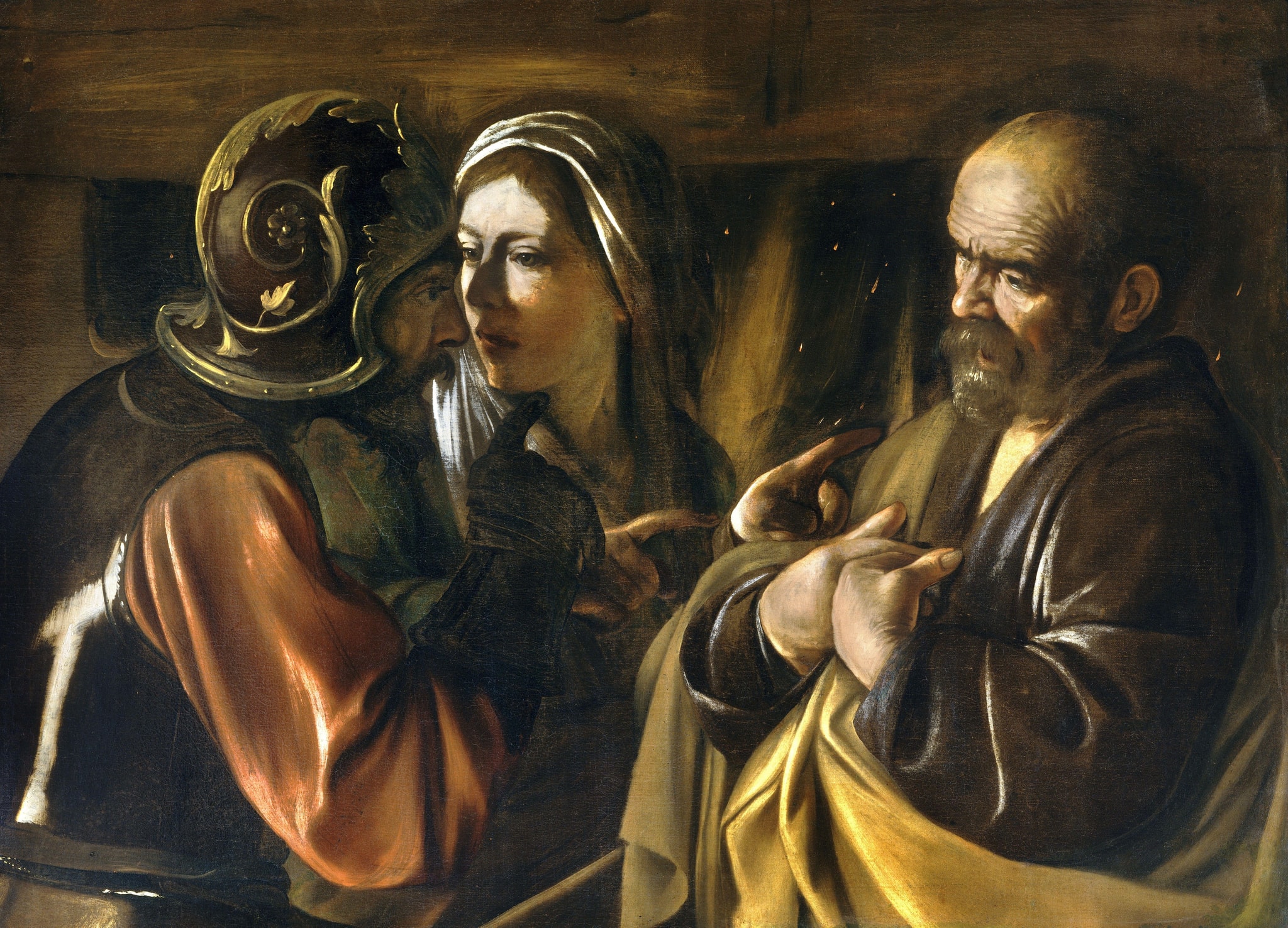
And the Lord turned and looked at Peter.
Luke 22:61 · BSB
At the last meal before Jesus is arrested, Peter makes a promise: “Even if I have to die with You, I will never deny You” (Matthew 26:35). He means it. A few hours later Jesus is under arrest inside the high priest’s house, and Peter is outside in the courtyard, warming himself at a fire with the servants and guards. A servant girl looks at him in the firelight and says he was with Jesus. “Woman, I do not know Him” (Luke 22:57). It happens twice more. A rooster crows. And Luke adds one sentence none of the other Gospel writers has: Jesus turns and looks at him.
Here is the detail that changes how the night reads. Before any of it happened, Jesus had told Peter: “I have prayed for you, Simon, that your faith will not fail. And when you have turned back, strengthen your brothers” (Luke 22:32). Not if. When. Peter’s comeback was prayed for before his collapse.
Caravaggio painted the denial in the last year of his life, with only three people and almost no light. A soldier in armor and a servant girl lean in from the left; the Metropolitan Museum, which owns the painting, counts three accusing fingers between them—one for each denial. Peter’s own hands turn back toward his chest. His face is not defiant. It is the face of a man watching himself do the thing he swore he would never do.
Visio Divina Prompt: Count the pointing fingers. Then look at where Peter’s fingers point.
→ Read the longer piece: Saint Peter and What to Do After a Public Moral Failure
The Tears
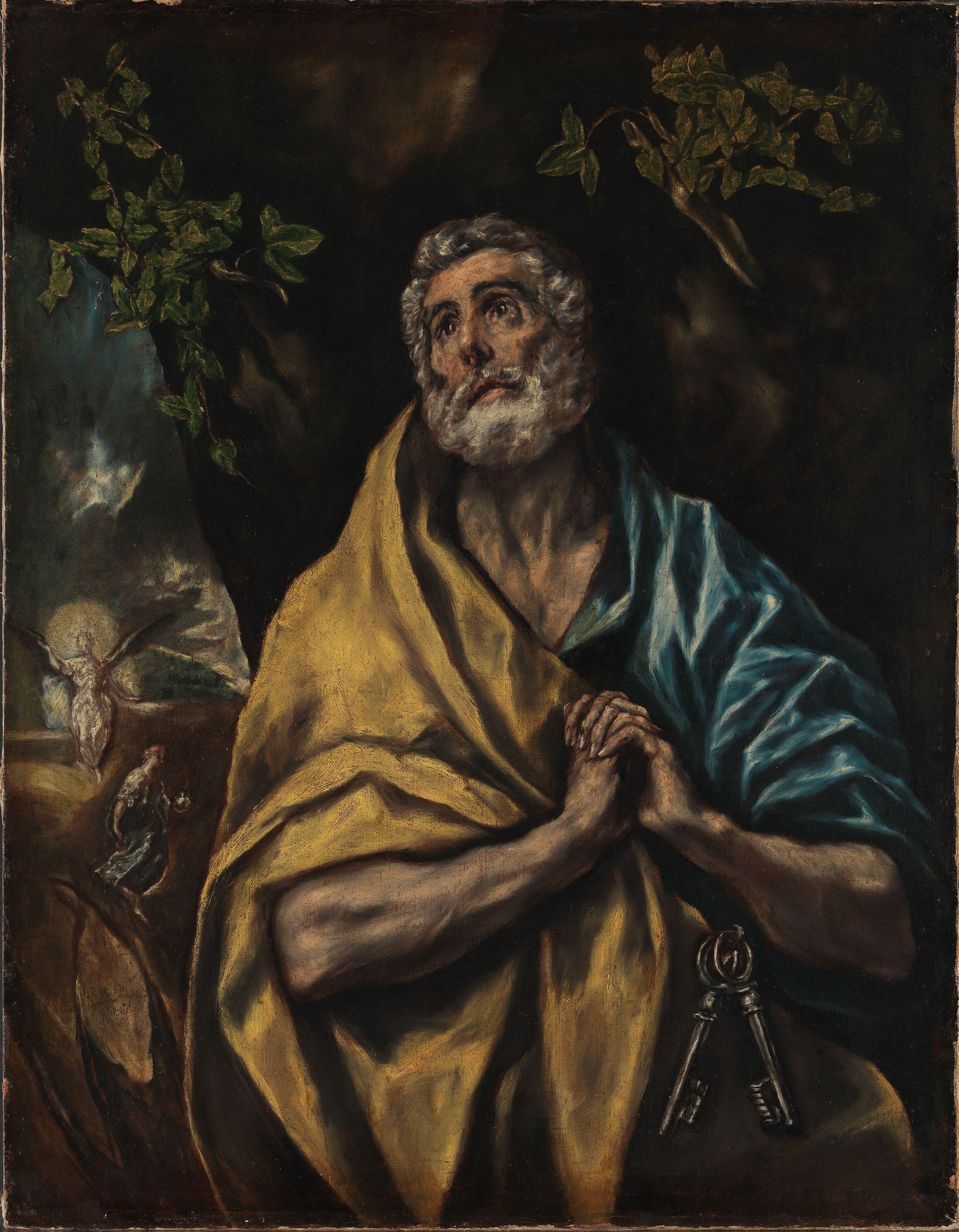
And he went outside and wept bitterly.
Luke 22:62 · BSB
The Gospels give Peter’s remorse one line. Painters gave it centuries. El Greco returned to this subject again and again: Peter alone, older, his hands knotted together, his eyes turned up and wet. Two keys hang below his clasped hands—still his, even now.
Look past him, though, to the small scene in the background on the left. A luminous angel, wings spread, appears behind a woman carrying a jar, who is walking away from the tomb. That is Mary Magdalene on Easter morning, and she is carrying the news that will end Peter’s night. El Greco has painted forgiveness already on its way, behind the back of a man who does not yet know it is coming.
This is the second half of the story told in the piece on public failure. The tears are not the end of anything. The Easter scene behind him opens his remorse toward the hope of reconciliation.
Visio Divina Prompt: Look at Peter’s face for a while, then find the small figures behind him. Hold both at once.
→ Continue in: Saint Peter and What to Do After a Public Moral Failure · Meet the woman with the jar: Mary Magdalene in Art
Breakfast on the Beach
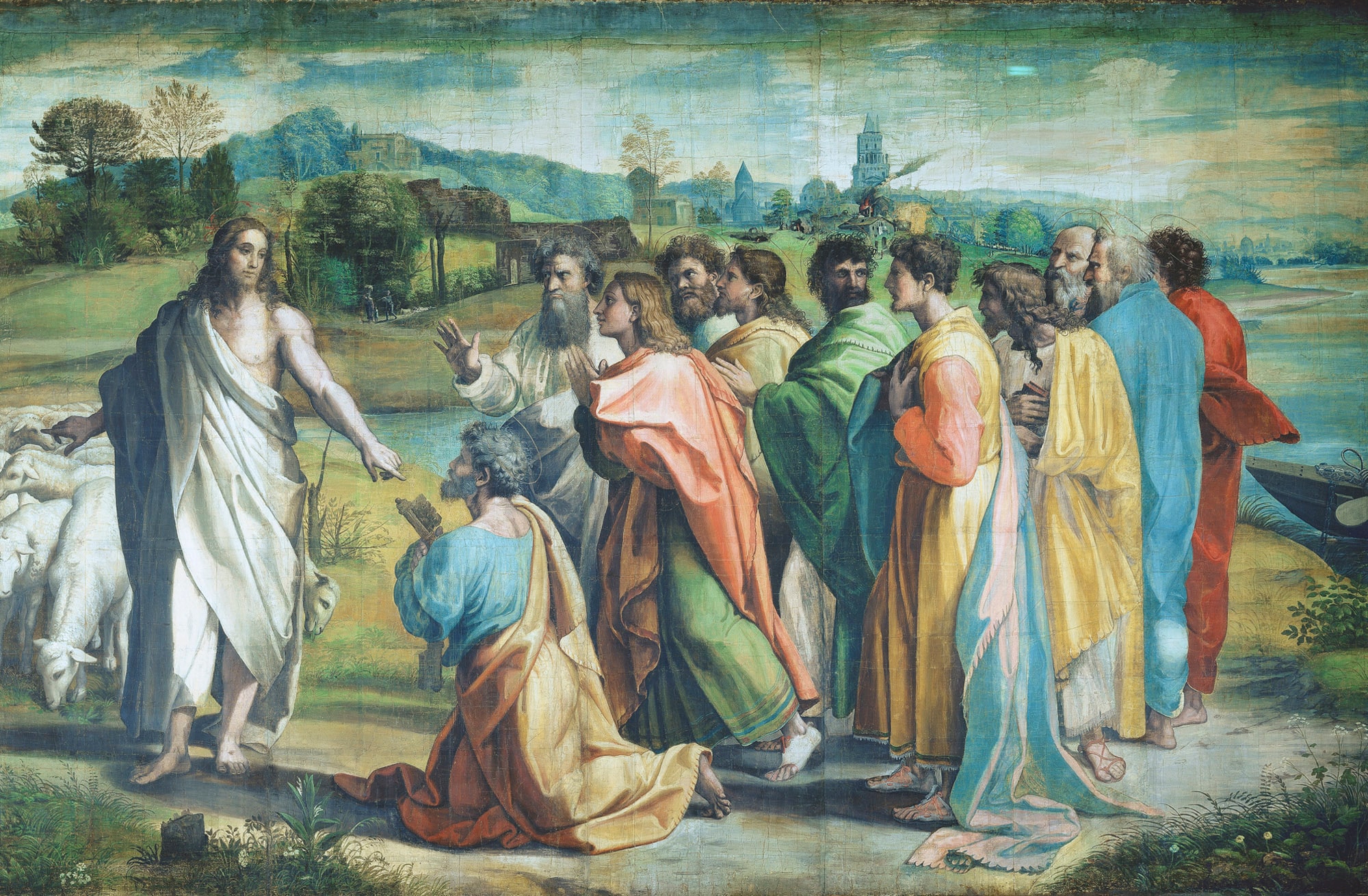
Jesus asked a third time, “Simon son of John, do you love Me?” Peter was deeply hurt that Jesus had asked him a third time, “Do you love Me?” “Lord, You know all things,” he replied. “You know I love You.” Jesus said to him, “Feed My sheep.
John 21:17 · BSB
After Easter, Peter goes back to fishing. It is the most human thing in the book. He catches nothing all night—again—until a stranger on the shore tells him where to throw the net, and the net fills, and someone says, “It is the Lord!” (John 21:7). Peter throws on his coat and jumps into the water rather than wait for the boat.
On the beach there is a charcoal fire with fish on it. The only other charcoal fire in the whole New Testament is the one Peter warmed his hands at on the night he denied Jesus (John 18:18). Jesus has rebuilt the scene of the failure, and made breakfast on it. Then he asks the same question three times—do you love me?—once for each denial. Peter is hurt by the third asking. Each time, the answer he gets is not “that’s all right” but a task: feed my lambs, shepherd my sheep, feed my sheep. Forgiveness here is not a feeling Peter has. It is a job he is given.
Raphael’s design shows the moment the job is handed over. Jesus, in white, points with one hand at the kneeling Peter and with the other at a flock of sheep, while the rest of the disciples crowd in behind. Peter holds two keys. Raphael has carried the keys from Matthew 16 into John 21, so that the man who was promised authority receives it again, after failing, on a beach—and what it turns out to mean is looking after other people.
Visio Divina Prompt: Look from the hand Jesus points at Peter to the hand he holds out over the sheep. Which direction is Peter being pointed?
→ Read the longer piece: Saint Peter and What to Do With a Second Chance
Where the Bible Stops and Tradition Begins
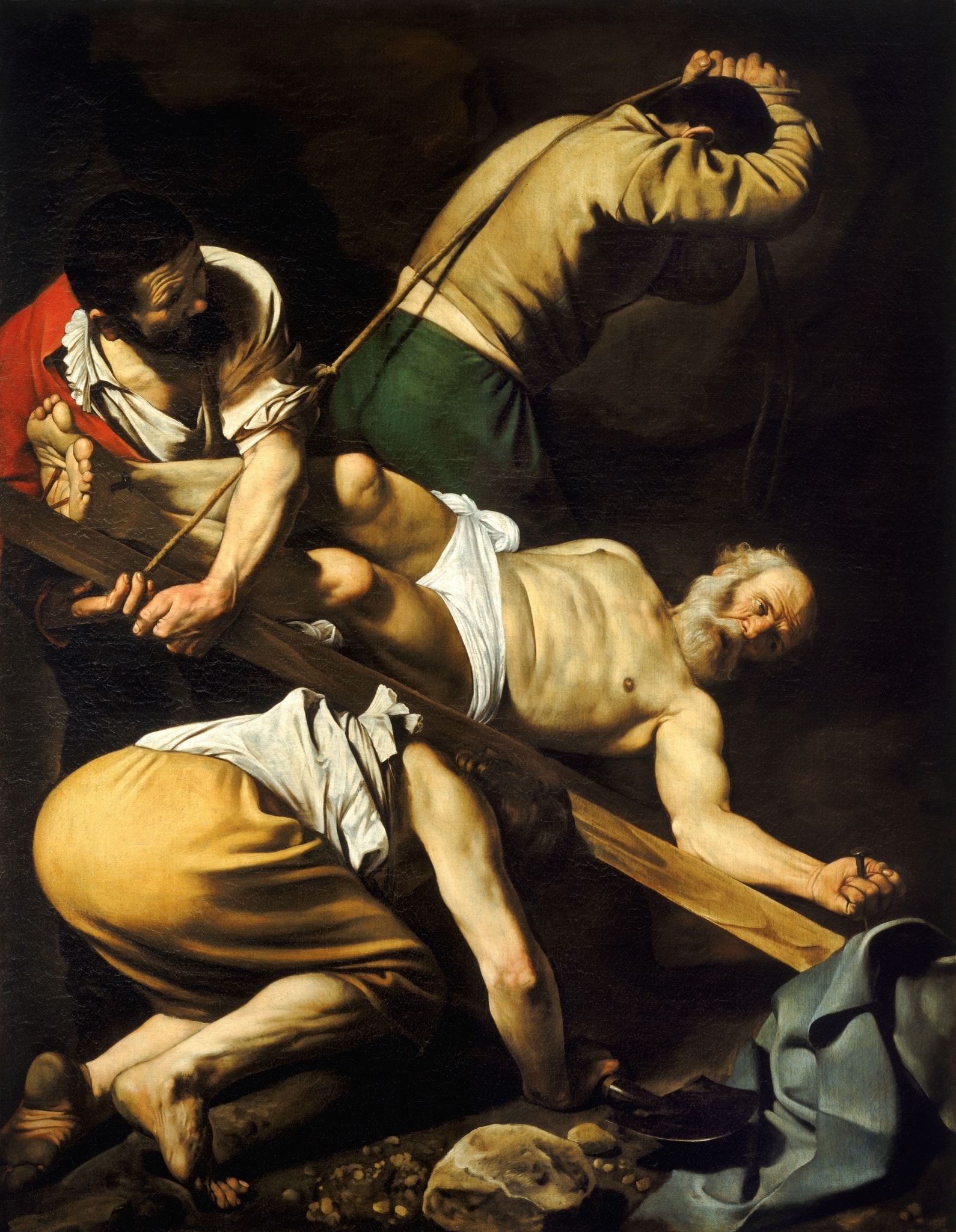
when you are old, you will stretch out your hands, and someone else will dress you and lead you where you do not want to go.
John 21:18 · BSB
The Bible does not describe Peter’s death. On the beach, Jesus tells him that when he is old someone else will lead him where he does not want to go, and John adds that this was said “to indicate the kind of death by which Peter would glorify God” (John 21:19). That is all. The rest of the New Testament follows him through the early years of the church—preaching in Jerusalem, healing, being jailed and freed, learning, slowly and in public, that people he had been raised to keep at a distance belonged at the table too—and then his letters, and then silence.
Everything after that comes from tradition, which is a different kind of knowing. An early letter from the church in Rome remembers Peter’s suffering and death. Later Christian writers place that death in Rome, on a cross, head downward; the earliest surviving telling of the upside-down story is in a second-century text called the Acts of Peter, which is not part of the Bible. The same text also tells how Peter tried to flee the city and met Jesus walking the other way, into Rome—Domine, quo vadis? “Lord, where are you going?”—and turned back. It is a story, not Scripture, and it is a good one.
Caravaggio painted the crucifixion in 1601 for a small chapel in Rome, where it still hangs opposite his Conversion of St. Paul. There is no halo and no crowd. Three workmen strain to raise the heavy cross—one crouching under the timber, one hauling on a rope, one bracing the beam beside Peter’s legs—and Peter, old and grey, lifts and turns his head as the cross goes up. It is a picture of an execution done by people who are just doing their job, and of a man who, this time, does not run.
Visio Divina Prompt: Look at the workmen’s hands and feet before you look at Peter. Then look at Peter’s eyes.
→ The story of his last years and this painting continues in: Saint Peter and Leadership Without Perfection
Why Painters Give Him Keys, a Rooster, and an Upside-Down Cross
Once you know the three symbols, you can find Peter in almost any church in Europe.
The keys come from Matthew 16:19, “I will give you the keys of the kingdom of heaven.” Artists usually paint two, and a later tradition explains them as gold for heaven and silver for earth, matching the next line about binding and loosing “on earth” and “in heaven.” If a bearded man in a painting is holding keys, he is Peter.
The rooster comes from the night of the denial. Jesus had warned him: “the rooster will not crow today until you have denied three times that you know Me” (Luke 22:34). Mark’s Gospel remembers the bird crowing twice (Mark 14:30, 72). A rooster in a painting of Peter is never decoration; it is the sound of the moment he realized what he had done.
The upside-down cross comes from the tradition about his death, not from the Bible. In Christian art it is called the cross of St. Peter. Its use as an anti-Christian sign in films and music is a modern reversal of that meaning; when you see one on a church or in a painting of Peter, it is pointing at him.
One more clue: the face. From very early on, painters gave Peter a fixed look—short, curly white hair, a short square beard, a broad face—so that viewers could pick him out of a crowd of apostles, the way you would recognize a friend across a room. (Paul, by contrast, got a long face, a high forehead, and a dark pointed beard.) After 1,600 years the convention still holds; look for it in El Greco and Caravaggio above.
How to Pray with St. Peter
Whether you are afraid of being found out, in over your head, living with a failure other people saw, or leading people while privately unsure of yourself, Peter has been there first. Choose one painting from this guide and try a brief Visio Divina:
- Look (Visio): Let your eyes rest on one physical detail—Jesus holding Peter up amid the waves, the keys below his clasped hands, the workman’s dirty foot. Describe what is actually there before you decide what it means.
- Meditate (Meditatio): Ask where this moment in Peter’s life touches yours. Name the specific fear, failure, or responsibility it brings up. You do not have to argue with it; just let it be in the room with the picture.
- Pray (Oratio): Say something honest. Peter’s own prayers in the Gospels are short—“Lord, save me!”; “You know I love You.” Yours can be too.
- Contemplate (Contemplatio): Stay in silence for one minute. You are not trying to produce a feeling. You are letting the painting, and the person in it, keep you company.
St. Peter and All Saints’ Day
Peter’s own feast day is June 29, which he shares with St. Paul. This collection also remembers him on November 1, All Saints’ Day, alongside the whole company of people the church calls saints—not because they never failed, but because they kept turning back.
He is a good patron for the day. When the authorities in Jerusalem interrogated him and John after the resurrection, the book of Acts says they “realized that they were unschooled, ordinary men” (Acts 4:13). Their courage astonished the authorities. That is also the point.
Explore the St. Peter collection
Each piece takes one turning point in Peter’s life and reads it beside a modern struggle, with four to six paintings and a short practice at the end.
- Saint Peter and the Fear of Being Chosen — For when good news feels like a mistake: the miraculous catch and the washing of feet.
- Saint Peter and What to Do When You Start to Sink — For when you are in over your head: the walk on the water and the hand that came first.
- Saint Peter and What to Do After a Public Moral Failure — For the morning after: the denial in six paintings, and the tears.
- Saint Peter and What to Do With a Second Chance — For starting again: breakfast on the beach, three questions, and a job.
- Saint Peter and Leadership Without Perfection — For leading when you know your limits: the keys, the rebuke, the argument with Paul, and the end.
Frequently asked questions
Who was St. Peter?
Peter was a fisherman from Galilee named Simon, one of the first followers of Jesus and the most prominent of the twelve disciples. Jesus renamed him Peter, meaning “rock.” He walked on water, declared Jesus to be the Christ, denied knowing him three times, was forgiven and given charge of the early community, and, according to tradition, died in Rome. He is the patron saint of fishermen and of the city of Rome.
Why is St. Peter always shown holding keys?
Because of Matthew 16:19, where Jesus tells him, “I will give you the keys of the kingdom of heaven.” Painters use the keys the way a comic strip uses a name tag: they identify him instantly. There are usually two, often one gold and one silver.
Why is there a rooster in paintings of Peter?
The rooster marks his denial of Jesus. Jesus predicted that before the rooster crowed Peter would deny him three times (Luke 22:34), and the bird crowed as the third denial left his mouth (Luke 22:60). In Mark’s telling it crows twice (Mark 14:72). The rooster in a painting is the sound of Peter remembering.
Is St. Peter really at the “pearly gates”?
Not in the Bible. The “pearly gates” are from Revelation 21:21, where the heavenly city has twelve gates, each made of a single pearl; no gatekeeper is named. Peter’s connection is the keys of Matthew 16:19. Popular imagination combined the two images, and the man with the keys became the man at the door.
Was Peter married?
Yes. Mark 1:30 says Jesus healed Peter’s mother-in-law, and Paul later mentions that Cephas—Peter’s Aramaic name—traveled with a believing wife (1 Corinthians 9:5). The Bible never gives her name.
Did Peter really walk on water?
According to Matthew 14:29, yes: he “walked on the water, and came toward Jesus.” Then he saw the wind, panicked, and began to sink, and Jesus caught him (14:30–31). Matthew is the only Gospel that includes Peter’s part of the story; Mark and John describe Jesus walking on the sea but not Peter.
How many times did Peter deny Jesus?
Three times, in a single night, in the courtyard of the high priest’s house. All four Gospels tell the story with slightly different details: Luke alone records Jesus turning to look at Peter (Luke 22:61); Mark alone remembers the rooster crowing twice (Mark 14:72); John places the scene at a charcoal fire (John 18:18).
Was Peter crucified upside down?
The Bible does not say. John 21:18–19 hints at how Peter would die but gives no details. The head-downward crucifixion comes from early Christian tradition outside the New Testament: the second-century Acts of Peter tells the story, and the historian Eusebius, quoting Origen, repeats it. The familiar explanation—that Peter felt unworthy to die the same way as Jesus—belongs to that tradition, not to Scripture.
Is the upside-down cross a satanic symbol?
Not originally. In Christian art the inverted cross is the cross of St. Peter and has been for many centuries. Its use as an anti-Christian symbol is a modern reversal that appears mostly in horror films and popular music. On a church, in a Catholic setting, or in a painting of Peter, it refers to him.
Was Peter the first pope?
Christians answer this differently, and the paintings often reflect the answer of whoever commissioned them. Catholics understand Jesus’ words in Matthew 16:18–19 as founding an office that continues in the Bishop of Rome, and count Peter as the first pope. Orthodox Christians honor Peter as first among the apostles but do not understand his primacy as establishing papal supremacy over the whole church. Many Protestants read “this rock” as Peter’s confession of faith, or as Christ himself, rather than as an office. This guide describes those readings without settling them.
When is St. Peter’s feast day?
June 29, the feast of Sts. Peter and Paul, in Roman Catholic and Eastern Orthodox church calendars. Catholics also keep February 22 as the feast of the Chair of St. Peter. This collection remembers him on All Saints’ Day, November 1.
Did Peter write any books of the Bible?
Two New Testament letters carry his name, 1 Peter and 2 Peter. Christian tradition attributes both to him; modern scholars debate their authorship, especially 2 Peter’s, though the church counts both as Scripture regardless. An early tradition also says that Mark’s Gospel preserves Peter’s preaching. Either way, the letter’s best-known line sounds like him: “Cast all your anxiety on Him, because He cares for you” (1 Peter 5:7).
Stay with the painting
If you want to sit with one of these images a little longer, you can restore it yourself. Open Caravaggio’s Crucifixion of Saint Peter as a puzzle—piece by piece, with the verse waiting at the end. Or get the app for a new painting, a new verse, and a new reflection every morning.
Continue in the open gallery