Second chances are supposed to be the good part. The apology is accepted, the door is reopened, and everyone tells you to forgive yourself and move on. So why does a second chance so often feel worse than the failure did? Because nobody tells you what to do with it. You are back in the same room, with the same people, holding a forgiveness you do not know how to carry and terrified of dropping it.
Peter’s second chance came on a beach, some time after the worst night of his life. It is one of the strangest and most tender scenes in the Bible, and it is not what most people expect forgiveness to look like. Nobody says “it’s fine.” Nobody makes a speech. There is a fire, a breakfast, a question asked three times, and a job.
Here is the detail that opens the whole thing. On the night of the denial, Peter had stood warming his hands at a charcoal fire in the high priest’s courtyard (John 18:18). When the disciples come ashore that morning, “they saw a charcoal fire there with fish on it, and some bread” (John 21:9). Jesus lit the same kind of fire Peter had failed beside—and made him breakfast on it.
Four paintings trace Peter’s way back: the meeting nobody wrote down, a familiar working lake, the man who would not wait for the boat, and the three questions. (If this is new to you: Visio Divina, Latin for “divine seeing,” just means praying with a picture instead of a passage. Look first; read second.)
The Meeting Nobody Wrote Down
and that He appeared to Cephas and then to the Twelve.
1 Corinthians 15:5 · BSB
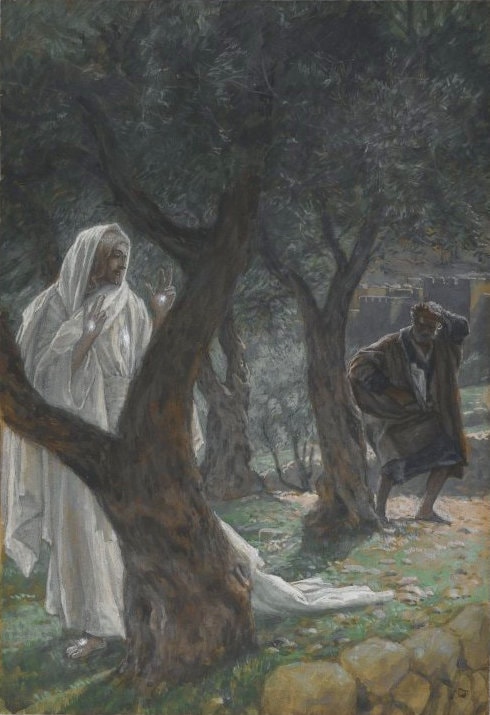
Before the beach, there was a private meeting. On Easter evening the disciples are already saying to one another, “The Lord has indeed risen and has appeared to Simon!” (Luke 24:34). Paul, writing the earliest surviving list of the people who saw the risen Jesus, puts Peter first (1 Corinthians 15:5). And that is all we get. What was said between them, nobody recorded. The man whose denial is told in all four Gospels, down to the rooster, left this conversation blank.
Tissot imagines it in an olive grove. Jesus, in white, stands half hidden behind a tree with his hands raised, palms open; Peter, in brown, has stopped on the path with his hand to his head, caught mid-step; the long white train of Christ’s robe trails across the ground by the roots. Tissot paints the second before either of them speaks, which is honest, because the second after is not ours to see.
That is the first thing to know about a second chance: it does not begin with your speech. You do not have to arrive with the apology perfectly worded. The Bible lets Peter’s first meeting with the person he failed stay private, and it lets yours stay private too.
Visio Divina Prompt: Look at Peter’s hand on his head. What would you say first? Now notice that the painting does not require you to say it yet.
Back to the Old Job
Simon Peter told them, “I am going fishing.” “We will go with you,” they said. So they went out and got into the boat, but caught nothing that night.
John 21:3 · BSB
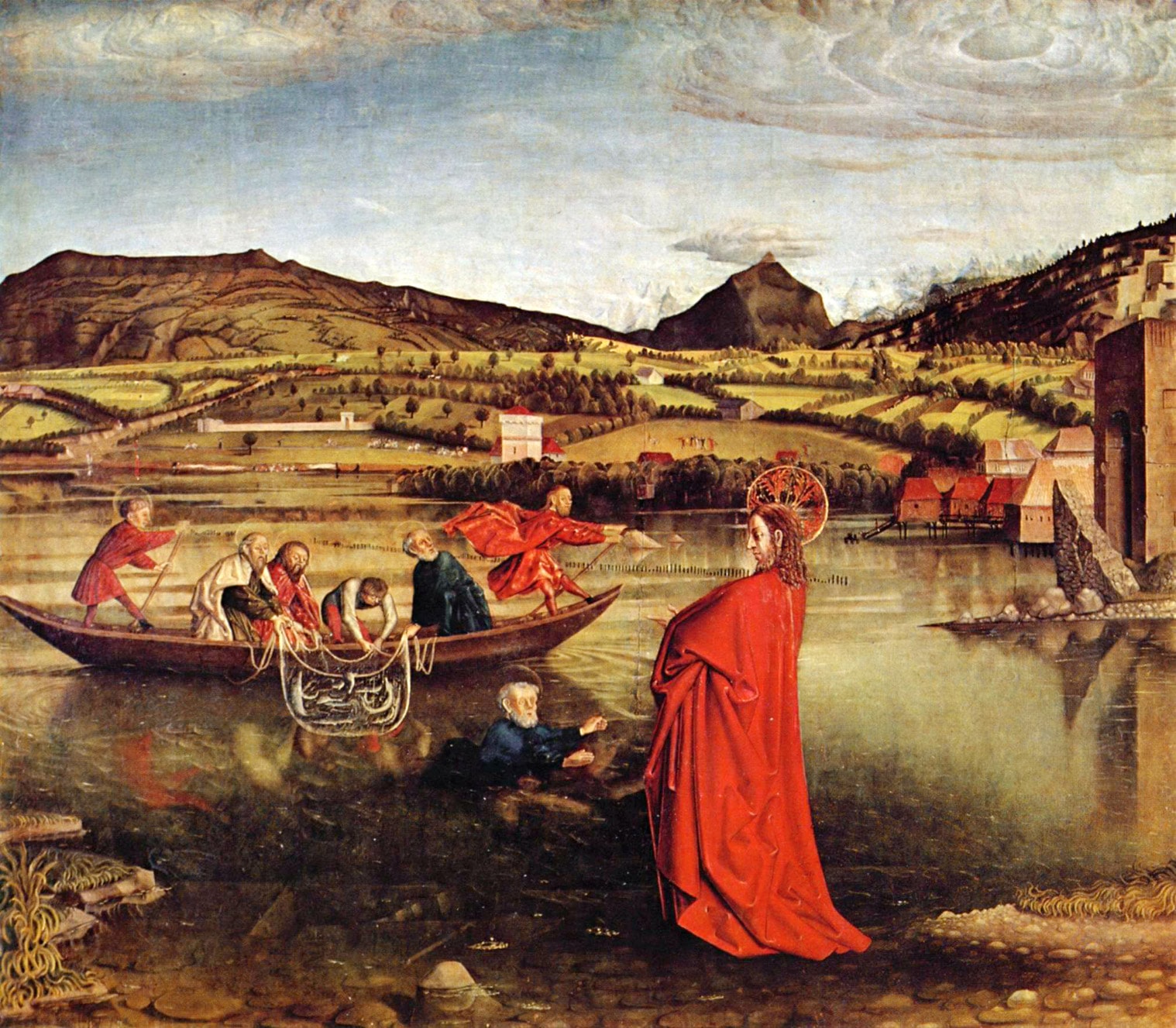
After all of that—the empty tomb, the appearances, the locked room—Peter says, “I am going fishing.” It is the most human line in the chapter. He goes back to the thing he knows how to do, and six of the others go with him, and they fish all night and catch nothing. If that sounds familiar, it should: it recalls another empty fishing night earlier in Luke’s Gospel (Luke 5:5).
At dawn a stranger calls from the shore. “Children, do you have any fish?” “No.” Throw the net on the right side. The net fills so fast they cannot haul it in, and the disciple Jesus loved says the words: “It is the Lord!” (John 21:4–7).
Witz painted this in 1444 for an altarpiece in Geneva, and he did something that is often described as a first in European painting: he set the scene in a real, recognizable place. The lake behind the boat is Lake Geneva, with the hills and the snow-capped peaks the people of the city could see from their own streets. Christ, in red, stands on the water near the shore; Peter is in the lake up to his chest with both hands out toward him; the others heave at a net so full it bulges, and at the bow a man in red leans forward over a long oar. Witz folds more than one lake story into a single picture—the miraculous catch and Christ appearing on the water—and sets it in someone’s hometown, on an ordinary working lake.
That is the second thing: a second chance comes to your actual life, not to a holy version of it. It arrives on a bad night at work, in your own geography. And you may not recognize it at first. John says plainly that the disciples “did not recognize that it was Jesus” (21:4).
Visio Divina Prompt: Look at the landscape before the figures. It is a real place. Where, in your real places, might a stranger already be standing on the shore?
The Man Who Would Not Wait for the Boat
As soon as Simon Peter heard that it was the Lord, he put on his outer garment (for he had removed it) and jumped into the sea.
John 21:7 · BSB
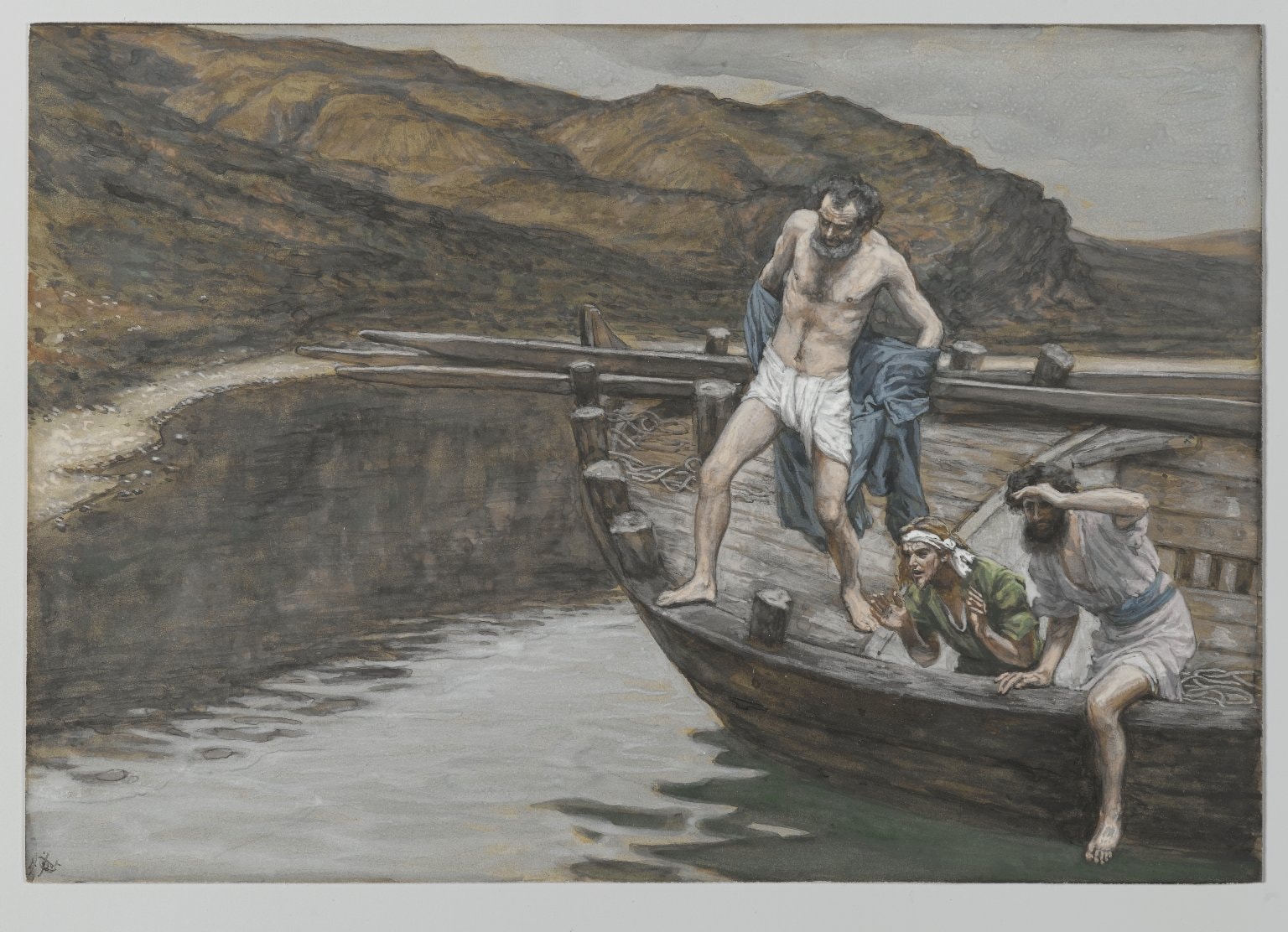
The boat was about a hundred yards from shore (John 21:8). The other disciples simply rowed in, dragging the net. Peter could not wait a hundred yards. He grabs the coat he had stripped off to work, pulls it on, and goes over the side.
Tissot catches him at the edge of the boat, bare-chested, a blue garment gathered around his arms, both feet still planted on the wood in the second before he jumps. Behind him a young man in green leans over the rail, mouth open—the one who just said it. There is something almost comic about the picture, and Tissot knows it. The dignity of the apostle is nowhere. What is left is a man who wants to get to someone faster than a boat can carry him.
Remember how the last piece began: on the night of the arrest, “Peter followed at a distance” (Luke 22:54). This is the same man closing the distance from his side, wet and ridiculous. The third thing to do with a second chance is not to wait for the boat. Go toward the person you failed before you feel ready, before you look composed. The awkwardness is the price of admission, and it is worth paying.
Visio Divina Prompt: Look at Peter poised at the edge of the boat, the second before the leap. What is the hundred yards between you and someone you need to reach, and what would it mean to swim it?
Three Questions, and a Job
Jesus asked a third time, “Simon son of John, do you love Me?” Peter was deeply hurt that Jesus had asked him a third time, “Do you love Me?” “Lord, You know all things,” he replied. “You know I love You.” Jesus said to him, “Feed My sheep.
John 21:17 · BSB
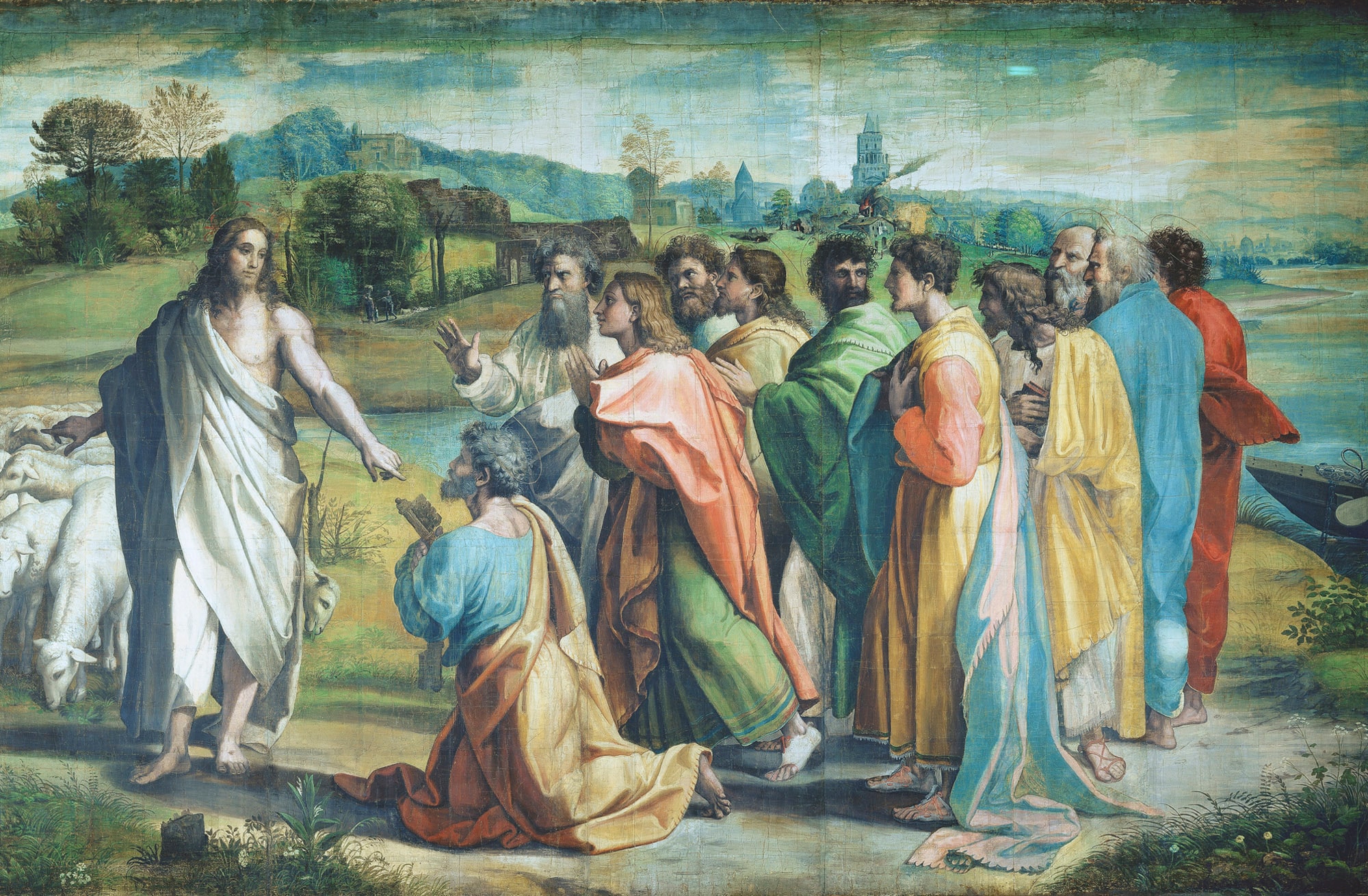
Breakfast first. “Come, have breakfast,” Jesus says, and takes the bread and gives it to them, and the fish (John 21:12–13). Only “when they had finished eating” does he turn to Peter (21:15)—and he uses the old name. Not Peter, not the rock. “Simon son of John, do you love Me?”
Three times. Feed my lambs. Shepherd my sheep. Feed my sheep. At the third asking Peter is “deeply hurt,” and readers have always heard why: three denials, three questions. The Gospel does not spell out the match. It does not need to.
Notice what Jesus does not say. Not “it’s fine.” Not “I forgive you.” Not “let’s never speak of it again.” Each time Peter answers “You know I love You,” what he gets back is not reassurance but a task—and the task is other people. Forgiveness here is not a feeling Peter is handed. It is a job. That is the fourth thing, and the center of this whole piece: a second chance is not something you are given so much as something you are given to do.
Raphael painted the moment the job is handed over. Jesus, in white, points with one hand at the kneeling Peter and with the other at a flock of sheep, while the rest of the disciples crowd in behind. Peter holds two keys. Raphael has carried the keys of Matthew 16—promised before the failure—into John 21, so that the authority is given again, after the failure, on a beach, and turns out to mean looking after sheep.
The scene has one more beat, and it is painfully familiar. Jesus tells Peter how his own life will end and says, “Follow Me.” Peter turns, sees the other disciple, and asks, “Lord, what about him?” The answer is short: “what is that to you? You follow Me!” (21:19–22). Even inside forgiveness, the urge to compare shows up within seconds.
Visio Divina Prompt: Look from the hand Jesus points at Peter to the hand he holds out over the sheep. Which direction is Peter being pointed—back at himself, or out?
What to Do With a Second Chance
Peter’s morning, read as instructions:
- Do not wait until you have the speech. The first meeting stays private. Forgiveness does not begin with your apology being perfect. (Tissot, the olive grove)
- Go back to your ordinary life. That is where it arrives—on a bad night at work, in your own geography, from someone you may not recognize at first. (Witz)
- Do not wait for the boat. Go toward the person you failed before you feel ready. (Tissot, the leap)
- Let the scene be rebuilt. The charcoal fire. Repair often means standing in the same place with a different ending.
- Eat first. Jesus fed Peter before he asked about his love. Be fed—by rest, by a friend, by a morning—before you interrogate yourself. “His mercies … are new every morning” (Lamentations 3:22–23).
- Answer the question you are actually asked, and take the job. “Do you love me?” is not a trap, even the third time. And the answer comes with work attached: feed my sheep. (Raphael)
- Do not compare. “What is that to you? You follow Me.”
The job Peter is given on the beach turns out to be leadership, and he will be corrected again, in public, more than once. That is the next piece: Saint Peter and Leadership Without Perfection. The night this morning answers is the one before it: Saint Peter and What to Do After a Public Moral Failure.
A 4-Step Visio Divina Practice for a Second Chance
Return to whichever painting held you longest. Take a few unhurried minutes to move through these four steps:
- Look (Visio): Stay with one physical detail—the robe trailing by the tree roots, the hands out of the water, Peter’s feet braced at the edge of the boat, the sheep at the edge of the frame. Describe what is actually there before you decide what it means.
- Meditate (Meditatio): Name the second chance you are holding, and the person it involves. Then name what you have been waiting for before you act on it—the speech, the composure, the boat.
- Pray (Oratio): Jesus, you rebuilt the fire and made breakfast before you asked Peter about his love. Feed me before you question me. Then ask me, as many times as it takes, and give me the work that belongs to the answer. Amen.
- Contemplate (Contemplatio): Rest in silence for one minute. You are not trying to feel forgiven. You are sitting at a fire someone else lit, waiting to be asked.
Stay with the painting
If you want to keep one of these images with you, get the app: a new painting to restore, a new verse to reveal, and a new reflection to sit with, every morning.
Continue in the open gallery