“Doubting Thomas” is in the dictionary. It means a person who won’t believe a thing until they see it, and it comes from about one week in one man’s life.
You may know that week from the inside. The old answers have stopped working. Something cracked them: a question nobody would answer, a leader who turned out not to be who he said he was, a loss that the usual explanations only made worse. Some people call this faith deconstruction—taking apart what you were taught, to find out what still holds. The hard part is that you still care. If you didn’t, it wouldn’t hurt.
If you are looking for a Christian approach to faith deconstruction, St. Thomas is good company. He was one of the twelve disciples, the inner circle who traveled with Jesus. The Gospel of John lets him speak in three scenes, and he doubts in only one of them. Here they are in order, with four artworks to look at slowly. Each comes with its Scripture and a short prompt for Visio Divina—the old practice of praying with a picture instead of a page. You will not be asked to pretend you are sure. Thomas wasn’t.
The Loyal Skeptic
Then Thomas called Didymus said to his fellow disciples, “Let us also go, so that we may die with Him.”
John 11:16 · BSB
The first time Thomas speaks, nobody is asking him to believe anything. Jesus’ friend Lazarus has died in Bethany, a village just outside Jerusalem, and Jesus announces that they are going. The disciples object, and they have a point: the last time he was near Jerusalem, people tried to stone him. Jesus says they are going anyway. Then one voice from the group: Let us also go, so that we may die with Him.
It is not a cheerful sentence. Thomas expects the worst. He goes anyway, and talks the others into going with him. John introduces him with two names, Thomas and Didymus. Both mean “twin,” one in Aramaic and one in Greek. We never learn whose.
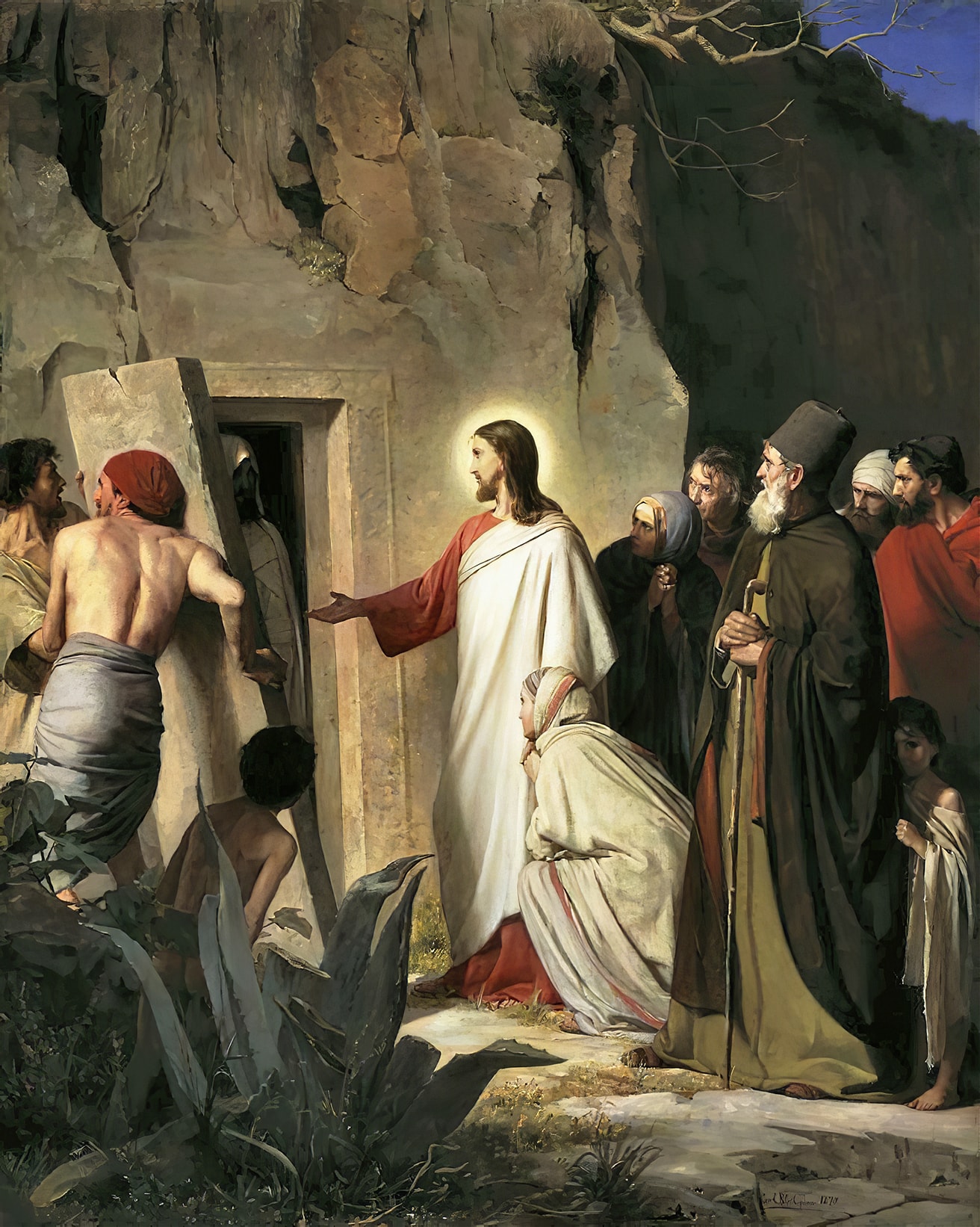
Carl Bloch painted what they found when they arrived, as one of twenty-three scenes from the life of Jesus for a royal chapel in Denmark. A bare-backed man braces a heavy stone slab beside the opening, while another crouches below it. Jesus stretches one arm toward the dark doorway, his palm turned upward—and inside the doorway a figure stands upright, bound in pale grave cloths. It is Lazarus. A woman kneels beside Jesus with a hand held near her chin, looking toward the tomb. At the far right, a small barefoot child peeks out from behind an old man’s robe and looks straight at us.
Bloch does not identify Thomas among the onlookers. But Thomas’s words give the scene another layer. He had urged the others to go with Jesus even if the journey meant death. Now the story has brought them to a doorway where death is being undone.
If you are taking your faith apart, remember where Thomas’s story starts. It does not start with a question. It starts with a man who loved someone enough to walk toward danger with him. Your questions hurt because you cared that much. You do not have to decide that every earlier prayer was foolish before you can ask an honest question now. And an earlier commitment does not oblige you to swallow a present concern. Both belong to the same life.
Visio Divina Prompt: Find the doorway and the wrapped figure in it. Then find the child who is looking at you. Which of the watchers are you today?
The Question He Asked Out Loud
“Lord,” said Thomas, “we do not know where You are going, so how can we know the way?”
John 14:5 · BSB
No painter in this collection chose the second scene, so picture it yourself. It is the night before Jesus dies, at the last meal he shares with his friends. He tells them he is going away to prepare a place for them, and then he says: “You know the way to the place where I am going” (John 14:4).
There are eleven disciples at that table with Jesus. It is the kind of sentence people nod along to. Thomas does not nod. He says what is true: we do not know where You are going, so how can we know the way? Notice the “we.” He is asking on behalf of the whole table.
What he gets back is one of the best-known sentences in the Bible: “I am the way and the truth and the life” (John 14:6). It exists because one man admitted, out loud, that he was lost.
Many rooms run on an unspoken rule that everyone already understands. If you grew up in one, you know what it costs to raise your hand. Thomas pays that cost, and the whole table gets the answer. An honest question is not the opposite of faith. In this story, it is how faith gets one of its best answers.
A question to carry: What have you been nodding past?
The Demand for Evidence
Then Jesus said to Thomas, “Put your finger here and look at My hands. Reach out your hand and put it into My side. Stop doubting and believe.”
John 20:27 · BSB
Now the famous week. On the evening of the first Easter, the disciples are hiding behind locked doors when Jesus comes and stands among them and shows them his hands and his side. Thomas is not there. John does not say why.
When he comes back, the others tell him, “We have seen the Lord!” His friends’ testimony is not enough for him, and his answer is the line that earned him the nickname: “Unless I see the nail marks in His hands, and put my finger where the nails have been, and put my hand into His side, I will never believe” (John 20:25).
Two details are easy to miss. First, most of what Thomas asks for, the others had already been given: Jesus had shown them his hands and his side. Like them, Thomas wants to see the wounds for himself. He goes one step further and insists on touching them. Second, John writes, “Eight days later.” For a week Thomas is the only person in the room who has not seen what everyone else is celebrating. He does not leave. They do not push him out. “Thomas was with them.” His doubt did not cost him his belonging.
Then Jesus comes again, through the same locked doors, and repeats Thomas’s conditions back to him almost word for word—conditions Thomas had set when, as far as anyone knew, Jesus was not in the room.
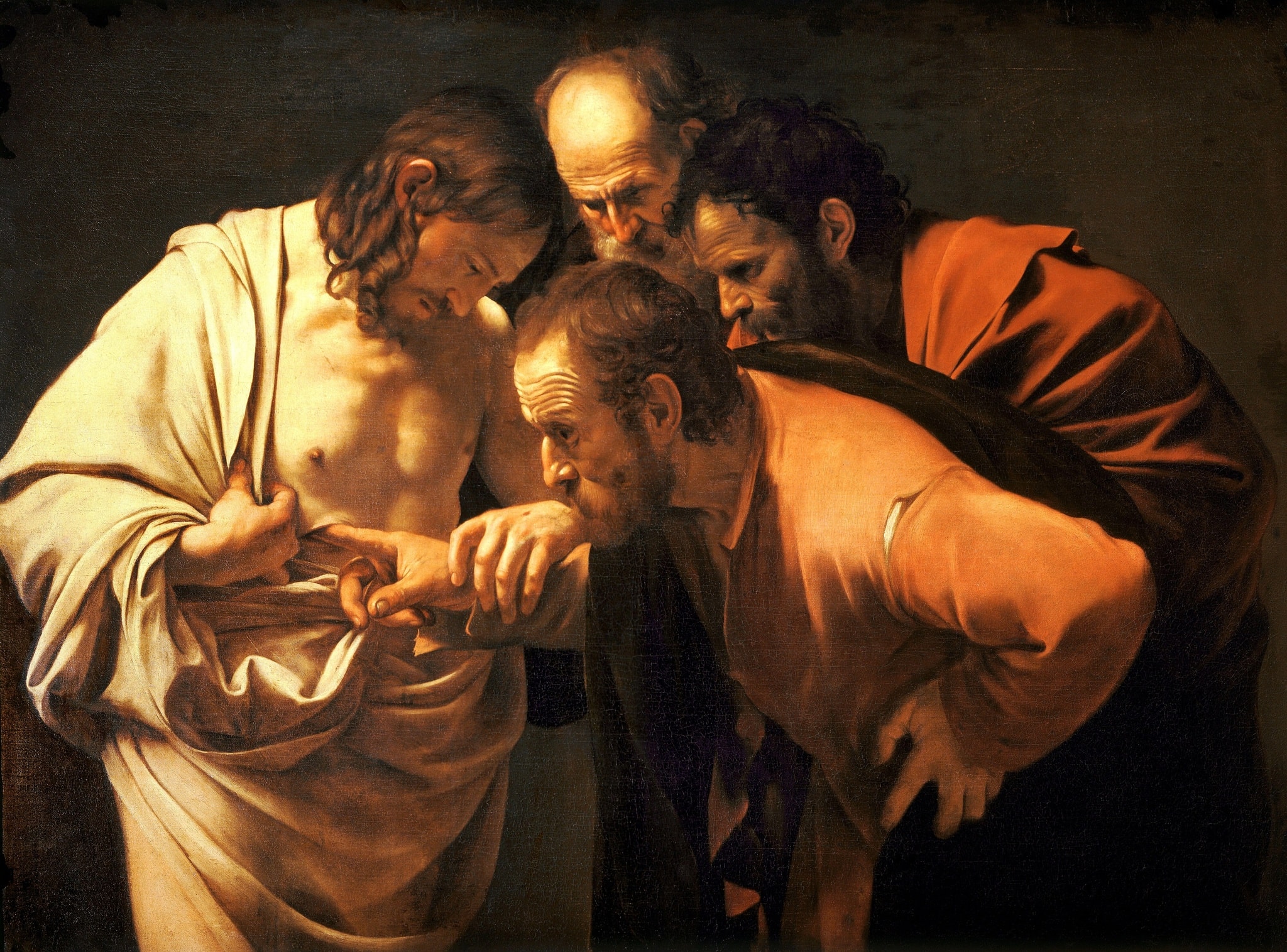
Caravaggio painted the next second for a banker named Vincenzo Giustiniani; it hangs today in the Sanssouci Picture Gallery in Potsdam, Germany. Four heads press together so closely they almost touch. Jesus has Thomas by the wrist and is steering his finger into the wound—right in, the skin lifting over the fingertip. Thomas’s forehead is ploughed with lines. His sleeve has split at the shoulder seam, and there is dirt under his thumbnail; the worn clothes and rough hands bring the scene close to ordinary life. And look at the two disciples behind him. In John’s telling, the other disciples had seen Jesus a week earlier. In Caravaggio’s painting, the two men behind Thomas lean toward the wound anyway, brows furrowed, watching just as intently. Whatever Thomas is doing, he is not doing it alone.
One thing to know: John never says that Thomas touched. Jesus makes the offer, and the next thing we hear is Thomas’s answer. Caravaggio decided that he did, and painted it so that you cannot look away. The picture is one reading of the story, not a record of it.
Wanting evidence is not the same as refusing to believe. If you are in the middle of your own demand for evidence, a useful first step is to ask what, exactly, you are trying to find out. Whether a historical claim is reliable, whether a leader can be trusted, and whether God is good are connected questions, but they are not the same question. Naming the one that is actually yours makes it smaller, and more honest.
Caravaggio Visio Divina Prompt: Look at the two hands beside the wound. Whose hand is guiding the other?
The Personal Encounter
Thomas replied, “My Lord and my God!”
John 20:28 · BSB
Five words. It is a confession of faith, arguably the strongest thing anyone says to Jesus in the whole Gospel of John, and it comes from the last holdout in the room.
Then Jesus says something that is not really for Thomas at all: “Because you have seen Me, you have believed; blessed are those who have not seen and yet have believed” (John 20:29). That blessing is aimed over Thomas’s shoulder, at everyone who would ever hear this story without having been in the room. John says as much two verses later: “these are written so that you may believe” (John 20:31). The blessing is for readers. It is for you.
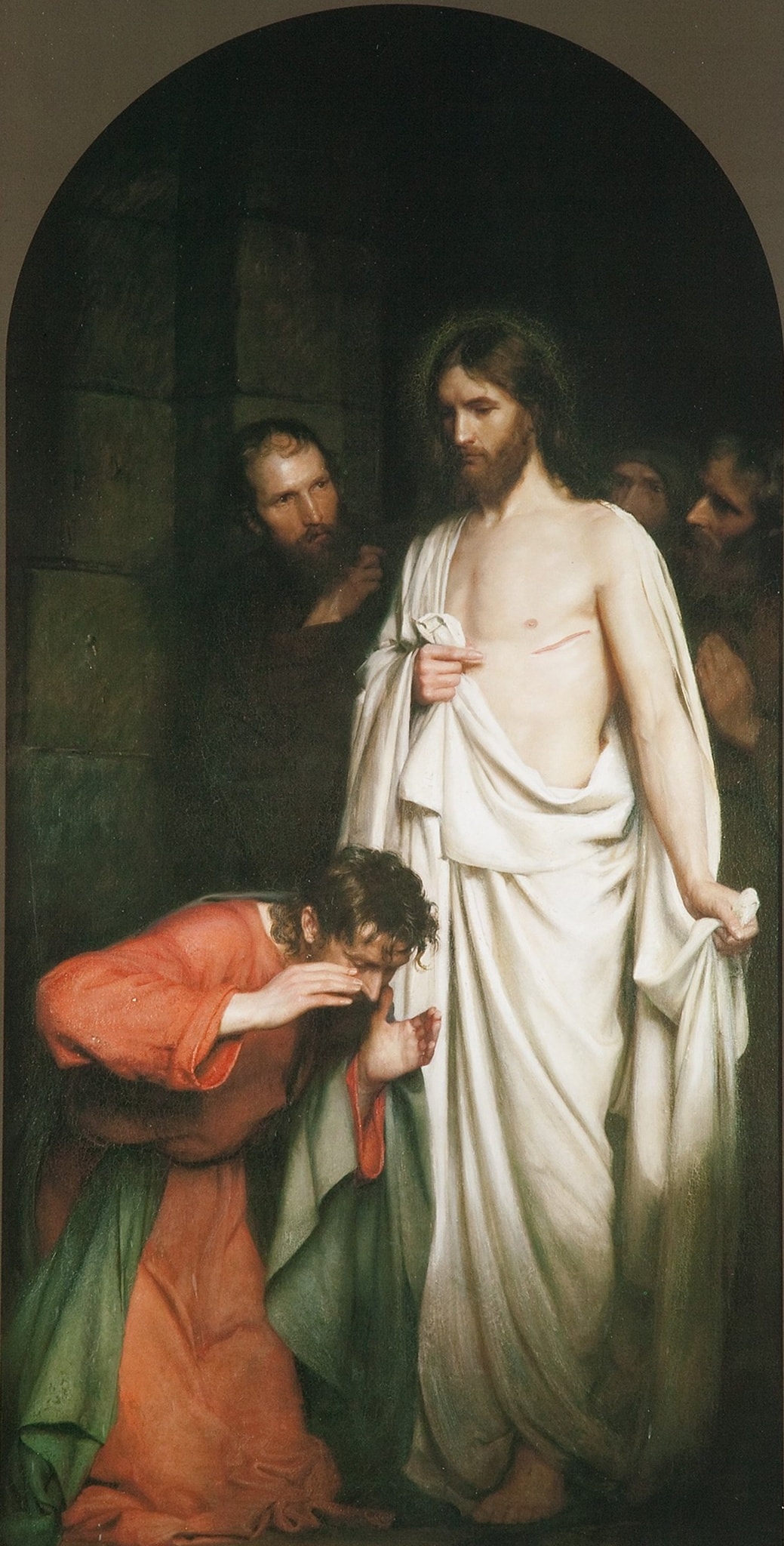
Carl Bloch painted this scene in 1881 as the altarpiece for a village church in Ugerløse, Denmark, and it makes a striking contrast with Caravaggio. His Thomas is not touching the wound. He kneels with his head bowed, one hand raised beside his face and the other held open. Jesus stands over him with his robe drawn aside and the wound in plain view, and Thomas, head down, is not looking at it. Jesus’ head is bent toward him, eyes lowered.
So two painters read the moment John leaves open in two different ways. Caravaggio paints a close inspection, finger in the wound. Bloch paints a bowed head and an open hand, and the scene feels less like an examination than an encounter.
Jesus does challenge Thomas. “Stop doubting and believe” is not an endorsement of refusing forever to consider other people’s testimony. But look at how the challenge arrives: inside an encounter, after a week of patience, from someone who came back for one person and offered exactly what that person had asked for. If “stop doubting” has been used on you to end a conversation, notice the difference. Being told to stop asking is not the same as being met.
Visio Divina Prompt: Look at Thomas’s two hands, then at Jesus’ face. If you were kneeling there, what would your hands be doing?
→ More of this painter: 27 Carl Bloch Paintings of Jesus
Hope While Questions Remain
But if we hope for what we do not yet see, we wait for it patiently.
Romans 8:25 · BSB
You may not finish this journey where Thomas finishes his. His week ended in a locked room with the answer standing in front of him. Yours may not end that way, or not yet. So the last painting is not of Thomas at all.
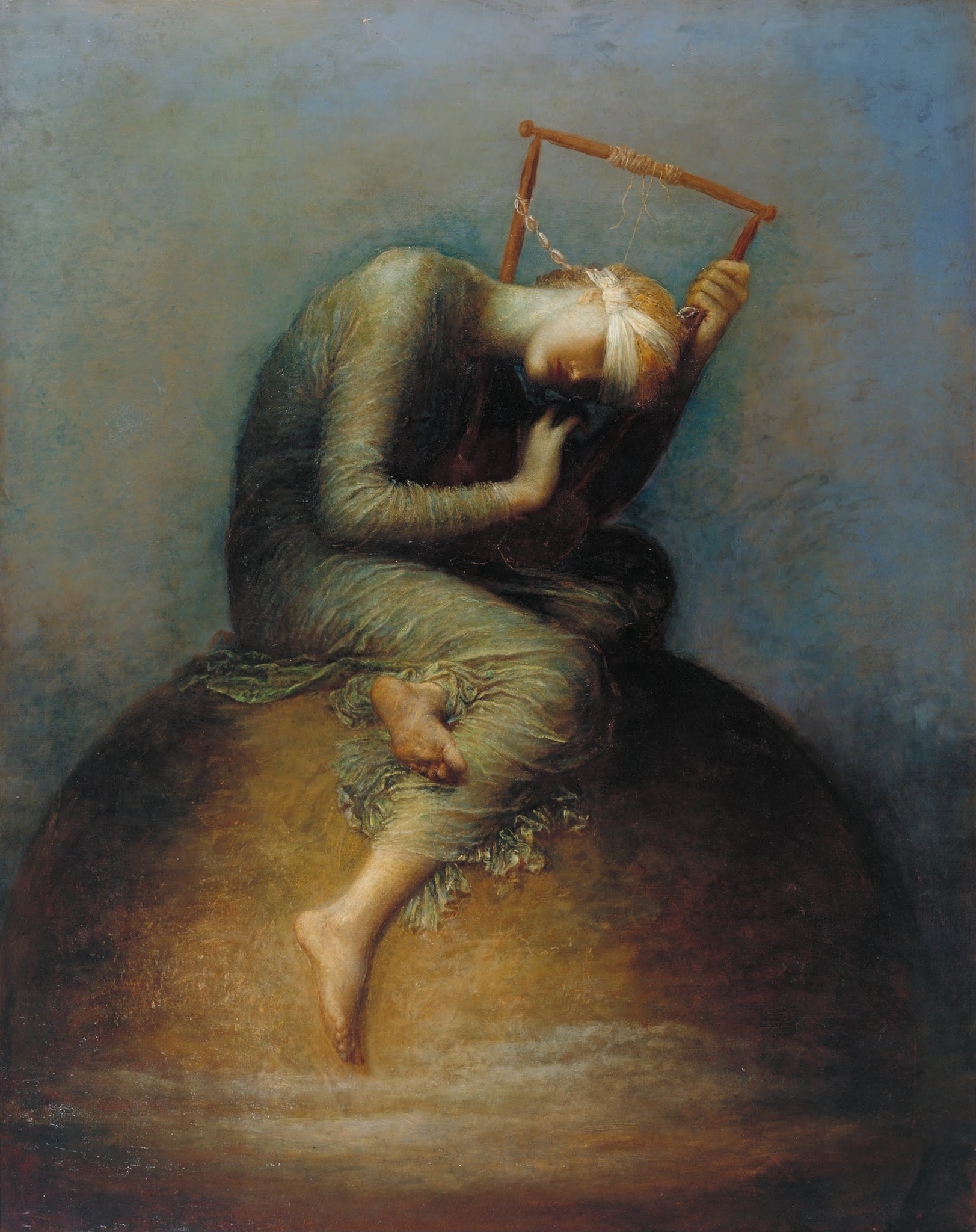
George Frederic Watts painted Hope in 1886, and it is an allegory: a picture of an idea rather than a person. A young woman sits on top of a globe, blindfolded, bent nearly double over a small wooden lyre. Every string has snapped but one; you can see the broken ends hanging loose from the crossbar. She plays the one that is left, bending her head close to the lyre to listen.
Not everyone saw hope in it. Several critics thought the picture would have been better titled Despair. Watts meant every inch of it; in a letter he described the lyre as having “all the strings broken but one.” Decades later Martin Luther King Jr. preached about this painting in a sermon called “Shattered Dreams,” describing her seated on top of the world with her head bowed, plucking the one string that had not broken.
Set beside that line of Scripture—Paul, in Romans 8:24–25, on hoping for what we do not yet see—the painting asks a quieter question than “what do I believe?” It asks: what is my one string? Perhaps you can still tell the truth. Perhaps you can sit with someone in pain without offering an explanation you no longer believe. Perhaps your whole prayer is making yourself available to whatever is true. None of that settles the resurrection or any other disputed claim. It keeps you humane and attentive while you look.
One caution: the blindfold is not advice to stop examining evidence. Thomas’s whole story says otherwise. And you are allowed to move slowly. Uncertainty is not indifference.
Visio Divina Prompt: Notice the loose string ends beneath the crossbar, then the way she bends close to listen. What might it mean to make music with what remains?
A 4-Step Visio Divina Practice for Doubt
Go back to the painting that held your attention longest, even if it did not make you comfortable, and take a few unhurried minutes to move through these four steps:
- Look (Visio): Read the Scripture beside the painting, then rest your eyes on one physical detail: the finger at the wound, Thomas’s raised hand, the loose strings beneath the lyre’s crossbar. Describe what is actually there before deciding what it means.
- Meditate (Meditatio): Name the question that feels too important for a rehearsed answer. Say it as specifically as you can. You do not have to defend it or resolve it.
- Pray (Oratio): Use these words, or your own: God, if you are here, meet me in the truth of my questions. Protect me from pretending, and from using certainty or skepticism to keep every encounter at a distance. Give me patient companions, careful judgment, and courage to follow what is true. Receive what I can honestly offer today. Amen.
- Contemplate (Contemplatio): Sit in silence for two minutes without composing a defense of your beliefs. You may finish with the question still open.
Where Thomas Went Next
The Bible’s last glimpses of Thomas are quiet ones. He is in the boat when Peter goes back to fishing (John 21:2), and he is in the upstairs room in Jerusalem when the disciples gather to pray after Jesus has gone (Acts 1:13). He stayed.
After that, tradition takes over, and tradition sends him a very long way. The Saint Thomas Christians of Kerala, in southern India, trace their church to him; their tradition has him landing on that coast in the year 52 and dying near present-day Chennai about twenty years later. Historians argue over how much of this can be confirmed, and the main ancient source, a book called the Acts of Thomas, was written well over a century after his death. But it is a striking way to be remembered. The disciple with the nickname about doubt is also the one remembered for going to the far side of the known world.
His feast day is July 3 in the Catholic calendar (formerly December 21, a date still used in some Anglican calendars). Orthodox Christians remember him on October 6 and on the Sunday after Easter, which they call Thomas Sunday. This collection remembers him on All Saints’ Day, November 1, among people the church calls saints not because they were always sure, but because they stayed in the room.
→ Another disciple who got it wrong and stayed: The Life of Saint Peter · Explore all saints’ journeys: All Saints’ Day in Art
Stay with the Painting
If you want more time with one of these images, you can restore it yourself. Open Caravaggio’s Incredulity of Saint Thomas as a puzzle—piece by piece, with the verse waiting at the end. Or get the app for a new painting, a new verse, and a new reflection every morning.
Saint Thomas at a Glance
- Who: one of the twelve disciples of Jesus. John calls him “Thomas called Didymus”; both names mean “twin.”
- Where he speaks in the Bible: John 11:16 (“Let us also go”), John 14:5 (“how can we know the way?”), and John 20:24–29 (the locked room).
- What he is known for: asking to see and touch the wounds of the risen Jesus, and then saying, “My Lord and my God!”
- In art: usually shown reaching toward, or kneeling before, the wound in Jesus’ side. Painters also give him a builder’s square, from the later legend that he worked as a builder in India.
- Feast days: July 3 (Catholic; formerly December 21), October 6 and Thomas Sunday (Orthodox).
- Patron saint of: architects and builders, and India. Devotional writers often call him the patron saint of doubters.
FAQ
Is it a sin to doubt God?
An unwanted doubt or an honest question is not the same as deliberately rejecting what you believe to be true. Christian traditions distinguish these experiences differently. Thomas’s story invites you to bring uncertainty into conversation with God rather than hide it out of shame.
How to pray during faith deconstruction?
Begin with what you can honestly say: “God, I am not sure what I believe.” Look at one painting, name one question, offer a short prayer, and sit quietly. You do not need to resolve every belief before beginning.
Who is the patron saint of doubters?
St. Thomas the Apostle is often called the patron saint of doubters in devotional writing because of John 20. Here, the title describes a spiritual association rather than a claim of formal designation. His story offers companionship when belief feels difficult.
Source: Commonweal, “My Patron, Thomas the Doubter”.
Why is he called Doubting Thomas?
Because of one sentence. When the other disciples told him they had seen the risen Jesus, Thomas asked for evidence: “Unless I see the nail marks in His hands … I will never believe” (John 20:25). The nickname ignores his other two scenes in John’s Gospel, where he is brave (John 11:16) and honest (John 14:5).
Did Thomas actually touch Jesus’ wounds?
The Bible does not say. Jesus invites him to (“Put your finger here”), and the next words are Thomas’s: “My Lord and my God!” (John 20:27–28). Caravaggio painted him touching the wound; Carl Bloch painted him kneeling without touching it. Both are interpretations.
What does the Bible say about doubt?
More gently than many people expect. “Have mercy on those who doubt” (Jude 1:22). When the risen Jesus met his disciples in Galilee, “they worshiped Him, but some doubted” (Matthew 28:17), and he gave all of them their mission anyway. One father’s prayer has been borrowed ever since: “I do believe; help my unbelief!” (Mark 9:24).
What happened to St. Thomas after the Bible?
The New Testament last mentions him in Acts 1:13, praying with the other disciples in Jerusalem. Early tradition says he traveled east and preached in India, where the Saint Thomas Christians of Kerala trace their origins to him. Historians debate the details; the tradition itself is very old.