In Carl Bloch’s paintings of Jesus, someone is usually close enough to touch him: a child, a sick man, a frightened disciple, even the man mocking him. That closeness is a good place to begin. Before we know the date of a painting or the name of its patron, we recognize the human encounter.
We follow the story of Jesus from the Annunciation to the Resurrection and its aftermath. Each painting is paired with a Bible passage and a close reading of Bloch’s choices as a painter. Along the way, we meet the artist behind these familiar faces and the disagreements his work has provoked.
If you would like to begin with a painting you can explore interactively, open Bloch’s The Sermon on the Mount in our gallery. You can assemble the image as a puzzle, then spend time with its Scripture and reflection.
Who was Carl Bloch?
Carl Heinrich Bloch (1834–1890) was a Danish painter whose route into art began with a different career in mind. As a boy in Copenhagen, he prepared for the navy. Drawing captured his attention more successfully than his other lessons; at fifteen, he entered the Royal Danish Academy of Fine Arts. A scholarship took him to Italy in 1859. On his travels, Rembrandt’s treatment of light and shadow made a lasting impression.Source: BYU Magazine’s biography
The painter now associated with Jesus became a sensation in Denmark with a figure from Greek mythology. His Prometheus Unbound, commissioned for the king of Greece, became a celebrated attraction when exhibited in Copenhagen in 1865. Bloch’s career encompassed portraits, religious scenes, and everyday encounters; the National Gallery of Denmark’s exhibition Carl Bloch—Seduced brought that wider range back into view in 2023.Sources: SMK’s exhibition account; the story of Prometheus Unbound
One unexpected name behind the Jesus paintings is Carlsberg. Frederiksborg’s account of the commission identifies the brewery’s founder, J. C. Jacobsen, as the patron who commissioned Bloch’s new Gospel scenes for the King’s Oratory after the castle’s devastating 1859 fire. A brewer’s patronage helped create images that would travel far beyond a Danish royal prayer chamber.
Bloch married Alma Trepka in 1868, while work on the castle paintings was under way. His friends included the writer Hans Christian Andersen. Family life and a demanding public career developed together; later came the loss of Alma in 1886, seven years after the cycle’s completion. Bloch died in 1890. The paintings survived him to meet audiences he would never know.Source: BYU Magazine
How to follow these 27 paintings
The sequence below is a reading journey through the Gospels, followed by a final painting of Christ’s invitation to the weary. It does not claim that all four Gospels arrange every event in the same order. The Annunciation and Visitation belong to the story of Jesus before his birth, even though he is not visibly present in those pictures.
Bible quotations are from the Berean Standard Bible (BSB). A painting can supply a face, a gesture, or a room that the text leaves undescribed. We will keep those contributions visible as Bloch’s interpretation.
The birth and childhood of Jesus
1. The Annunciation: God’s favor comes before Mary’s answer
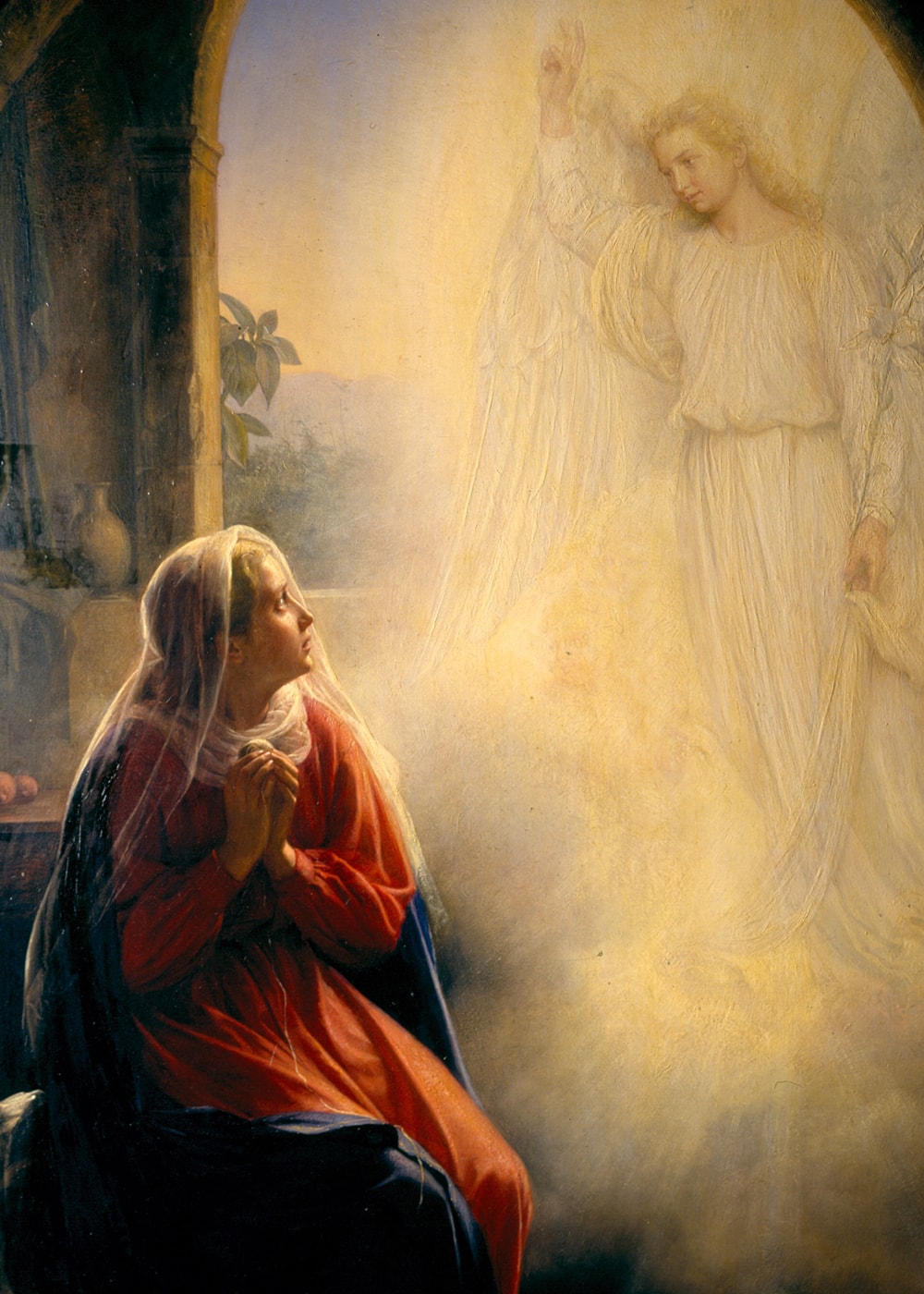
Bible story: Luke 1:26–38.
May it happen to me according to your word.
Luke 1:38 (BSB)
Gabriel tells Mary that God is with her before she agrees to become Jesus’ mother. He calls her favored before she has said yes. God’s favor is not presented as a reward for her agreement. Mary’s answer is a response to the love God has already shown her.
Bloch paints Gabriel almost blending into the bright light around him. Mary’s face and clasped hands are clearly defined near us. Her upward gaze connects the two figures. The angel fills much of the picture, but Mary’s response gives us a human way into an overwhelming event. We can look at her face while imagining what it means to receive those words.
2. The Visitation: two women trusting God’s promises
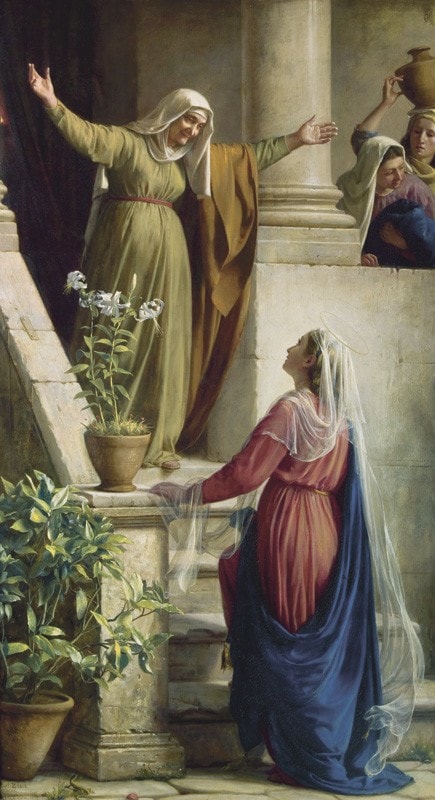
Bible story: Luke 1:39–45.
Blessed are you among women, and blessed is the fruit of your womb!
Luke 1:42 (BSB)
Bloch shows the women before they embrace. Elizabeth stands above Mary on the steps with both arms open. Mary has not yet reached her, but the welcome is already clear. The space between them lets us see Elizabeth responding to the arrival itself.
That choice fits Luke’s account: Elizabeth recognizes Mary’s unborn child as her Lord when she hears Mary’s greeting. Luke says she is filled with the Holy Spirit. Elizabeth then blesses Mary for believing God’s promise. She too is expecting a child after an extraordinary promise from God. In Bloch’s painting, Elizabeth’s open arms make it easy to imagine Mary being welcomed by someone who can understand her situation.
3. The Annunciation to the Shepherds: good news during an ordinary night’s work
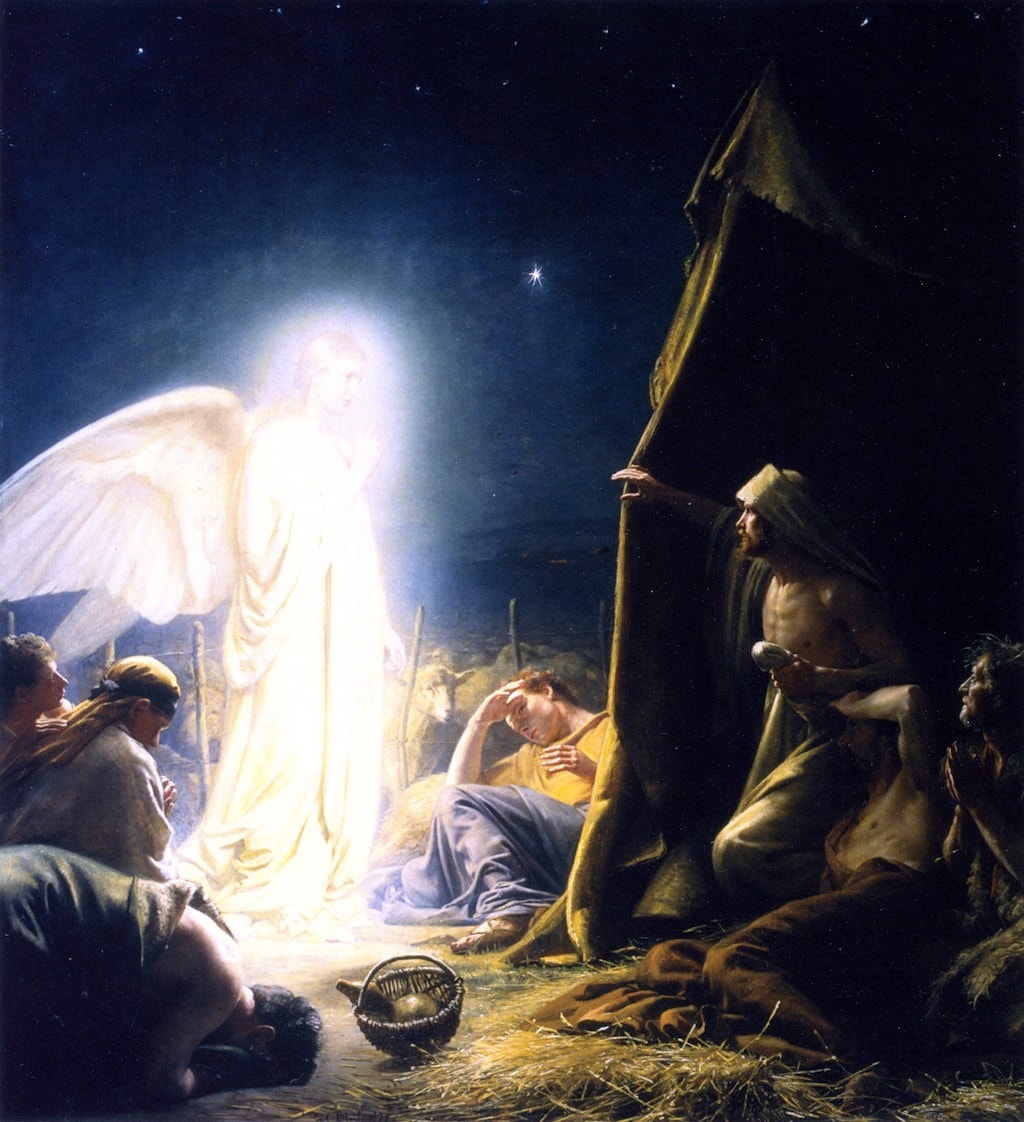
Bible story: Luke 2:8–14.
Do not be afraid!
Luke 2:10 (BSB)
The angel has appeared inside the shepherds’ campsite, close to their tent and provisions. Bloch gives the men different reactions: one shields his eyes, another clasps his hands, and another bends toward the ground. Their bodies help us follow the first shock of the announcement before they have had time to respond together.
The basket and scattered straw keep the scene connected to an ordinary night’s work. Then the angel gives these men a familiar sign to look for: a baby lying in a feeding trough. People who care for animals will find the Savior in a place used to feed them.
4. The Adoration of the Shepherds: a feeding trough and the bread of life
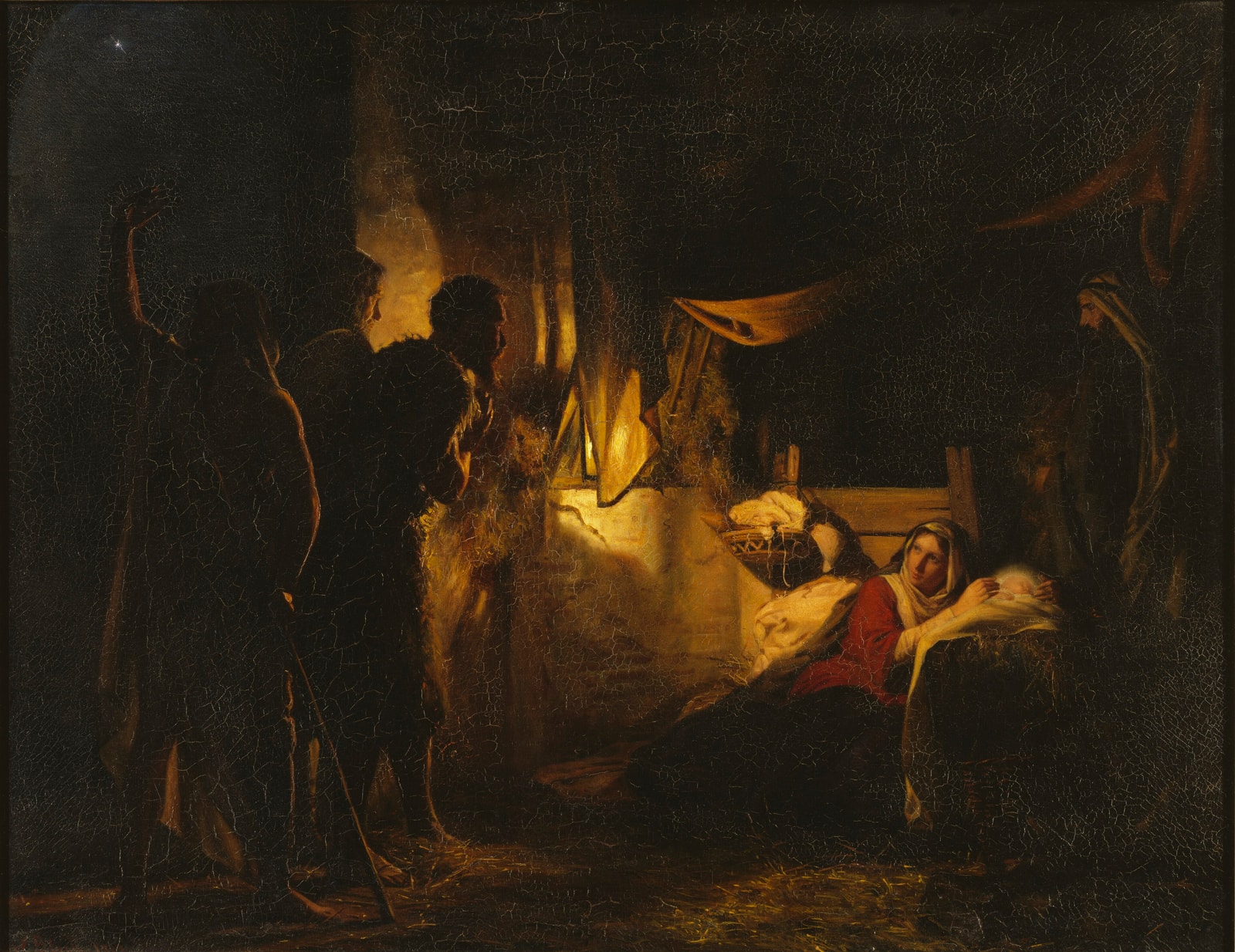
Bible story: Luke 2:15–20.
So they hurried off and found Mary and Joseph and the Baby, who was lying in the manger.
Luke 2:16 (BSB)
The shepherds occupy the left side of Bloch’s painting, close to the viewer. Mary and the baby are farther to the right, so we look past the visitors into the shelter. Mary turns toward them while keeping a hand near her child. The arrangement gives this great announcement the intimacy of people being welcomed into a family’s space.
A manger is a feeding trough. That detail can remind Christian readers of Jesus’ later description of himself as the bread of life. At the Last Supper, he will give bread to his disciples and call it his body. Reading these passages together connects his birth with his promise to give himself for others.
5. Jesus Found in the Temple: Jesus returns home with his parents
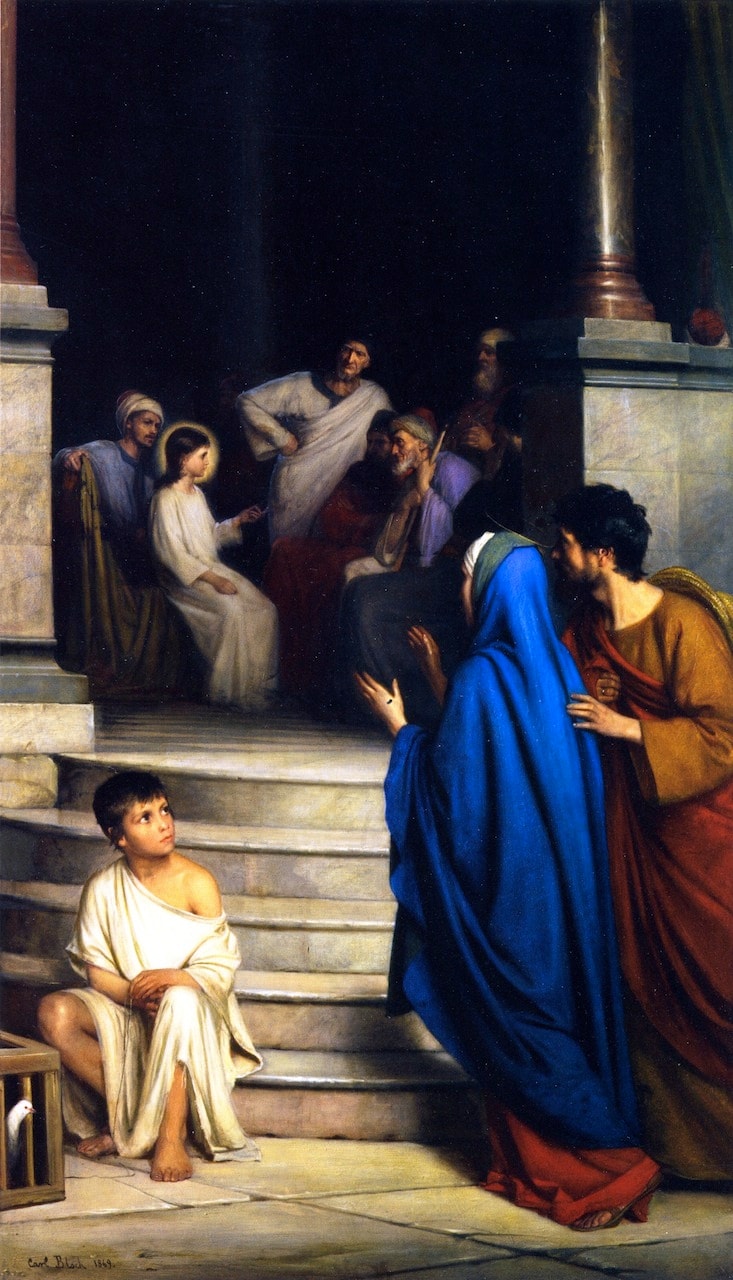
Bible story: Luke 2:41–52.
Did you not know that I had to be in My Father’s house?
Luke 2:49 (BSB)
Mary calls Joseph Jesus’ father. Jesus then speaks of his Father’s house, meaning God’s temple. Bloch lets us see the two relationships in one picture. Jesus sits among the teachers above the steps, while Mary and Joseph approach from below. We look toward him from near the parents’ position. Mary’s raised hands draw our attention to their concern, even as the discussion around Jesus continues.
Luke follows the exchange with a detail that is easy to miss: Jesus returns to Nazareth and obeys his parents. The distance between the two groups in the painting makes that return worth thinking about. The boy who amazes the teachers is also the child these parents have come to take home.
For another view of these early Gospel scenes, follow the life of the Virgin Mary in paintings, which also includes Bloch’s Annunciation.
Teaching, healing, and the people around Jesus
6. The Baptism of Christ: John thinks Jesus should baptize him
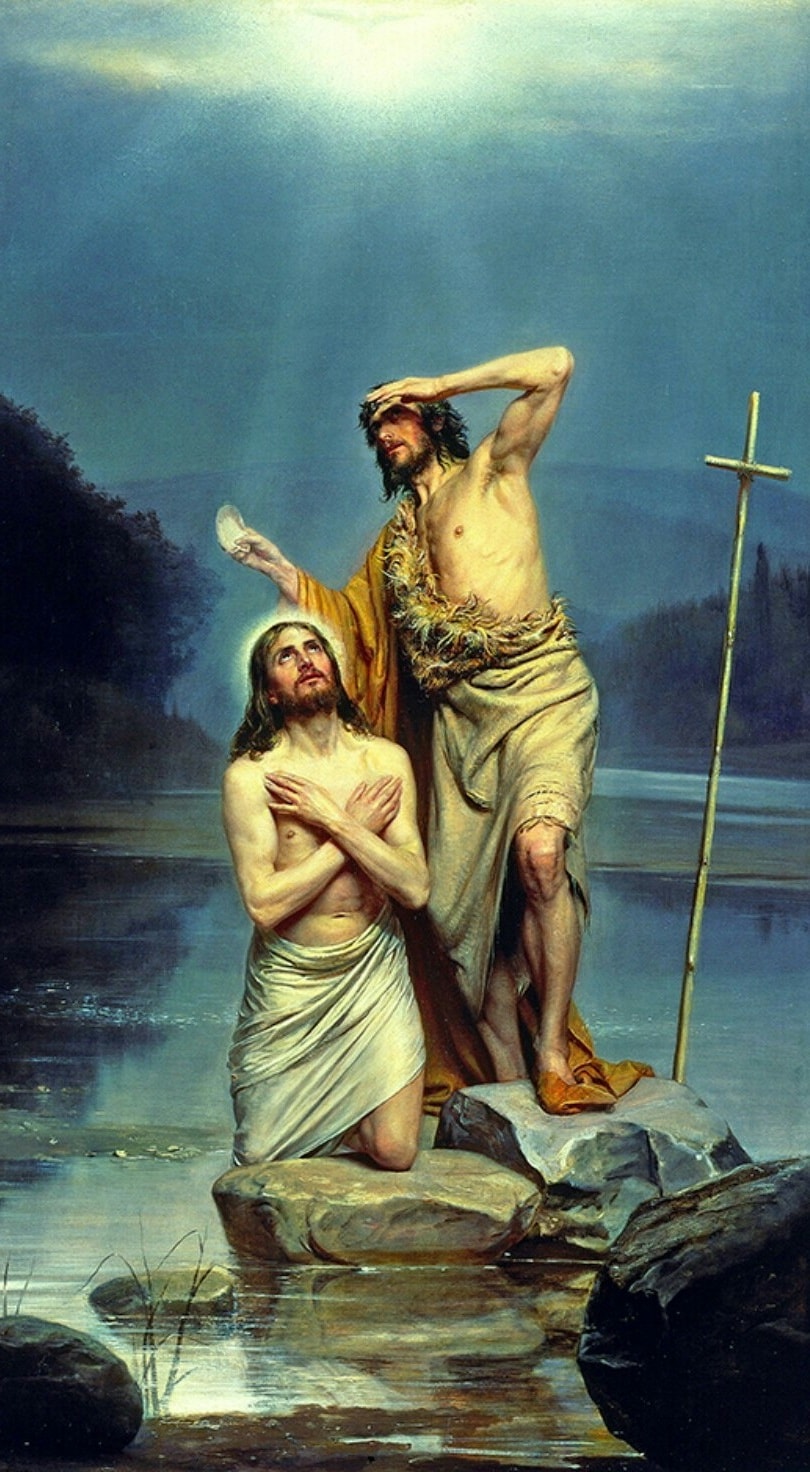
Bible story: Matthew 3:13–17.
This is My beloved Son, in whom I am well pleased!
Matthew 3:17 (BSB)
John thinks Jesus should be baptizing him, so he tries to stop the baptism. Jesus asks him to go ahead. Bloch makes this reversal visible by placing John above Jesus, who kneels on a rock with his hands crossed over his chest. The person John considers greater has accepted the lower position and is receiving baptism from him.
Both figures also respond to the light above them. Jesus looks upward, while John raises his free hand to shield his eyes. Their attention moves ours beyond the baptism to the Father’s declaration in Matthew: Jesus is his beloved Son. Bloch brings the act of receiving and the heavenly announcement into the same scene.
7. Jesus Casting out Satan: Jesus answers with words from Deuteronomy
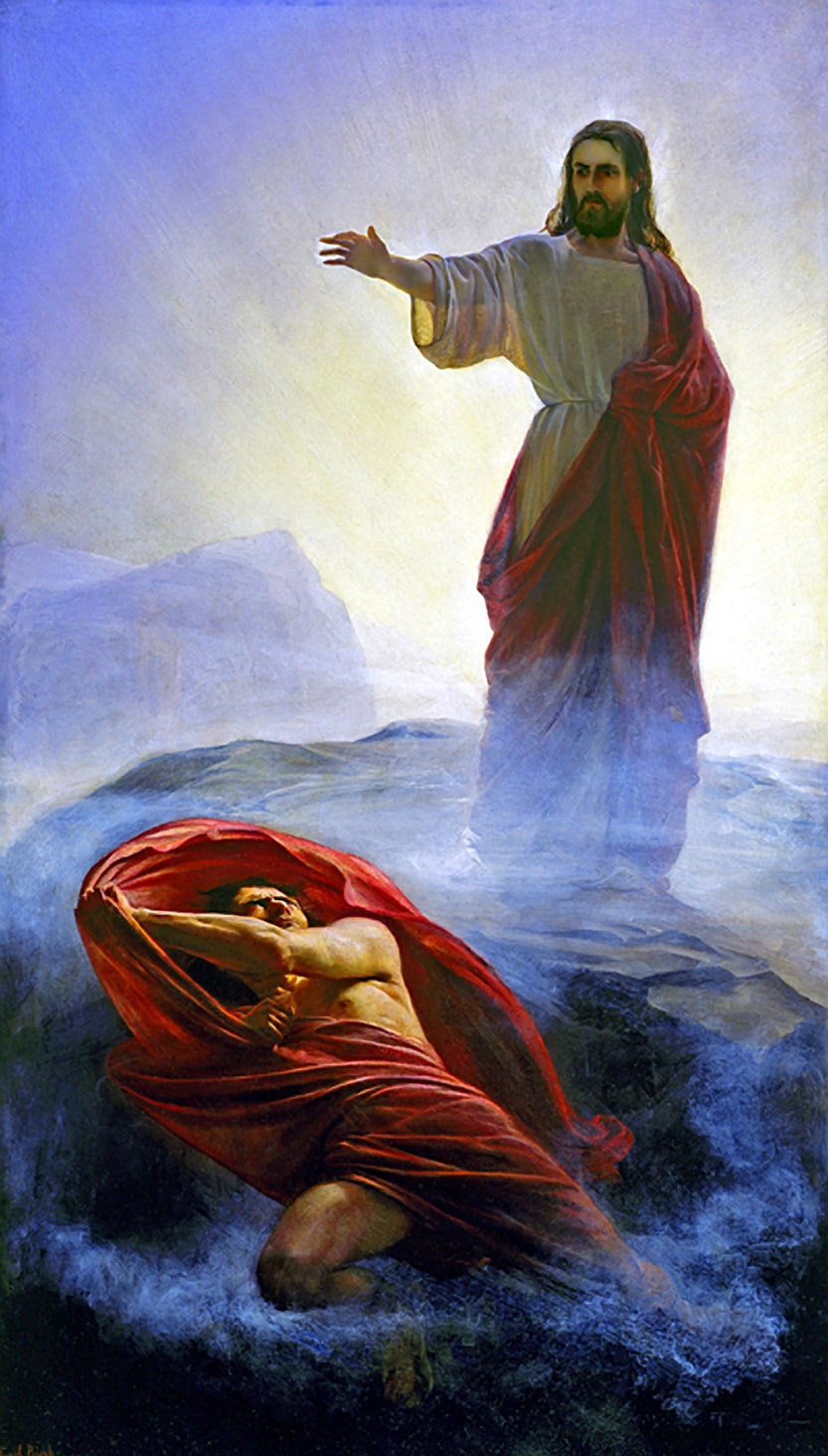
Bible story: Matthew 4:1–11.
Worship the Lord your God and serve Him only.
Matthew 4:10 (BSB)
Jesus answers each of Satan’s three temptations by quoting Deuteronomy. That book recalls Israel’s years in the wilderness, and Jesus’ forty days invite a comparison with Israel’s forty years. Satan’s final offer is power over kingdoms in exchange for worship. Jesus will serve God alone.
Bloch chooses the moment of dismissal. Jesus stands upright with one arm extended, while Satan recoils and draws his cloak around his head. There is no physical struggle between them. The authority comes through Jesus’ gesture and the tempter’s response. The painting gives a decisive ending to the argument we hear in the Gospel.
8. The Wedding at Cana: the servants know where the wine came from
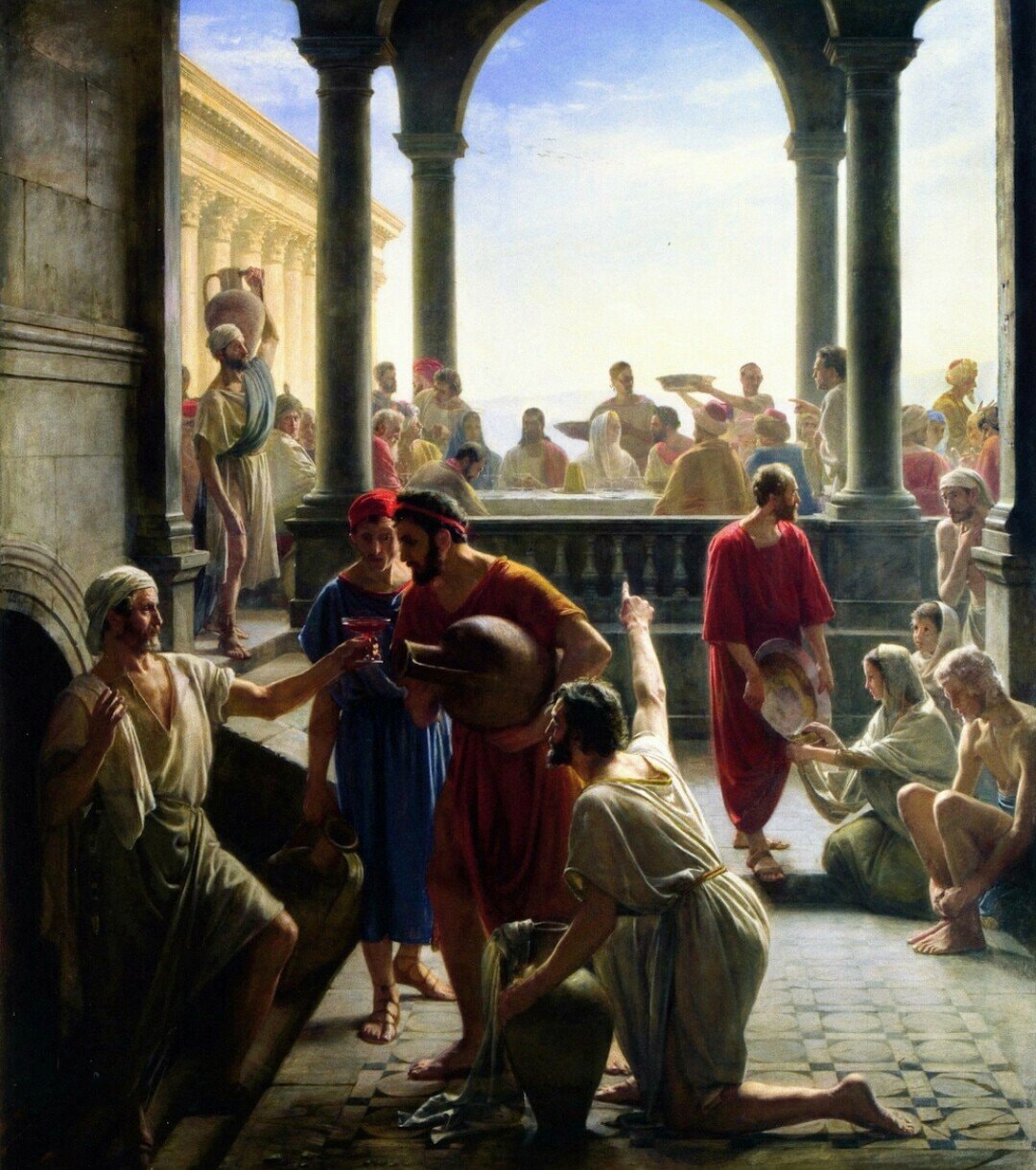
Bible story: John 2:1–11.
Do whatever He tells you.
John 2:5 (BSB)
The servants and their vessels fill the foreground, while Jesus sits much farther back at the table. Bloch puts us near the work of handling the water and wine. We discover the miracle through the people responding to its result, and then have to look beyond them to find Jesus.
That arrangement fits John’s detail that the servants know where the wine came from. The master of the banquet tastes it without knowing its source. The people doing the work know more than the man in charge. Bloch’s distant placement of Jesus also makes a simple point visible: someone can enjoy the gift without immediately noticing its giver.
9. Woman at the Well: Jesus begins by asking her for help
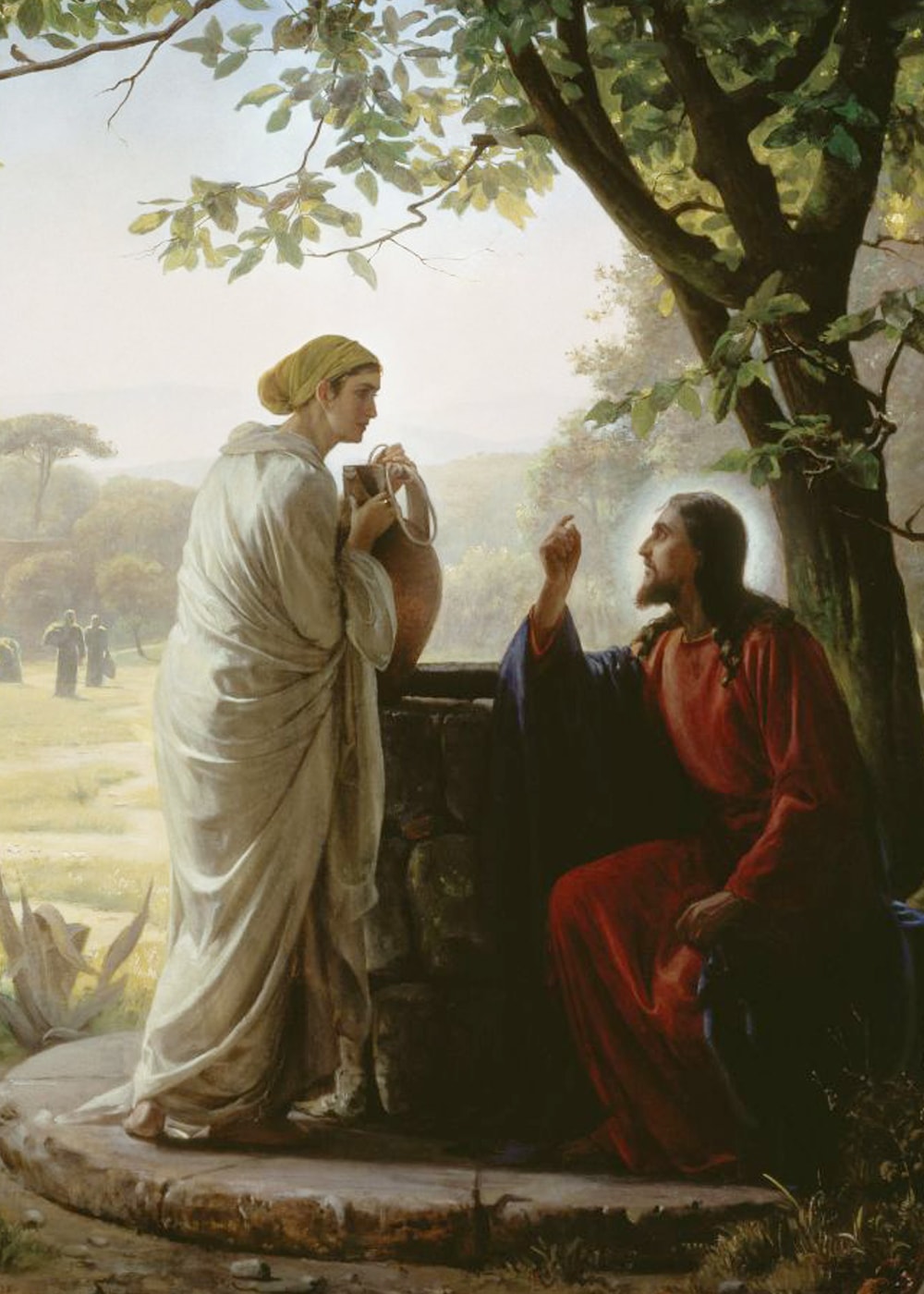
Bible story: John 4:5–30.
But whoever drinks the water I give him will never thirst.
John 4:14 (BSB)
Jesus begins by asking the Samaritan woman for a drink. Bloch keeps that request visible through the water jar beside her. She stands in the foreground while Jesus sits and looks up toward her. Their faces are turned toward each other, and the other figures are far down the path. The space gives their conversation our full attention.
She is surprised that a Jewish man would ask a Samaritan woman for help. Later, Jesus tells her that he knows about her marriages. She continues asking about worship and the Messiah. Bloch gives her a strong, active presence in the scene. She has questions of her own, and the painting lets us see an exchange in which both people are engaged.
10. The Sermon on the Mount: Jesus blesses people who are still grieving
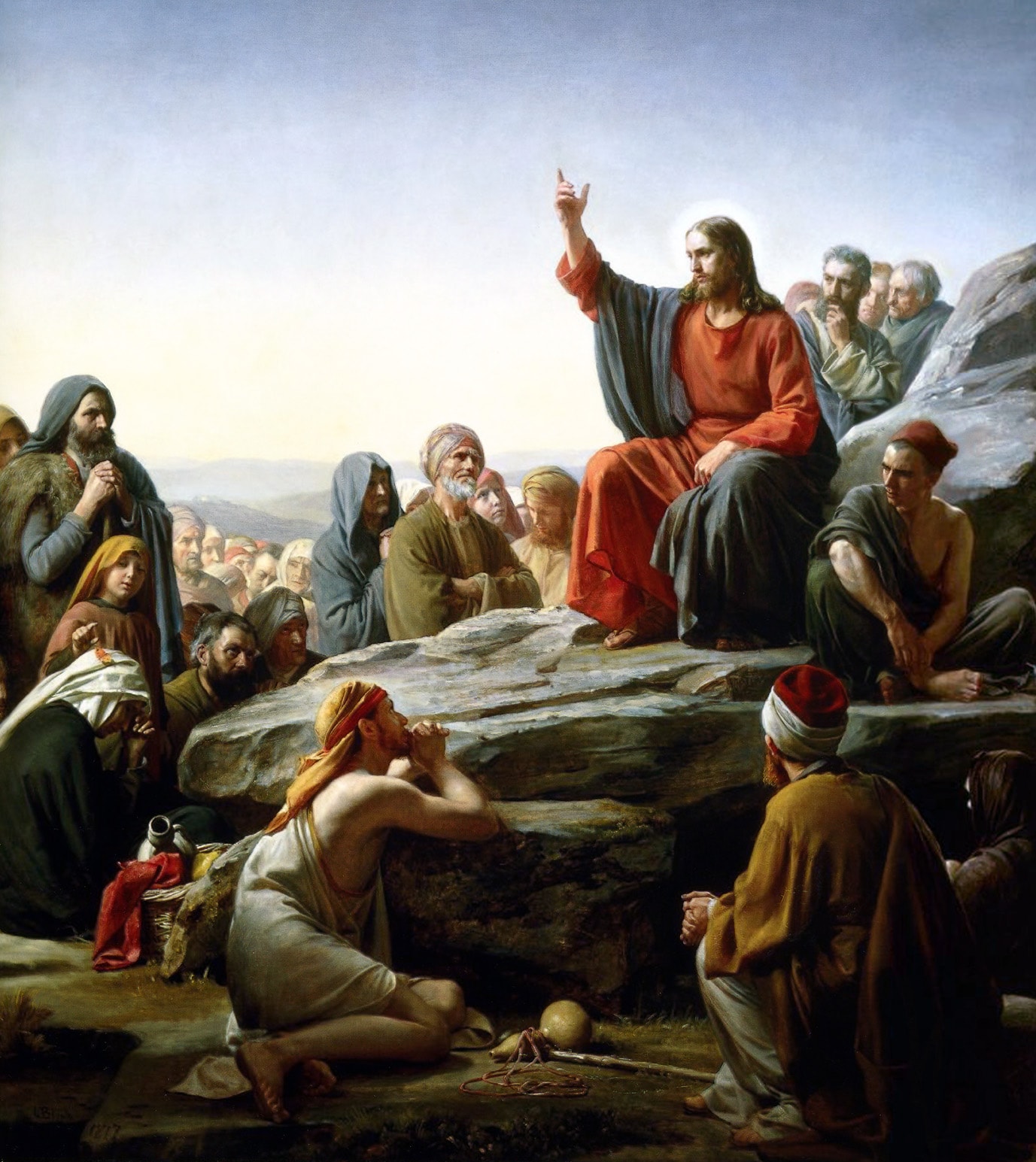
Bible story: Matthew 5–7; the Beatitudes, Matthew 5:1–12.
Blessed are the pure in heart, for they will see God.
Matthew 5:8 (BSB)
The Beatitudes are the opening blessings in the Sermon on the Mount. Jesus calls people blessed while they are still grieving, poor in spirit, or meek. He promises comfort to those who mourn before that comfort has arrived.
Bloch places listeners close to us with their backs turned, so we look into the gathering from behind them. Jesus sits higher on the rock, his raised hand clear against the sky. Around him, people clasp their hands, fold their arms, or lower their heads. The different responses keep the crowd from becoming an anonymous background. We cannot know each person’s circumstances, but we can imagine the same words reaching them differently.
Look more closely at The Sermon on the Mount in Visio Divina.
11. Christ Healing the Sick at Bethesda: the man can now carry his mat
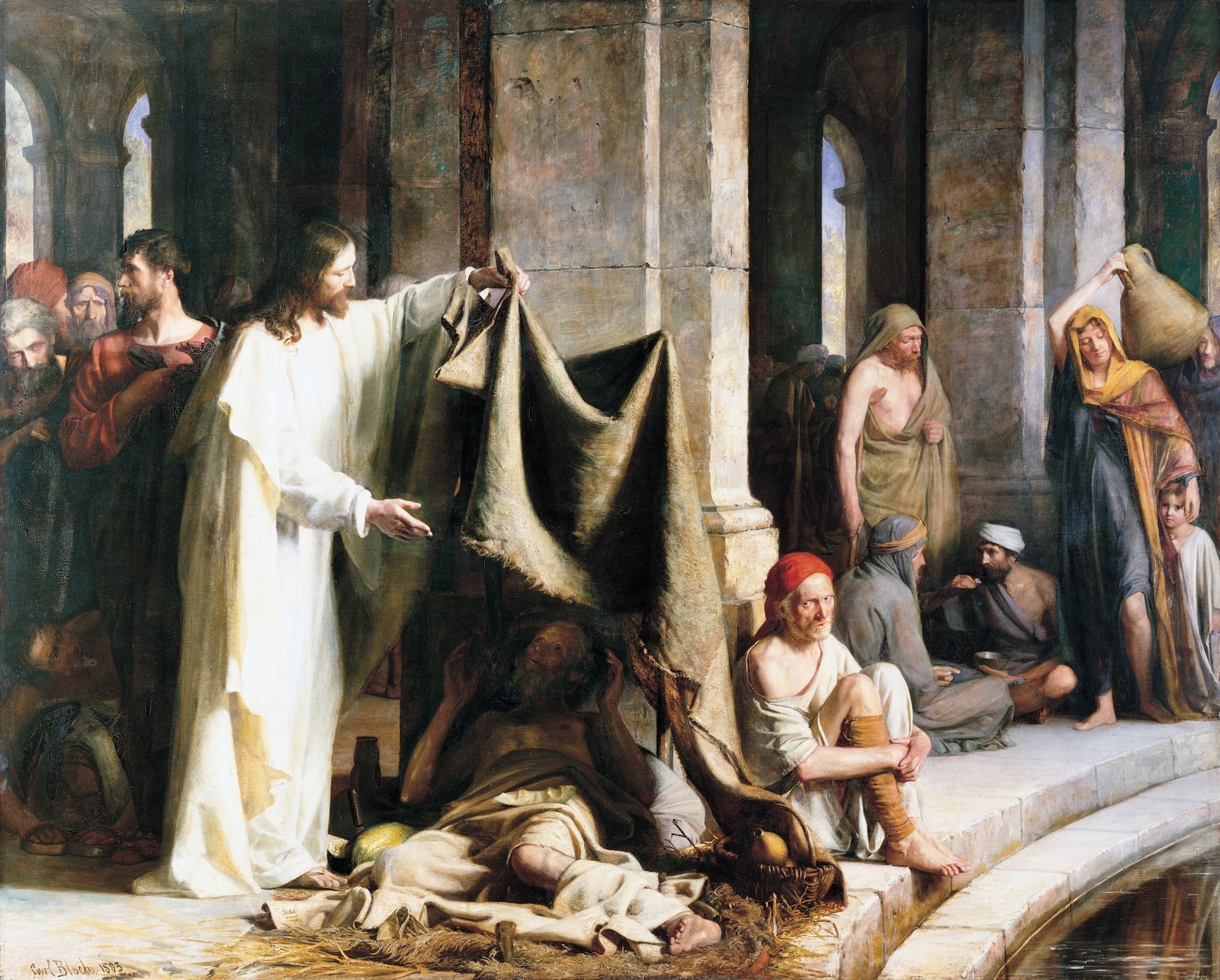
Bible story: John 5:1–9.
Get up, pick up your mat, and walk.
John 5:8 (BSB)
Bloch shows Jesus lifting the cloth over the sick man. This simple gesture opens a dark, partly hidden space to our view. The man is still lying down, and his bedding occupies the foreground. Before we read about his recovery, the painting makes his physical dependence easy to see.
The man says he cannot reach the pool before someone else gets in. Jesus tells him to get up, pick up his mat, and walk. He is healed without entering the water. The bedding that has supported him will become an object he can carry. By showing him before he stands, Bloch gives that later action more weight: we have seen what getting up will change.
Artwork note: This 1883 painting is separate from the Frederiksborg cycle. BYU Museum of Art acquired it in 2001.Source: BYU Magazine
12. The Daughter of Jairus: after raising the girl, Jesus asks that she be fed
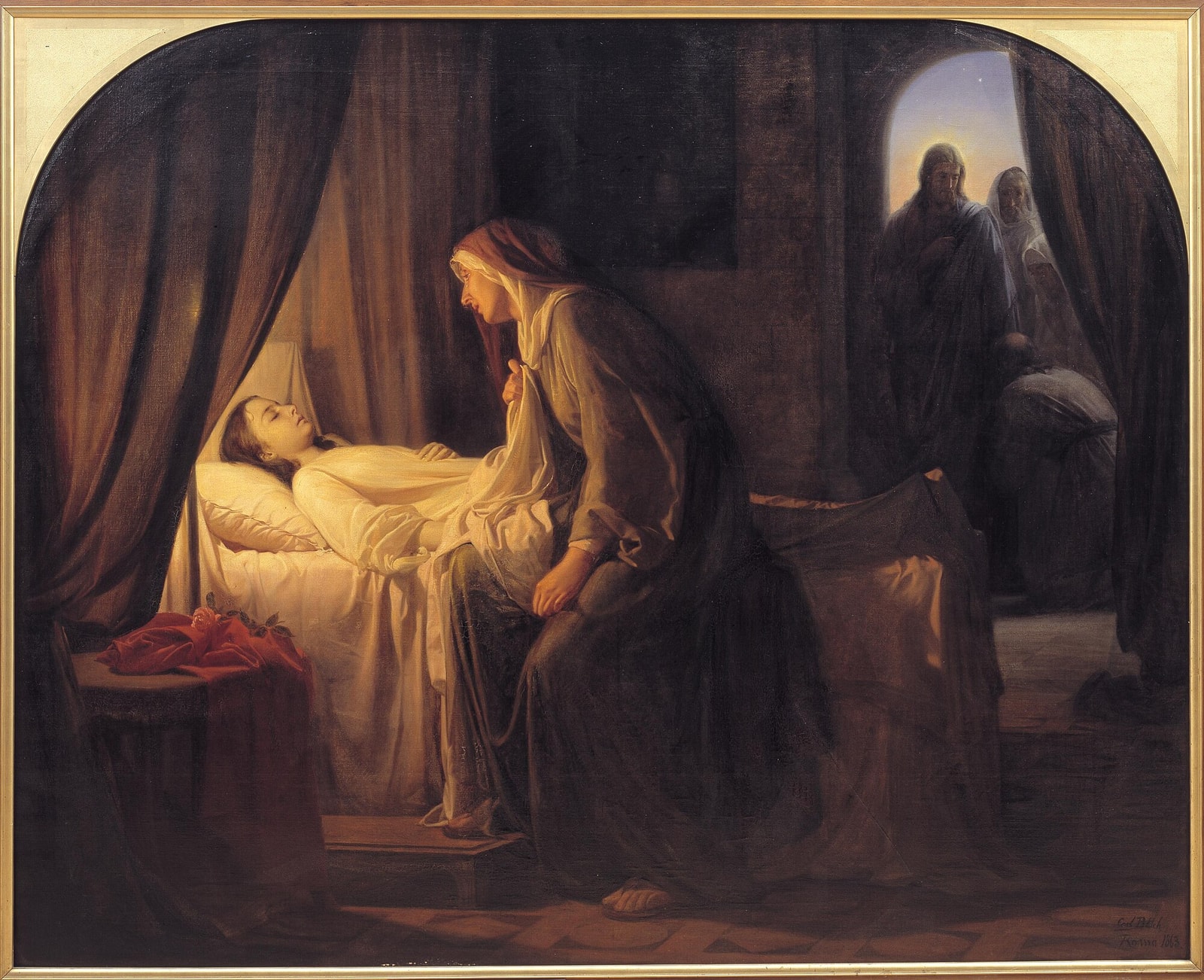
Bible story: Mark 5:21–43.
Little girl, I say to you, get up!
Mark 5:41 (BSB)
Bloch keeps the girl and the woman beside her close to the front of the picture. Jesus is still in the doorway behind them. The light falls strongly on the child, while the space between Jesus and the bed makes us wait for his approach. Bloch gives the family’s grief our attention before showing any recovery.
Mark’s account takes the scene further. After raising Jairus’s daughter, Jesus tells the adults to give her food. It is a practical task at the end of an astonishing event. The room Bloch shows in mourning will become a place where a living child needs care again, beginning with a meal.
13. Christ Healing the Blind: Jesus gives the man a chance to speak
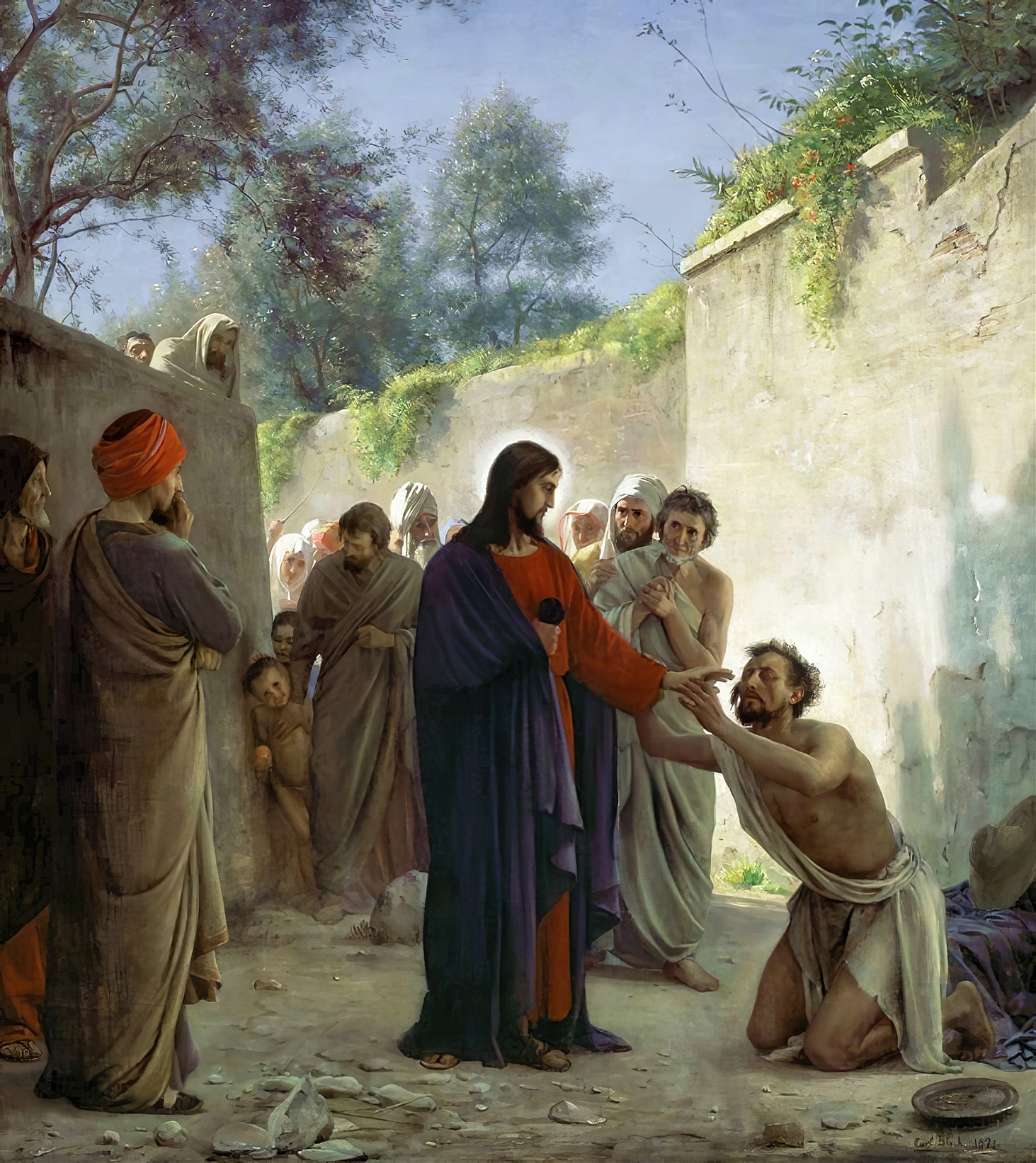
Bible story: Luke 18:35–43.
What do you want Me to do for you?
Luke 18:41 (BSB)
The crowd tells the blind man to be quiet. Jesus stops and asks what he wants. Although his need may seem obvious, the man is invited to say it himself: “Lord,” he says, “let me see again.”
Bloch gives that exchange a clear place in the picture. The man is close to us, with his hands raised toward Jesus’ outstretched arm. The people behind them remain visible, but no one stands between the two main figures. The man the crowd tried to silence now has our attention. His gesture shows him taking part in the encounter, just as Luke gives importance to his own spoken request.
14. Let the Little Children Come unto Jesus: Jesus is angry when the children are kept away
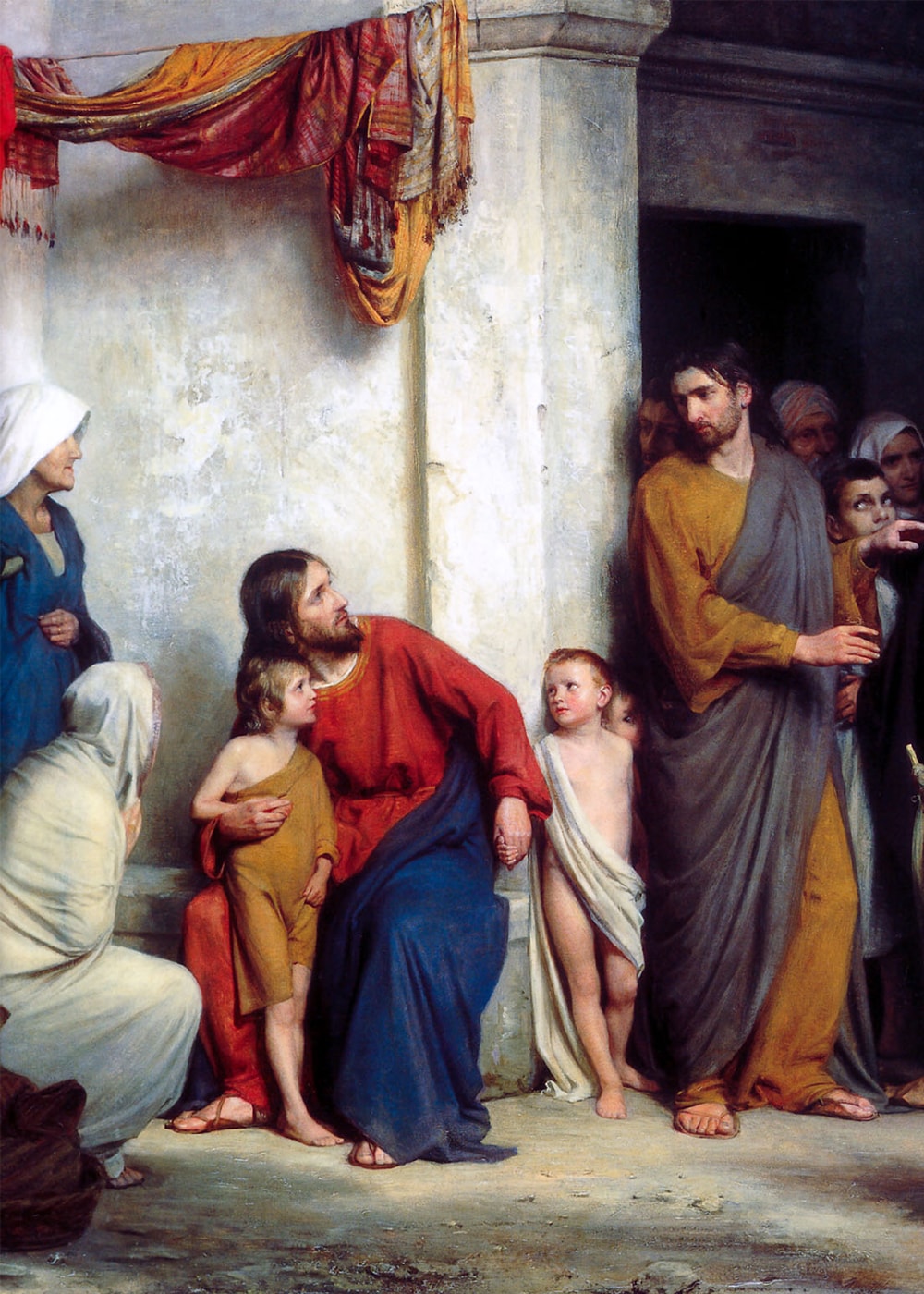
Bible story: Mark 10:13–16.
Let the little children come to Me, and do not hinder them!
Mark 10:14 (BSB)
Mark says Jesus is angry when the disciples try to keep the children away. He tells the adults to receive God’s kingdom like a child, then takes the children in his arms and blesses them.
Bloch brings the instruction and the welcome together. Jesus looks up toward a standing adult while keeping a child close at each side. One arm holds a child against him, and his other hand holds the smaller child’s hand. He can address the adults without letting go of the children. His hands make their welcome visible even while the discussion continues.
15. Transfiguration of Jesus: Peter offers to build; God tells him to listen
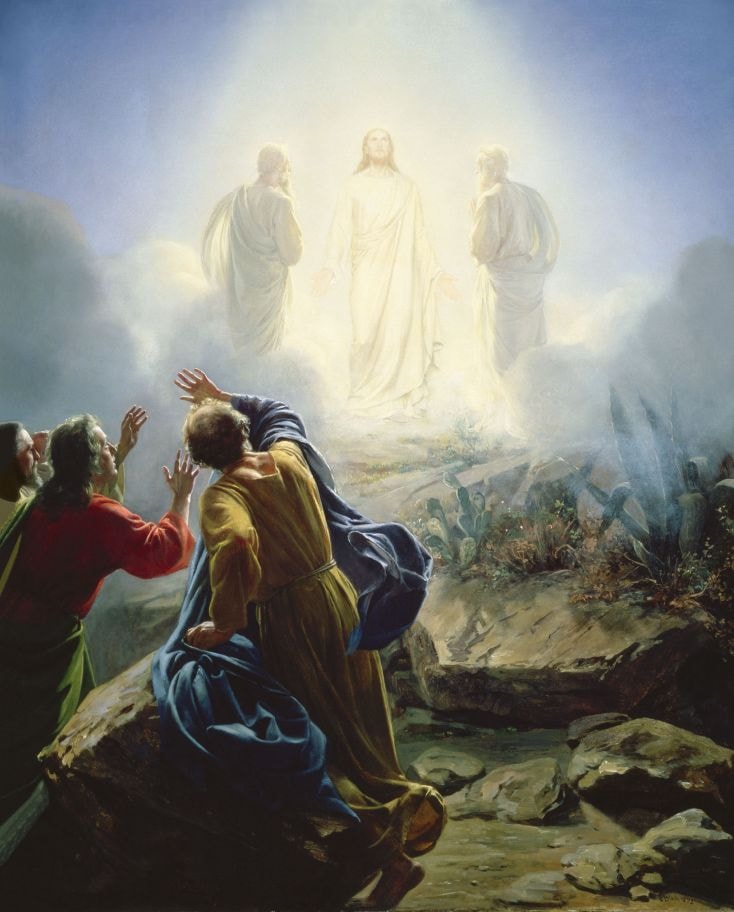
Bible story: Matthew 17:1–8.
His face shone like the sun, and His clothes became as white as the light.
Matthew 17:2 (BSB)
Peter offers to build three shelters: one for Jesus, one for Moses, and one for Elijah. While he is still speaking, a voice from the cloud tells the disciples to listen to Jesus. His proposed building task is interrupted by a different instruction.
Bloch shows the scene from the disciples’ side. They are close to us, raising their hands toward the light, while Jesus, Moses, and Elijah form a more still and ordered group above them. That difference makes the disciples’ difficulty in taking in the event easy to understand. Peter’s offer can be read as a familiar response to being overwhelmed: proposing a task he knows how to do.
16. The Raising of Lazarus: Martha worries about opening the tomb
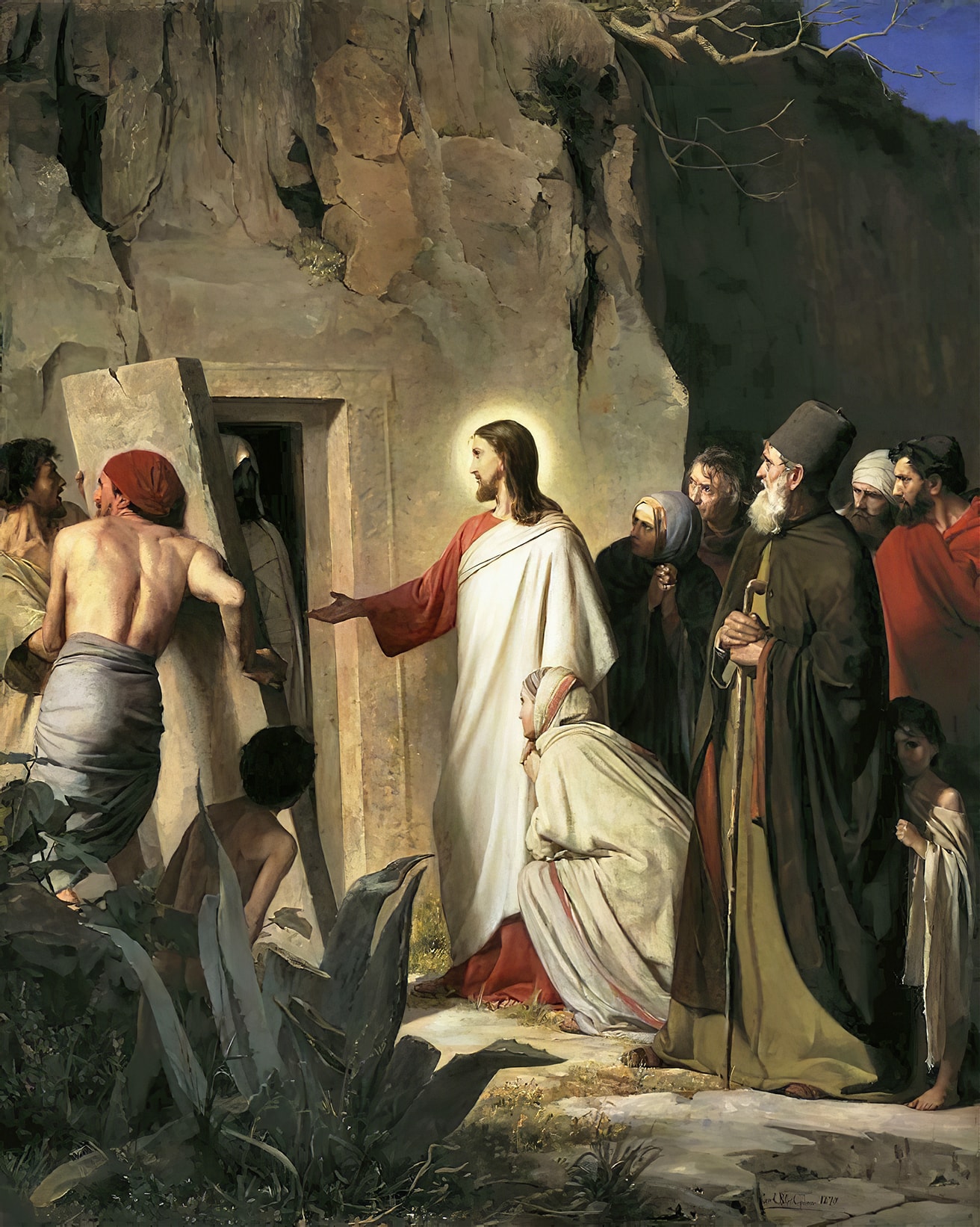
Bible story: John 11:1–44.
Did I not tell you that if you believed, you would see the glory of God?
John 11:40 (BSB)
Martha points out that Lazarus has been dead for four days. She expects a smell when the tomb is opened. Jesus reminds her of his promise. In John’s account, the stone is removed before Jesus calls Lazarus out. Those removing it act before they can see the result.
Bloch brings the removal and the result into one picture. A large stone occupies the foreground, with a man still gripping it, while Lazarus is already visible in the narrow opening. Jesus’ hand directs our attention toward him. The stone makes the practical work of opening the tomb hard to overlook. Martha’s objection concerns a real action that people must carry out, and Bloch gives that action a substantial place in the scene.
17. Jesus Cleanses the Temple: when business takes the place of worship
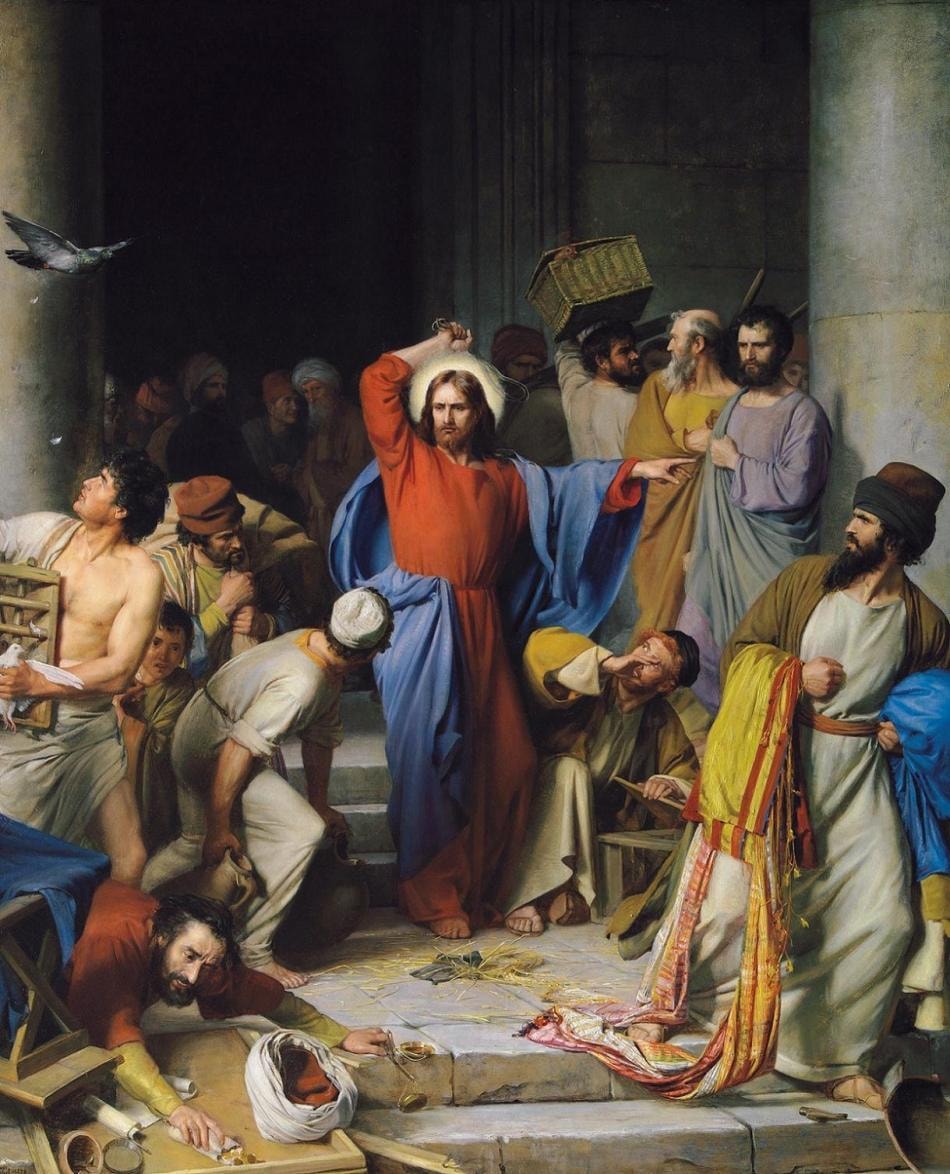
Bible story: John 2:13–22.
How dare you turn My Father’s house into a marketplace!
John 2:16 (BSB)
The activities meant to support worship have become more important than worship itself. That is one way to understand Jesus’ protest against the market in his Father’s house.
Bloch fills the foreground with overturned furniture, trading goods, and men trying to gather them. Jesus stands firmly in the middle, with one arm raised and the other extended, while people bend and turn around him. His position gives us a clear point to look at within the confusion. The goods occupy so much of the picture that clearing the space feels like a major disruption. This painting adds force to the gentler scenes in the series: the Jesus who welcomes children also challenges what people are doing in a holy place.
Chronology note: John places this episode early in Jesus’ ministry; the other Gospels place a temple cleansing near the Passion. Our sequence is thematic.
The Last Supper and the Passion of Christ
18. The Last Supper: the same actions as the feeding miracle
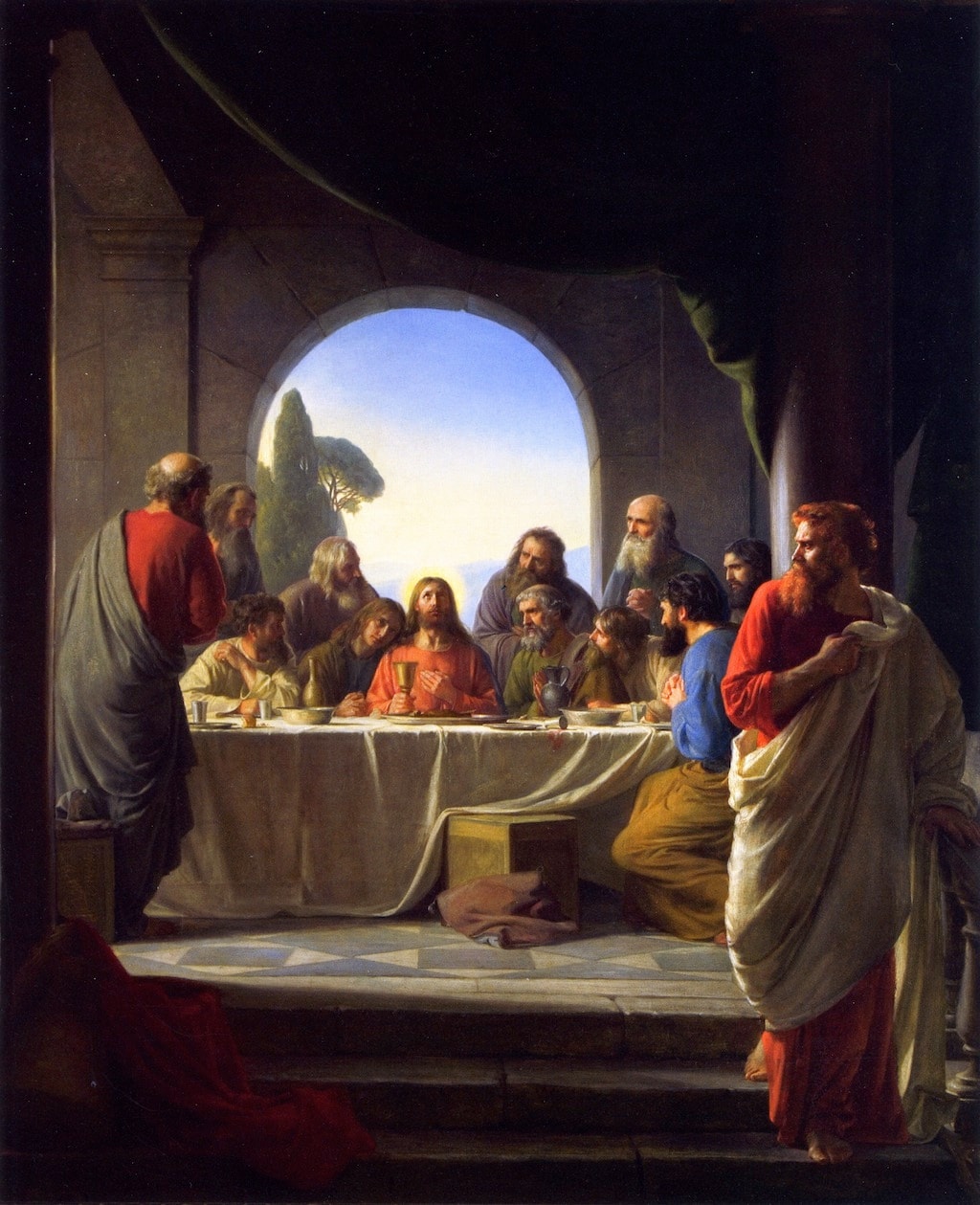
Bible story: Mark 14:17–25.
Take it; this is My body.
Mark 14:22 (BSB)
Jesus takes bread, blesses it, breaks it, and gives it to the disciples. Mark describes the same actions when Jesus feeds the five thousand. At the Last Supper, he adds that the bread is his body. The one who has fed others is preparing to give his own life for them.
Bloch focuses on the cup that follows. Jesus sits holding it and looking upward, with the bright opening of the arch behind the group. The white tablecloth draws attention to the meal, while the people around Jesus turn toward him. A large figure near the right edge looks back at the table, placing us near someone at the edge of the gathering. The cup connects the visible meal with Jesus’ words about his blood being poured out for many.
19. Gethsemane: the angel helps, but the suffering continues
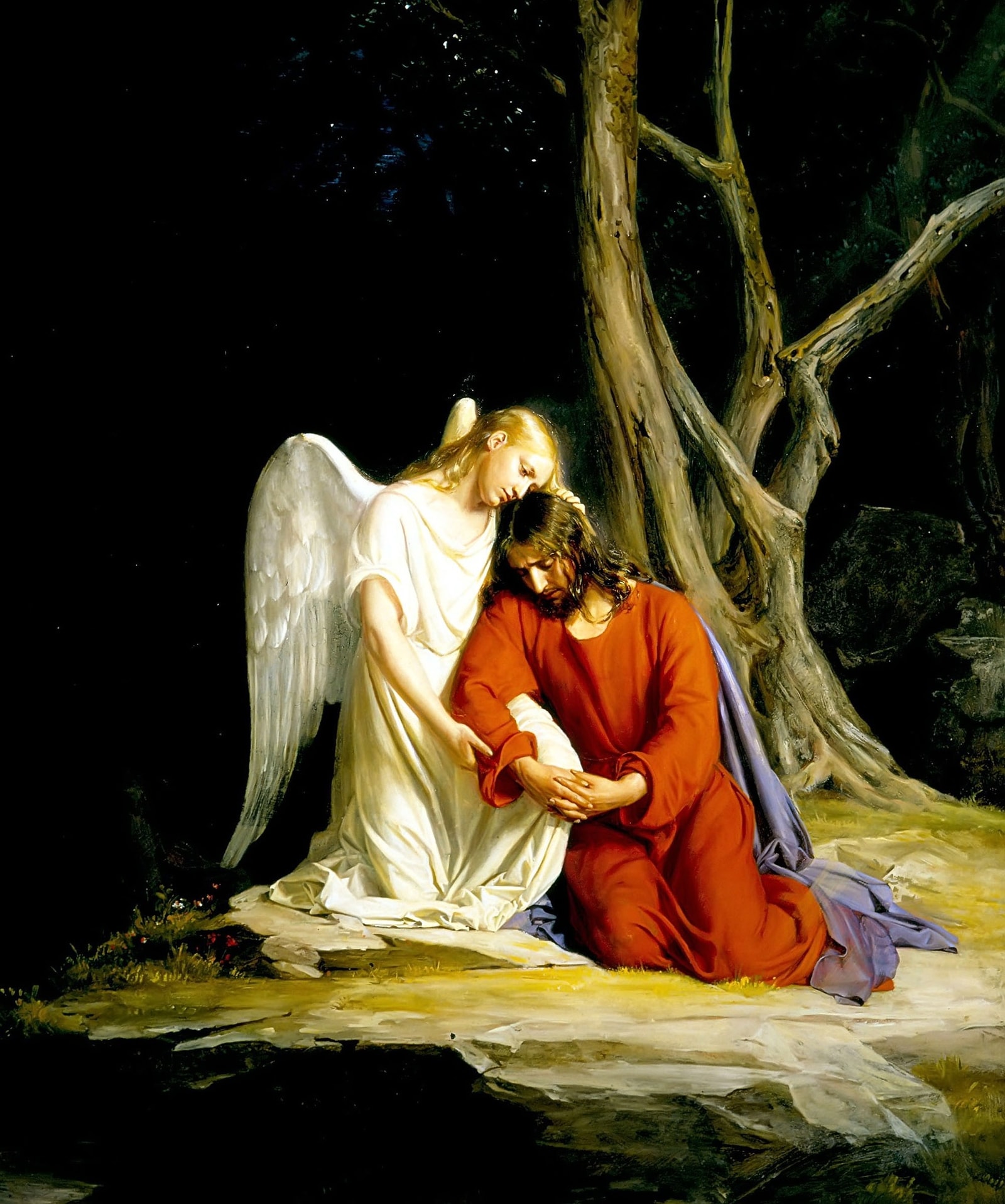
Luke says Jesus knelt and an angel strengthened him. The embrace and wings are details added by Bloch.
Bible story: Luke 22:39–46.
Then an angel from heaven appeared to Him and strengthened Him.
Luke 22:43 (BSB)
Luke says an angel strengthens Jesus. Afterward, Jesus remains in anguish and prays more earnestly. The help has not removed the suffering he faces.
Bloch makes that help physical. The angel bends close, resting one hand on Jesus’ head and supporting his arm with the other. Jesus remains bowed with his hands clasped. The two figures are brought close together against the dark background, so the support becomes the main action we notice. Bloch pictures what strengthening might look like when the pain is still present: someone is there to help Jesus bear it.
Spend time with Bloch’s Gethsemane and its Bible passage.
20. Peter’s Denial: Jesus trusts Peter again after his failure
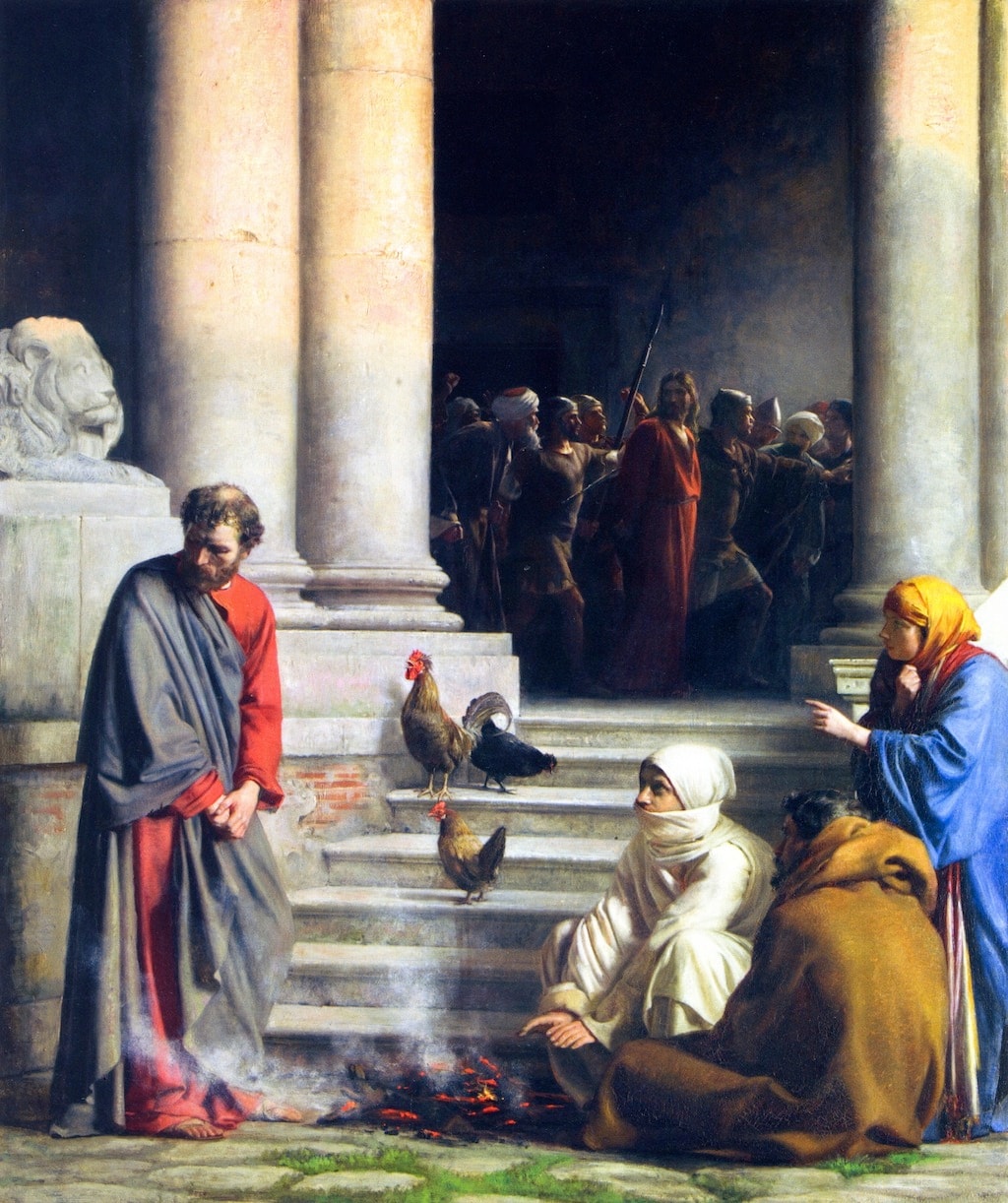
Bible story: John 18:15–27; compare Luke 22:54–62.
Peter denied it once more, and immediately a rooster crowed.
John 18:27 (BSB)
Peter draws a sword to defend Jesus in the garden, yet later denies knowing him three times. Bloch keeps the personal cost of that denial visible. Peter stands apart in the left foreground, turning his face away as a woman gestures toward him. Jesus remains visible in the doorway behind the group, and the rooster stands on the steps between them. We see Peter’s denial and the person he is denying in the same picture.
Jesus turning to look at Peter is a detail from Luke’s account; John records the denial and the rooster’s crow. John later describes a breakfast after the Resurrection, when Jesus asks Peter three times whether he loves him. Each answer brings responsibility for Jesus’ followers. That later meeting changes how we read the distance between the two men here. Peter’s failure will not end their relationship.
21. The Mocking of Christ: his suffering brings peace to others
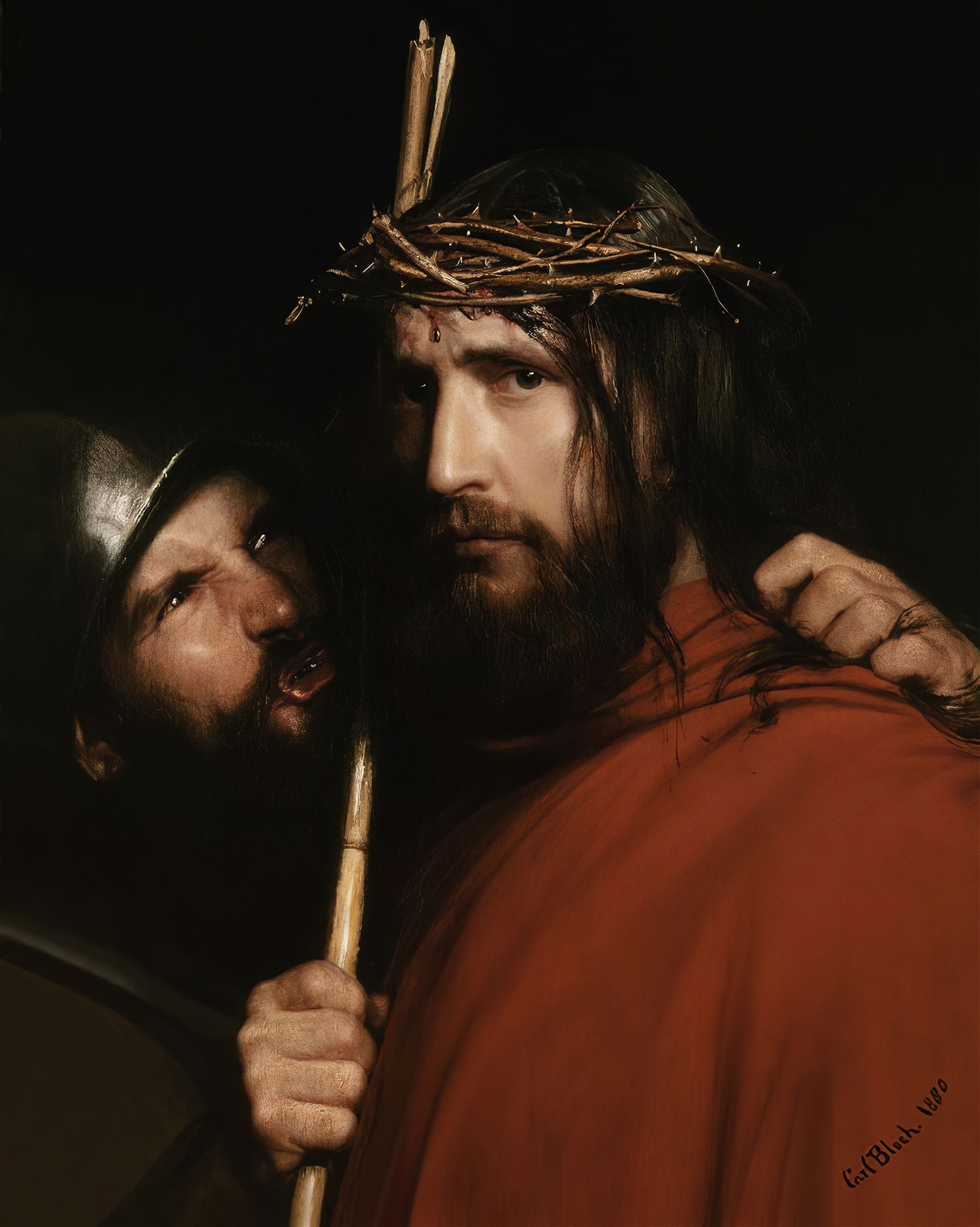
Bible story: Matthew 27:27–31. Related Scripture: Isaiah 53:5.
Hail, King of the Jews!
Matthew 27:29 (BSB)
Bloch crops this scene closely around Jesus and the man mocking him. A hand grips Christ’s shoulder, and the tormentor’s face presses into the space beside his. Jesus’ eyes turn outward, giving the viewer the sense of being noticed. The close framing makes it difficult to stand back from the cruelty as a distant spectator.
Christians often read the scene alongside Isaiah’s words, “pierced for our transgressions.” They understand “for” to mean that Jesus suffers on behalf of others. Isaiah says his punishment brings them peace. The outward gaze can make that belief feel personal: the man being mocked is also the one Christian viewers believe suffers for them.
Artwork note: BYU’s 2015 acquisition is a different, more muted version of this composition. Its account identifies two versions painted in 1880.Source: BYU Magazine
Explore The Mocking of Christ with Isaiah 53 in our gallery.
22. The Crucifixion: Jesus prays with words from Psalm 31
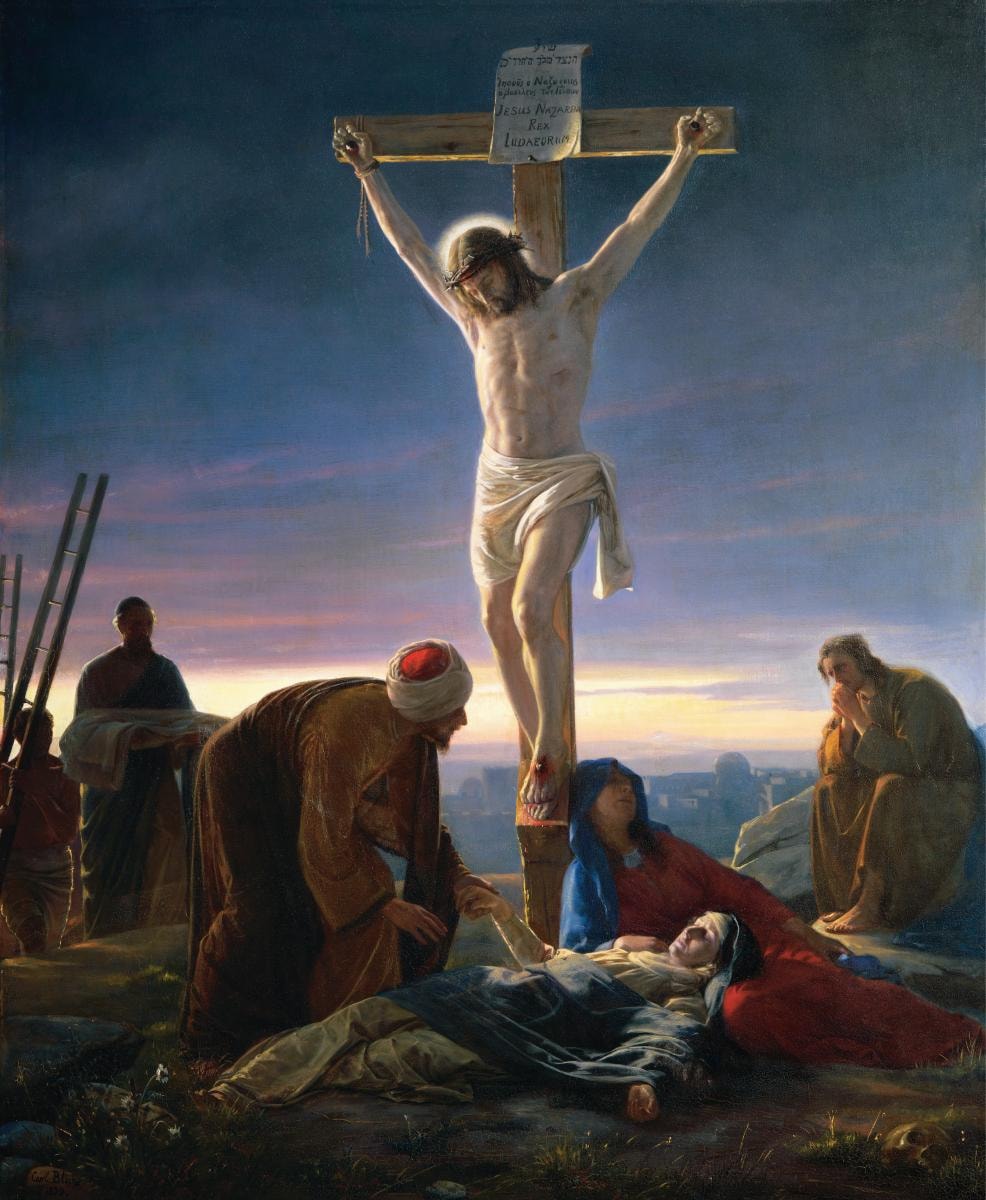
Bible story: Luke 23:33–49.
Father, into Your hands I commit My Spirit.
Luke 23:46 (BSB)
Jesus’ final prayer in Luke draws on Psalm 31:5: “Into Your hands.” The psalm expresses trust in God during suffering. Jesus uses its words as he dies, entrusting his life to his Father.
Bloch includes a detail that directs us toward what will happen next: men arrive at the left with ladders and a folded cloth. Christ’s bowed head and still body remain high above them, but preparations for lowering and caring for him have begun. Read beside Luke’s prayer, the painting brings together two kinds of care. Jesus entrusts his spirit to his Father, while people prepare to receive his body. These small figures connect this image with the Entombment that follows in our selection.
Bloch’s Crucifixion also appears in our Exaltation of the Holy Cross collection, where you can compare how other artists approach Christ’s Passion.
23. The Entombment: Jesus’ body now needs others’ care
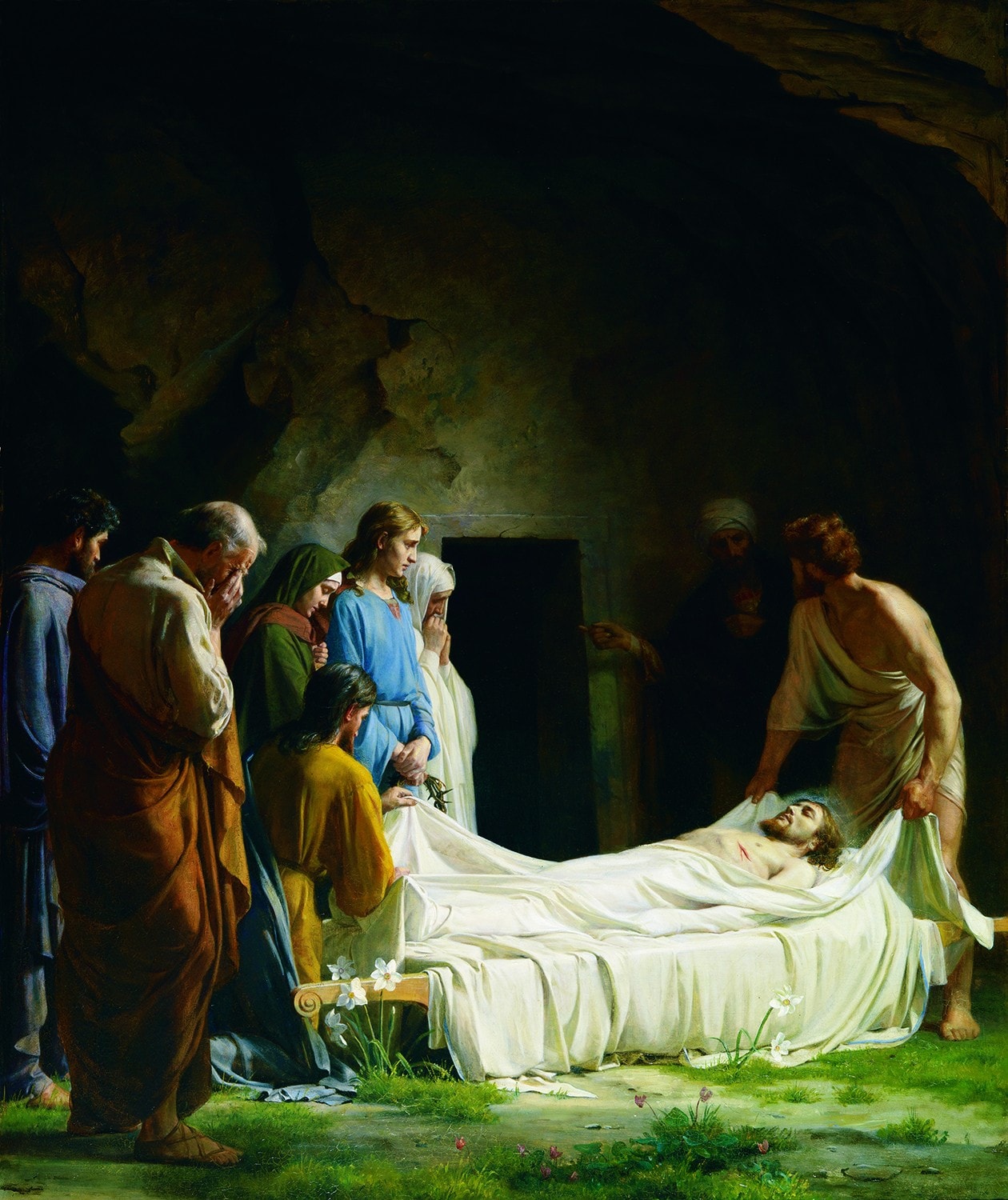
Bible story: Luke 23:50–56.
Then he took it down, wrapped it in a linen cloth, and placed it in a tomb cut into the rock, where no one had yet been laid.
Luke 23:53 (BSB)
Christ’s body lies across the picture, with the long side of the bier left open toward us. Bloch places us close enough to notice the cloth gathered in the bearer’s hands. The people around Jesus have practical work to do: his body must be lifted, moved, and laid to rest.
Jesus has walked on water, fed the hungry, and healed the sick. Now other people must carry him. Christians believe that all things were made through him, which makes this dependence especially difficult to take in. The open view of the body and the attention to its care give us a reason to pause here before moving on to the Resurrection.
Resurrection, recognition, and an invitation
24. The Resurrection: Paul explains how to respond to the Resurrection
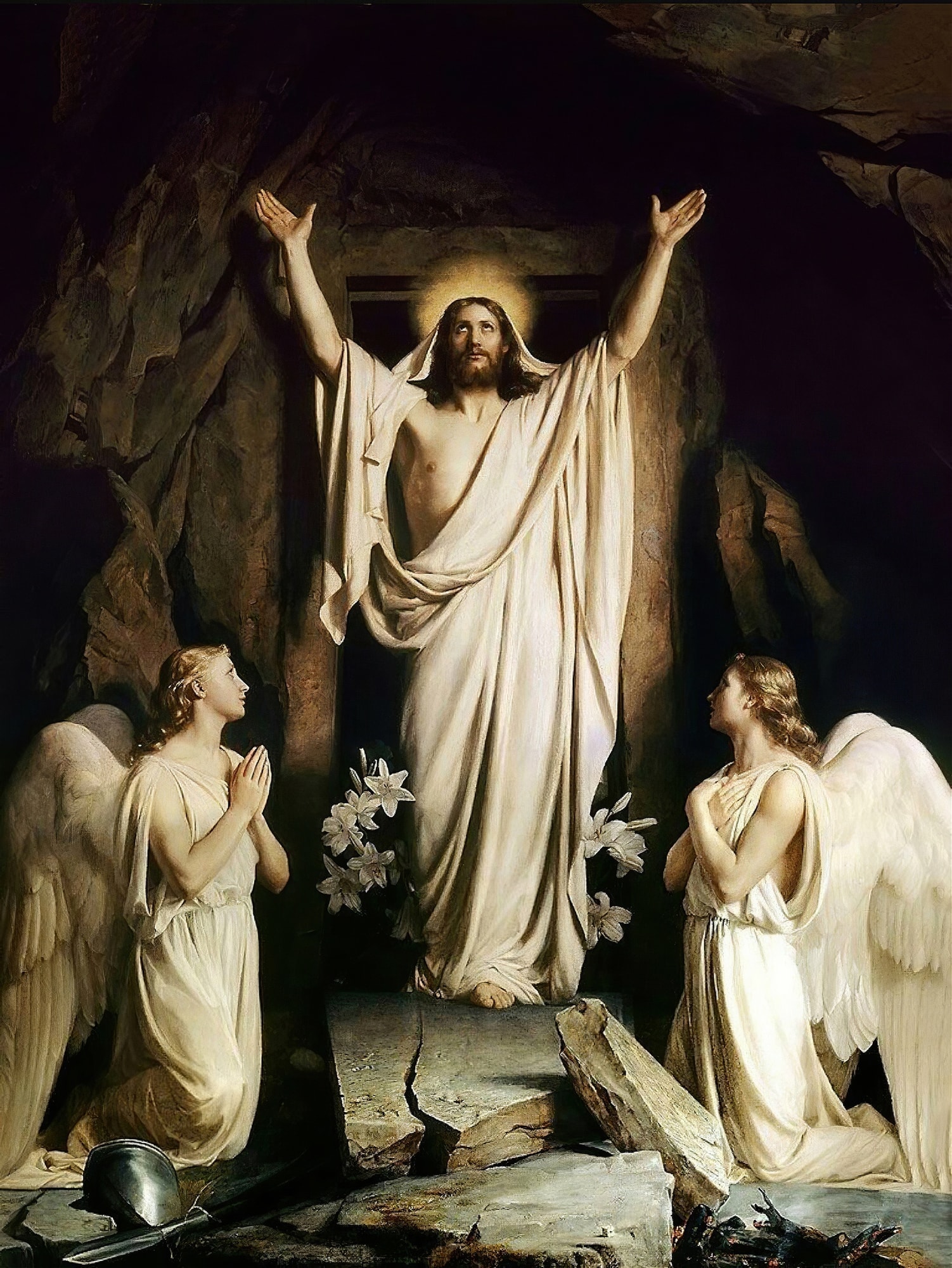
The Gospels describe the empty tomb and the risen Jesus. They do not describe anyone watching his body return to life. Bloch imagines that moment.
Bible story: Luke 24:1–12. Related Scripture: Romans 10:9.
He is not here; He has risen!
Luke 24:6 (BSB)
Bloch imagines Jesus standing tall and bright at the tomb entrance, above broken stone. Two angels look upward toward him. His raised arms and position above them make the victory over death easy to read. The angels also give us a response to the event: they worship the risen Christ.
Romans 10 describes a response the reader can make. Paul says that the message of faith is within reach. A person believes that God raised Jesus from the dead and openly says that Jesus is Lord. This explains his references to the heart and mouth. Bloch presents the Resurrection on a grand scale; Paul’s words connect that event with a personal act of faith.
25. Supper at Emmaus: they thought their hope was over
Bible story: Luke 24:13–35.
Then their eyes were opened and they recognized Jesus—and He disappeared from their sight.
Luke 24:31 (BSB)
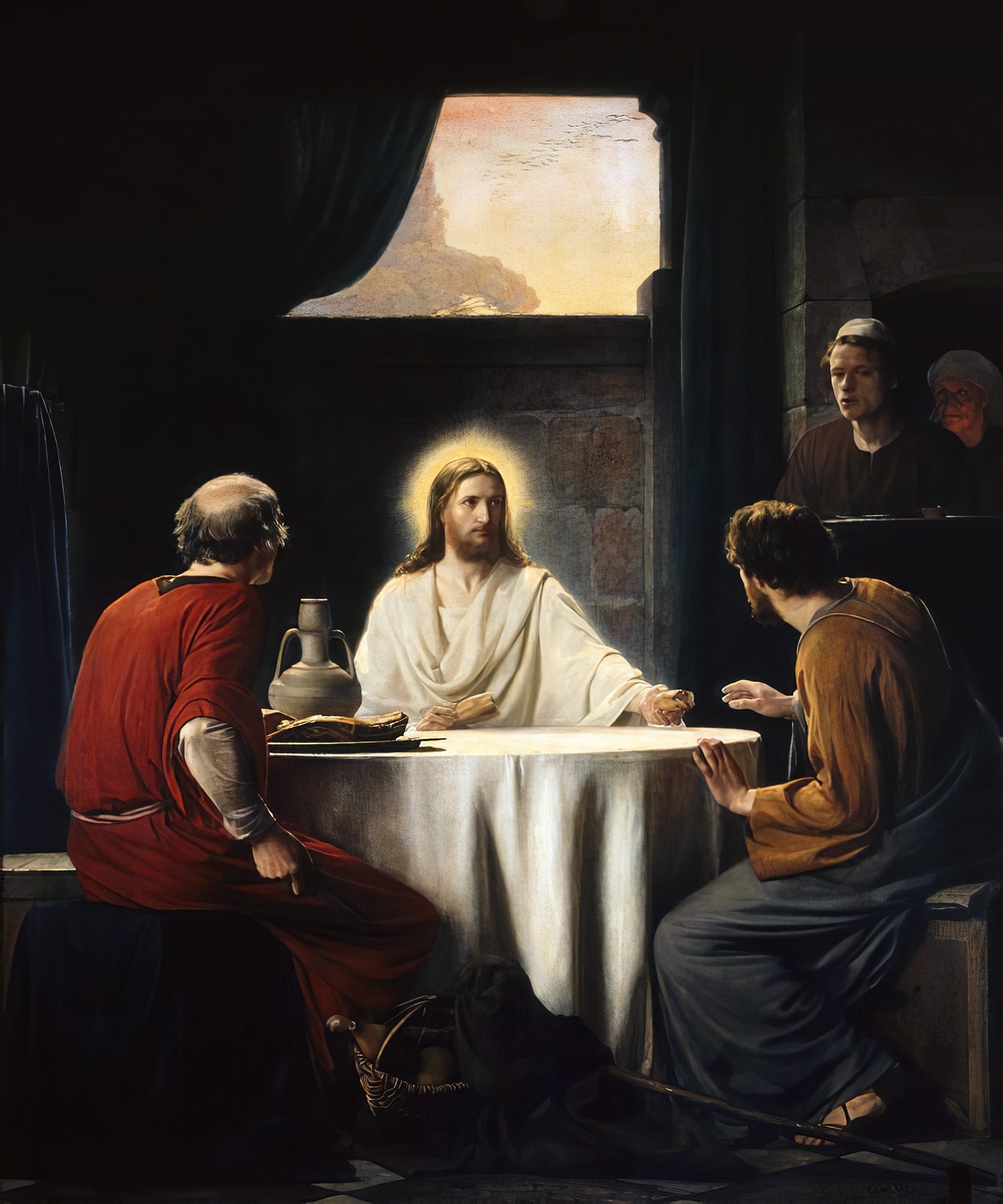
“But we were hoping.” The two travelers speak as though Jesus’ death has ended their hope. They do not realize that the man listening is Jesus himself. He explains the Scriptures as they walk, and they recognize him when he breaks bread.
Bloch chooses that moment at the table. One disciple turns toward Jesus with a hand braced on his seat; the other reaches toward the offered bread. Their movements make the discovery feel sudden, while Jesus remains seated between them. The painting lets us watch their understanding change. The person they have just recognized is the one who has already spent the journey listening to them and helping them understand.
26. Doubting Thomas: Thomas also makes a statement of faith
Bible story: John 20:24–29.
My Lord and my God!
John 20:28 (BSB)
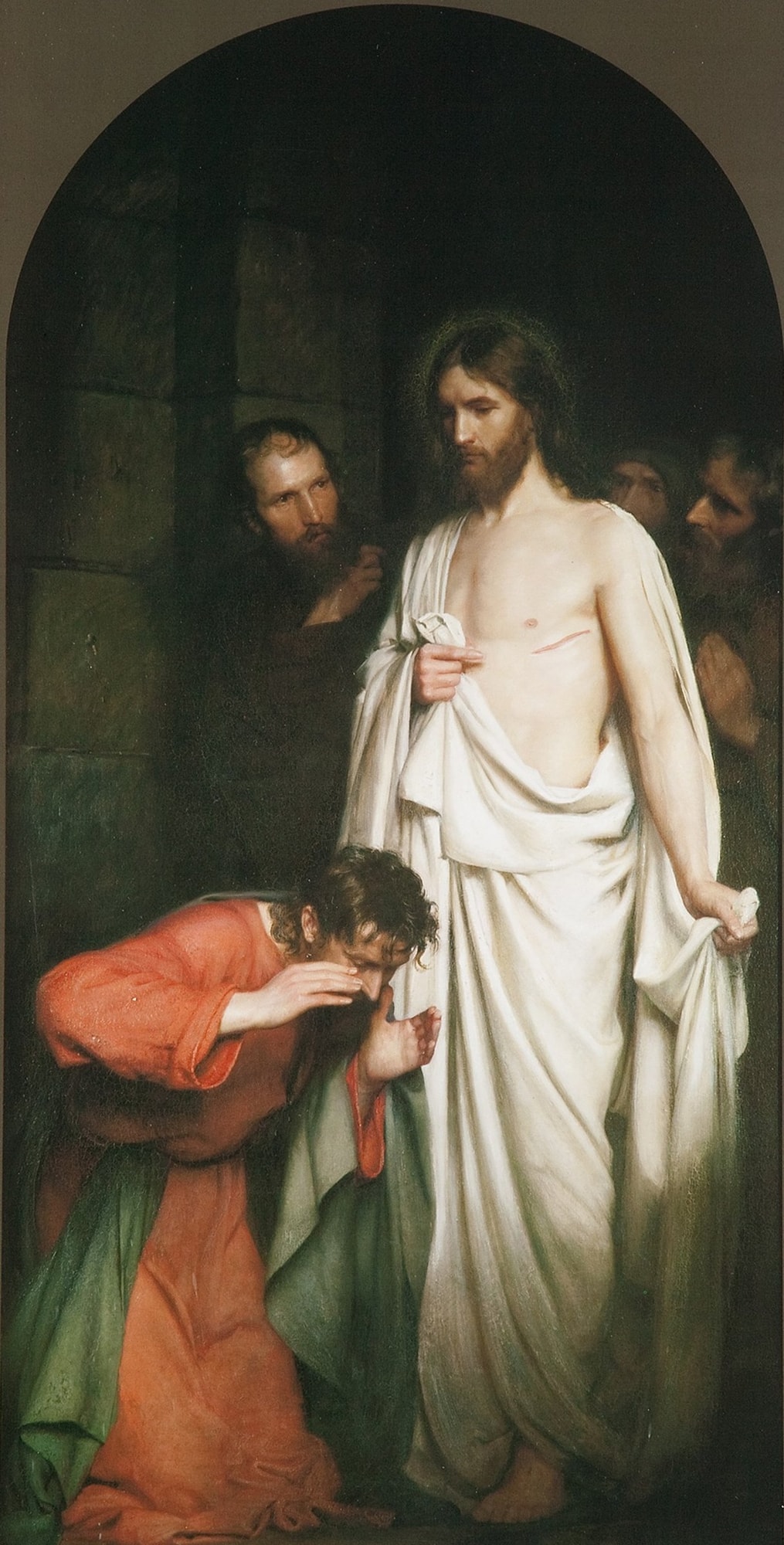
We remember Thomas for his doubts, but his story also includes the words “My Lord and my God!” John records Jesus’ invitation to touch the wounds without explicitly saying whether Thomas does so.
That distinction matters in Bloch’s painting. Christ holds his robe aside to show the wound, while Thomas bends low with his hands raised. There is visible space between those hands and Christ’s body. His gesture can be read as awe at what he has been shown. Bloch gives us a way to see Thomas’s belief as well as his demand for proof. The familiar nickname describes only part of the encounter.
27. Christus Consolator: the man comes while still wearing his cuff
Scripture: Matthew 11:28–30.
Come to Me, all you who are weary and burdened, and I will give you rest.
Matthew 11:28 (BSB)
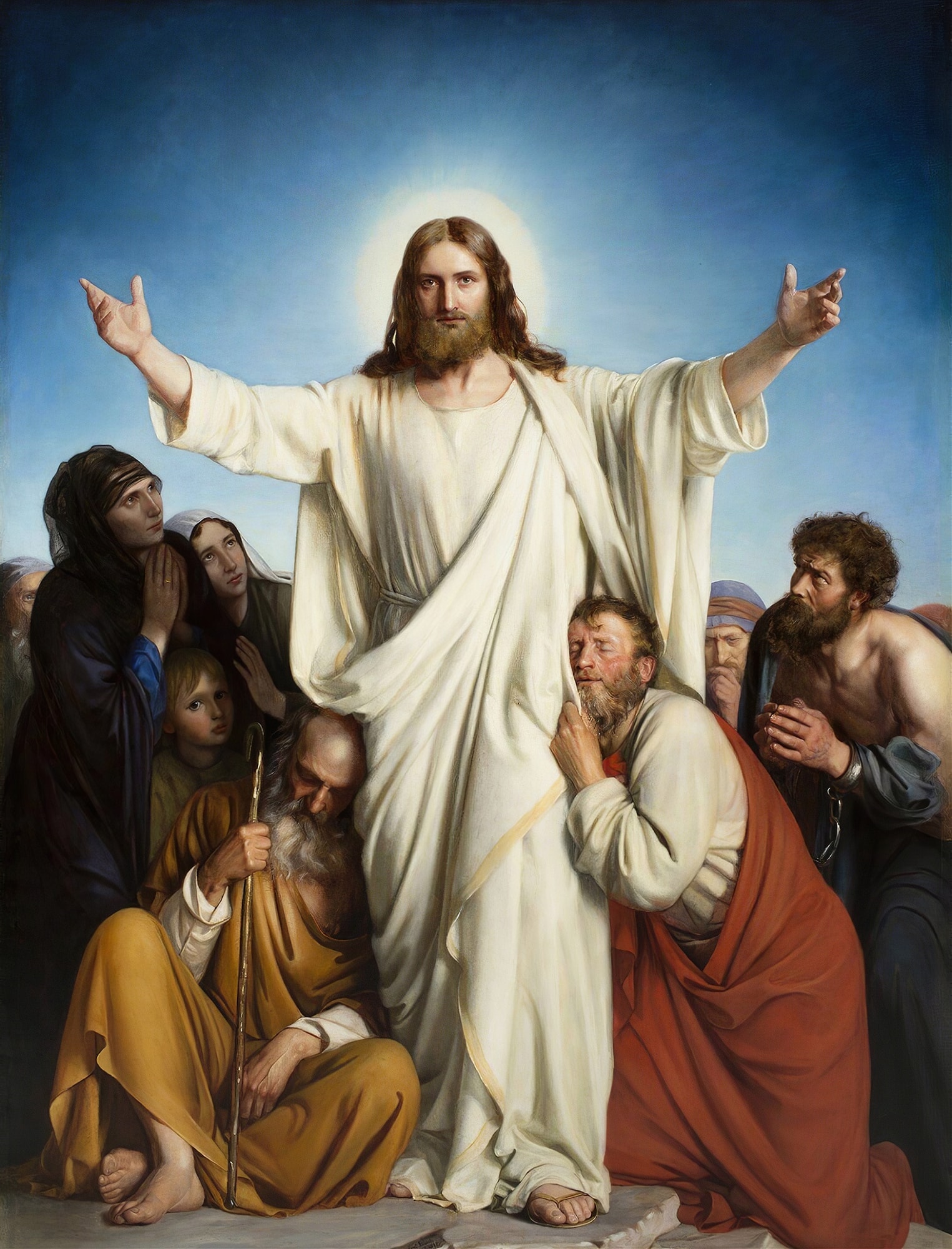
Christ’s arms extend across nearly the whole picture, with people gathered closely beneath them. Bloch makes the welcome broad, then gives us individual details to notice. At the right, a man has come close to Jesus with an iron cuff still on his wrist. His trouble has not disappeared before he joins the gathering.
Matthew 11 offers a useful connection: John the Baptist is still in prison in the chapter where Jesus invites the weary to come to him for rest. The painted man is not identified as John, and this gathering visualizes an invitation rather than one recorded Gospel event. But his place beneath Christ’s open arms makes the invitation concrete. He can approach while still carrying the evidence of his suffering.
Open Christus Consolator in Visio Divina and explore the painting, Scripture, and reflection.
Why did Carl Bloch’s paintings become controversial?
After these encounters, the argument about Bloch’s reputation feels less abstract. His figures communicate quickly. A gesture tells us who is afraid, who is listening, who needs help. That clarity is part of the pleasure of looking at them.
The National Gallery of Denmark’s account of Carl Bloch—Seduced describes an artist celebrated during his lifetime whose reputation later fell sharply. Critics considered his work outdated, while audiences continued to respond to its technique, storytelling, and emotional directness. The museum’s 2023 exhibition revisited that uneven legacy.
The question for a viewer is still interesting: when does carefully staged emotion help us recognize another person’s experience, and when does it tell us too firmly what to feel? We can ask that while continuing to admire Bloch’s skill. His paintings reward looking closely enough to form an opinion.
From Lutheran churches to a Latter-day Saint audience
Bloch made major altarpieces for Lutheran churches in Denmark and Sweden. His later association with The Church of Jesus Christ of Latter-day Saints belongs to the history of how his images circulated.Source: BYU Magazine
According to the Church’s account of Bloch’s reception, its magazine Improvement Era published sixteen color reproductions of his work in November 1962. His paintings subsequently became familiar through church publications and buildings, giving the Danish artist a substantial audience far from the settings for which he had painted.
That afterlife has its own disputes. Art historian Noel A. Carmack documents alterations to a reproduction of Bloch’s Resurrection image in the December 2011 Ensign, including changes to angel wings and the addition of sleeves. This concerns a published reproduction long after Bloch’s death. It raises a different question from the criticism of his style: what changes when a community adapts an inherited image to its own conventions?Source: Carmack’s study in Dialogue
Where can I see Carl Bloch’s original paintings?
The King’s Oratory at Frederiksborg Castle in Denmark houses Bloch’s 23-painting cycle. The Frederiksborg Museum’s visitor guide describes the prayer chamber and its paintings, completed between 1865 and 1879.
In Provo, Utah, the BYU Museum of Art owns Christ Healing the Sick at Bethesda (1883), acquired in 2001. BYU’s account of the painting traces its place in the collection. The museum also acquired a version of The Mocking of Christ in 2015: its acquisition announcement explains that this is the more muted of two versions painted in 1880. It is different from the colorful version reproduced in this guide.
Collection ownership does not guarantee that a painting is currently on view. Check the museums’ current exhibition and visiting information before planning a trip.
Questions about Carl Bloch’s Jesus paintings
Was Carl Bloch a Latter-day Saint?
No. Carl Bloch was a Lutheran, not a member of The Church of Jesus Christ of Latter-day Saints. Church News’s account of his relationship with Latter-day Saint audiences makes that distinction. The Church adopted his images long after his death; their familiarity in its publications does not mean he painted them for that audience.
How many paintings did Carl Bloch paint?
Carl Bloch painted more than 250 works across religious and secular subjects, according to BYU Magazine’s overview of his career. That total includes much more than paintings of Jesus. The same account distinguishes his 23 paintings for Frederiksborg from his eight large altar paintings; those are commissions within a wider career, not competing totals.
Are the paintings exact illustrations of the Bible?
They interpret biblical passages through composition, clothing, light, and imagined gestures. Read the paired passage as you look. The wings in the Annunciation, the arrangement of the Nativity, and the visible emergence from the tomb are examples of details supplied by the artist.
Can I explore these paintings as Bible art puzzles?
All 27 paintings in this guide are available as free puzzles in Visio Divina’s online gallery. Use the puzzle button beneath any painting to assemble the image and read its Scripture. Reflections accompany the paintings where available.
Stay with one painting
Twenty-seven paintings can be a journey through the life of Jesus. One painting can be enough for today.
Choose the scene you kept returning to. Look for a hand, a face, or someone at the edge whom you barely noticed on the first pass. Read the Bible passage beside it. Notice where Bloch follows the words and where he gives them a form of his own.
You can begin with Christus Consolator, or browse the Bible art gallery and find a painting that holds your attention. Visio Divina brings the image, a puzzle, Scripture, and reflection together, so that looking has time to become attention.
Continue in the open gallery