Someone has told a story about you that is not true. Maybe it cost you a job, a friendship, a place in a family. You have explained. It did not help, because the people repeating it were never confused. They wanted it to be true.
Saint Stephen knew that situation from the inside. He is famous for how he died: the first Christian martyr, praying for the men who were stoning him. But the reason he was killed is a quieter story. He was trusted with a practical job, the people who opposed him could not out-argue him, and so false witnesses were found. This is that story in six paintings, each with a short prompt for Visio Divina, the old practice of praying with a picture.
Before the Stones: The Widows Who Were Being Overlooked
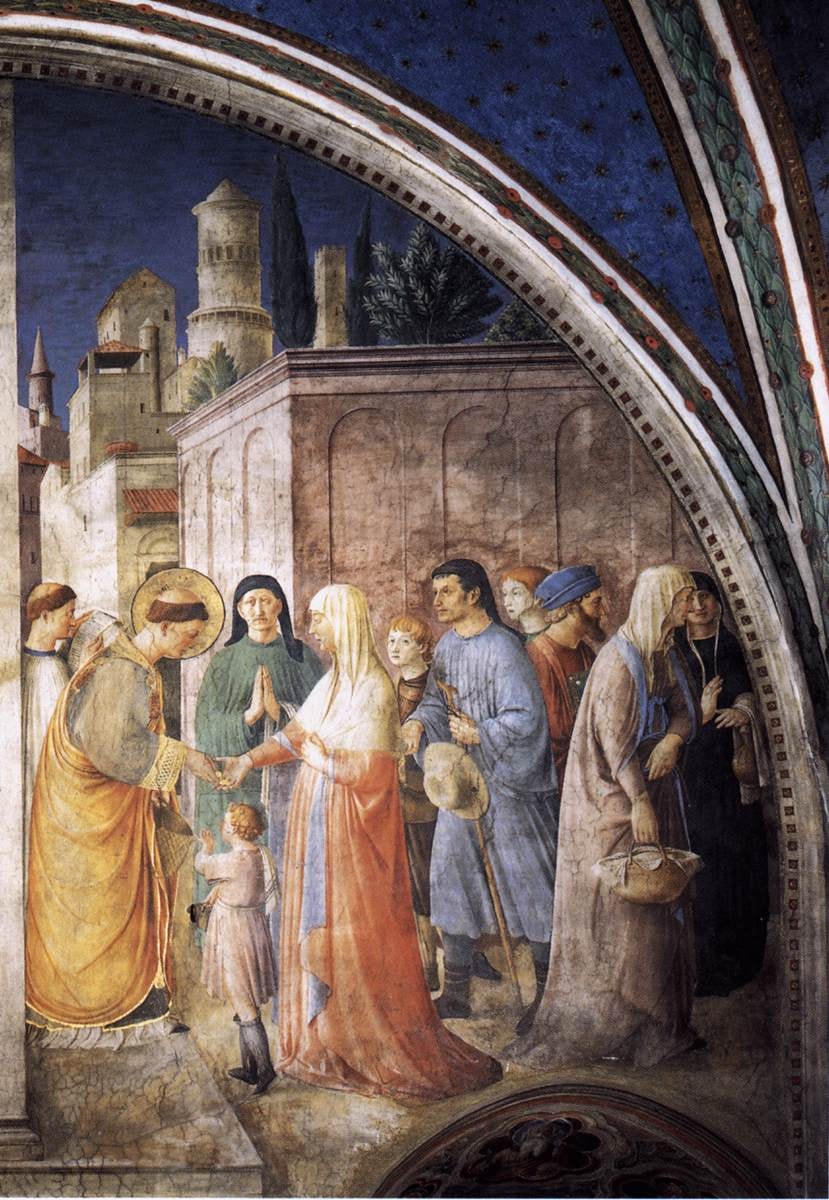
their widows were being overlooked in the daily distribution of food.
Acts 6:1 · BSB, excerpt
Stephen enters the Bible through a complaint about food. The first church in Jerusalem was growing fast, and its daily food distribution was failing some of its members. The Greek-speaking believers said their widows were being passed over in favor of the Hebrew-speaking ones. Sharing a faith had not automatically made the community fair.
The twelve apostles—Jesus’ closest followers, now leading the church—called a meeting. They would not give up preaching “in order to wait on tables” (Acts 6:2), so they asked the community to choose seven trusted men, “full of the Spirit and wisdom,” to take the work over (6:3). Stephen is the first one named.
Fra Angelico painted him at that work on a chapel wall in the Vatican. A young man in a gold robe presses a coin into a woman’s outstretched hand, while a small child between them looks up at him. Behind her, others wait, and at the right a veiled woman carrying a basket turns toward another woman. It is a painting of a line of people, and of someone making sure nobody in it is skipped.
So the first thing we learn about the first martyr is that he was given practical work—getting food to the people it was meant for—and that he was picked for it because of his character. Keep that in mind when the accusations start. The people who knew his work had already said who he was.
Was Saint Stephen a deacon?
Christian tradition honors Stephen and the other six as the first deacons, though Acts itself simply calls them “the seven.” The word fits: deacon comes from the Greek word for a servant, sharing a root with the verb behind “wait on tables” in Acts 6:2. That is why painters dress him in a dalmatic, the wide-sleeved robe deacons wear.
Visio Divina Prompt: Look at the two hands meeting at the center. Then find the person in the line you would have overlooked.
Chosen to Serve
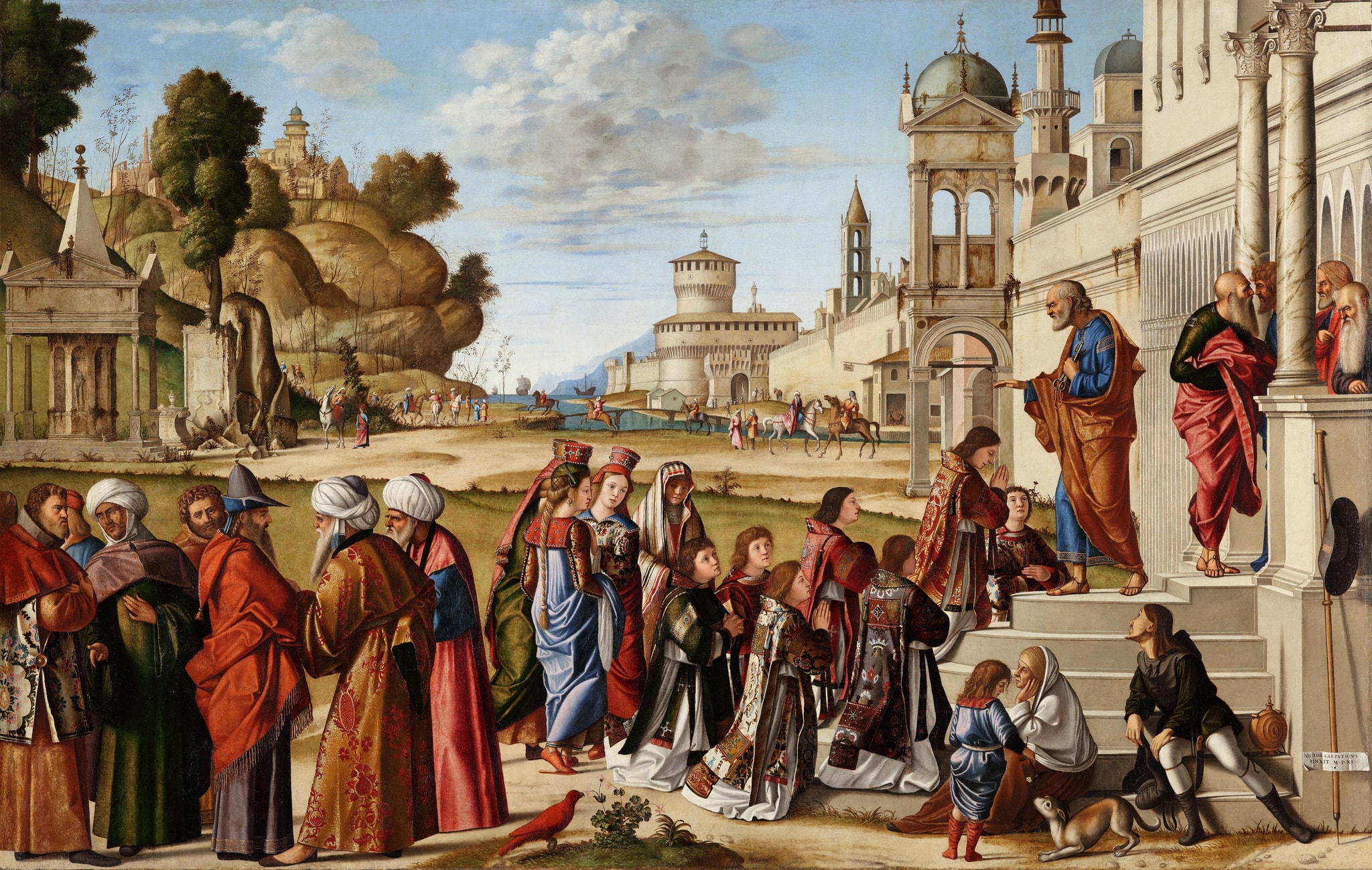
They presented these seven to the apostles, who prayed and laid their hands on them.
Acts 6:6 · BSB
Carpaccio sets the moment in a dream Jerusalem of domes, towers, and a round fortress by the water. A crowd in turbans and tall red hats fills the left side. On the right, young men in patterned vestments gather at a flight of steps, and Stephen kneels higher on the stair, hands together, before a white-bearded Peter, who extends a hand over him. Around them the city carries on: riders in the distance, a child standing before a seated woman on the steps, a dog at their feet, a red parrot in the grass. Stephen receives his calling in public, in the middle of ordinary life.
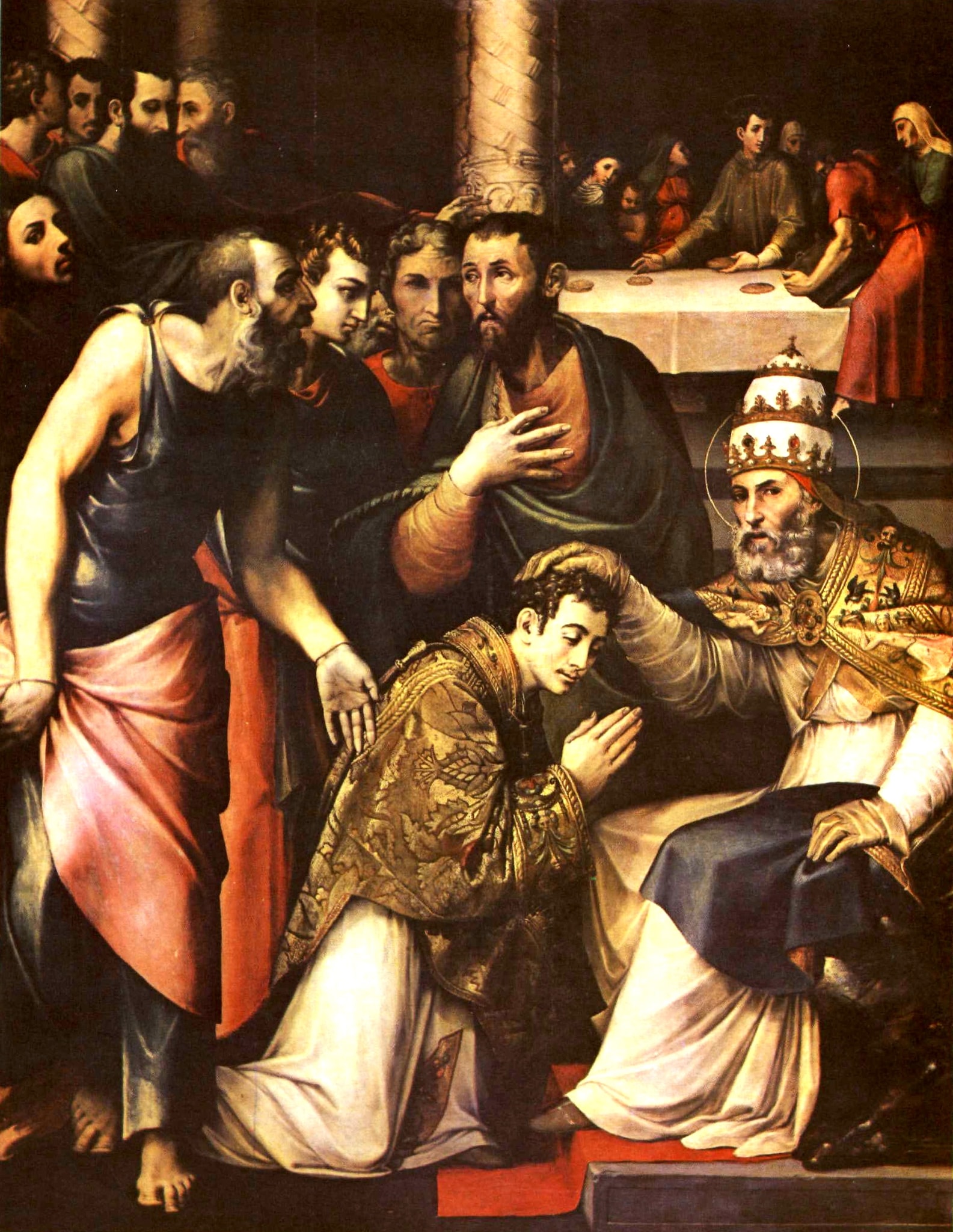
Falcó moves in close. A boyish Stephen in gold brocade kneels with his hands together while a seated Peter lays a hand on his head. Peter is wearing a pope’s triple crown, which would not exist for well over a thousand years; the painter is showing how his own church understood its link to the apostles, not what anyone wore in first-century Jerusalem. In the background, easy to miss, a table is being served. That is the job Stephen is being ordained for.
In both paintings the apostle who blesses him is Peter, who knew something about failing in public and being trusted again. There is a quiet kindness in that pairing. The hand on Stephen’s head belongs to someone who understood that a reputation is not the same as a person.
Visio Divina Prompt: In Falcó, look at the hand on Stephen’s head, then at the table behind him. Who once trusted you with something before you had proved anything?
A Life Becomes a Public Witness
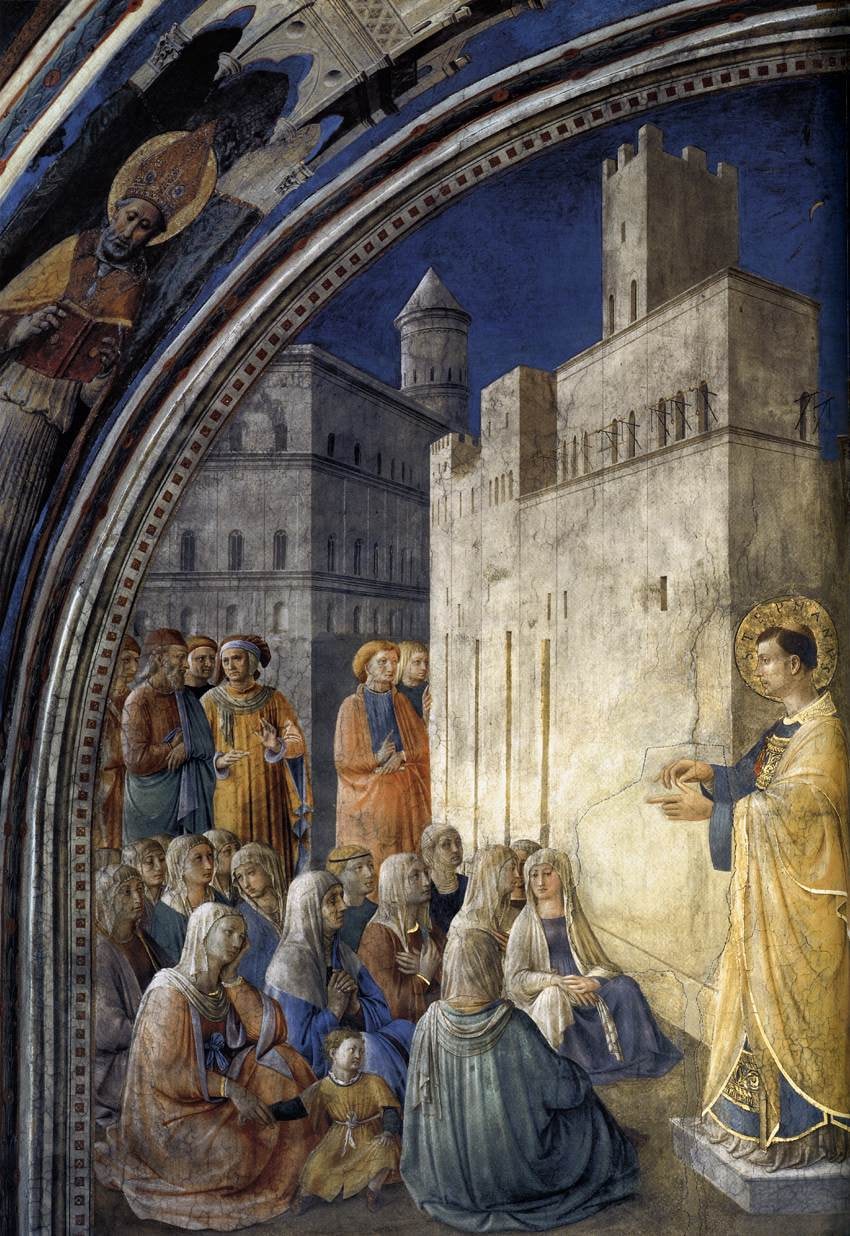
Now Stephen, who was full of grace and power, was performing great wonders and signs among the people.
Acts 6:8 · BSB
Stephen turned out to be more than an organizer. Acts says he performed “great wonders and signs,” without describing a single one, and that he spoke in public about Jesus. Members of one synagogue began to argue with him, “but they could not stand up to his wisdom or the Spirit by whom he spoke” (Acts 6:10).
Fra Angelico shows Stephen preaching. He stands at the right on a low stone platform, gesturing with his fingers as he makes a point. Women sit on the ground before him with a child among them. Behind them men stand in small groups, some listening, some gesturing to one another. It is a calm picture. In Acts, the calm does not last.
Anyone who has been lied about will recognize the order of events. The trouble did not start when Stephen did something wrong. It started when he did something well, in front of people, and could not be beaten fairly.
Visio Divina Prompt: Pick one listener and stay with that face. What do you notice about the different ways people receive his words?
False Witnesses, and a Face Like an Angel’s
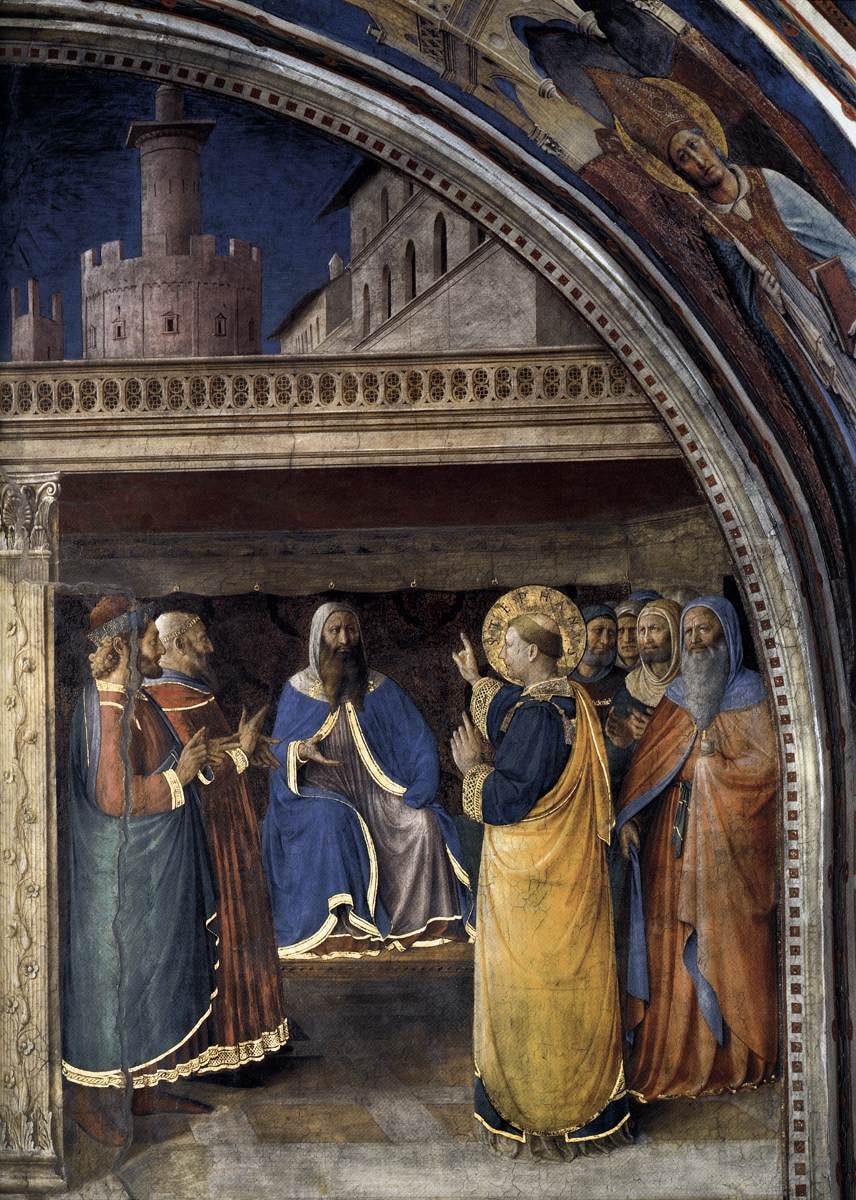
All who were sitting in the Sanhedrin looked intently at Stephen, and they saw that his face was like the face of an angel.
Acts 6:15 · BSB
Having lost the argument, his opponents changed tactics. “They prompted some men to say, ‘We heard Stephen speak words of blasphemy against Moses and against God’” (Acts 6:11). They stirred up the crowd, had him seized, and brought him before the Sanhedrin, the religious high court in Jerusalem. There, Acts says flatly, “they presented false witnesses” (6:13).
What was Saint Stephen accused of?
Stephen was accused of blasphemy: of speaking against the Temple and the law of Moses, and of claiming that Jesus would destroy the Temple and change the customs Moses handed down (Acts 6:13–14). Acts calls the witnesses false. The charge also echoes the one brought against Jesus at his own trial.
In the fresco we see the back of Stephen’s gold vestment and his face in profile, one finger raised as he speaks. A seated figure in blue faces him beneath a dark canopy, and bearded men stand closely gathered on both sides.
Then comes the strangest sentence in the story. The whole court stares at him and sees “the face of an angel.” Luke does not explain it. He does not say Stephen felt calm, or that he was not afraid. He only says what the people accusing him could see. Whatever they had said he was, his face said something else, and they noticed.
You cannot control the story being told about you. Stephen could not either. But the lie did not get to choose his face. He walked into that room as the same man who had been handing out bread.
Visio Divina Prompt: Look at the space between Stephen’s raised finger and the seated figure in blue. If you are carrying a false story, name it plainly before God. You do not have to turn it into a lesson first.
Why Does Stephen Answer with Such a Long Speech?
Brothers and fathers, listen to me!
Acts 7:2 · BSB, excerpt
The high priest asks one question: “Are these charges true?” (Acts 7:1). Stephen answers with the longest speech in the book of Acts, and he never says yes or no.
Instead he tells his judges their own history. Joseph was sold into slavery by his jealous brothers, “but God was with him” (7:9). Moses was rejected by his own people with the words “Who made you ruler and judge?”—and he was the one God had sent to rescue them (7:35). Again and again, Stephen says, God sends someone, and the people in charge push him away. He is not really defending himself. He is telling them what is happening in that room, and what happened to Jesus.
Then he says it straight: “You stiff-necked people with uncircumcised hearts and ears! You always resist the Holy Spirit, just as your fathers did… And now you are His betrayers and murderers” (Acts 7:51–52).
Two things need saying. This is an argument inside one family. Stephen is a Jew speaking to fellow Jews—he calls Abraham “our father”—in the fierce language Israel’s own prophets used. For centuries words like these were turned into a charge against Jewish people as a whole, and they are no such thing. And it is not a model for insulting whoever has wronged you. It is a prophet’s speech at a trial for his life.
What it does show is what Stephen did not do. He did not grovel. He did not tell a counter-lie. He did not spend his defense explaining himself to people who were not confused. He told the truth once, clearly, in public, knowing it might not save him.
Visio Divina Prompt: Go back to Fra Angelico’s courtroom and look at the raised finger again. What is the one true thing you need to say, once, without pleading?
The Open Heaven: Stephen Sees Jesus Standing
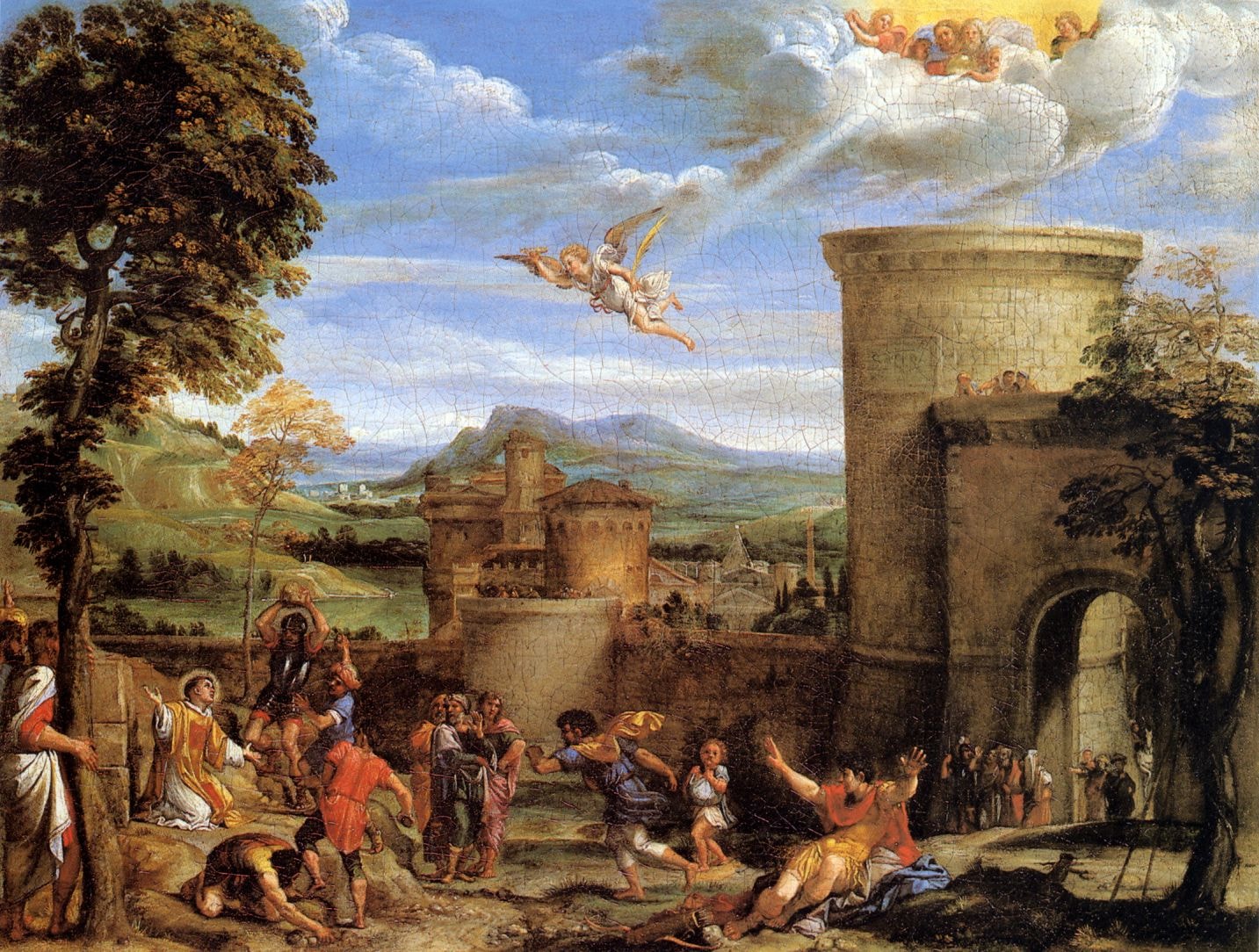
“Look,” he said, “I see heaven open and the Son of Man standing at the right hand of God.”
Acts 7:56 · BSB
The court is grinding its teeth when Stephen looks up and says what he sees: heaven open, and Jesus standing at God’s right hand.
Why was Jesus standing?
Acts does not explain it. Elsewhere the New Testament describes Jesus seated at God’s right hand; here he is on his feet. In the fourth century St. Ambrose read the standing Christ as an advocate for his people and as the one who awards the martyr his victory. That is an interpretation, not something the text says.
Carracci gives the vision a whole sky. The violence is small and low at the left, under a huge tree: Stephen on his knees in his deacon’s robe, arms open, a man above him with a rock raised in both hands. On the right stand a round tower and the city gate. But follow the diagonal upward and an angel flies down toward him carrying a martyr’s palm, and in the top corner heaven is lit and open.
This is where the story of the lie ends, and it does not end with Stephen being cleared. The court never takes it back. What he is given instead, if Ambrose is right, is the knowledge that the courtroom in front of him is not the only court there is—and that in the other one, someone is standing up for him.
“At this they covered their ears” (Acts 7:57).
Visio Divina Prompt: Let your eye travel the diagonal from Stephen to the open sky, slowly, and back again.
→ What happened next: Saint Stephen and How to Forgive Someone Who Never Said Sorry
When People Lie About You: What Stephen’s Story Offers
It does not offer a technique for clearing your name. Stephen’s name was not cleared in his lifetime. It was cleared later, by Luke, who wrote down one flat sentence—they presented false witnesses—and let it stand for two thousand years. The truth about you is not decided by whoever repeats their version most often.
It offers permission to stop explaining. Stephen said what was true once, clearly, and did not chase his accusers for their agreement. You are still free to defend yourself, keep records, ask for help, and seek justice; none of that is unforgiving, and none of it is vengeance.
It offers a second courtroom. You may never get a fair hearing from the people telling the story. In Ambrose’s reading, there is an advocate beyond that courtroom, already standing for Stephen.
And it offers a face. The lie can change what people think of you. It does not have to change what you are. They looked at him, in the middle of all of it, and saw someone they could not explain.
A 4-Step Visio Divina Practice for When You Have Been Misrepresented
Return to the painting that held your attention most.
- Look (Visio): Stay with one physical detail—the coin passing between two hands, the raised finger in the courtroom, the angel diving through Carracci’s sky.
- Meditate (Meditatio): Name the false story exactly, and who is telling it. Then name what is actually true about you. Say both before God without arguing your case.
- Pray (Oratio): Lord, you know what is true. Stand up for me where I cannot be heard, and keep my face from becoming what they say I am.
- Contemplate (Contemplatio): Rest in silence for one minute. You do not have to win today.
Stay with the painting
If you want to sit with one of these images a little longer, you can restore it yourself. Open Fra Angelico’s Saint Stephen Distributing Alms as a puzzle—piece by piece, with the verse waiting at the end. Or get the Visio Divina app for a new painting, a new verse, and a new reflection every morning.
Back to Saint Stephen’s martyrdom and last prayer · All Saints’ Day in Art