The first thing the crowd did was cover their ears. Then they dragged a man named Stephen outside the walls of Jerusalem and stoned him to death, and the last thing he said—shouted, from his knees—was a prayer for the people throwing the stones.
Most of us will never face a mob. But many of us know a smaller version of that moment. Someone did real harm. They are not sorry, and the apology you keep rehearsing in your head is not coming. What do you do with a wrong when the person who did it will not take it back?
Saint Stephen was the first Christian martyr; the word simply means “witness.” This is the end of his story in six paintings, each with a short prompt for Visio Divina, the old practice of praying with a picture. Nothing here will ask you to pretend it didn’t happen. Stephen didn’t.
The Crowd Closes In
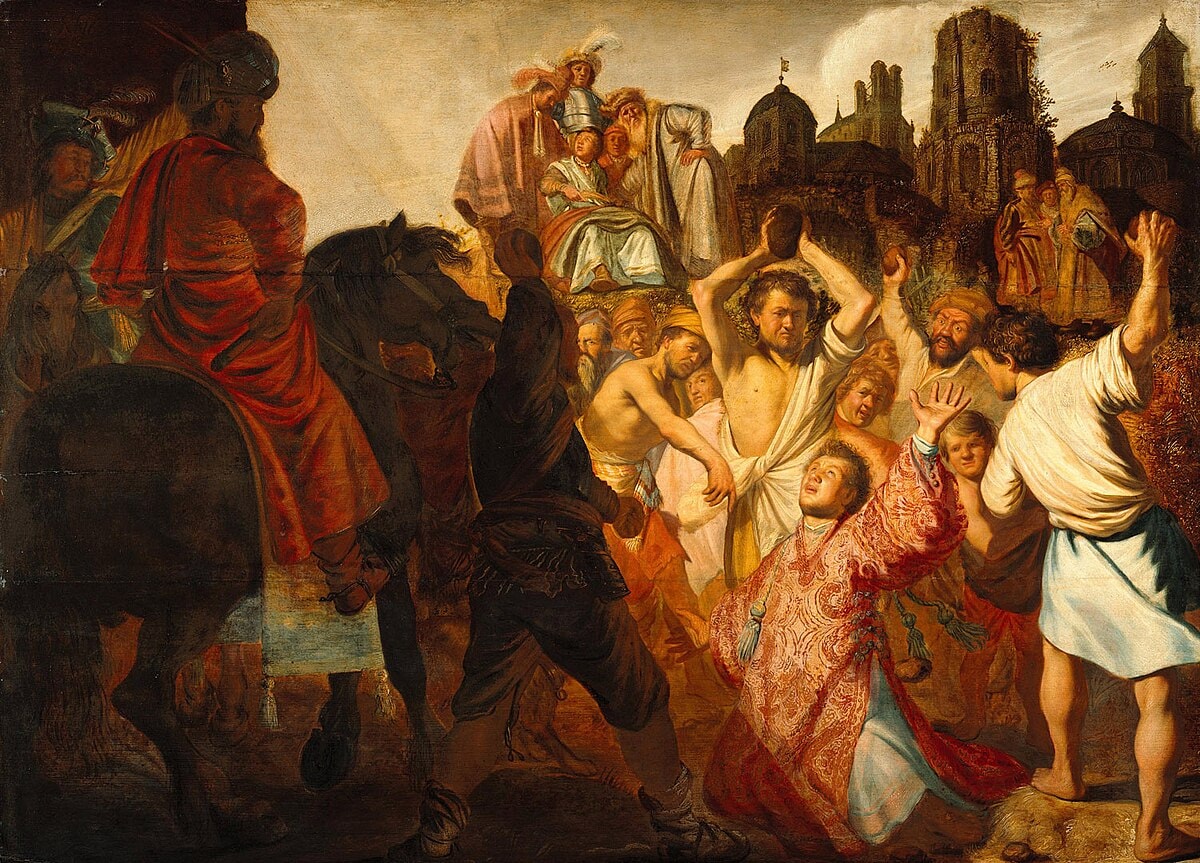
At this they covered their ears, cried out in a loud voice, and rushed together at him. They dragged him out of the city and began to stone him.
Acts 7:57–58 · BSB, excerpt
Stephen had been on trial for his life, accused by false witnesses, and he had answered by telling the court exactly what he thought of it. Then he looked up and said he could see heaven open and Jesus standing at God’s right hand. That was the sentence they could not bear.
Rembrandt painted what happened next when he was about nineteen. It is his earliest known signed and dated painting, and he chose for it a killing by a crowd. Stephen kneels in a red-and-gold robe, one hand flung up and open, his face lifted past everyone around him. Directly above him a bare-chested man hoists a rock over his head with both hands. The left third of the picture sits in deep shadow—a rider on a horse, a dark figure drawing back his arm to throw—while the right side is flooded with strong light.
Now look just above Stephen’s head. A young face is squeezed into the crowd, grimacing. The Lyon museum, which owns the painting, identifies it as Rembrandt’s own—his earliest known self-portrait. The painter did not place himself beside the saint. He put himself among the people throwing stones.
That is an honest place to begin. These are not monsters. They are people who are certain they are right, and the first thing certainty does is stop listening. They cover their ears. Only then do they pick up stones.
Visio Divina Prompt: Find the face directly above Stephen’s head. Then find Stephen’s open hand.
At the Edge of the Violence: Saul and the Coats
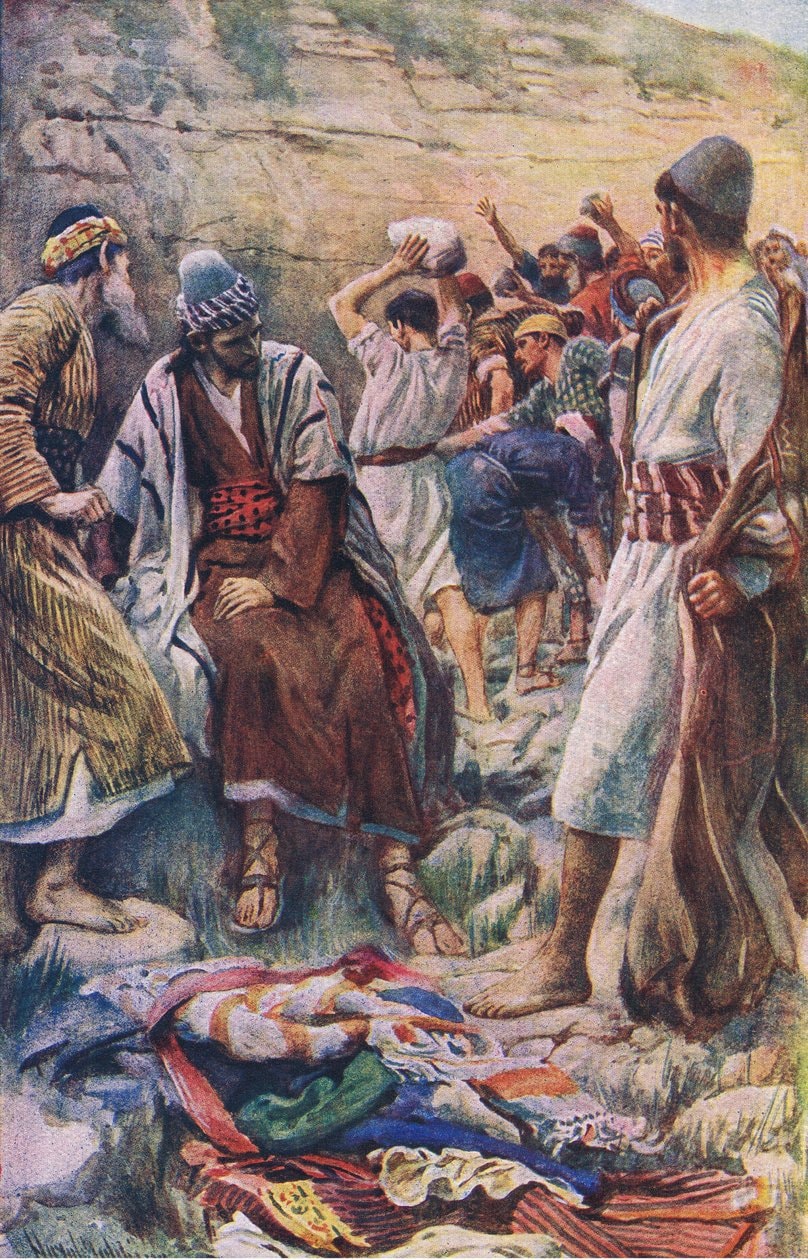
Meanwhile the witnesses laid their garments at the feet of a young man named Saul.
Acts 7:58 · BSB, excerpt
The men about to kill Stephen take off their coats first, and someone has to mind them. Luke, who wrote Acts, could have left the coat-minder anonymous. He gives us the name instead, and a few verses later he removes any doubt about where the man stood: “And Saul was there, giving approval to Stephen’s death” (Acts 8:1).
Harold Copping built a whole picture around that one practical detail. The foreground belongs to a heap of bright coats and three men, one seated between two standing. None is shown throwing a stone. The killing is pushed into the middle distance behind them: raised arms, a rock lifted overhead in both hands.
Acts never says Saul threw a stone. It does not need to. He approved, he helped, he made it easier for other people. Most of the harm in the world has people like this at its edges: the ones who held the coats, stayed quiet in the meeting, looked at the ground. The first painting asks how a crowd becomes this. This one asks something closer to home: where was I standing?
And yet this is the man who becomes St. Paul. Not yet; his next move is to drag men and women out of their houses to prison (Acts 8:3). But years later he still remembers the scene exactly: “when the blood of Your witness Stephen was shed, I stood there giving my approval and watching over the garments of those who killed him” (Acts 22:20). A line long attributed to St. Augustine goes further than the Bible does: if Stephen had not prayed, the Church would not have had Paul. Luke never says the prayer caused the conversion. He only lets us see who was standing close enough to hear it.
Visio Divina Prompt: Start with the coats. Then look at each of the three men near them, and ask which one you would have been.
→ See what happened to him: Caravaggio’s Conversion of Saint Paul
Radical Forgiveness: Stephen’s Last Prayer
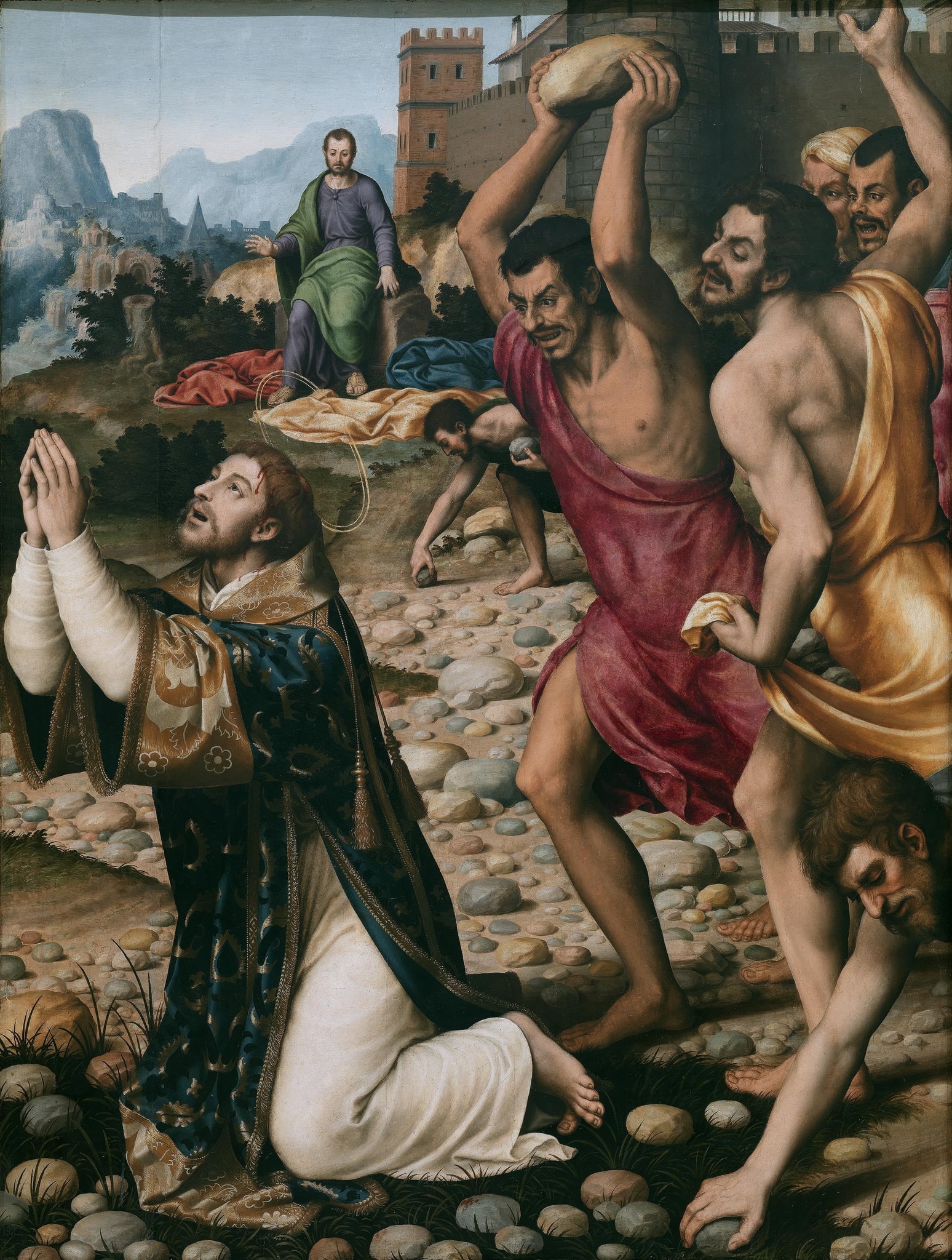
While they were stoning him, Stephen appealed, “Lord Jesus, receive my spirit.” Falling on his knees, he cried out in a loud voice, “Lord, do not hold this sin against them.”
Acts 7:59–60 · BSB, excerpt
Stephen prays twice: once for himself, once for them. If the two prayers sound familiar, they should. On the cross Jesus prays, “Father, forgive them, for they do not know what they are doing,” and then, “Father, into Your hands I commit My Spirit” (Luke 23:34, 46). Luke wrote both books, and he wants us to hear the echo.
Juan de Juanes puts the prayer an arm’s length from the violence. On the left, Stephen kneels on ground littered with stones, hands pressed together, face turned up. On the right, barely a stride away, the executioners crowd in: one in red with a rock hoisted over his head, another in gold twisting to throw, a third bending for the next stone. In the background, easy to miss, a man sits beside a heap of cloaks, watching: the coat-minder again.
Read the prayer slowly. It is more exact than it first sounds.
He calls it a sin. “Do not hold this sin against them.” No they didn’t mean it, no it wasn’t that bad. In the courtroom he had called these men “betrayers and murderers” to their faces (Acts 7:52), and he has not changed his mind. Forgiveness, in this story, starts with an accurate name for the wrong.
Nobody has apologized. Acts records no apology and no sign of regret from the attackers before Stephen dies. The prayer goes out ahead of any remorse. As far as the story tells us, it does not wait for them at all.
And he never says “I forgive you.” He is not even speaking to them. He is speaking to God about them. He hands the case over: the debt is real, and he asks the only judge he trusts not to collect it. For anyone who has tried to forgive by sheer willpower and failed, this may be the most useful detail in the whole account. Stephen does not manufacture a feeling. He makes a request.
You may not be able to pray his prayer today. That is not failure; it is an honest starting point. A truthful beginning might be no more than this: God, I cannot want good for this person yet. You will have to.
Visio Divina Prompt: Stay with Stephen’s joined hands, then the raised ones. Read Acts 7:60 aloud once, slowly. If you cannot mean it, say so. That counts as prayer.
After His Voice Falls Silent
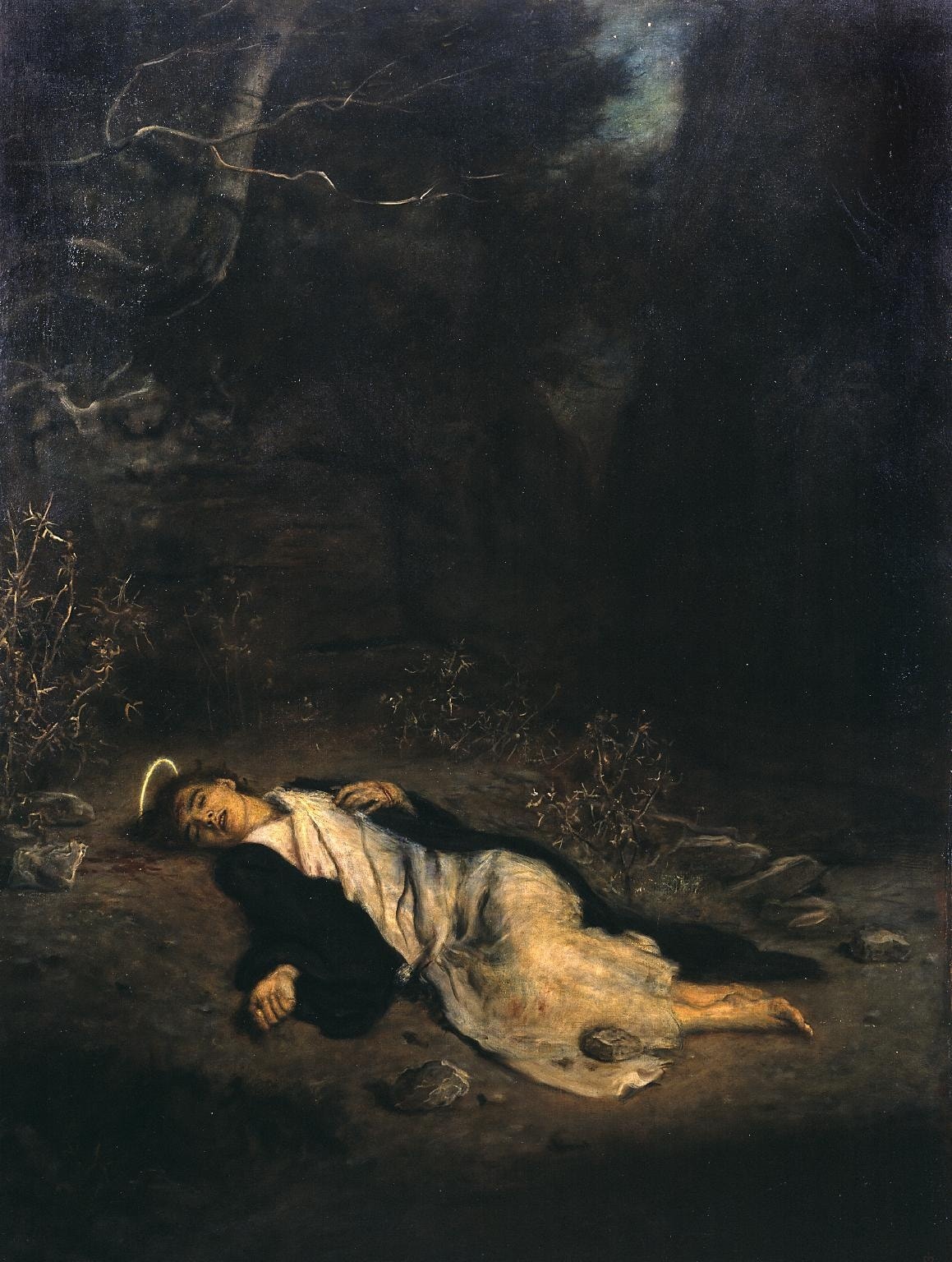
And when he had said this, he fell asleep.
Acts 7:60 · BSB, excerpt
Millais leaves Stephen alone in the aftermath. The crowd is absent from the picture. He lies at the edge of a dark wood, his pale robe catching what light there is, a thin halo at his head, the stones still scattered around him.
Luke does not write “he died.” He writes that Stephen “fell asleep.” It was the early Christians’ word for death, and it carries a whole belief inside it, because sleep is a word that expects waking.
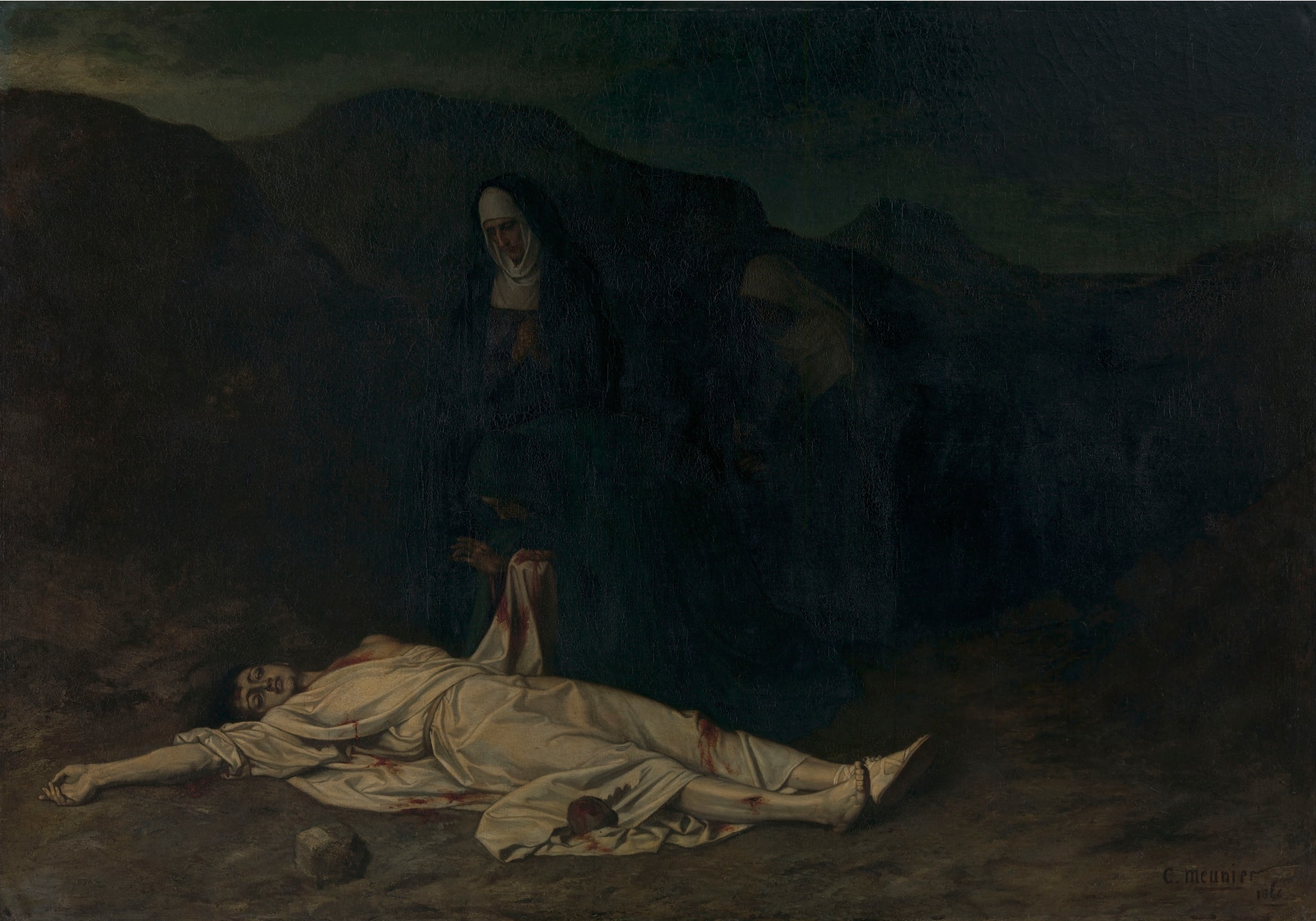
Constantin Meunier gives the aftermath a different form. Stephen lies before us in a bloodstained white robe, one arm flung out, a stone resting on the cloth. But here he is not alone. A dark-cloaked mourner bends over him and lifts a fold of the stained cloth, and other figures stand behind in the dark. Set the two paintings side by side and the difference is simple: in one, no one is there; in the other, someone is.
Both tell the truth about the cost. The prayer did not save him. Forgiveness did not make the story end well in any way a bystander could have seen. If you are forgiving someone and it has not changed them, or fixed anything, or even made you feel better yet, you are not doing it wrong. Sometimes this is what it looks like from the outside.
Visio Divina Prompt: In Millais, count the stones. In Meunier, find the hand holding the cloth.
The People Who Carry Him
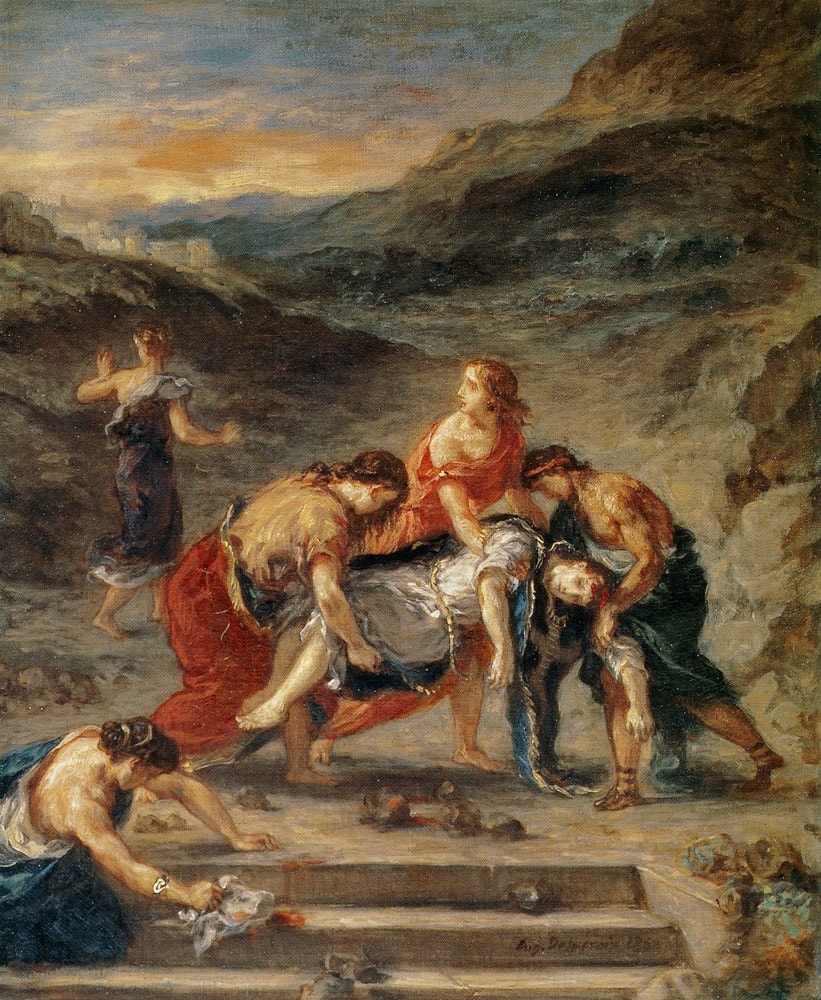
God-fearing men buried Stephen and mourned deeply over him.
Acts 8:2 · BSB
One verse is all the burial gets. Delacroix painted it in 1862, the year before he died, and he made it heavy. Three people carry Stephen’s body over rocky ground while the light goes: the figures at either side bend under the weight, while the red-clad figure between them turns to look anxiously across the scene. Stephen’s arm hangs down. At the lower left another figure kneels on the steps, wiping away blood with a cloth. Acts sets this burial in the same breath as the outbreak of “a great persecution” (Acts 8:1–2). Caring for this body was not a safe thing to do. They did it anyway.
Stephen first appears in the Bible as one of seven men chosen to see that overlooked widows received their daily food. He leaves it being carried. No one in this picture can undo what happened. They can only take the weight, and they do.
If you are the one who was harmed, notice that Stephen’s forgiveness never had to do all the work alone. It was surrounded by people who told the truth, buried their dead, and grieved out loud. Forgiveness was never meant to be a private feat of strength. And if someone you love is the one carrying an injury, this painting is your instruction. You cannot fix it. You can take a corner.
Visio Divina Prompt: Follow the hands under the body, one at a time. Who carried you when you could not carry yourself?
What Radical Forgiveness Asks of Us—and What It Doesn’t
Stephen’s prayer is sometimes quoted at hurting people like a verdict: he forgave his murderers, so what is your excuse? The story itself shows why that is a misuse.
Radical forgiveness does not ask you to call the wrong anything less than it was. Stephen says “this sin” in his last recorded words. Nor does it ask you to stay where you are being harmed. In Fratelli tutti, Pope Francis writes that forgiving does not mean giving up your own dignity or allowing someone to go on doing harm, and that seeking justice is not revenge. Christian mercy should never be used to keep a person in danger or to silence someone who has been abused.
It does not require reconciliation, either. Reconciliation takes two people, and one of them has to be sorry. Stephen and the crowd are never reconciled; he forgives anyway. And it does not have to be a feeling, or be finished. It can be one sentence, prayed through gritted teeth, again, for years.
What it does ask is smaller and harder: to hand the verdict to God instead of carrying it yourself, and to be willing to want, someday, that the person who hurt you would become someone who never does it again. Stephen’s story ends with a prayer for mercy. Saul’s story is still unfolding.
A 4-Step Visio Divina Practice for Forgiveness
Return to the painting that held your attention most.
- Look (Visio): Stay with one physical detail—Stephen’s joined hands, the stones around the body, the hands under it. Describe what is actually there before deciding what it means.
- Meditate (Meditatio): Name the injury plainly, the way Stephen did. What happened? Who did it? You do not have to be fair about it yet.
- Pray (Oratio): Say what is true. If you can pray Stephen’s words, pray them. If you cannot: God, I cannot want good for them yet. Hold this for me until I can.
- Contemplate (Contemplatio): Rest in silence for one minute. You do not have to settle the question of forgiveness today.
Interested in His Life Before All This?
The paintings above follow Stephen’s death and its aftermath. The rest of his story is quieter: the practical job he was first chosen for, the false witnesses brought against him, the court that stared at him and saw “the face of an angel,” the speech that enraged his judges, and what he saw when he looked up. It is told in six more paintings by Fra Angelico, Carpaccio, Falcó, and Carracci.
→ Saint Stephen and What to Do When People Lie About You
Before the Stones: The Widows Who Were Being Overlooked
A Life Becomes a Public Witness
False Witnesses, and a Face Like an Angel’s
Saint Stephen and All Saints’ Day
Stephen’s own feast is December 26 in the Roman Catholic calendar—the “Feast of Stephen” in the carol “Good King Wenceslas”—and December 27 in the Orthodox Church in America’s. This collection also remembers him on All Saints’ Day, November 1. In 2026 the Catholic Gospel for that day is the Beatitudes, and two of them could have been written with him in mind: “Blessed are the merciful, for they will be shown mercy,” and “Blessed are those who are persecuted because of righteousness, for theirs is the kingdom of heaven” (Matthew 5:7, 10).
Stephen shows forgiveness given. For forgiveness received, continue with the life of Saint Peter, or return to All Saints’ Day in Art.
Stay with the painting
If you want to sit with one of these images a little longer, you can restore it yourself. Open Delacroix’s Saint Stephen Borne Away by His Disciples as a puzzle—piece by piece, with the verse and a reflection waiting at the end. Or get the Visio Divina app for a new painting, a new verse, and a new reflection every morning.
Saint Stephen at a Glance
- Who he was: one of seven men chosen by the first church in Jerusalem to make sure widows who were being overlooked received their daily food (Acts 6:1–6). Christian tradition honors the seven as the first deacons.
- Known for: being the first Christian martyr—the protomartyr—stoned to death after a trial before the Sanhedrin built on false witnesses (Acts 6:13; 7:58).
- Last words: “Lord Jesus, receive my spirit,” and then, “Lord, do not hold this sin against them” (Acts 7:59–60).
- Who was watching: a young man named Saul, who approved of the killing and later became the apostle Paul (Acts 8:1; 22:20).
- In art: a young man in a deacon’s robe, called a dalmatic, often holding stones, a palm branch, or a book.
- Feast day: December 26 in the Roman Catholic calendar.
FAQ: Saint Stephen’s life, martyrdom, and art
What is Saint Stephen known for, and why is he called the first martyr?
Stephen was a member of the first Christian community in Jerusalem, chosen with six others when Greek-speaking widows were being overlooked in the daily distribution of food. Christian tradition honors these seven as the first deacons. Stephen also preached and performed signs and wonders. He is called the first Christian martyr, or protomartyr, because Acts presents his death as the first martyrdom of the Church after Pentecost. John the Baptist had died earlier and is also honored as a martyr; Stephen's title does not deny John's witness. It identifies Stephen's place in the story of the emerging Church.
Sources: Acts 6; Benedict XVI on Stephen and the first community, January 10, 2007; Benedict XVI on the martyrdom of John the Baptist, August 29, 2012.
What was Saint Stephen accused of, and why was he killed?
Stephen was accused of blasphemy against Moses and God, and of speaking against the Temple and the law. Acts explicitly identifies the witnesses brought against him as false witnesses. His reply retold Israel's history and challenged his hearers for resisting the Holy Spirit and betraying the Righteous One. When he declared that he saw Jesus at God's right hand, they rushed at him, dragged him outside the city, and stoned him. The narrative concerns particular opponents and participants in Jerusalem. It is not a warrant for blaming Jewish people collectively; Stephen and the first believers belonged to that same Jewish world.
Sources: Acts 6; Acts 7, including the note on 7:57; Benedict XVI on the Jewish origins of the Jerusalem community.
What is the miracle of Saint Stephen?
Acts says Stephen performed "great wonders and signs among the people" (Acts 6:8), but it does not describe a particular healing or other individual miracle. It also records that the council saw his face as being like an angel's, and that Stephen saw God's glory and Jesus standing at God's right hand before his death. These are distinct details in the narrative. If a painting shows Stephen healing someone, the artist may be developing the general statement about his ministry; we should not turn the painted scene into a separately documented biblical episode.
Did Saint Stephen ever meet Jesus?
The New Testament does not tell us whether Stephen met Jesus during Jesus' earthly ministry. Stephen first appears by name in Acts 6, within the Jerusalem community after Pentecost. We therefore cannot confidently answer yes or no about an earlier meeting. What Acts does explicitly record is his vision before his death: he sees Jesus standing at the right hand of God. That distinction matters. His encounter with the risen Christ in Acts 7 is part of the biblical account; a meeting with Jesus before the Crucifixion would go beyond what that account tells us.
Why was Jesus standing when Stephen was killed?
Acts 7:55–56 says Jesus was standing at God's right hand, but it does not explain the posture. Christian readers have long reflected on its meaning. In the fourth century, Saint Ambrose interpreted the standing Christ as an advocate for his people and as the one who receives and honors the martyr. That is a theological reading, not an explanation supplied by Luke. The central assurance of the scene is less uncertain: while Stephen is rejected on earth, he sees the risen Jesus in glory. A painting can help us contemplate that assurance without pretending to settle every detail of the vision.
Sources: Acts 7 and the note on 7:55; Ambrose, Exposition of the Christian Faith, Book III, chapter 17, paragraph 137.
Was Saint Paul involved in Stephen's death?
Yes. Paul, called Saul in this part of Acts, was present and approved of Stephen's death. The witnesses placed their garments at his feet while Stephen was being stoned. Later in Acts, Paul recalls that he stood there approving and guarding the clothing of those who killed Stephen. The text does not say that Saul threw a stone himself. Nor does it say that he converted immediately afterward: Acts 8 describes him continuing to persecute the Church. His later conversion gives the scene an extraordinary place in Christian memory, but Scripture does not explicitly say that Stephen's prayer caused it.
Sources: Acts 7; Acts 8; Acts 22.
What did Saint Stephen say before he died?
Acts records two final prayers. While the stones were falling, Stephen said, "Lord Jesus, receive my spirit" (Acts 7:59). Then, falling to his knees, he cried, "Lord, do not hold this sin against them" (Acts 7:60). His last recorded words are therefore a prayer for the people killing him. They do not pretend that nothing wrong is happening: Stephen calls the violence a sin. Yet he asks that it not be held against his attackers. The prayer echoes Jesus' forgiveness at the Crucifixion and makes Stephen's faith visible in the very moment when his life is being taken.
Sources: Acts 7; Benedict XVI on Stephen's prayers, May 2, 2012.
How old was Saint Stephen, and how long after Jesus' death was he killed?
Acts does not give Stephen's age, birth year, or an exact date for his death. It places his martyrdom after Pentecost, during the earliest period of the Church in Jerusalem, and before Saul's conversion. That sequence is much firmer than a precise number of years after the Crucifixion. Later traditions and reference works offer approximate ages and dates, but those should not be presented as information recorded in Scripture. The young face familiar from so many paintings belongs to Stephen's artistic tradition; it cannot establish his age when he died.
Sources: Acts 7; National Gallery, Saint Stephen glossary. For contrast, the Orthodox Church in America's traditional life supplies an approximate age; that is a tradition, not an age given in Acts.
Why is Saint Stephen shown holding stones, a palm, or a book?
The stones identify the way Stephen was martyred. Artists may place them in his hands, on a book, or even on his head and shoulders. A palm marks him as a martyr, while a Gospel book recalls his witness and preaching. His wide-sleeved outer garment, called a dalmatic, identifies him as a deacon. These details help distinguish him from other saints, though each artwork uses them differently. They also compress his life into a single image: service, the proclamation of Christ, violent death, and the Church's hope that death has not overcome him.
Sources: National Gallery, Carlo Crivelli's Saint Stephen, with stones, palm, Gospel book, and dalmatic; National Gallery, Saint Stephen glossary.
What do people pray to Saint Stephen for?
In Catholic devotion, asking Saint Stephen to pray for us means seeking his intercession with God. His life makes him a fitting companion in prayer for courage in bearing witness, care for people who are overlooked, and the grace to forgive. He is honored as a patron of deacons and altar servers; Catholic sources also list bricklayers and stonemasons among his traditional patronages. These associations are devotional traditions, not a promise of a particular result. Christians who do not ask saints for intercession can still pray directly to God while reflecting on Stephen's service and final prayer.
Sources: Benedict XVI, December 26, 2009, explicitly naming deacons and altar servers; USCCB Saint Stephen resource, naming bricklayers and stonemasons; Catechism of the Catholic Church, paragraphs 956–957, on intercession.
When is Saint Stephen's feast day, and why include him in an All Saints' Day collection?
Saint Stephen's feast falls on December 26 in the Roman Catholic calendar. The Orthodox Church in America commemorates him on December 27. November 1 is All Saints' Day in the Roman calendar, a celebration embracing all the saints rather than Stephen's individual feast. His place in this collection is therefore natural: his life helps us contemplate what holiness looks like in service, witness, suffering, and mercy. For All Saints' Day in 2026, the Catholic Gospel is the Beatitudes, including Jesus' words about the merciful and those persecuted for righteousness. Stephen's story gives those words a human face.
Sources: Vatican News, Saint Stephen, December 26; Orthodox Church in America, December 27; USCCB, Solemnity of All Saints, November 1, 2026.
Does Stephen's radical forgiveness mean accepting abuse or abandoning justice?
No. Stephen's prayer asks for mercy while still naming the violence as sin. His story does not command someone to stay in danger, conceal abuse, or excuse the person responsible. In Fratelli tutti, Pope Francis explains that forgiveness remains compatible with defending one's dignity, seeking justice, and preventing further harm. The radical movement in Stephen's prayer is his appeal that God show mercy to his attackers while they are still attacking him. Readers may need time, support, protection, and repeated prayer to approach forgiveness in their own lives. His witness invites us toward Christ; it should never become a weapon against someone already wounded.
Sources: Francis, Fratelli tutti, paragraphs 241–243 and 250.