The All Saints’ Day Collection

St. Sebastian’s Life in Art

Follow St. Sebastian’s story through 23 works of art: the arrows he survived, Irene’s rescue, his final martyrdom, and his enduring image.

You probably know the picture: a young man, a tree, and far too many arrows.

That’s St. Sebastian. And here’s the part that’s easy to miss: according to the story behind the paintings, the arrows didn’t kill him.

Someone came back for him. He recovered. Then, when he had the chance to leave Rome, he went to confront the emperor instead.

Once you know that, these paintings feel different. The lonely figure still has someone on her way to help him. The women leaning over him have a life to save. And the story has one more, heartbreaking turn ahead.

First, a little of his story

The story artists inherited goes like this. Sebastian was a soldier in Emperor Diocletian’s guard, secretly helping fellow Christians in prison. When his faith was discovered, the emperor ordered him shot with arrows. The soldiers left him for dead.

But a Christian woman named Irene found him alive and cared for him until he recovered. Sebastian then returned to challenge the emperor’s persecution of Christians. This time, he was killed.

A few things to know before we look:

  • His feast day is January 20 in the Western church calendar.
  • He isn’t a person from the Bible. Scripture can help us reflect on his story, but it doesn’t tell it.
  • The arrows aren’t the end. They belong to the ordeal he survived.
  • We know more about his story than we can prove about his life. Christians in Rome remembered Sebastian by the fourth century; the detailed account of the soldier, the arrows, and Irene comes from a later saint’s life.

Source: Vatican News, “San Sebastiano, martire.”

Before the arrows, a secret

Imagine keeping your faith hidden while working close to the emperor. In the traditional account, Sebastian used that position to help people the empire had imprisoned. Most painters skip this part, so it’s worth remembering: the man we’re about to meet had already been taking risks for others.
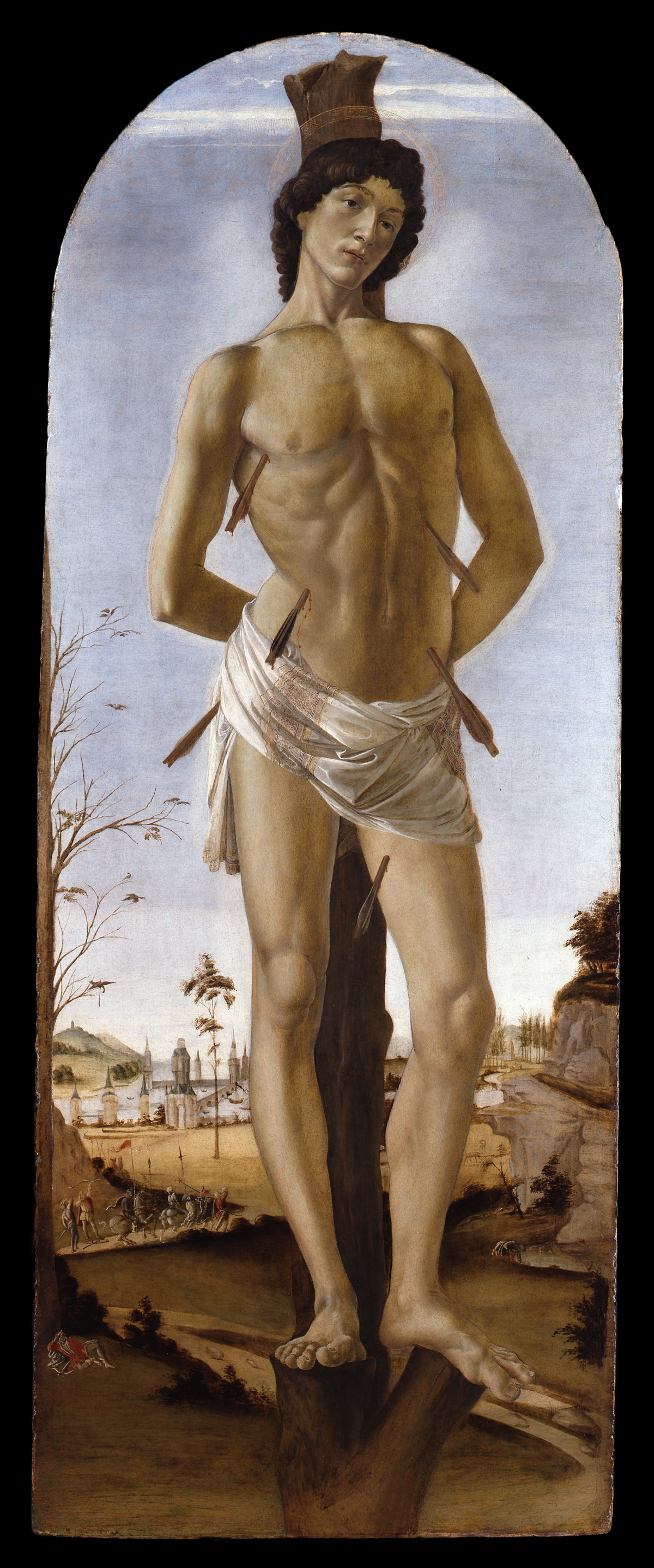
Saint Sebastian stands tied to a tree stump, his body pierced by arrows, before a distant river landscape.
Saint Sebastian1474Sandro BotticelliOpen the Puzzle - Play Now!

Botticelli’s Sebastian looks so calm that you might notice the lovely landscape before you count the arrows. Then you see what’s happened to him, and that quiet face becomes much harder to forget.

Alone among the trees

Soon the uniform is gone, and so is the protection of his position. The painters give him different surroundings, but the loneliness is there in every version.
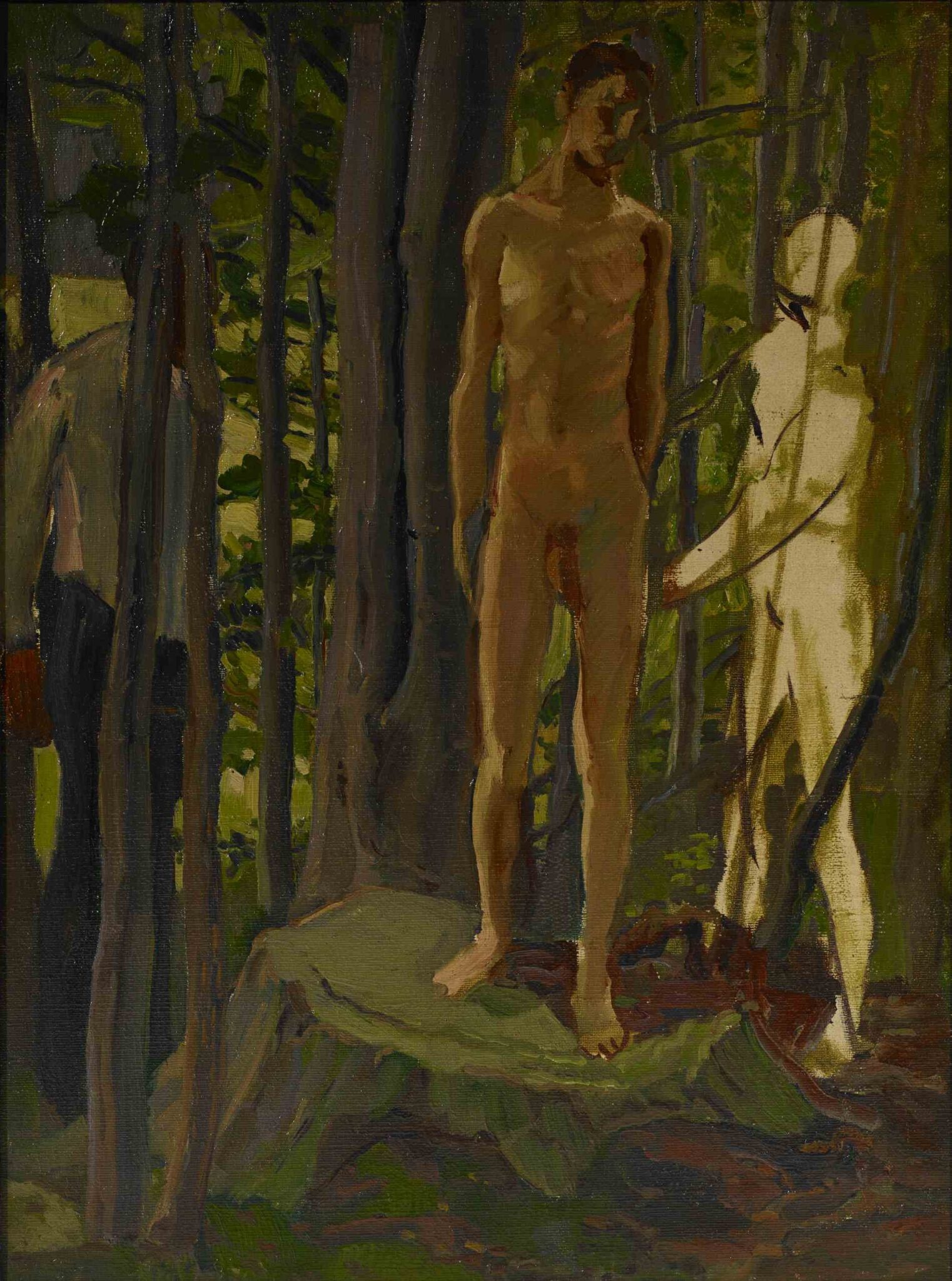
Sebastian stands barefoot on a broad tree stump among dense green and brown trees, with his head turned aside.
Sebastian auf dem Baumstumpf1909Albert WeisgerberOpen the Puzzle - Play Now!

Weisgerber kept coming back to Sebastian between 1909 and 1913, trying the subject again and again. Here, the trees crowd around the young man, and the little stump beneath his feet feels like a terribly lonely stage.
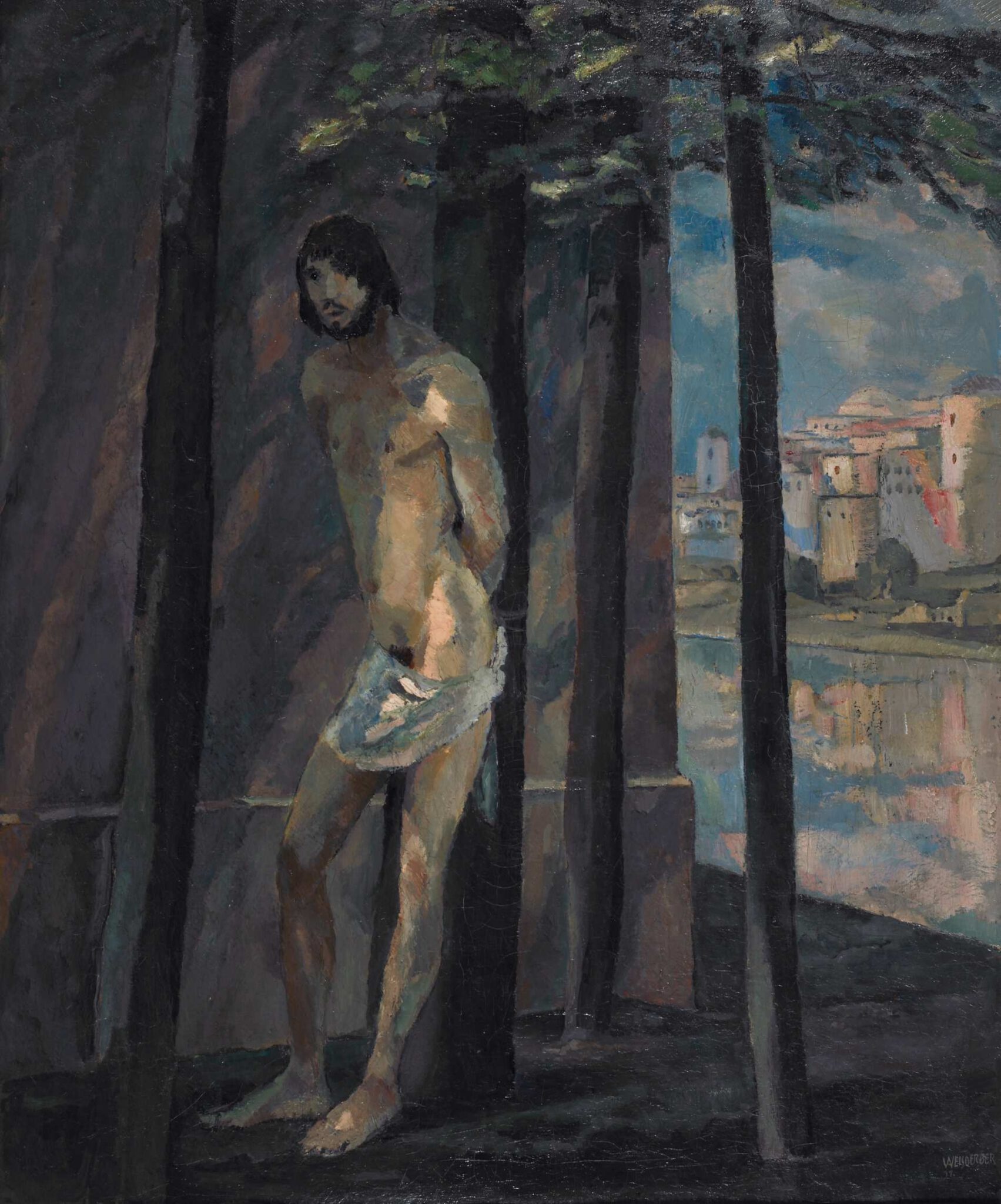
Sebastian stands in shadow against a high wall, while a sunlit town appears beyond the trees to the right.
Sebastian an der Mauer1911Albert WeisgerberOpen the Puzzle - Play Now!

See the sunlit buildings beyond the wall? That’s the detail that hurts here: a whole world seems to be carrying on just a short distance from a man who needs help.
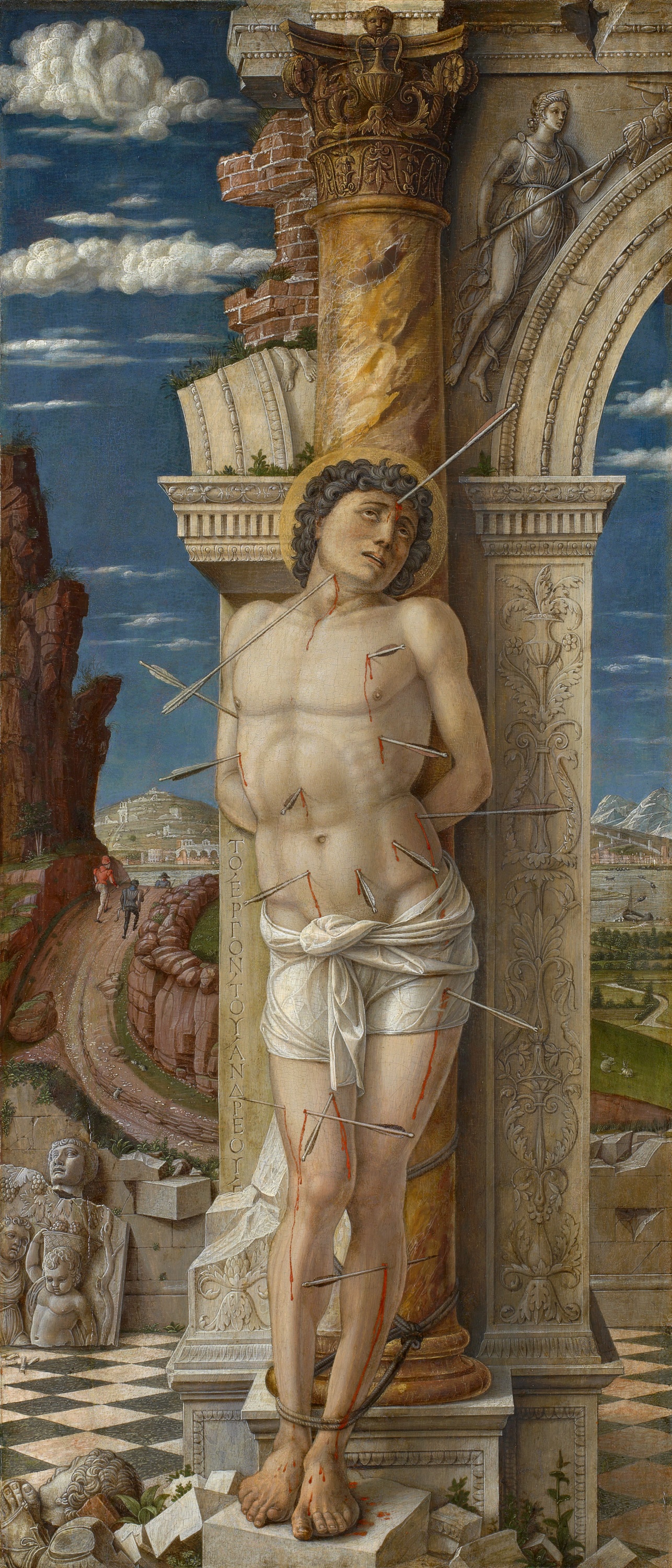
Sebastian stands bound to a carved classical column amid broken stone, with arrows piercing his body and a town in the distance.
Saint Sebastian (Vienna version)c. 1457–1459Andrea MantegnaOpen the Puzzle - Play Now!

Mantegna gives you plenty to explore around Sebastian: broken stone, carved figures, and a town in the distance. You can spend a while looking at all that beautiful detail before coming back to the terrible thing at the center—a living person tied to a column.

The arrows

Some painters show us who is holding the bows. Others let the soldiers leave, keeping us with the person they’ve left behind.
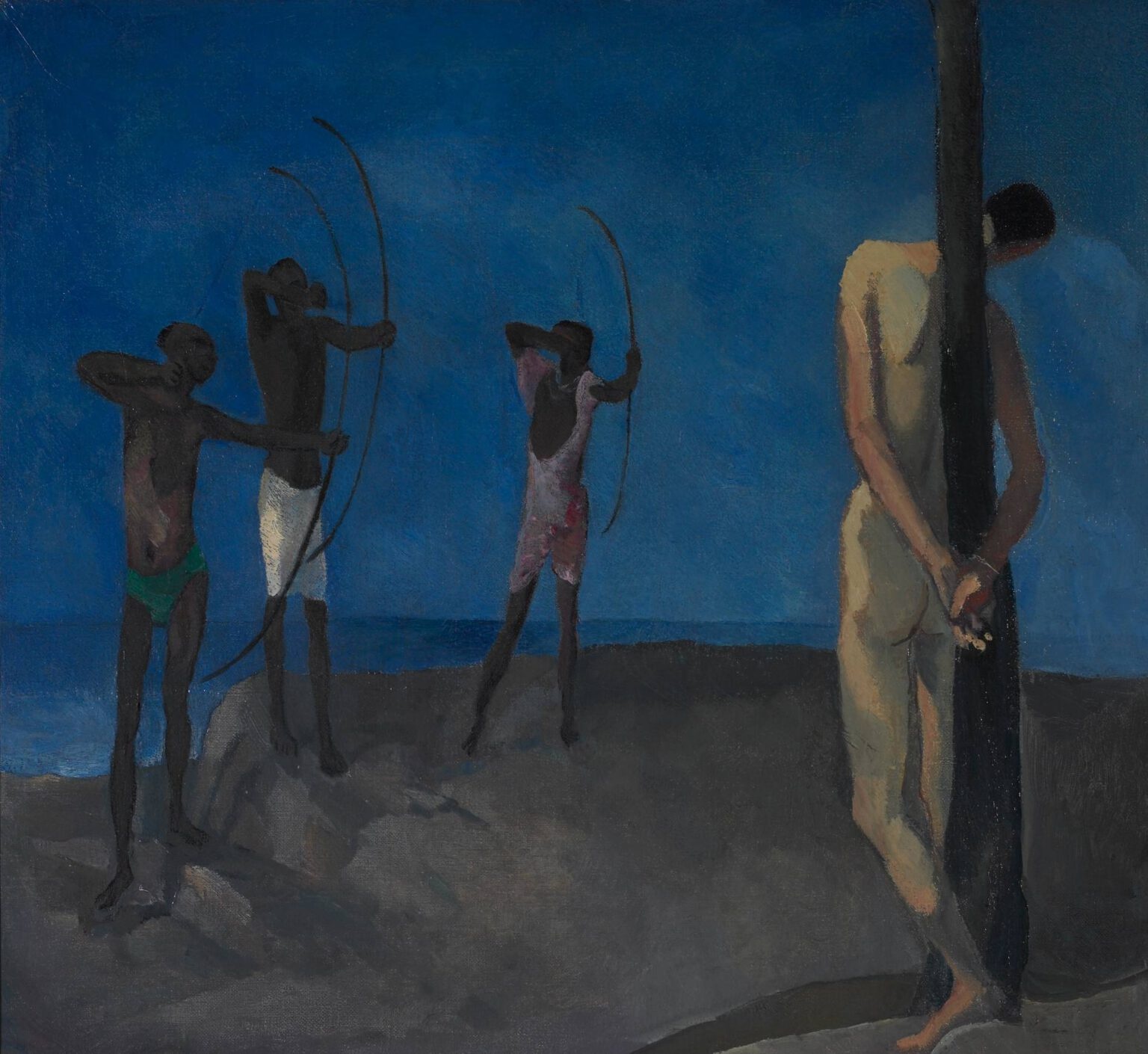
Sebastian stands with his back to the viewer and his hands bound behind a tree trunk as three archers aim their bows across a bare plateau.
Sebastian mit schwarzen Bogenschützen1913Albert WeisgerberOpen the Puzzle - Play Now!

Here the archers are still at work, and Sebastian has his back to us. That distance is unsettling: we can see what’s happening, but we can’t even meet his eyes.
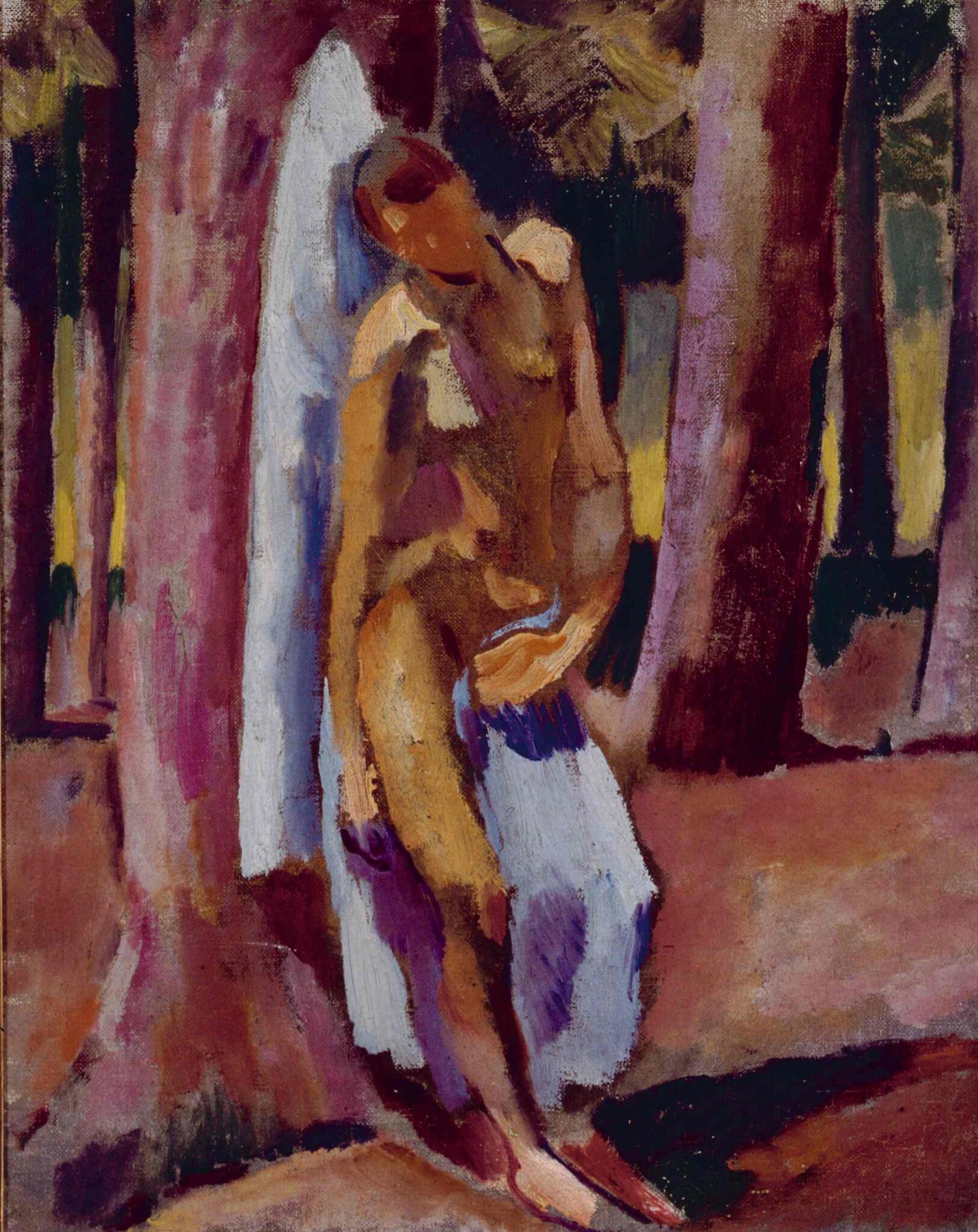
Sebastian leans against a tree with his head bowed, holding a blue cloth against his body amid violet trunks and pink ground.
Sebastian mit blauem Tuch1913Albert WeisgerberOpen the Puzzle - Play Now!

The colors almost catch you off guard after all that darkness: violet trees, warm pink ground, a flash of blue and white. Then you notice Sebastian’s bent head and awkward stance, and the brightness starts to feel painfully at odds with what he’s enduring.
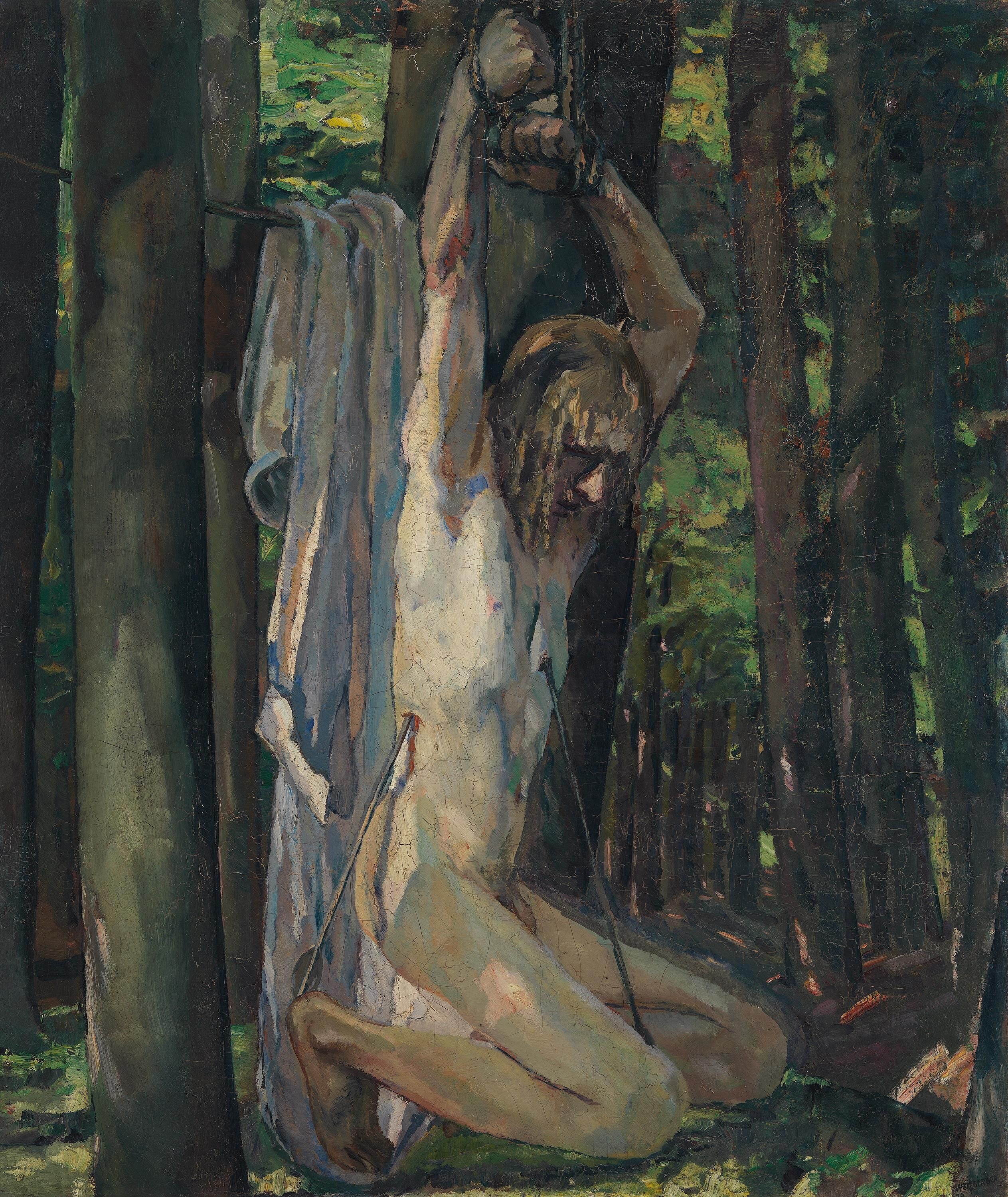
Sebastian kneels with bent legs beside a tree, his wrists bound above his bowed head, surrounded by green woodland.
Hl. Sebastian1910Albert WeisgerberOpen the Puzzle - Play Now!

His knees have given way, but his arms are still held up against the tree. Weisgerber makes you feel how tired this body is; even keeping his head raised seems beyond him now.
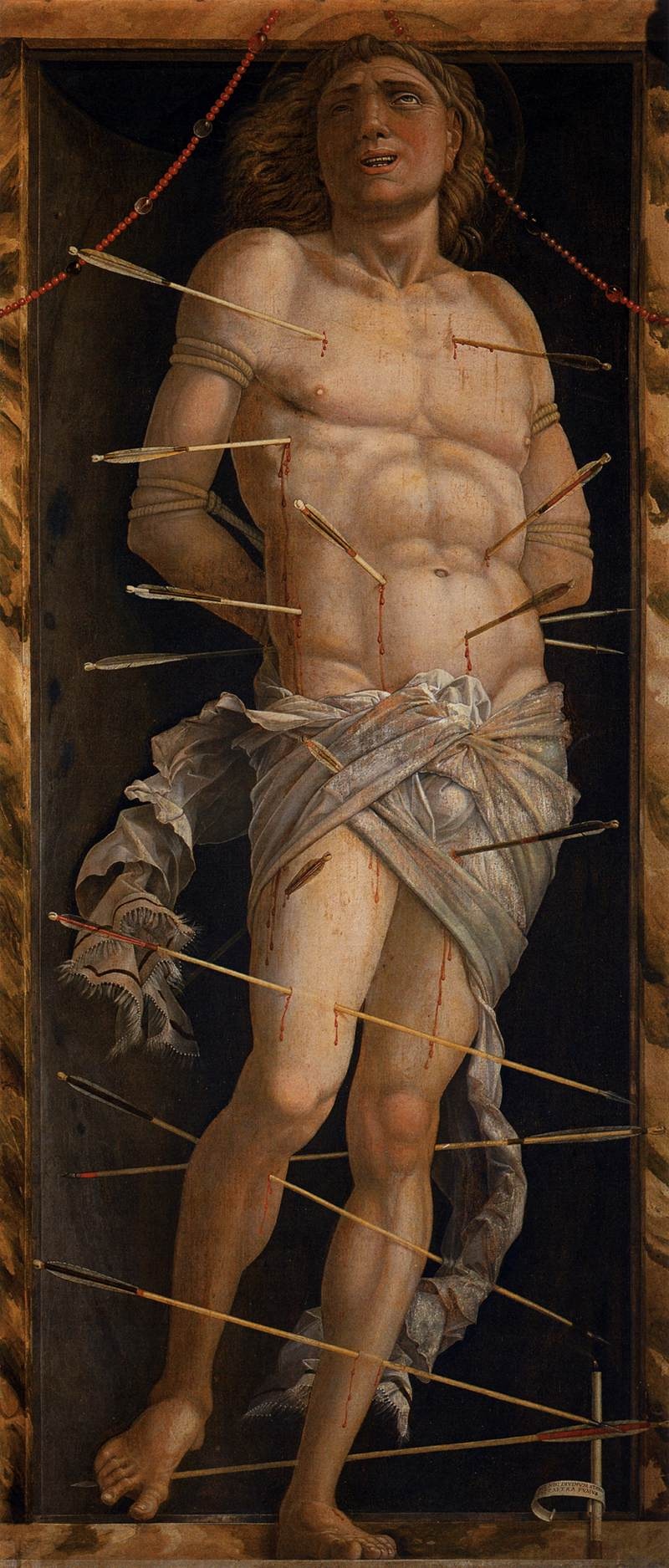
Sebastian stands against a dark background with numerous arrows crossing his torso and legs and pale fabric wound around his hips.
Saint Sebastian (Venice version)c. 1506 (dating varies)Andrea MantegnaOpen the Puzzle - Play Now!

There are arrows everywhere, crossing the body and cutting through the dark space around it. Mantegna brings us so close that it’s difficult to look comfortably at this picture, which feels right for something so cruel.

Where do you look when you can’t move?

Again and again, painters turn Sebastian’s face toward the sky. We can’t know his thoughts, but that upward gaze gives us somewhere to begin imagining his prayer.
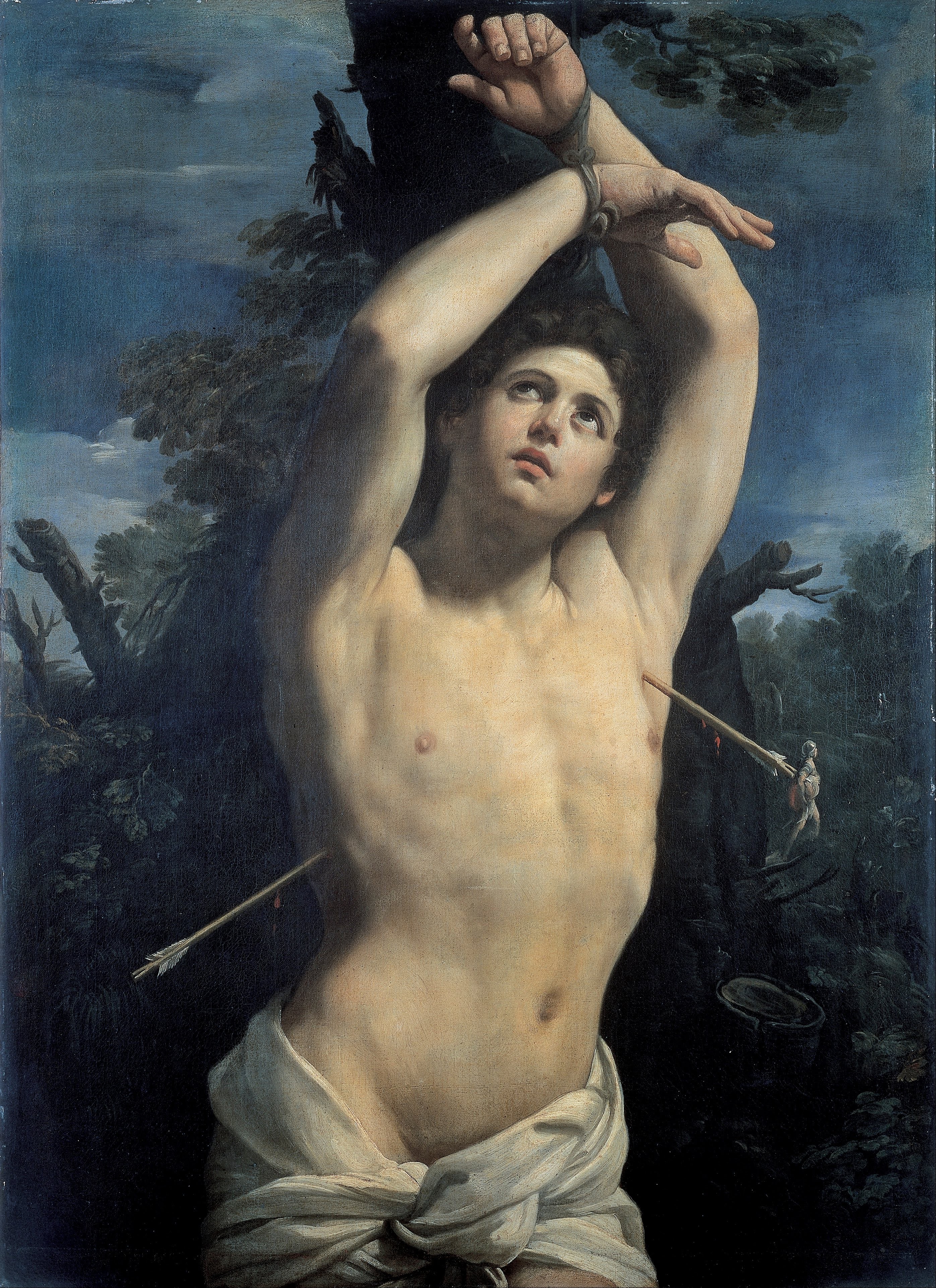
Sebastian looks upward with both wrists bound above his head, two arrows piercing his body against a dark wooded landscape.
Saint Sebastian (Genoa version)1615–1616Guido ReniOpen the Puzzle - Play Now!

Follow the curve of Sebastian’s raised arms, and you arrive at his face. Reni makes him beautiful, certainly, but it’s the searching look in his eyes that makes you want to stay.
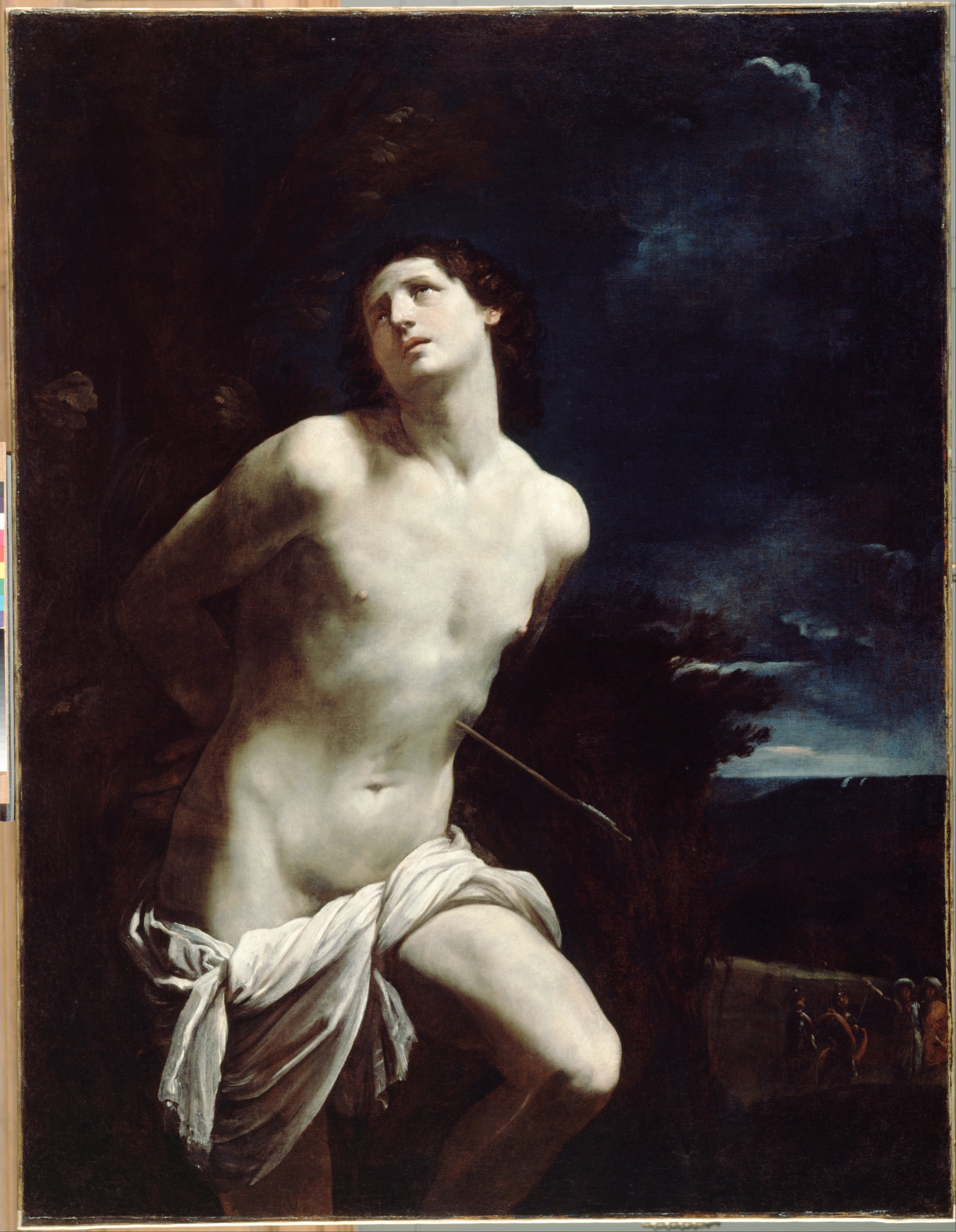
Sebastian looks upward with his arms behind his body and one knee bent forward; an arrow pierces his side and distant soldiers walk away.
Saint Sebastian (Dulwich version)c. 1630–1635Guido ReniOpen the Puzzle - Play Now!

This time, a single arrow is enough to tell you who he is; look behind him and you’ll spot the soldiers walking away. There’s a hidden detail, too: X-rays revealed that Reni first planned the cloth higher around Sebastian’s waist, then lowered it as he painted.
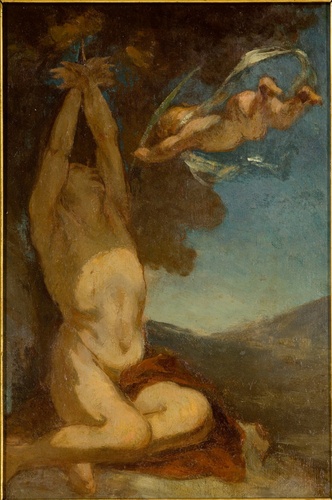
Sebastian kneels with his arms stretched overhead against a tree as an angel flies toward him across a blue sky.
Le Martyre de saint Sébastienc. 1849Honoré DaumierOpen the Puzzle - Play Now!

Daumier was famous for caricatures, so a church painting of Sebastian might seem an unexpected choice—but he picked the subject himself. This little study turned up in a private collection in 1978, and the large finished painting was rediscovered the following year: even the pictures have a story of being found again.

Someone comes back

Irene arrives expecting to bury him. Instead, she finds someone she can still save.

This is the turn in the story I keep coming back to. After so many pictures of a man alone, another person reaches into the frame.
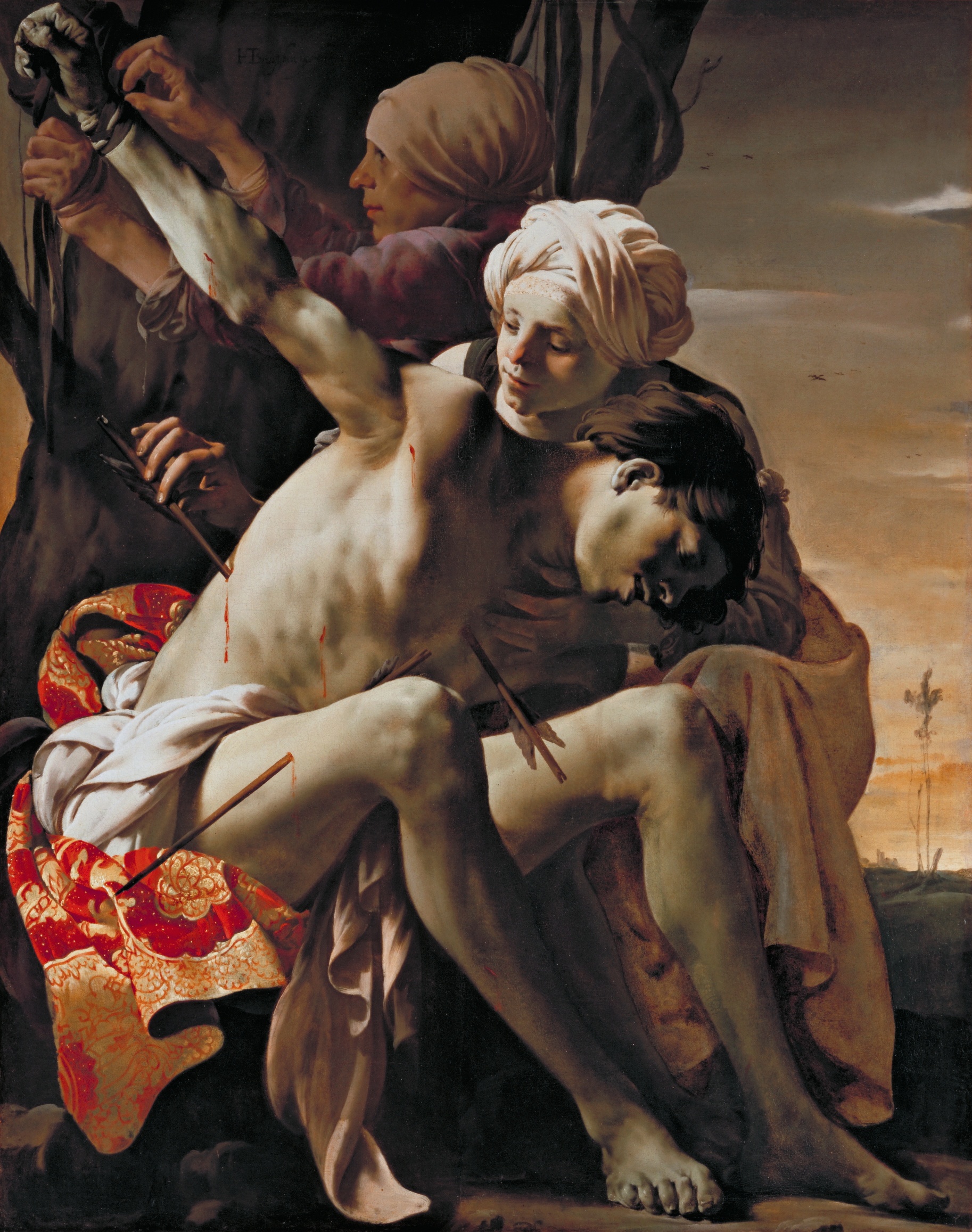
Two women support Sebastian as his body slumps forward, one working at his raised wrist while the other steadies him.
St. Sebastian Tended by Irene1625Hendrick ter BrugghenOpen the Puzzle - Play Now!

Look at how heavily Sebastian leans into the woman supporting him, while her companion works at his bonds. You can almost feel the effort in their arms: getting him down safely is going to take both of them.
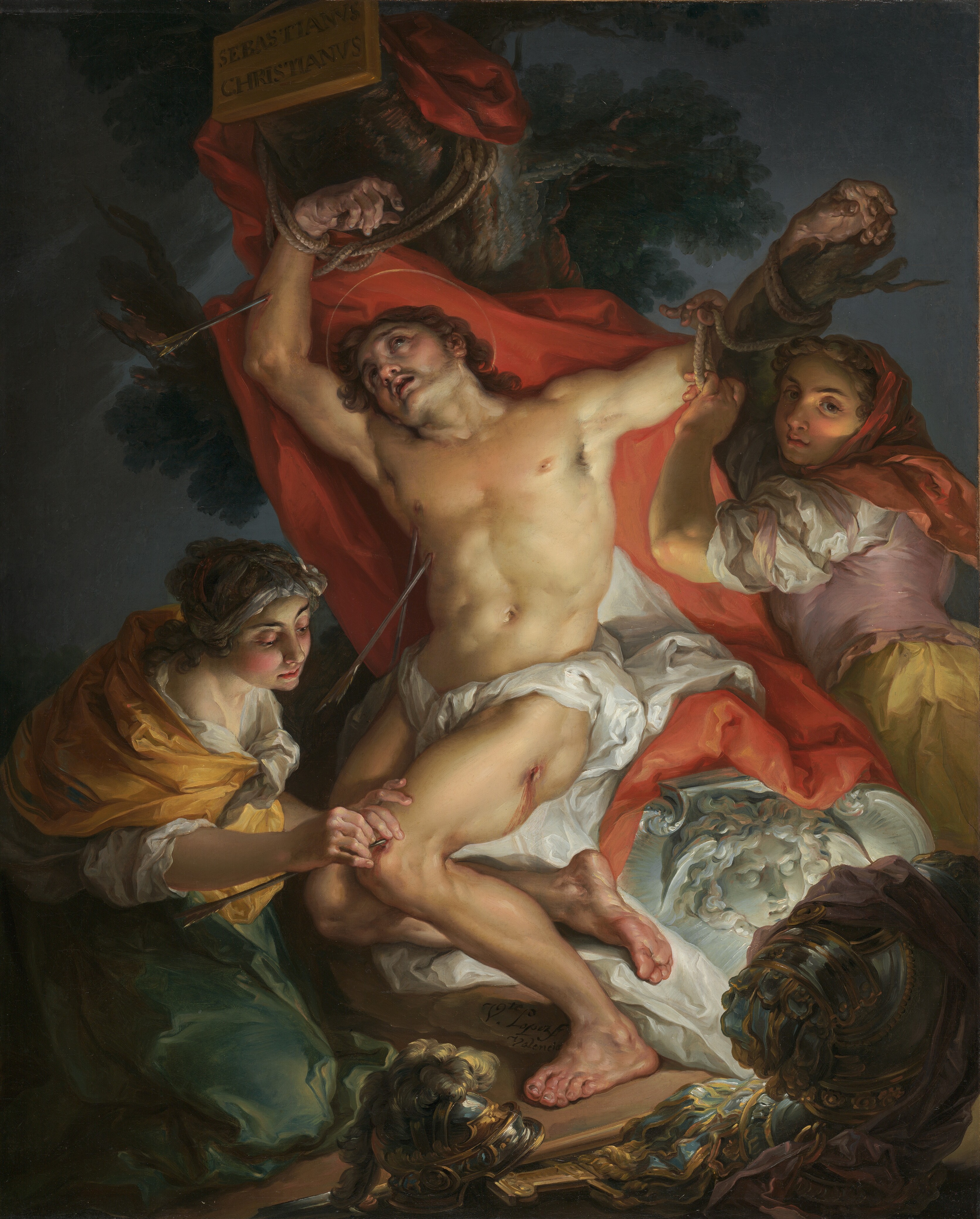
Two women tend Sebastian, whose arms remain bound to a tree, with red cloth behind his body and ornate armor at his feet.
Saint Sebastian Tended by Saint Irene1795–1800Vicente López y PortañaOpen the Puzzle - Play Now!

There’s so much happening here—hands reaching, faces leaning in, red cloth tumbling around his body—that your eyes hardly know where to settle. Try the discarded armor at the bottom: it’s a small reminder that this helpless man was a soldier.
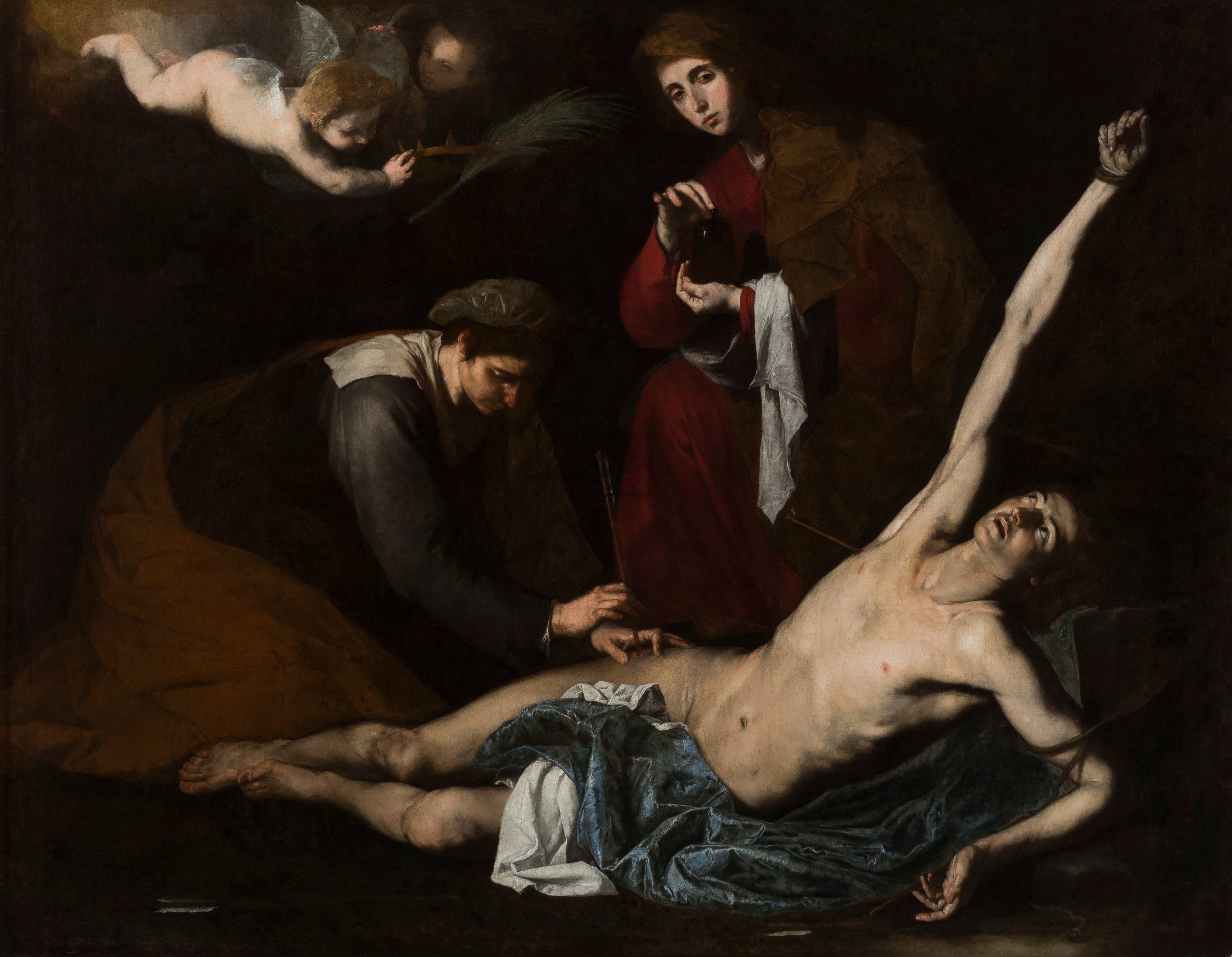
Sebastian lies diagonally across dark blue cloth with one arm raised as two women tend him and small angels hover overhead.
Saint Sebastian Tended by the Holy Womenc. 1620–1623Jusepe de RiberaOpen the Puzzle - Play Now!

Sebastian’s arm is still stretched upward, even as the women bend close to help. The little angels above seem to have come to watch over them, but down here the women have the difficult work in hand.

Just enough light to help

In the next pictures, the world shrinks to a few faces and a flame. You almost find yourself leaning closer, as if you could help them see.
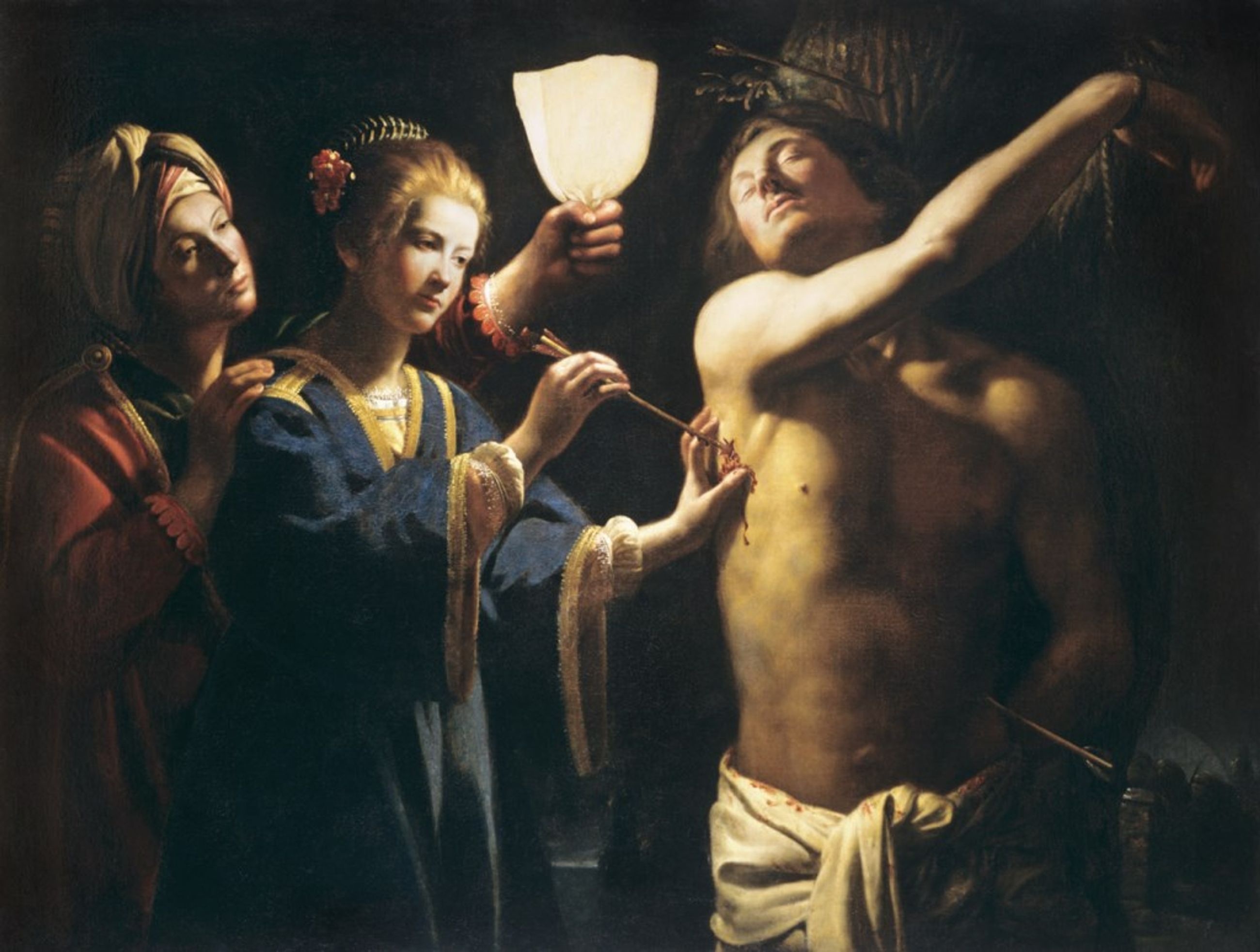
By a shielded flame, a woman draws an arrow from Sebastian’s side while another woman watches and his arm stretches above his head.
Saint Sébastien soigné par Irène17th centuryAttributed to Maître à la chandelleOpen the Puzzle - Play Now!

The name Maître à la chandelle means “Candlelight Master,” and you can see why it fits. We’re still uncertain who painted this work—it was once credited to Trophime Bigot—but the woman carefully drawing an arrow from Sebastian’s side gives us something wonderfully human to hold on to.
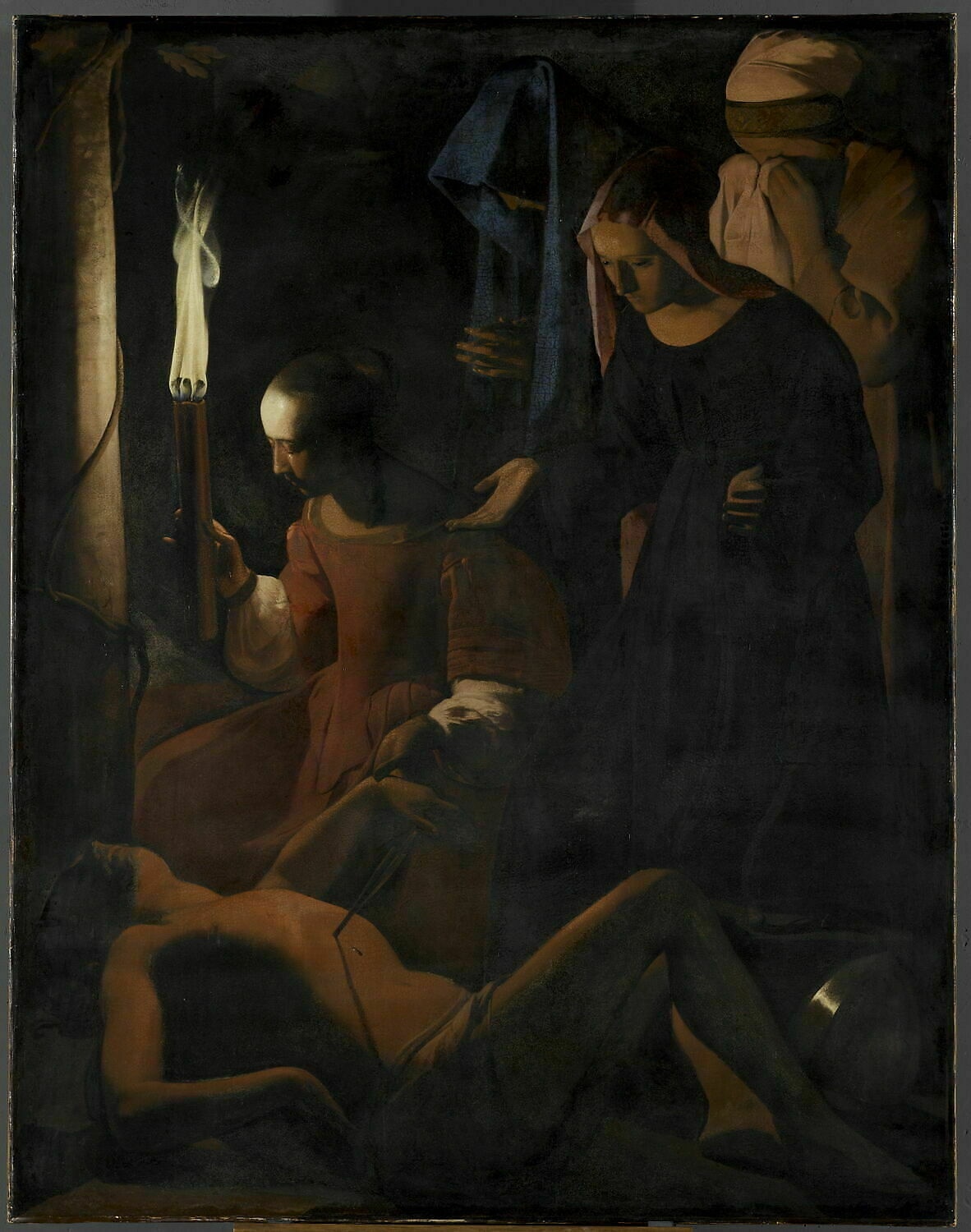
Four women gather around the reclining Sebastian in darkness; one holds a tall flame and another covers her face with a cloth.
Saint Sébastien soigné par Irènevers 1649Georges de La TourOpen the Puzzle - Play Now!

This one makes me want to lower my voice. The flame picks out the women gathered around Sebastian, and their bowed heads make you feel how frightening it must be to care for someone whose survival is still uncertain.
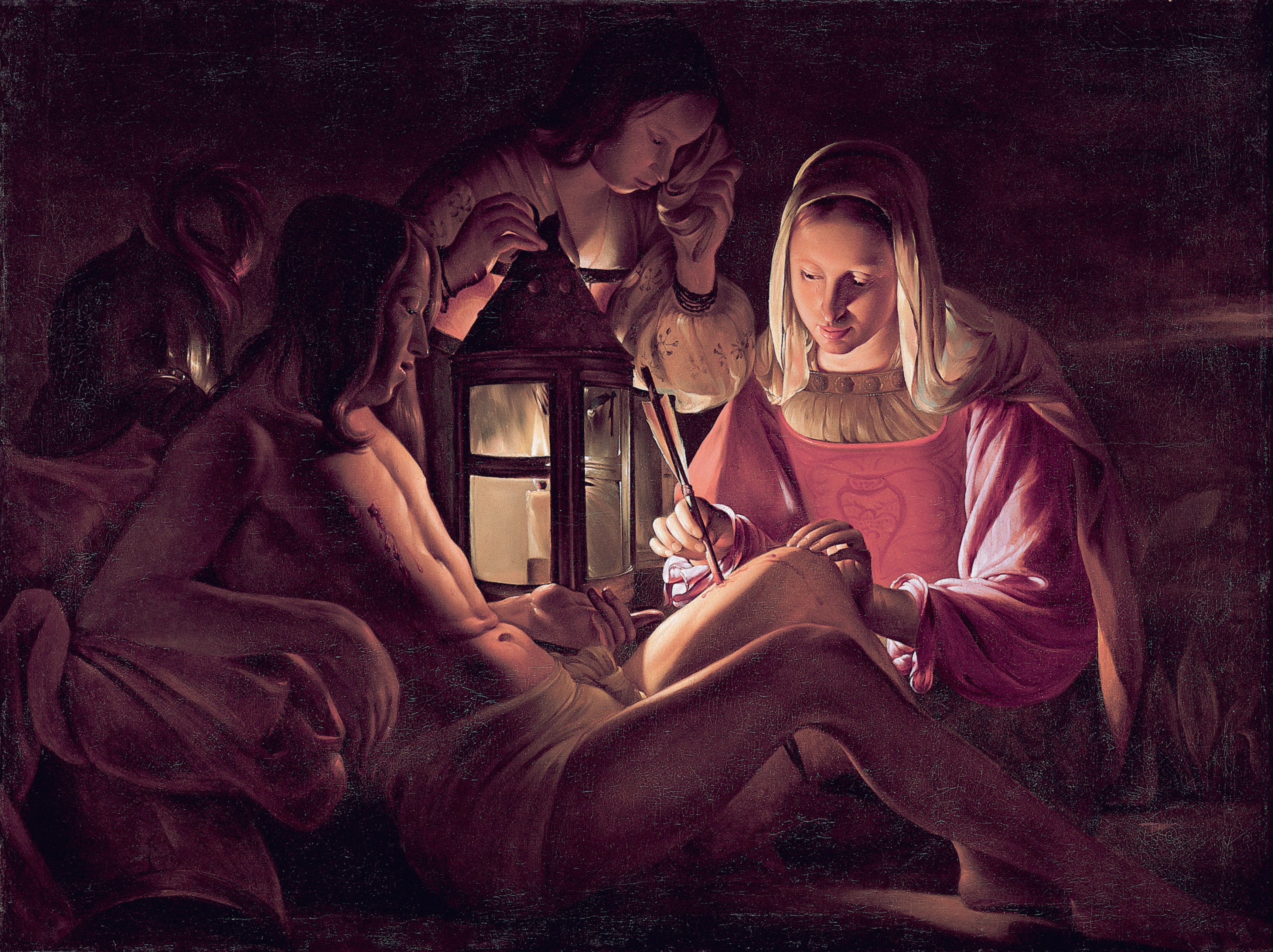
Women tend Sebastian’s outstretched body in a dark room, their faces and hands lit by a lantern beside him.
Saint Sebastian Tended by Ireneearly 1630sAttributed to Georges de La TourOpen the Puzzle - Play Now!

A lantern brings everyone close enough that the scene feels almost within reach. In this painting attributed to La Tour, the women’s faces and Sebastian’s outstretched body hold us in that small pool of warmth, with the darkness waiting just beyond it.

Stay with him

The rescue is only the beginning of caring for someone. These painters give us room to pause with Sebastian and the women, while the landscape stretches out around them.
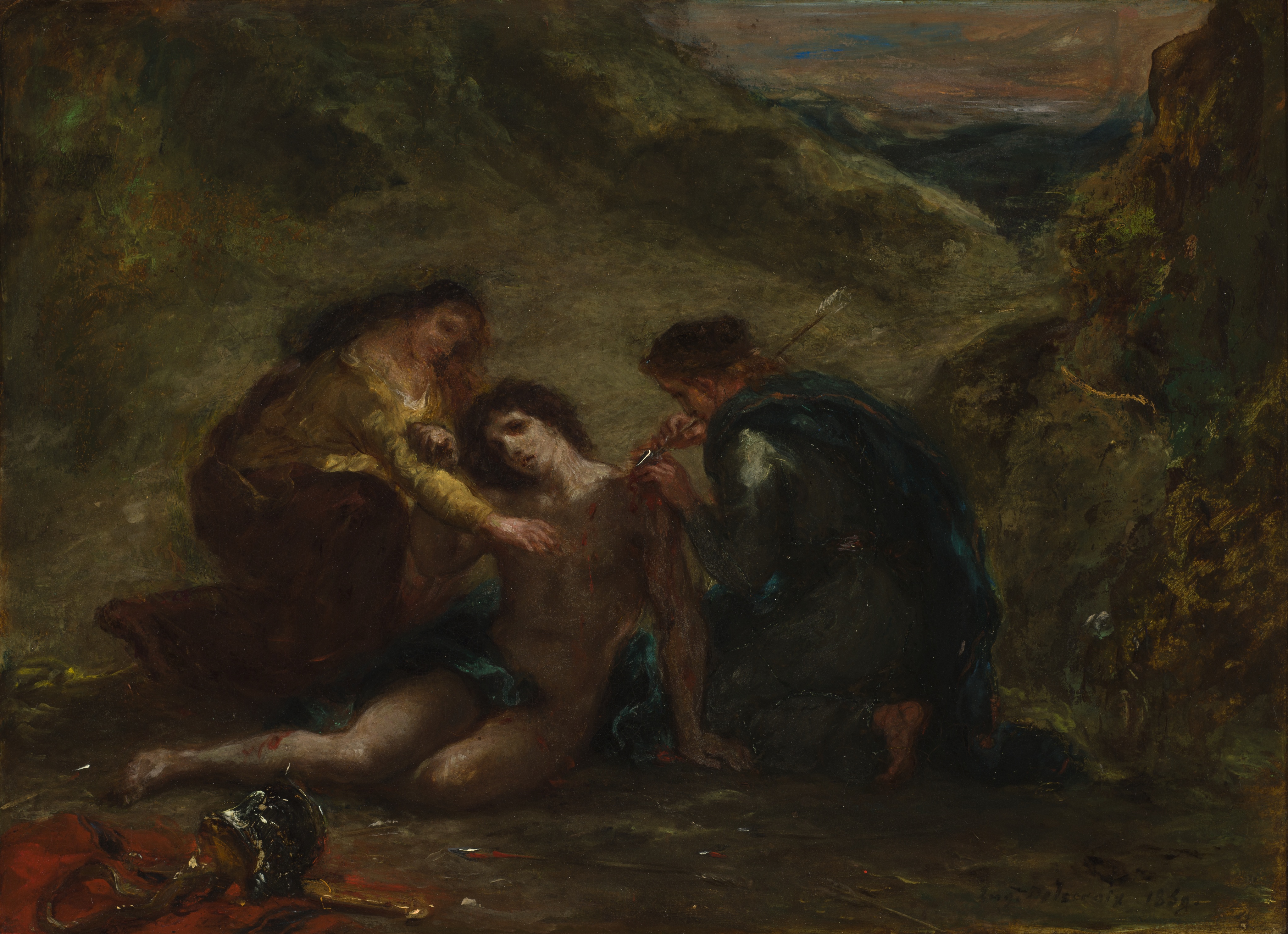
Two women bend over the wounded Sebastian on the ground beneath dark trees and a rocky landscape.
St. Sebastian with St. Irene and Attendant1858Eugène DelacroixOpen the Puzzle - Play Now!

Delacroix huddles the three figures together beneath a great sweep of dark landscape. Everything feels hurried and difficult, as though we’ve come upon them before anyone has had time to catch a breath.
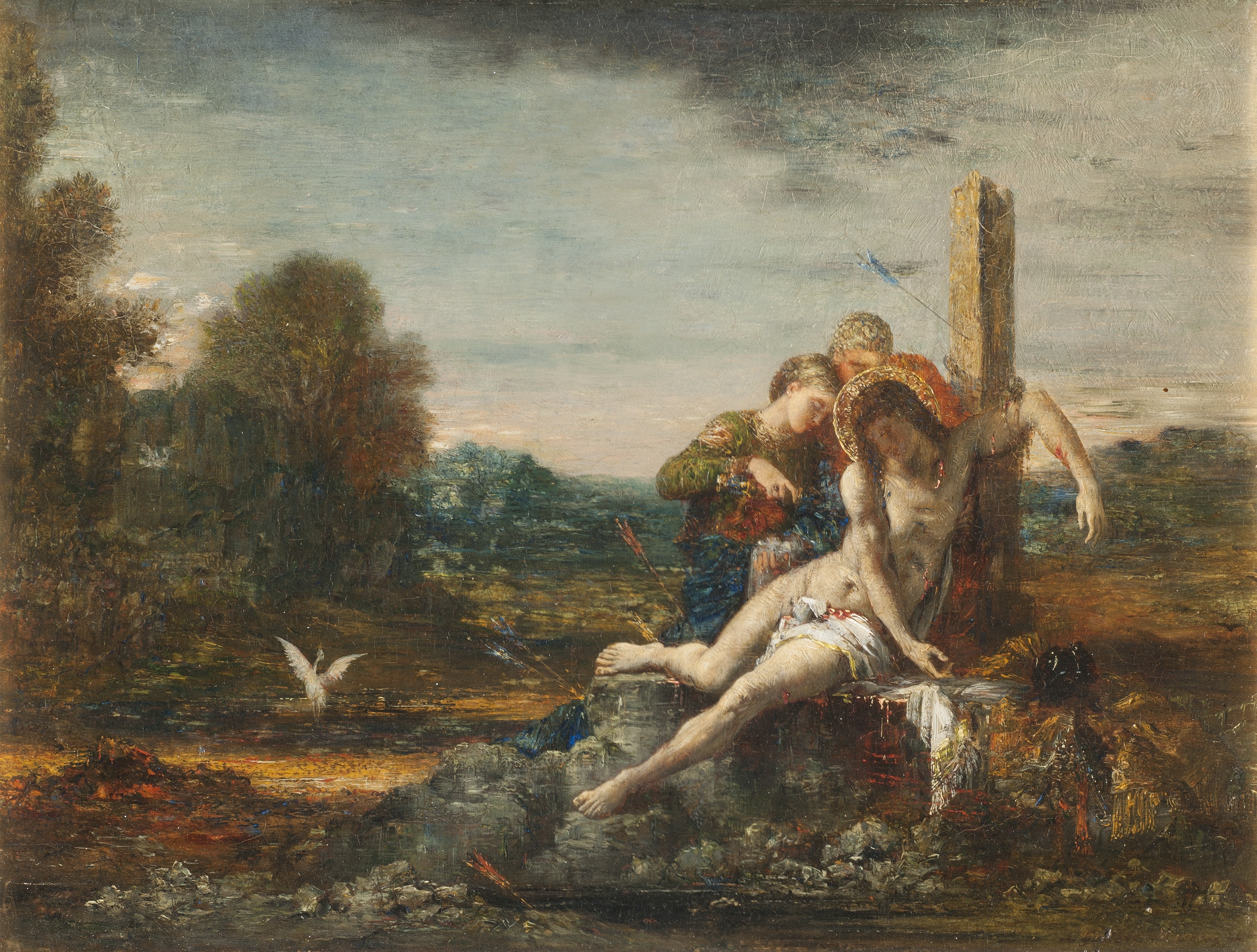
Two women tend Sebastian beside a rough stake in a wide rocky landscape, with touches of red near his body and the ground.
Saint Sébastienc. 1869Gustave MoreauOpen the Puzzle - Play Now!

This whole landscape fits on a wooden panel only about 25 by 32 centimeters—roughly the size of a magazine. Moreau still makes room for the women, the wounded man, and touches of red around the stake and rocks that keep the violence close in mind.
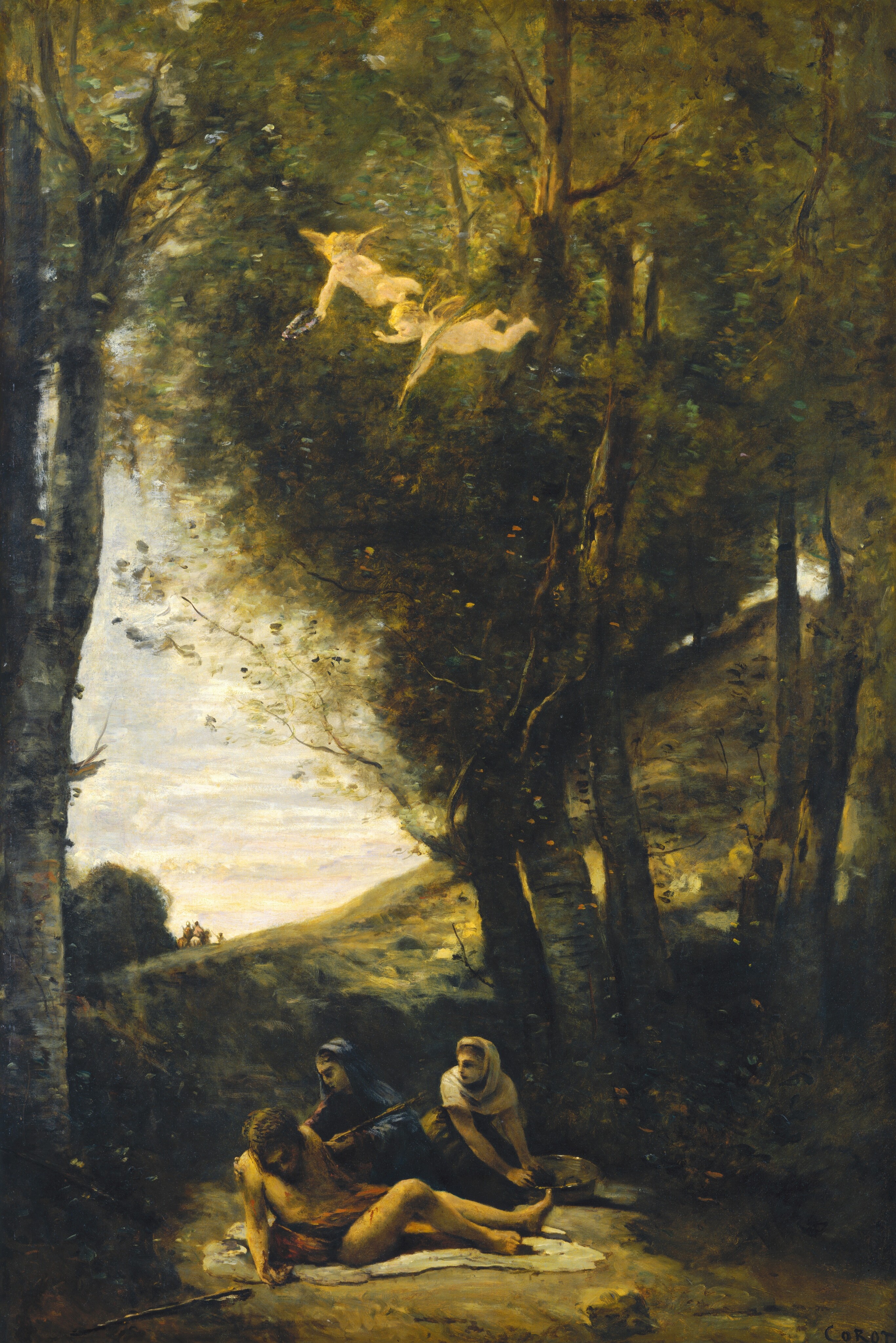
Two women tend Sebastian beneath tall forest trees as small angels appear among the branches above.
Saint Sebastian Succored by the Holy Women1874Jean-Baptiste-Camille CorotOpen the Puzzle - Play Now!

Look up into the branches and you’ll find the angels; look down and you’ll find the women tending Sebastian. I love how much room Corot gives to both, while keeping the hands-on work of helping someone right there at our feet.

There’s a line from Paul that feels especially close to these pictures:

“persecuted, but not forsaken; struck down, but not destroyed.”

2 Corinthians 4:9, Berean Standard Bible

Those are Paul’s words, not Sebastian’s. But after seeing Irene reach for him, “not forsaken” feels very concrete.

He goes back

Here’s the choice that makes the rest of the story so hard to take in. Sebastian has survived. He has been cared for. According to the traditional account, he is urged to leave Rome.

He goes to confront the emperor instead.

He speaks against the persecution of Christians, and this time he is beaten to death. His body is thrown into the city’s sewer. Later, a Christian woman named Lucina recovers it for burial.

Sources: Vatican News, Sebastian’s recovery and return; Albert Weisgerber Foundation, the traditional account.
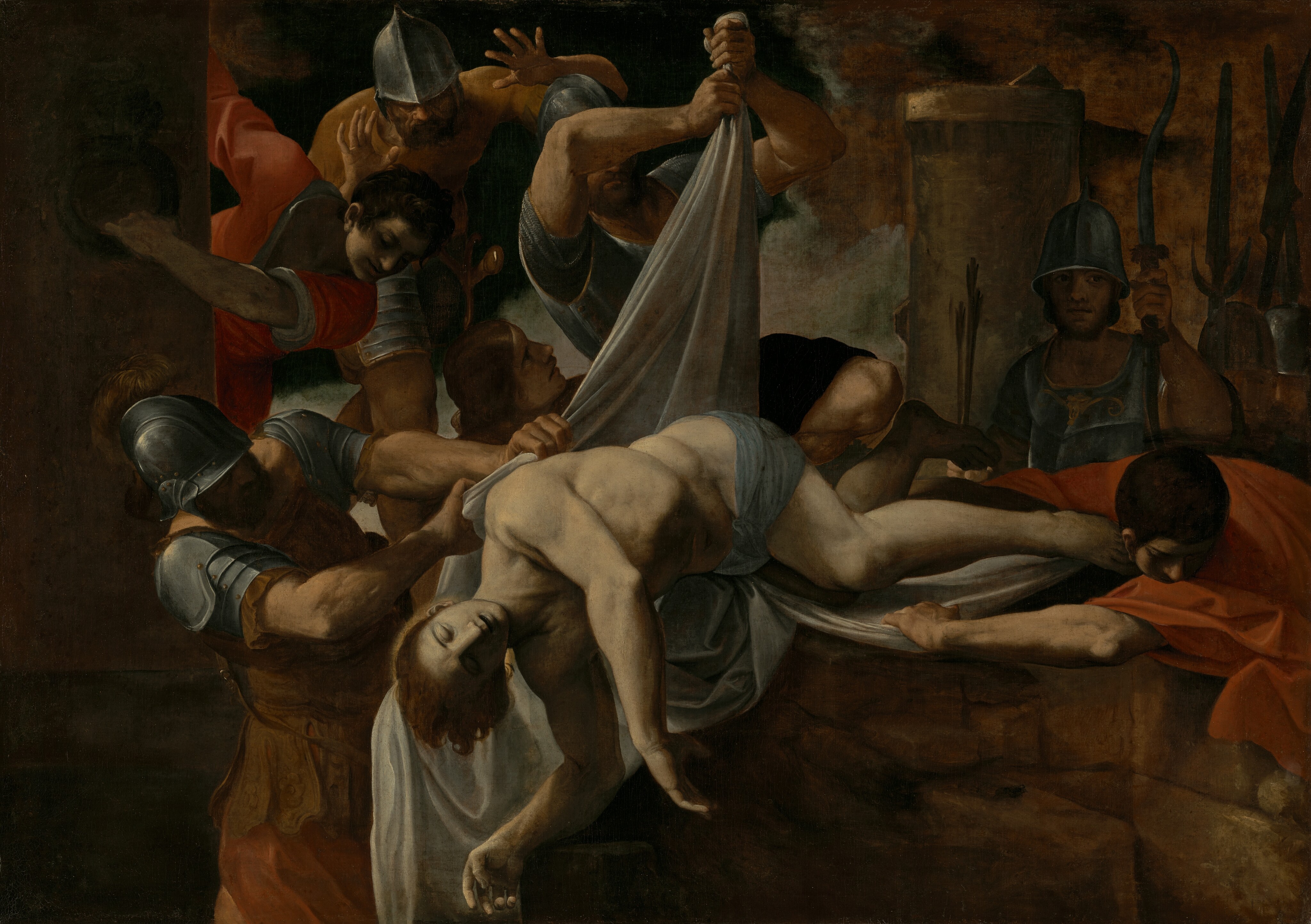
Men lift and push Sebastian’s limp body over a stone edge toward the dark opening of the Cloaca Maxima.
Saint Sebastian Thrown into the Cloaca Maxima1612Ludovico CarracciOpen the Puzzle - Play Now!

Carracci takes us to the part of Sebastian’s story that’s so easy to miss if we only know the arrows. His body hangs heavily over the edge as the men handle it, and it’s a painful picture to end his life with—especially after all those hands that worked so hard to save him.

The confrontation and the fatal beating happen between the scenes in our selection. This is their aftermath. Knowing what came before makes it difficult to look away.

Why we’re still looking

His story didn’t disappear with his body. Christians remembered him, prayed for his intercession, and came to ask for his protection against plague. That devotion goes back long before the Black Death; Paul the Deacon tells of an altar to Sebastian being raised during a plague at Pavia around 680.

And artists kept coming back, too. Centuries later, Sebastian would find himself in some very unexpected colors.

Source: Paul the Deacon, History of the Lombards, book VI, chapter 5; English translation by William Dudley Foulke.
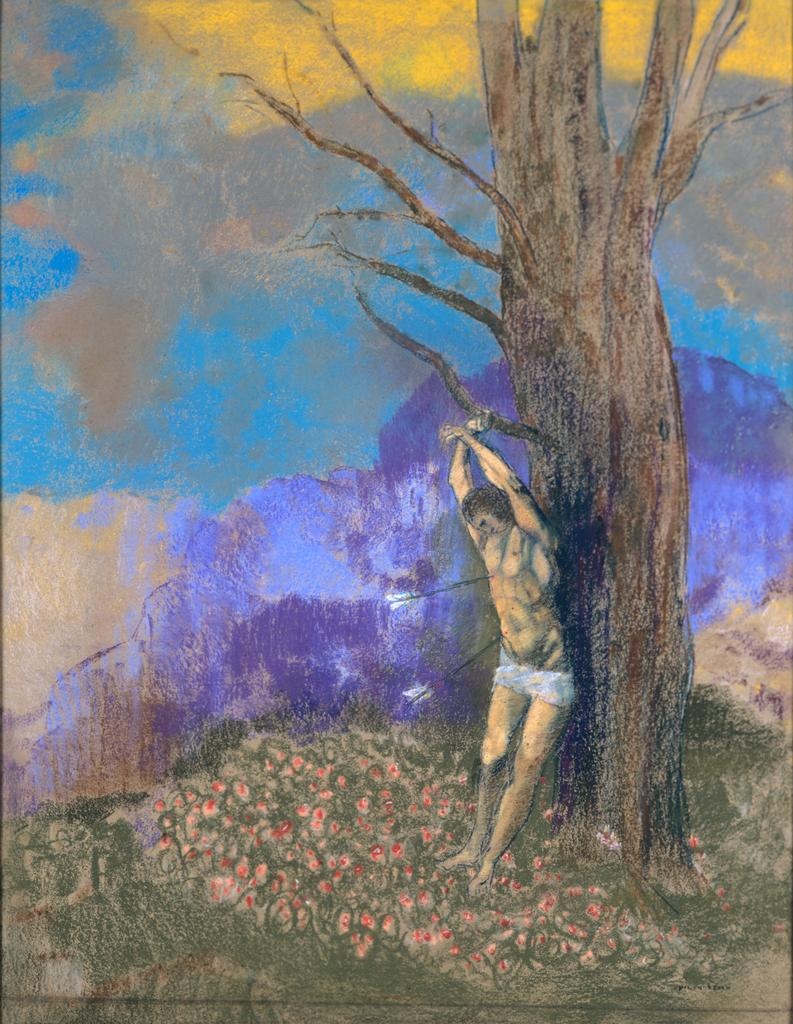
Sebastian is bound to a tall bare tree among pink flowers, violet hills and a turquoise sky streaked with golden clouds.
Saint-Sébastienc. 1910Odilon RedonOpen the Puzzle - Play Now!

Those violet hills and that turquoise sky look like somewhere out of a dream, but Redon drew on a place he knew: the countryside around his childhood home at Peyrelebade. The Bordeaux museum also suggests that the flowers seem to spring from Sebastian’s fallen blood, giving this strange, lovely landscape a much more tender meaning.
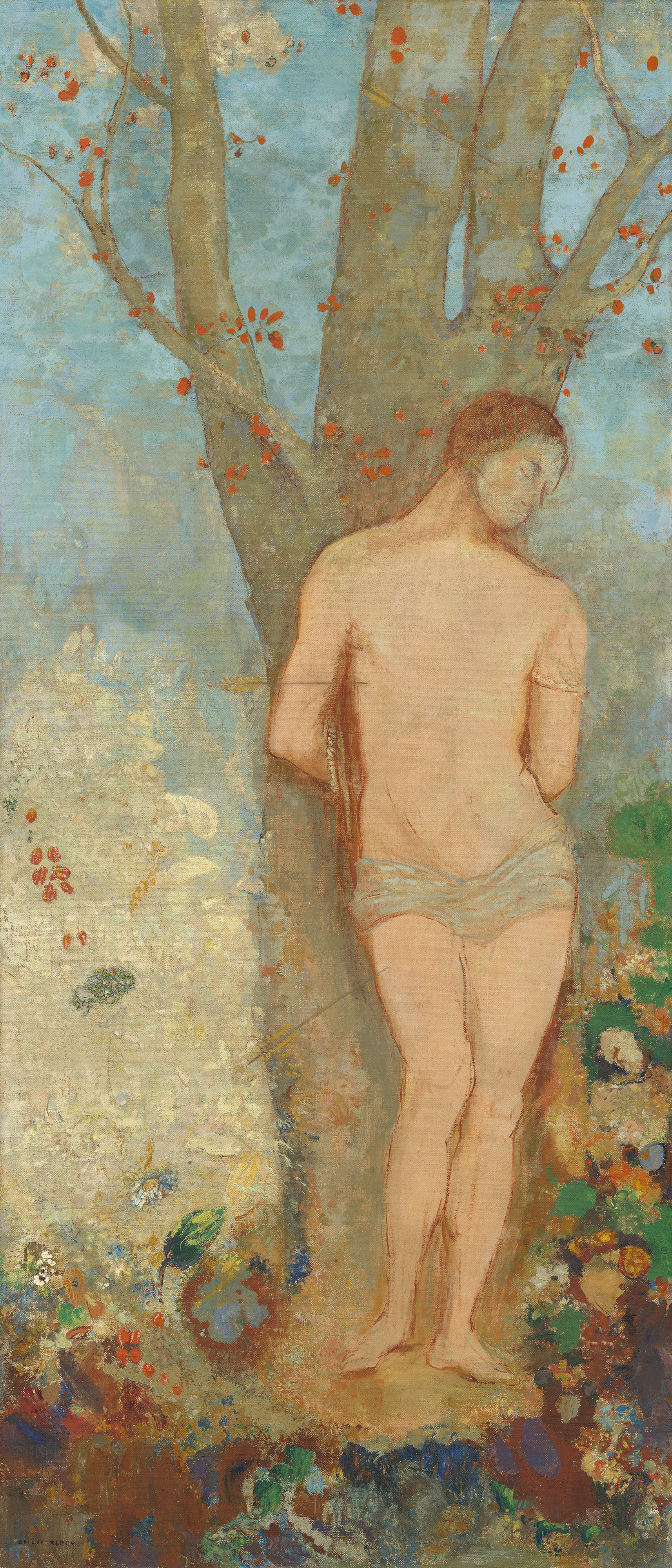
Sebastian stands against a tree with his hands behind him and arrows in his body, surrounded by pale blue and green tones and colorful flowers.
Saint Sebastian1910/1912Odilon RedonOpen the Puzzle - Play Now!

You have to look a little longer to take in the arrows among all these soft blues and flowers. Redon lets the wounded figure almost melt into the tree, and after the darkness of the earlier pictures, I find that gentleness unexpectedly moving.

One last look

Which picture stays with you?

Maybe it’s Reni’s upward gaze. Maybe it’s Sebastian’s weight in the women’s arms, or the small flame someone holds so another person can see what she’s doing.

For me, it’s the arrival of Irene. We’ve spent so long looking at a man alone that the sight of someone coming to help feels enormous.

If you’d like to pray with one of these paintings, start there. Remember people who are suffering for their faith today, and the people who go toward them with help. Ask for courage for both.

Continue in the open gallery

Paintings in this essay

Works appear in narrative order. The arrows belong to the ordeal Sebastian survives in the traditional account; the selected paintings show several artists’ interpretations of the same episodes. Dates and attributions retain their source qualifications. Scripture references are thematic companion passages; Sebastian is not a biblical figure.

ArtworkArtistDateCollectionScripture
Saint SebastianSandro Botticelli1474Gemäldegalerie, Staatliche Museen zu BerlinJames 1:12
Sebastian auf dem BaumstumpfAlbert Weisgerber1909Albert-Weisgerber-Stiftung, St. IngbertJames 1:12
Sebastian an der MauerAlbert Weisgerber1911Albert-Weisgerber-Stiftung, St. IngbertJames 1:12
Saint Sebastian (Vienna version)Andrea Mantegnac. 1457–1459Kunsthistorisches Museum, ViennaJames 1:12
Sebastian mit schwarzen BogenschützenAlbert Weisgerber1913Private collection, on long-term loan to Albert-Weisgerber-Stiftung, St. IngbertJames 1:12
Sebastian mit blauem TuchAlbert Weisgerber1913Albert-Weisgerber-Stiftung, St. IngbertJames 1:12
Hl. SebastianAlbert Weisgerber1910Bayerische Staatsgemäldesammlungen – Neue PinakothekJames 1:12
Saint Sebastian (Venice version)Andrea Mantegnac. 1506 (dating varies)Galleria Giorgio Franchetti alla Ca’ d’Oro, VeniceJames 1:12
Saint Sebastian (Genoa version)Guido Reni1615–1616Palazzo Rosso, Musei di Strada Nuova, GenoaJames 1:12
Saint Sebastian (Dulwich version)Guido Renic. 1630–1635Dulwich Picture Gallery, LondonJames 1:12
Le Martyre de saint SébastienHonoré Daumierc. 1849Musée d’Orsay, RF 1994 18James 1:12
St. Sebastian Tended by IreneHendrick ter Brugghen1625Allen Memorial Art Museum, Oberlin College2 Corinthians 4:8–9
Saint Sebastian Tended by Saint IreneVicente López y Portaña1795–1800J. Paul Getty Museum, 2000.472 Corinthians 4:8–9
Saint Sebastian Tended by the Holy WomenJusepe de Riberac. 1620–1623Bilbao Fine Arts Museum2 Corinthians 4:8–9
Saint Sébastien soigné par IrèneAttributed to Maître à la chandelle17th centuryMusée des Beaux-Arts de Bordeaux, Bx 1966.7.12 Corinthians 4:8–9
Saint Sébastien soigné par IrèneGeorges de La Tourvers 1649Musée du Louvre, RF 1979 532 Corinthians 4:8–9
Saint Sebastian Tended by IreneAttributed to Georges de La Tourearly 1630sKimbell Art Museum, AP 1993.042 Corinthians 4:8–9
St. Sebastian with St. Irene and AttendantEugène Delacroix1858Los Angeles County Museum of Art, 39.12.72 Corinthians 4:8–9
Saint SébastienGustave Moreauc. 1869Clemens Sels Museum Neuss, 1964Ma0682 Corinthians 4:8–9
Saint Sebastian Succored by the Holy WomenJean-Baptiste-Camille Corot1874National Gallery of Art, Timken Collection, 1960.6.42 Corinthians 4:8–9
Saint Sebastian Thrown into the Cloaca MaximaLudovico Carracci1612J. Paul Getty Museum, 72.PA.14Revelation 2:10
Saint-SébastienOdilon Redonc. 1910Musée des Beaux-Arts de Bordeaux, Bx 1980.6.12 Timothy 4:7
Saint SebastianOdilon Redon1910/1912National Gallery of Art, Chester Dale Collection, 1963.10.572 Timothy 4:7

Sources

Scripture quotations use the Berean Standard Bible. Artwork records and background reading are listed below.

  1. Vatican News, “San Sebastiano, martire.”Source cited in the article narrative.
  2. Albert Weisgerber Foundation, the traditional accountSource cited in the article narrative.
  3. Paul the Deacon, History of the Lombards, book VI, chapter 5Source cited in the article narrative. The narrative moves from plague at Rome to Ticinum/Pavia; the altar follows and the relics are brought from Rome.
  4. English translation by William Dudley FoulkeSource cited in the article narrative. English primary-text translation and historical notes identify Pavia and explain date uncertainty.
  5. Saint Sebastian — Sandro BotticelliGemäldegalerie, Staatliche Museen zu Berlin. Image credit: Staatliche Museen zu Berlin, Gemäldegalerie / Jörg P. Anders. The museum record marks the image with Public Domain Mark 1.0.
  6. Sebastian auf dem Baumstumpf — Albert WeisgerberAlbert-Weisgerber-Stiftung, St. Ingbert. Image credit: © Bildarchiv Albert-Weisgerber-Stiftung / Foto: Tom Gundelwein. No unrestricted image license is claimed for this reproduction.
  7. Sebastian an der Mauer — Albert WeisgerberAlbert-Weisgerber-Stiftung, St. Ingbert. Image credit: © Bildarchiv Albert-Weisgerber-Stiftung / Foto: Tom Gundelwein. No unrestricted image license is claimed for this reproduction.
  8. Saint Sebastian (Vienna version) — Andrea MantegnaKunsthistorisches Museum, Vienna. Image credit: Kunsthistorisches Museum, Vienna. No unrestricted image license is claimed for this reproduction.
  9. Sebastian mit schwarzen Bogenschützen — Albert WeisgerberCurrent record AW9. Private collection, on long-term loan to Albert-Weisgerber-Stiftung, St. Ingbert. Image credit: © Bildarchiv Albert-Weisgerber-Stiftung / Foto: Tom Gundelwein; rights reserved. No unrestricted image license is claimed for this reproduction.
  10. Sebastian mit blauem Tuch — Albert WeisgerberAlbert-Weisgerber-Stiftung, St. Ingbert. Image credit: © Bildarchiv Albert-Weisgerber-Stiftung / Foto: Jürgen Köhler; rights reserved. No unrestricted image license is claimed for this reproduction.
  11. Hl. Sebastian — Albert WeisgerberBayerische Staatsgemäldesammlungen – Neue Pinakothek. Image credit: Bayerische Staatsgemäldesammlungen – Neue Pinakothek München. Licensed under CC BY-SA 4.0; responsive copies are resized and JPEG-encoded without cropping, and retain the same license.
  12. Saint Sebastian (Venice version) — Andrea MantegnaGalleria Giorgio Franchetti alla Ca’ d’Oro, Venice. Image credit: Web Gallery of Art, via Wikimedia Commons. The late dating is approximate and varies between references. The specific Wikimedia Commons reproduction is marked as public domain.
  13. Saint Sebastian (Venice version) — image sourceGalleria Giorgio Franchetti alla Ca’ d’Oro, Venice. Image credit: Web Gallery of Art, via Wikimedia Commons. The late dating is approximate and varies between references. The specific Wikimedia Commons reproduction is marked as public domain.
  14. Saint Sebastian (Genoa version) — Guido ReniPalazzo Rosso, Musei di Strada Nuova, Genoa. Image credit: Musei di Strada Nuova, Palazzo Rosso, Genoa; Google Art Project, via Wikimedia Commons. The specific Wikimedia Commons reproduction is marked as public domain.
  15. Saint Sebastian (Genoa version) — image sourcePalazzo Rosso, Musei di Strada Nuova, Genoa. Image credit: Musei di Strada Nuova, Palazzo Rosso, Genoa; Google Art Project, via Wikimedia Commons. The specific Wikimedia Commons reproduction is marked as public domain.
  16. Saint Sebastian (Dulwich version) — Guido ReniDulwich Picture Gallery, London. Image credit: Dulwich Picture Gallery; Google Art Project, via Wikimedia Commons. The specific Wikimedia Commons reproduction is marked as public domain.
  17. Saint Sebastian (Dulwich version) — image sourceDulwich Picture Gallery, London. Image credit: Dulwich Picture Gallery; Google Art Project, via Wikimedia Commons. The specific Wikimedia Commons reproduction is marked as public domain.
  18. Le Martyre de saint Sébastien — Honoré DaumierMusée d’Orsay, RF 1994 18. Image credit: © Musée d’Orsay, dist. GrandPalaisRmn / Patrice Schmidt. No unrestricted image license is claimed for this reproduction.
  19. St. Sebastian Tended by Irene — Hendrick ter BrugghenAllen Memorial Art Museum, Oberlin College. Image credit: Allen Memorial Art Museum, Oberlin College; Wikimedia Commons reproduction. The specific Wikimedia Commons reproduction is marked as public domain.
  20. St. Sebastian Tended by Irene — image sourceAllen Memorial Art Museum, Oberlin College; Wikimedia Commons reproduction The displayed reproduction is the specific Wikimedia Commons image, marked as public domain; the Allen Memorial Art Museum record identifies the painting.
  21. Saint Sebastian Tended by Saint Irene — Vicente López y PortañaJ. Paul Getty Museum, 2000.47. Image credit: J. Paul Getty Museum, Los Angeles, 2000.47. The Getty makes this reproduction available under CC0.
  22. Saint Sebastian Tended by the Holy Women — Jusepe de RiberaBilbao Fine Arts Museum. Image credit: Museo de Bellas Artes de Bilbao / Bilboko Arte Ederren Museoa. No unrestricted image license is claimed for this reproduction.
  23. Saint Sébastien soigné par Irène — Attributed to Maître à la chandelleMusée des Beaux-Arts de Bordeaux, Bx 1966.7.1. Image credit: Musée des Beaux-Arts de Bordeaux (MusBA), Bx 1966.7.1. Attributed to Maître à la chandelle; formerly attributed to Trophime Bigot. No unrestricted image license is claimed for this reproduction.
  24. Saint Sébastien soigné par Irène — Georges de La TourMusée du Louvre, RF 1979 53. Image credit: © 2007 GrandPalaisRmn (musée du Louvre) / Jean-Gilles Berizzi. The specific Wikimedia Commons reproduction is marked as public domain.
  25. Saint Sébastien soigné par Irène — image source© 2007 GrandPalaisRmn (musée du Louvre) / Jean-Gilles Berizzi
  26. Saint Sebastian Tended by Irene — Attributed to Georges de La TourKimbell Art Museum, AP 1993.04. Image credit: Kimbell Art Museum, Fort Worth, AP 1993.04; Wikimedia Commons reproduction. Attribution to Georges de La Tour is qualified. The specific Wikimedia Commons reproduction is marked as public domain.
  27. Saint Sebastian Tended by Irene — image sourceKimbell Art Museum, AP 1993.04. Image credit: Kimbell Art Museum, Fort Worth, AP 1993.04; Wikimedia Commons reproduction. Attribution to Georges de La Tour is qualified. The specific Wikimedia Commons reproduction is marked as public domain.
  28. St. Sebastian with St. Irene and Attendant — Eugène DelacroixLos Angeles County Museum of Art, 39.12.7. Image credit: Los Angeles County Museum of Art, Paul Rodman Mabury Collection; photo © Museum Associates/LACMA. No unrestricted image license is claimed for this reproduction.
  29. Saint Sébastien — Gustave MoreauClemens Sels Museum Neuss, 1964Ma068. Image credit: Clemens Sels Museum Neuss, 1964Ma068; photograph Carsten Gliese. No unrestricted image license is claimed for this reproduction.
  30. Saint Sebastian Succored by the Holy Women — Jean-Baptiste-Camille CorotNational Gallery of Art, Timken Collection, 1960.6.4. Image credit: National Gallery of Art, Washington, Timken Collection, 1960.6.4. The National Gallery of Art makes this image freely available as public domain.
  31. Saint Sebastian Thrown into the Cloaca Maxima — Ludovico CarracciJ. Paul Getty Museum, 72.PA.14. Image credit: J. Paul Getty Museum, Los Angeles, 72.PA.14. The Getty makes this reproduction available under CC0.
  32. Saint-Sébastien — Odilon RedonMusée des Beaux-Arts de Bordeaux, Bx 1980.6.1. Image credit: Musée des Beaux-Arts de Bordeaux, Bx 1980.6.1; photograph F. Deval, mairie de Bordeaux. No unrestricted image license is claimed for this reproduction.
  33. Saint Sebastian — Odilon RedonNational Gallery of Art, Chester Dale Collection, 1963.10.57. Image credit: National Gallery of Art, Washington, Chester Dale Collection, 1963.10.57. The National Gallery of Art makes this image freely available as public domain.
  34. Sandro Botticelli, Saint Sebastian: Public Domain Mark 1.0Image credit: Staatliche Museen zu Berlin, Gemäldegalerie / Jörg P. Anders. Responsive copies are proportionally resized and JPEG-encoded; no crop or content changes. Those copies retain the source license.
  35. Albert Weisgerber, Hl. Sebastian: CC BY-SA 4.0Image credit: Bayerische Staatsgemäldesammlungen – Neue Pinakothek München. Responsive copies are proportionally resized and JPEG-encoded; no crop or content changes. Those copies retain the source license.
  36. Vicente López y Portaña, Saint Sebastian Tended by Saint Irene: CC0Image credit: J. Paul Getty Museum, Los Angeles, 2000.47. Responsive copies are proportionally resized and JPEG-encoded; no crop or content changes. Those copies retain the source license.