Your child is old enough to make decisions you cannot reverse, yet your mind still works the night shift. You check whether a message has been read. You rehearse a conversation that has not happened. Parenting anxiety does not retire when your child turns eighteen.
Sixteen hundred years ago, a North African mother named Monica knew that night shift well. Her son was brilliant, ambitious, and headed everywhere she did not want him to go. He joined a religious movement she detested. He lived for years with a woman he never married. He lied to her face and sailed for Italy in the dark while she was praying in a chapel beside the harbor. She could not argue him out of any of it. She followed him, she wept, she prayed, and in Milan she set about arranging his marriage. He grew up to be St. Augustine, one of the most influential Christian writers who ever lived, and we know her story because he told it himself, in a book called Confessions, written from first page to last as a prayer.
This is not a story about a mother who prayed hard enough. Augustine’s turnaround was his own, and no family is promised the same ending. What Monica offers a worried parent is more practical than a guarantee: a long, honest look at what love can do, what it cannot, and how to live in the space between. Five paintings follow her through it, alongside passages of Scripture. With each one we will practice what we call Visio Divina—Latin for “divine seeing,” which simply means praying with a picture—and you need no background in the Bible or in art to begin.
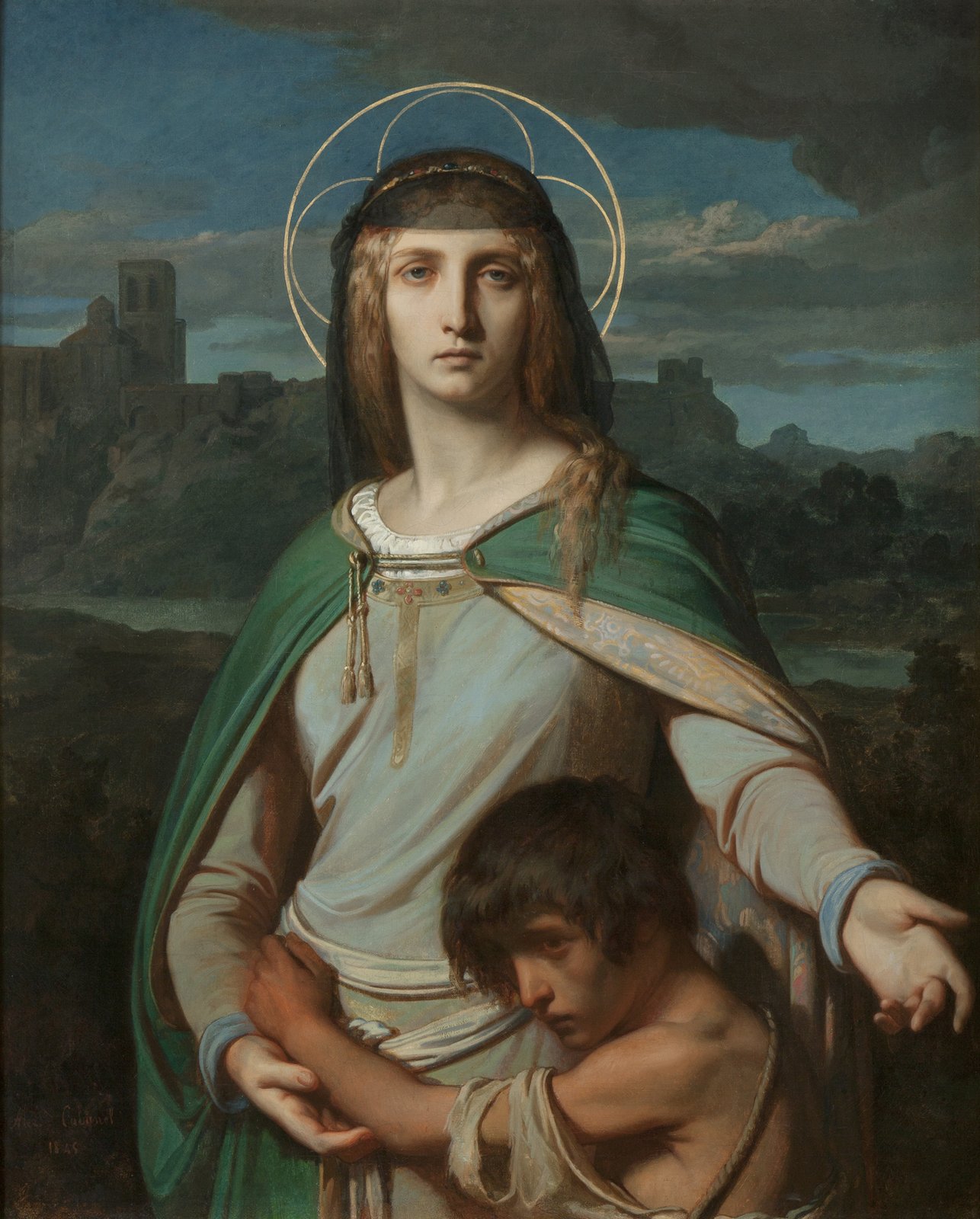
Start with her hands. Alexandre Cabanel painted Monica in 1845 as a young woman with a halo, standing in a dark landscape while a ragged boy presses against her side and clings to her forearm. You might take him for the young Augustine. The Milwaukee Art Museum, which owns the painting, describes him instead as “a young urchin,” placed beside her to show her charity as an ideal Christian mother. Look at who is holding whom. His fingers are wrapped around her arm. Her hands are open: the nearer one rests, palm up, beneath his arm; the other is held out to the side. She has not pushed him away, and she is not gripping him either. For a worried parent, that is a place to begin: how do you care for someone and still leave their freedom in their own hands?
The Night He Left Without Telling Her
After a few days, the younger son got everything together and journeyed to a distant country
Luke 15:13 · BSB, excerpt
Augustine was about twenty-nine, teaching in Carthage, a port city in what is now Tunisia, when he decided to teach in Rome. Monica was against it. She followed him all the way down to the water, and by his own account she held on to him, determined either to keep him home or to go along.
So he lied. He told her he was only seeing off a friend who was waiting for a fair wind, and he talked her into spending the night in a small chapel near the docks. “And I lied to my mother—and such a mother!—and got away,” he wrote years later. She spent the night praying and crying. In the morning the ship was gone.
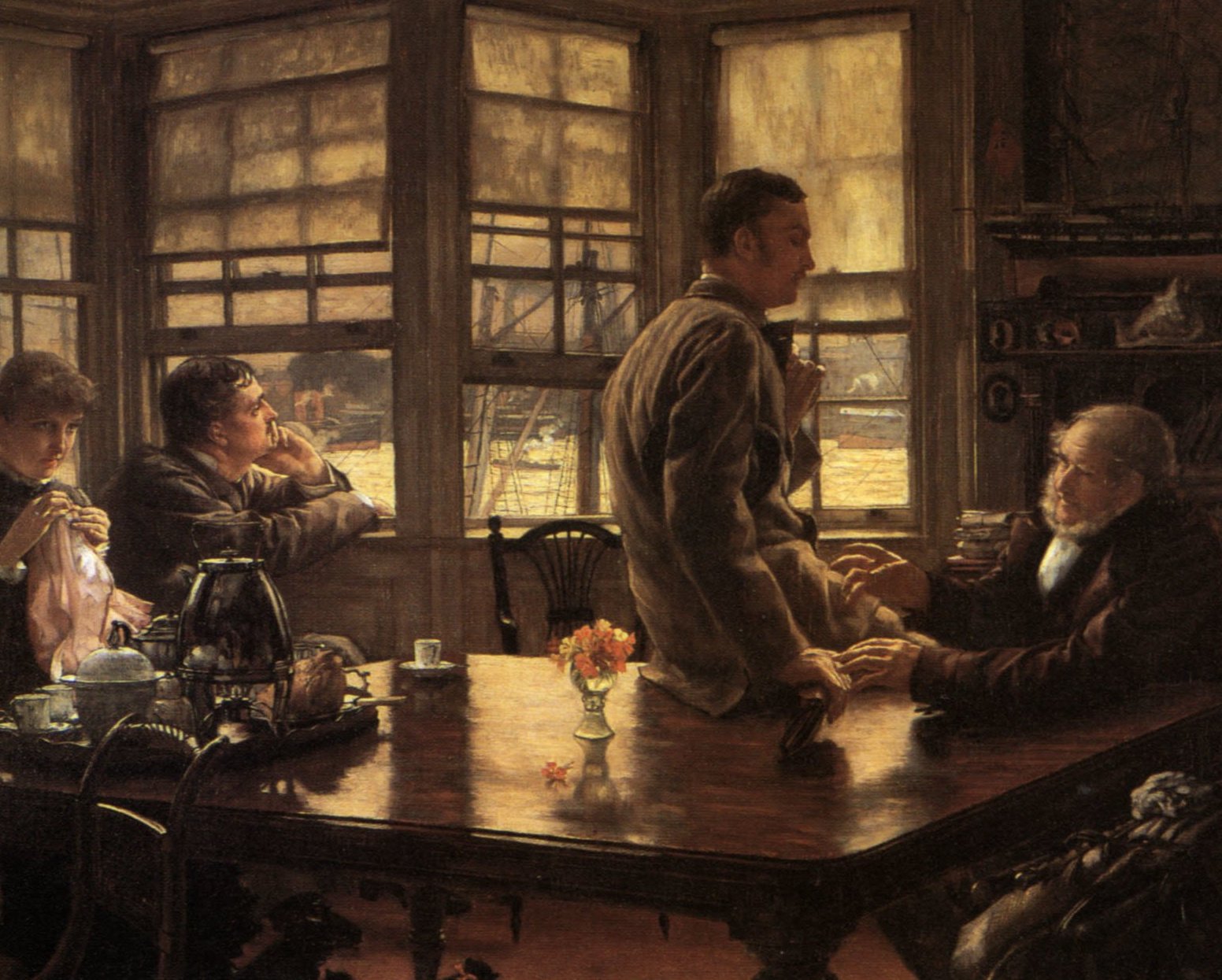
Tissot was not painting Monica. He was retelling a story Jesus told, about a son who takes his inheritance early and leaves home, and he set it in the London of his own day. But it is the same room. A young man sits on the edge of the table instead of at it, one hand at his collar, already half on his way. His old father leans across the corner of the table with both hands out: one laid over his son’s hand, the other lifted in the middle of a sentence. Behind them the window is full of masts and rigging. A man at the sill looks out toward the river. Beside him a woman holds her needlework, her eyes lifted from the cloth. The father is the one leaning in.
You may know this room: the conversation in which you can hear yourself still talking after the decision has already been made. A parent cannot control where a grown child goes. Monica tried, with both hands, and he went anyway.
Here is what Monica could not see from the shore. She had spent that night asking God for one specific thing: do not let him sail. “The wind blew and filled our sails,” Augustine writes. Looking back, he read that night differently:
But You, mysteriously counselling and hearing the real purpose of her desire, granted not what she then asked, in order to make me what she was ever asking.
Augustine, Confessions, Book 5
It was in Italy that he met the people and the books that changed him. That is hindsight, and it is Augustine’s, not a rule. A parent standing on the shore cannot see it and should not be told to feel fine. What the story does let you say is smaller and sturdier. The prayer that was refused that night and the prayer that was answered years later came from the same mother. An unanswered request is not an unheard one.
Visio Divina Prompt: Look at the father’s two hands, then at the window behind him. What are you asking God to prevent this week? What are you asking for underneath that?
The Son of These Tears
When the Lord saw her, He had compassion on her and said, “Do not weep.”
Luke 7:13 · BSB
Go back about ten years. At nineteen Augustine had joined the Manichees, a fashionable religious movement of his day, and he stayed with them for nearly nine years. Monica took it hard. She wept for him, he says, “more than mothers are wont to weep the bodily death of their children.” For a while she would not even eat at the same table.
She was not only a weeper. One night she dreamed she was standing on a long wooden ruler, and a shining young man told her that where she stood, her son would stand too. Augustine tried to turn it around: perhaps it meant she would come over to his side. She did not miss a beat. No, she said; it was not told me that “where he is, there shall you be,” but “where you are, there shall he be.”
Then she went looking for reinforcements. She found a bishop, a man who knew the Manichees’ books well, and begged him to sit down with her son and argue him out of it. The bishop said no. Augustine was not ready to listen, he told her. “Leave him alone for a time,” he said; “only pray God for him.” He added that he had been raised among the Manichees himself and had read his own way out, and he expected her son would do the same. She kept pleading, in tears, until the bishop, “a little vexed at her importunity,” gave her a sentence she would often repeat to her son afterward: “Go your way, and God bless you, for it is not possible that the son of these tears should perish.”
Years later, after she had crossed the sea to join him in Milan—calming the sailors herself when the ship hit bad weather—Augustine reached for a Gospel story to describe what his mother had been doing all that time. In Luke 7, Jesus meets a funeral at the gate of a town called Nain. A widow is burying her only son. Jesus stops the procession and tells the young man to get up. “Then Jesus gave him back to his mother” (Luke 7:15). Augustine says Monica had mourned him as one already dead, “carrying me forth upon the bier of her thoughts”—a bier is the stretcher a body is carried on—so that Christ might say those same words over him.
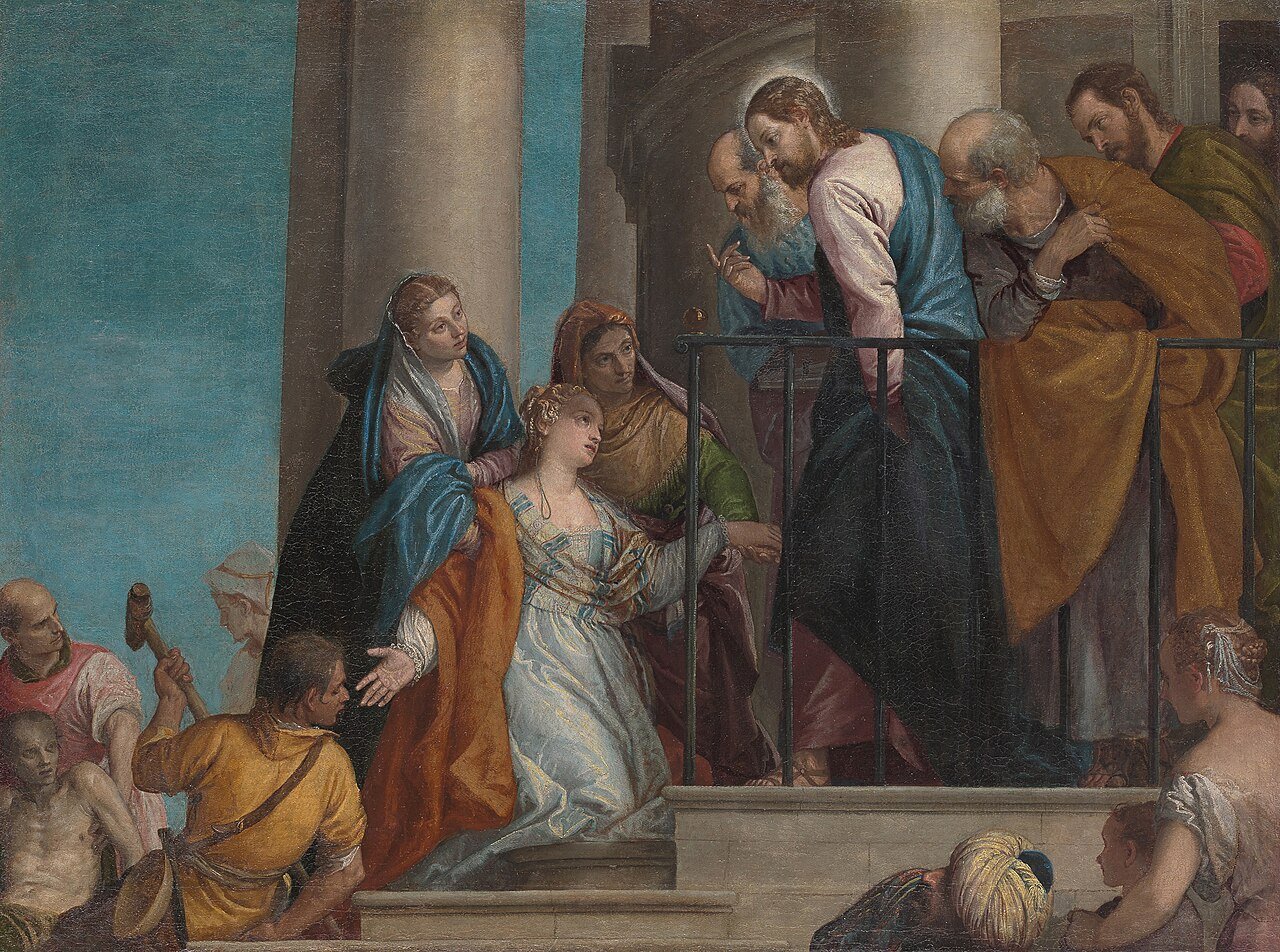
Veronese painted that scene around 1570, and he put the miracle in the corner and the mother in the middle. Jesus leans forward from a raised landing, behind a dark railing. Below him the mother kneels in a shimmering pale dress, her face turned up to him, two women close beside her. One open hand reaches back toward her son. The son himself is easy to miss: bottom left, pale and bare-chested, his body already raised. Luke tells it in the same order. Before Jesus touches the bier, he sees her. And when he does touch it, Luke adds a small detail: “those carrying it stood still” (Luke 7:14). The carrying stops.
Carrying a grown child on the bier of your thoughts is exhausting work. It is a large part of what people now call Christian mom burnout: ordinary tiredness, plus the belief that your vigilance is the thing holding your child’s future together. Rest starts to feel disloyal. The bishop’s advice has two halves, and both are hard. Stop recruiting people to fix him. Keep praying. Letting go of managing someone is not the same as giving up on them.
And the Gospel scene adds what the bishop did not say: the mother is seen first. Jesus once told his own overworked friends, “Come with Me privately to a solitary place, and let us rest for a while” (Mark 6:31). You do not have to reach a breaking point before your tiredness counts.
Visio Divina Prompt: Find the son in the corner, then find the mother’s face. In this painting, where is Jesus looking?
The Window at Ostia
Forgetting what is behind and straining toward what is ahead
Philippians 3:13 · BSB, excerpt
In Milan, Monica did not only pray. She set about finding her son a suitable fiancée—“my mother taking the greatest pains in the matter,” he says—and the woman he had lived with for years, the mother of his son, was sent back to Africa as “an impediment to my marriage.” Augustine writes that his heart “was racked, and wounded, and bleeding.” The engagement came to nothing. Even the patron saint of worried mothers was not above managing.
The decisive moment, as he tells it, was not one Monica could arrange. One day in the small garden behind their lodging, at the end of himself, Augustine heard a child in a neighboring house chanting, “Take up and read; take up and read.” He picked up the book of Paul’s letters he had left nearby, read a few lines, and “all the gloom of doubt vanished away.” Then, he says, “we go in to my mother. We make it known to her—she rejoices… she leaps for joy.” God had turned her grief, he writes, “into a gladness, much more plentiful than she had desired.” He was baptized in Milan the following Easter.
Later that year they started for home. At Ostia, the port of Rome, waiting for a ship, mother and son found themselves alone, “leaning in a certain window, from which the garden of the house… could be seen.” They talked about what the life of heaven might be like, “forgetting those things which are behind, and reaching forth unto those things which are before”—Augustine is quoting the verse above. For once there was no agenda. She was not warning him, and he was not dodging her. At the end she said: “Son, for myself, I have no longer any pleasure in anything in this life… There was indeed one thing for which I wished to tarry a little in this life, and that was that I might see you a Catholic Christian before I died. My God has exceeded this abundantly.”
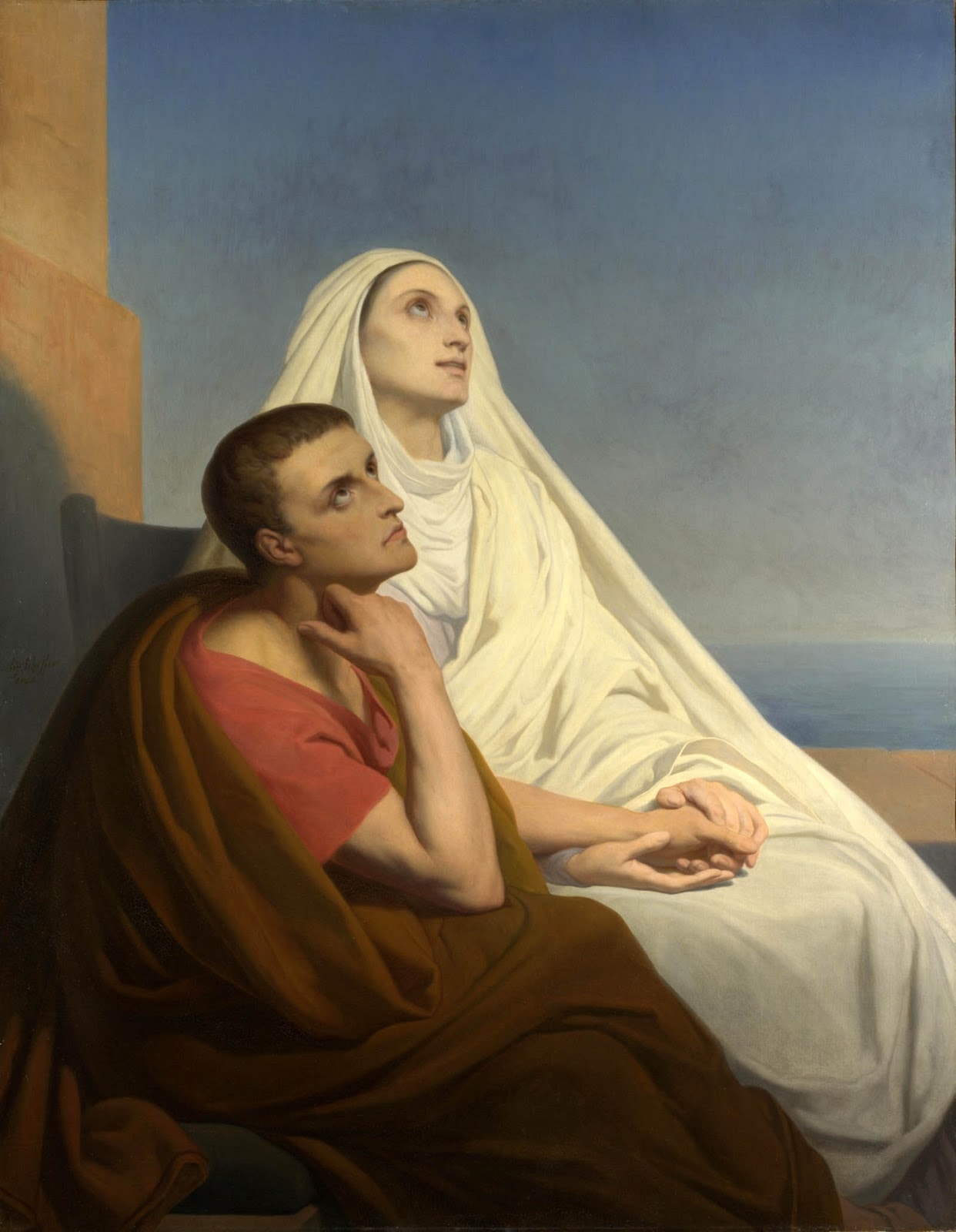
Scheffer first painted this moment in 1845—the National Gallery in London says his own mother sat for Monica—and returned to it in this version of 1854. He seats them by the sea, though Augustine says they stood. Monica, all in white, holds her son’s hand in both of hers. Neither is looking at the other. They are looking up and out, at the same thing.
After the conflicts Augustine records—over belief, over travel, over marriage—this scene offers a different kind of closeness. At the window they talk about something neither of them owns. A relationship with a grown child needs at least one room that is not about fixing them. It can be small. A meal, a walk, a question about something they love, asked without a second question waiting behind it. Being close to your child and managing your child are different skills. Scheffer’s painting is a picture of the first.
Visio Divina Prompt: Look at the joined hands, then follow their eyes. When did you and your child last look at the same thing, instead of at the problem?
“Lay This Body Anywhere”
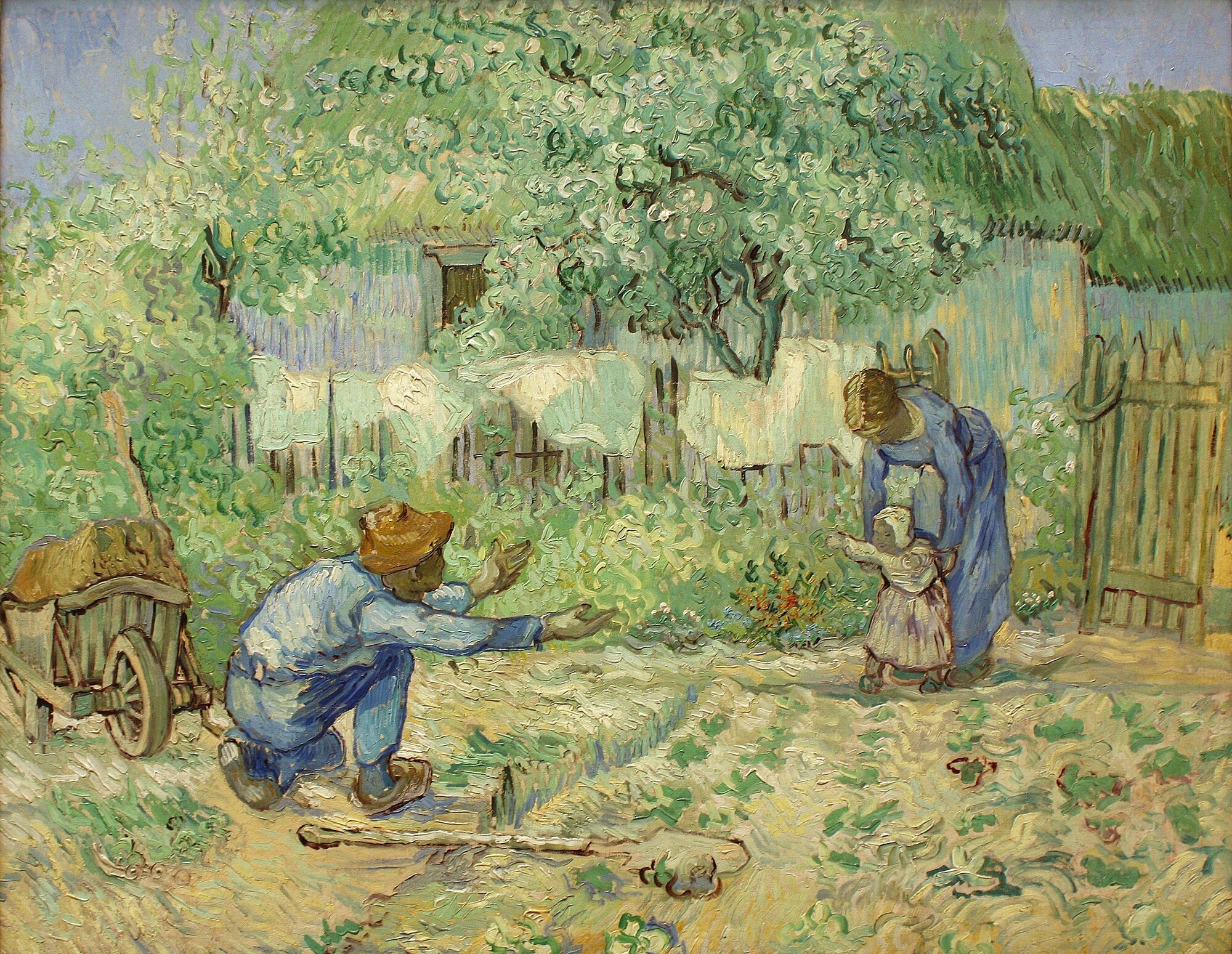
It was I who taught Ephraim to walk, taking them by the arms, but they never realized that it was I who healed them.
Hosea 11:3 · BSB
About five days after the conversation at the window, Monica came down with a fever. She had long planned to be buried at home, in the grave she had prepared beside her husband; Augustine says she “had ever burned with anxiety respecting her burial-place.” When his brother said he hoped she could at least die in her own country, she stopped him with a look.
Lay this body anywhere, let not the care for it trouble you at all. This only I ask, that you will remember me at the Lord’s altar, wherever you be.
Monica, in Augustine’s Confessions, Book 9
Friends asked whether she was not afraid to die so far from home. “Nothing is far to God,” she said. She died on the ninth day of her illness. She was in her fifty-sixth year; Augustine was in his thirty-third. The last thing Monica let go of was not her son. It was her own plan.
Van Gogh’s painting is not about Monica either. He made it in 1890, in the asylum at Saint-Rémy, copying a scene by the French painter Millet that he loved. A father has put down his spade and dropped to one knee in the garden, arms stretched wide. A mother bends over a toddler, holding the child up under the arms. Between the two pairs of hands lie a few feet of bare ground. That strip of ground is the most important thing in the picture. If it were not there, the child would have nowhere to walk.
The verse is God speaking as that kind of parent. Ephraim is a name for the people of Israel. God remembers teaching them to walk, holding them by the arms, and admits that they never knew whose hands those were. It is a picture of love that holds a child up and then, on purpose, opens.
What does that look like with a child who is thirty? First, tell danger apart from disagreement. A person in real danger needs action; an independent adult making a choice you dislike needs something else, and prayer does not excuse you from working out which one you are facing. Then ask before you advise. Say once, plainly, that you are reachable, and mean it. And notice that there is more than one pair of hands in Van Gogh’s garden. Other people can love your child. You are allowed to have a life in which your child is not the only thing growing. Being available is different from being in charge.
Visio Divina Prompt: Look at the open ground between the two pairs of hands. How wide is that space in your family right now? What would it take to leave it open this week?
A 4-Step Visio Divina Practice for a Worried Parent
Go back to the painting that held you longest and take a few unhurried minutes with it. This is praying with art, not studying it.
- Look (Visio): Stay with one physical detail—the hand laid over a hand, the mother’s upturned face, the strip of bare ground. Describe what is actually there before you decide what it means.
- Meditate (Meditatio): Name the specific thing you are afraid of for your child. Then name what you fear losing: their safety, your closeness, a shared language, or your sense that you parented well.
- Pray (Oratio): God, you know my child beyond the limits of my knowledge. Receive my love, my fear, and the exhaustion I sometimes hide beneath them. Help me act when action is needed, listen when listening is needed, and rest without treating rest as abandonment. Give my child wise companions, and give me a life that can hold love without being consumed by vigilance. Amen.
- Contemplate (Contemplatio): Sit quietly for one minute without planning your next message. If a worry rises, acknowledge the person you love and return to the image. This moment does not have to decide their future.
St. Monica and All Saints’ Day
Monica’s feast day is August 27, the day before her son’s; the calendar still keeps them side by side, mother first. This collection also remembers her on November 1, All Saints’ Day, with the whole company of people the church calls saints. She has long been a patron of mothers and married women, and of parents praying for what older prayer books call a wayward child.
Her name has traveled. A local legend says a Spanish priest named the springs near a stretch of the California coast after her tears; his own diary is less romantic, but the name stuck, and people who have never heard her story say it on their way to the beach in Santa Monica.
More paintings for worried parents
- William Holman Hunt, The Finding of the Saviour in the Temple — After three days of searching, Mary says the most honest sentence a parent speaks in the Gospels: “Your father and I have been anxiously searching for You” (Luke 2:48).
- Rembrandt, Return of the Prodigal Son — The other end of Tissot’s story: the same father’s hands, at his return, on his son’s back.
- Mary Cassatt, The Child’s Bath — The ordinary work of care, and a reminder that the person doing the caring has a body too.
- Henry Ossawa Tanner, Flight into Egypt — A small family on a dark road, taking the one step that belongs to tonight.
Stay with the painting
If you want to sit with one of these images a little longer, you can restore it yourself. Open Van Gogh’s First Steps as a puzzle, or Scheffer’s Saints Augustine and Monica—piece by piece, with the verse waiting at the end. Or get the app for a new painting, a new verse, and a new reflection every morning.
St. Monica at a glance
- She lived from about 332 to 387. She was born at Thagaste in Roman North Africa (today Souk Ahras, Algeria) and died at Ostia, the port of Rome.
- She was married to a man named Patricius and had three children, one of whom became St. Augustine of Hippo.
- Nearly everything we know about her comes from her son’s Confessions, especially Books 3, 5, 6, 8, and 9, so we see her through his eyes.
- Her feast day is August 27. She is a patron saint of mothers, married women, and parents praying for their children.
- In art she usually wears a widow’s veil and is often shown in tears or beside her son.
FAQ
How can a Christian parent let go of adult children?
Letting go of adult children, as a Christian, means respecting their freedom while staying reachable. Tell real danger apart from choices you dislike, say your concerns honestly, and ask before advising. Keep praying, as the bishop told Monica, but do not use prayer as a way to control the outcome. Near the end of Monica’s life, after her son’s baptism, the two of them stood at a window in Ostia and talked about eternal life. For a parent today, that scene is a picture of closeness without an agenda.
Does St. Monica’s story guarantee that my child will return to faith?
No. Augustine’s conversion is one particular story, not a promise that every family will follow the same path. Monica can be a companion in persistent love and prayer without making your child’s decisions a verdict on your faithfulness. Even in her story, the prayer she prayed hardest on the shore at Carthage was refused.
Can praying with art help with Christian mom burnout?
Praying with art can open a small space for honest attention and prayer, and a painting like Veronese’s Youth of Nain is a reminder that the tired mother is seen too. It does not replace sleep, shared responsibilities, supportive relationships, or professional help when you need it. Choose one image and a few quiet minutes, and do not turn contemplation into another demand to meet.
Who was St. Monica?
St. Monica (about 332–387) was a Christian woman from Roman North Africa and the mother of St. Augustine of Hippo. For years she prayed and wept over her son’s choices, followed him from Africa to Italy, and lived to see him baptized in 387. She died a few months later at Ostia, near Rome. Almost everything known about her comes from Augustine’s Confessions.
What is St. Monica the patron saint of?
St. Monica is honored as a patron saint of mothers and married women, of people in difficult marriages, and of parents praying for children who have drifted from faith or from home; she is often called the patron saint of parents with wayward children. Many parents ask her prayers for an adult child they are worried about.
What did the bishop say to St. Monica?
When Monica begged a bishop to argue her son out of his beliefs, he refused and told her, “Leave him alone for a time… only pray God for him.” When she kept pleading in tears, he said, “Go your way, and God bless you, for it is not possible that the son of these tears should perish.” Augustine records the scene in Confessions, Book 3.
When is St. Monica’s feast day?
August 27 in the Roman Catholic calendar and in several Anglican and Lutheran calendars, the day before the feast of her son, St. Augustine (August 28). Eastern churches, and the older Roman calendar, keep her memory on May 4.
Is Santa Monica, California named after St. Monica?
Yes, the city carries her name. A popular legend says the Franciscan priest Juan Crespí named local springs after St. Monica’s tears in 1769, though his own diary records a different name for the place. “Santa Monica” was in use by the 1820s.