Revelation 12 is the strangest seventeen verses most people have never read. No letters to churches, no seals, no trumpets — just a woman, a monster, a baby, and a battle. It is also the chapter that handed Western art three of its most-painted images: the archangel with a sword, the Madonna standing on a crescent moon, and the dragon.
Here is the whole chapter in plain language, with fourteen artworks, and the verses worth remembering set apart.
What Is Revelation 12 About?
Revelation 12 is a vision in six moves: a woman clothed with the sun cries out in labour, a huge red dragon waits to devour her child, the child is born and snatched up to God while the woman escapes, Michael and his angels fight the dragon and throw him out of heaven, a voice announces that the accuser has fallen, and the dragon, now on earth, hunts the woman and then turns on her other children.
Tap any part to jump to it, with the paintings and the verses.
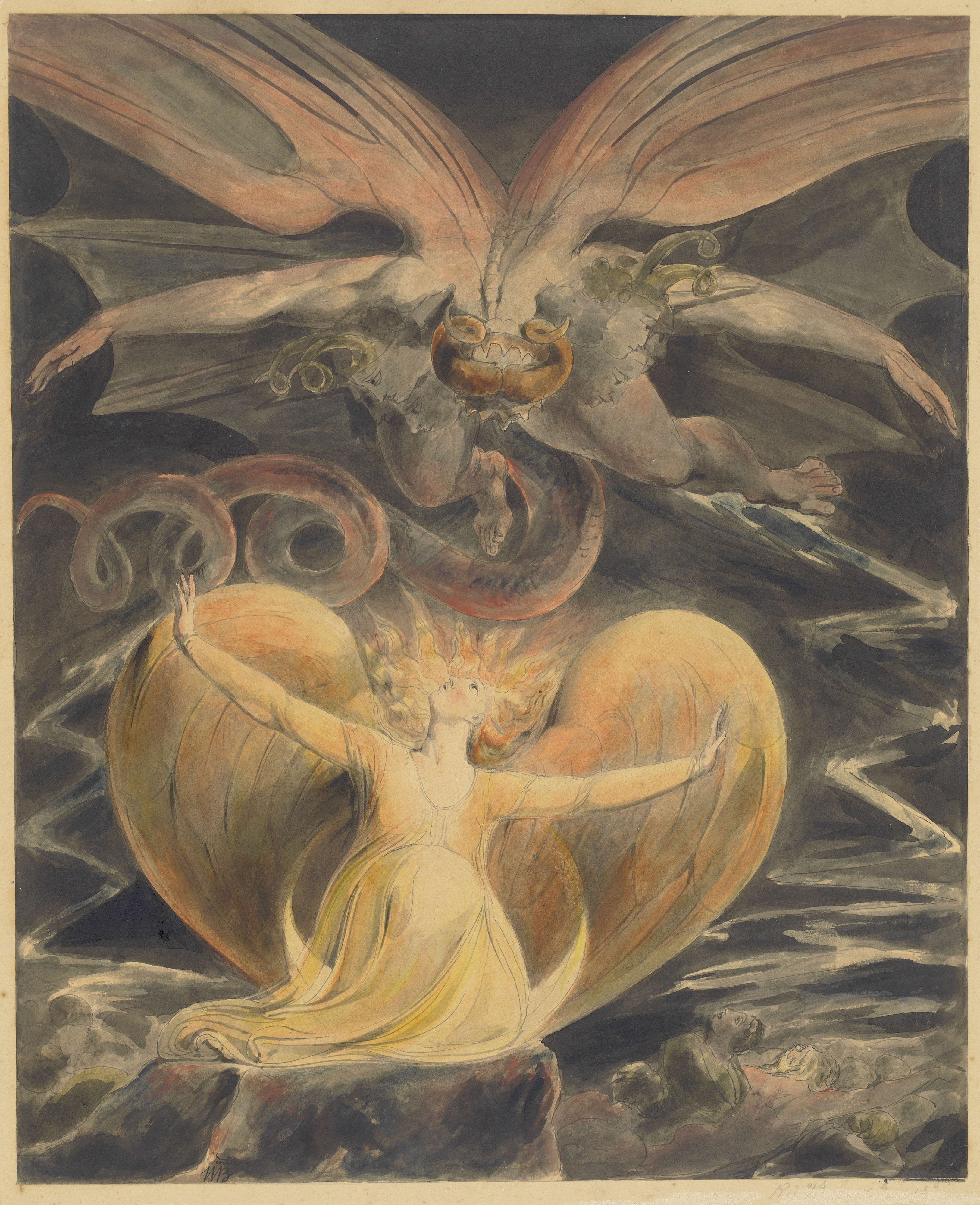
William Blake put the chapter's two signs into a single sheet and painted the confrontation rather than the story. It is the image most people carry in their heads for this chapter, whether or not they have ever read it.
A Woman Clothed With the Sun (Revelation 12:1–2)
John says he saw a sign — a woman in a symbolic vision. Hold on to that word, because the chapter is about to get very literal-looking.
And a great sign appeared in heaven: a woman clothed in the sun, with the moon under her feet and a crown of twelve stars on her head.
Revelation 12:1 · BSB
And then the second line lands with a thud, because it is the least cosmic sentence imaginable:
She was pregnant and crying out in the pain and agony of giving birth.
Revelation 12:2 · BSB
A figure dressed in the sun, standing on the moon, wearing the stars — and she is in labour, and it hurts.
Who is the woman in Revelation 12?
This is the most-asked question about the chapter, and it has three long-standing answers. Many readers take her as Israel, the people from whom the Messiah comes — the sun, moon and stars echo Joseph's dream in Genesis 37:9, where they stand for his family. Many take her as the church, especially because verse 17 speaks of "the rest of her children." And in Catholic tradition she is often read as Mary, the mother of the male child. The readings are not always treated as exclusive; a sign can carry more than one meaning at once. This guide is not going to pick for you.
What is not in dispute is what the verse did to art.
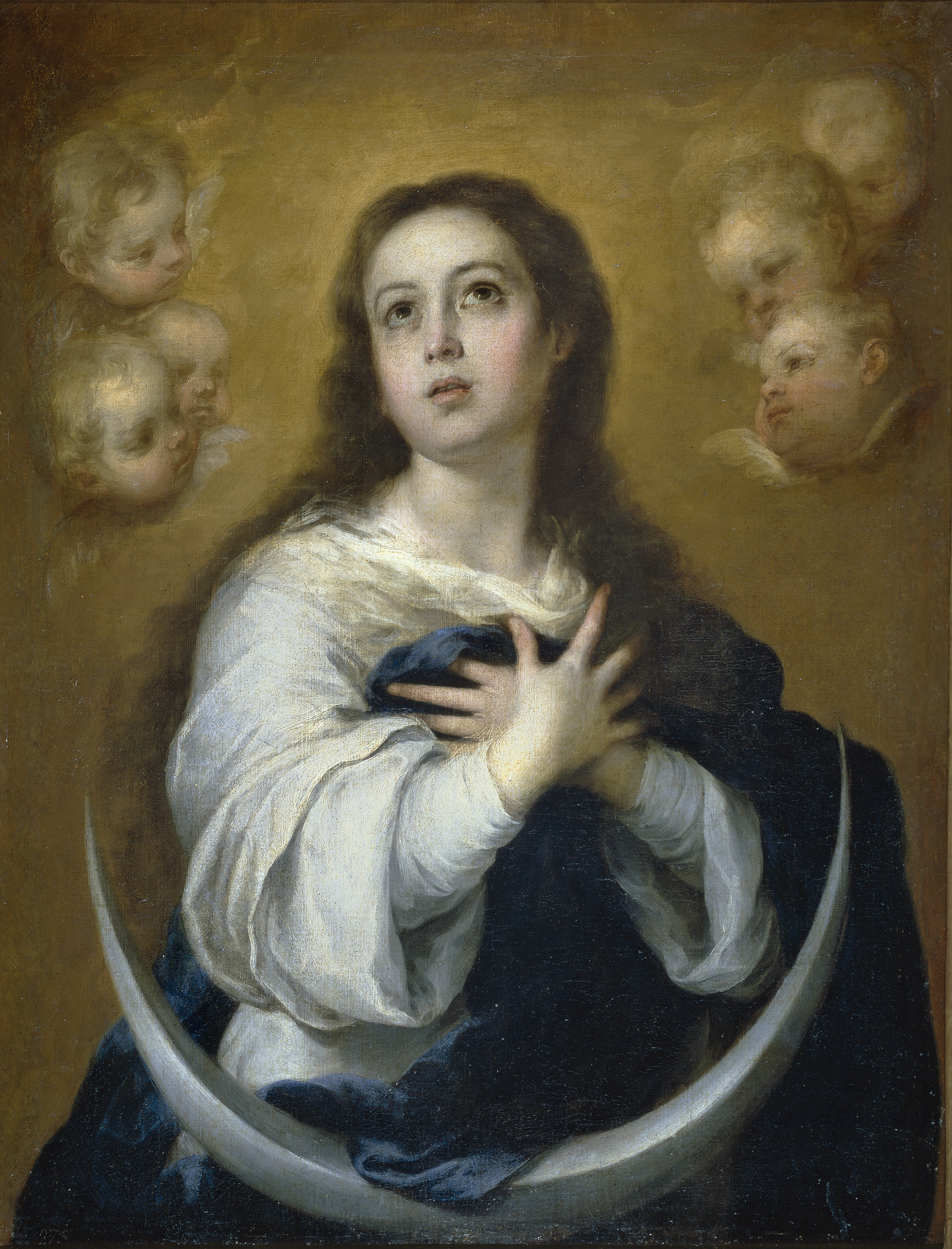
Why is Mary so often standing on a crescent moon?
Because of Revelation 12:1. The sun, the moon underfoot and the crown of stars were read onto Mary, and they became the standard equipment of the Immaculate Conception as a subject — a young woman in the air, a crescent beneath her, stars around her head. Once you know the verse you cannot unsee it in a museum. (The other half of that iconography, Mary with a serpent under her foot, draws on a Marian reading of Genesis 3:15.)
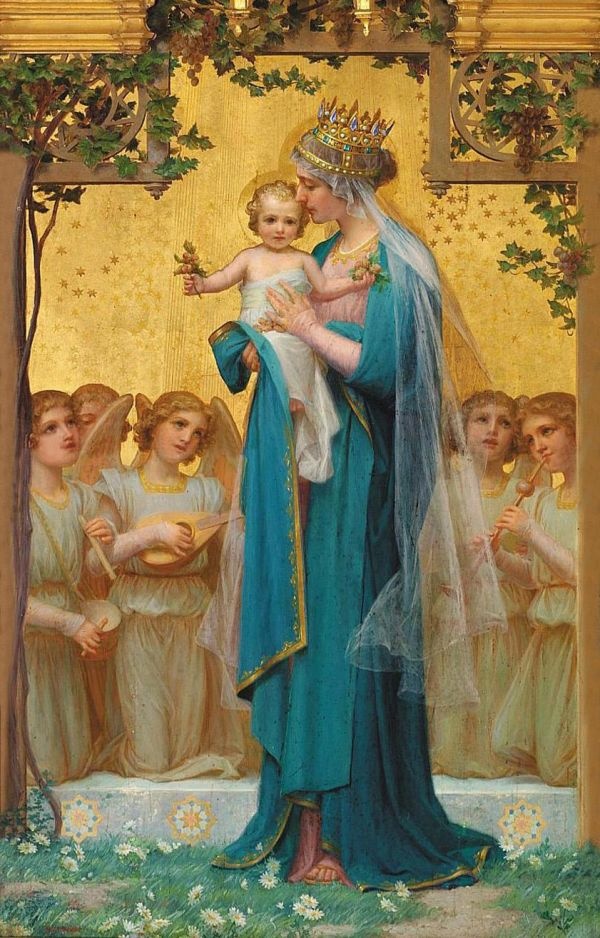
The Dragon (Revelation 12:3–4)
The second sign arrives, and John counts its parts.
Then another sign appeared in heaven: a huge red dragon with seven heads, ten horns, and seven royal crowns on his heads.
Revelation 12:3 · BSB
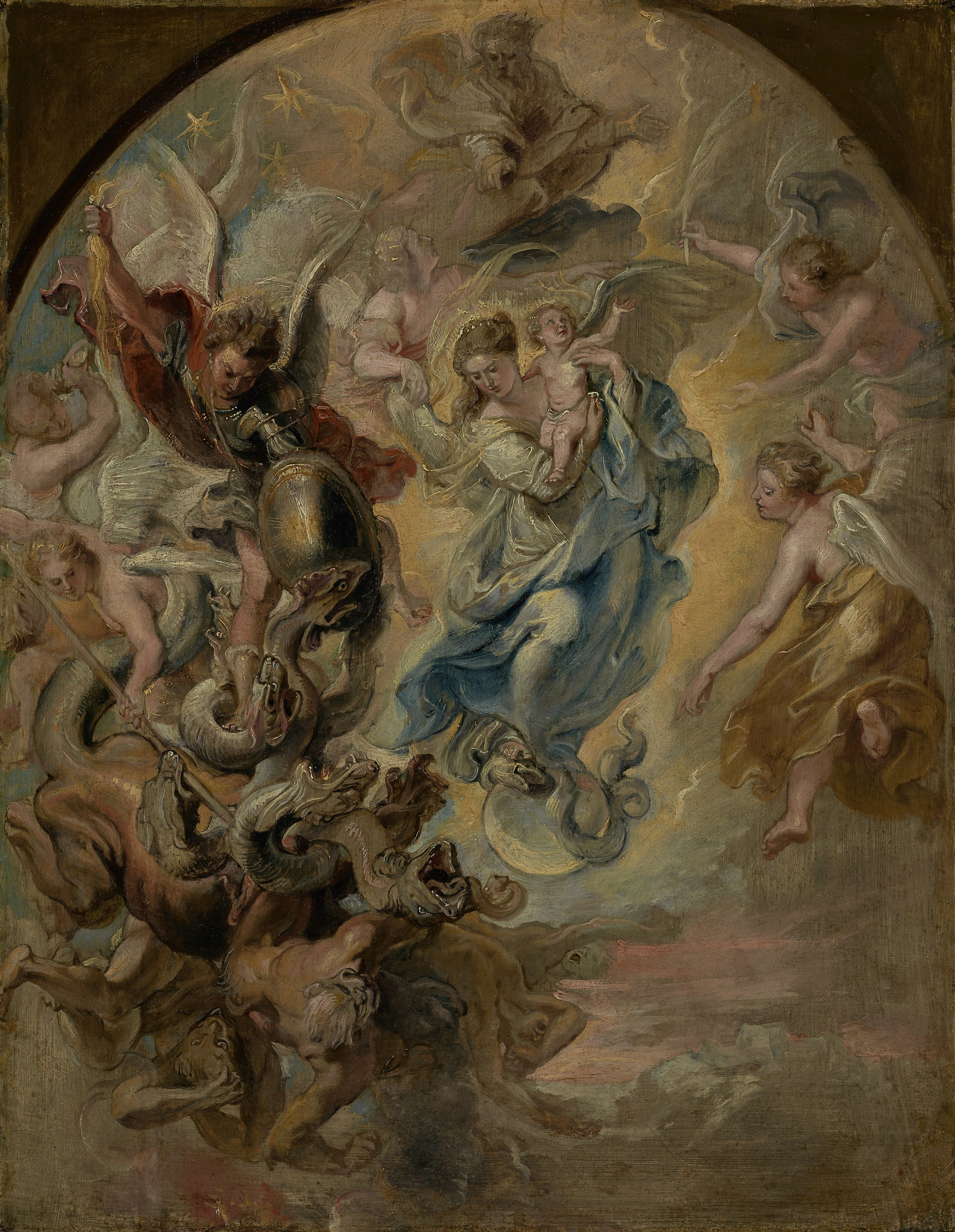
Rubens gave the dragon what a woodcut cannot: weight, muscle, and a great many mouths.
Then one of the most astonishing sentences in the Bible, followed immediately by one of the most sinister:
His tail swept a third of the stars from the sky, hurling them to the earth. And the dragon stood before the woman who was about to give birth, ready to devour her child as soon as she gave birth.
Revelation 12:4 · BSB
Note the crowns. The dragon is not sneaking. He is wearing seven of them, standing in the open, waiting — not for the woman, but for the baby, and specifically for the moment of birth.
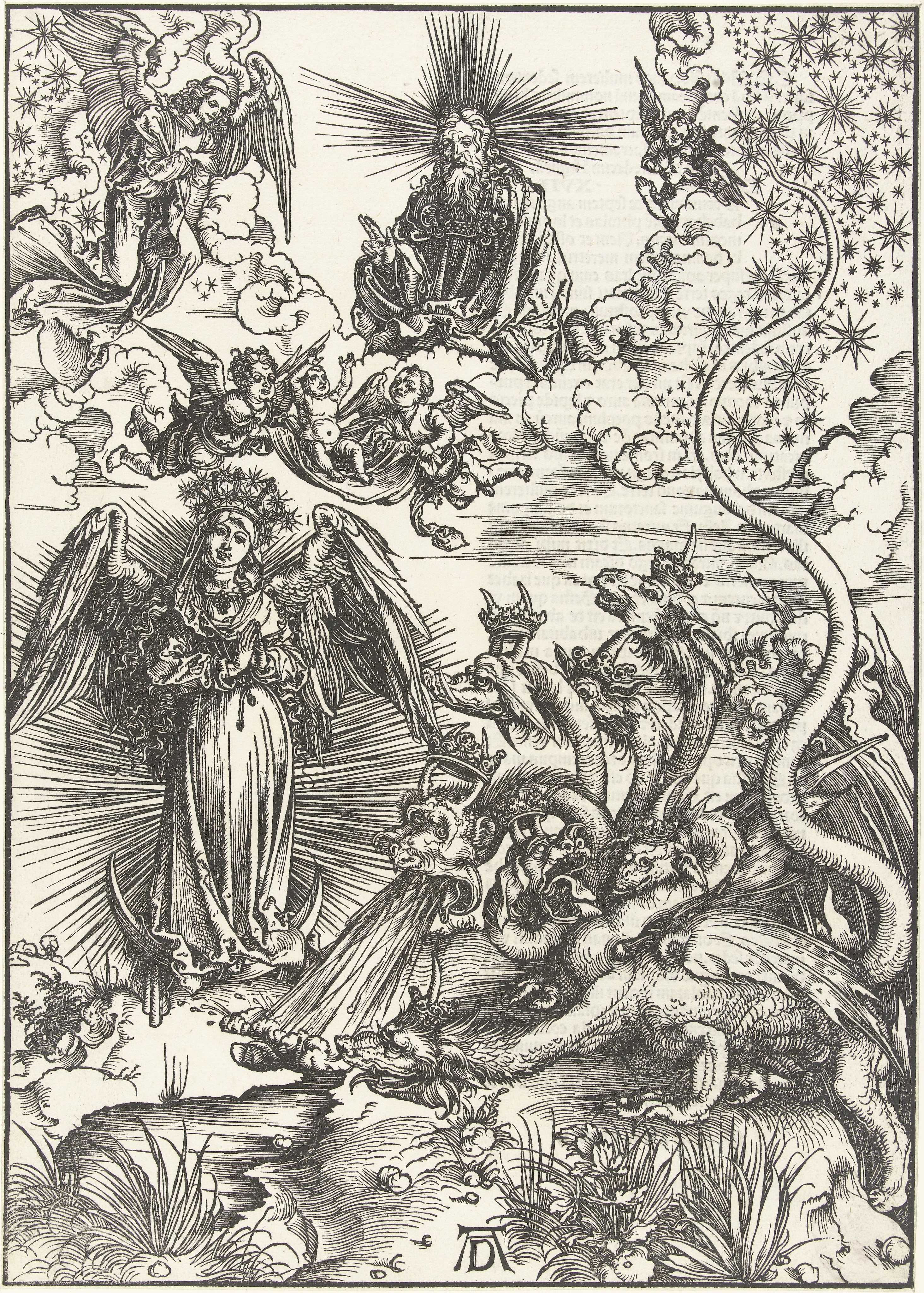
Dürer, in his twenties, turned the book of Revelation into a series of woodcuts — and on this sheet he fitted almost the entire chapter into one frame. The tail runs up the right-hand edge with the stars coming away in it; the dragon waits at the bottom; angels carry the child up to God at the top. He even gives the woman a pair of wings, which is the chapter running ahead of itself: she is not given wings until verse 14.
The Birth, and the Escape (Revelation 12:5–6)
What happens next takes one verse, and it skips most of a life.
And she gave birth to a son, a male child, who will rule all the nations with an iron scepter. And her child was caught up to God and to His throne.
Revelation 12:5 · BSB
Born, then straight to the throne. Nothing in between — no Bethlehem, no ministry, no cross, no tomb. Readers have long taken the child as Christ, and the leap from birth to throne as the whole gospel told at the speed of a vision.
The dragon, thwarted, is left in front of a woman with no baby. And she runs.
And the woman fled into the wilderness, where God had prepared a place for her to be nourished for 1,260 days.
Revelation 12:6 · BSB
What are the 1,260 days?
Three and a half years in the book’s symbolic reckoning — and Revelation likes saying it three different ways. Here and in 11:3 it is 1,260 days. In 11:2 and 13:5 it is 42 months. In 12:14, a few lines below, it becomes "a time, and times, and half a time." Same span, three costumes. Readers differ on whether it marks a literal period or stands for "a limited time, and God set the limit" — but either way, the span has an end.
Notice also who does the sheltering. The woman runs, and the place is already prepared.
War in Heaven (Revelation 12:7–9)
And now the chapter cuts, without warning, to a battle.
Then a war broke out in heaven: Michael and his angels fought against the dragon, and the dragon and his angels fought back.
Revelation 12:7 · BSB
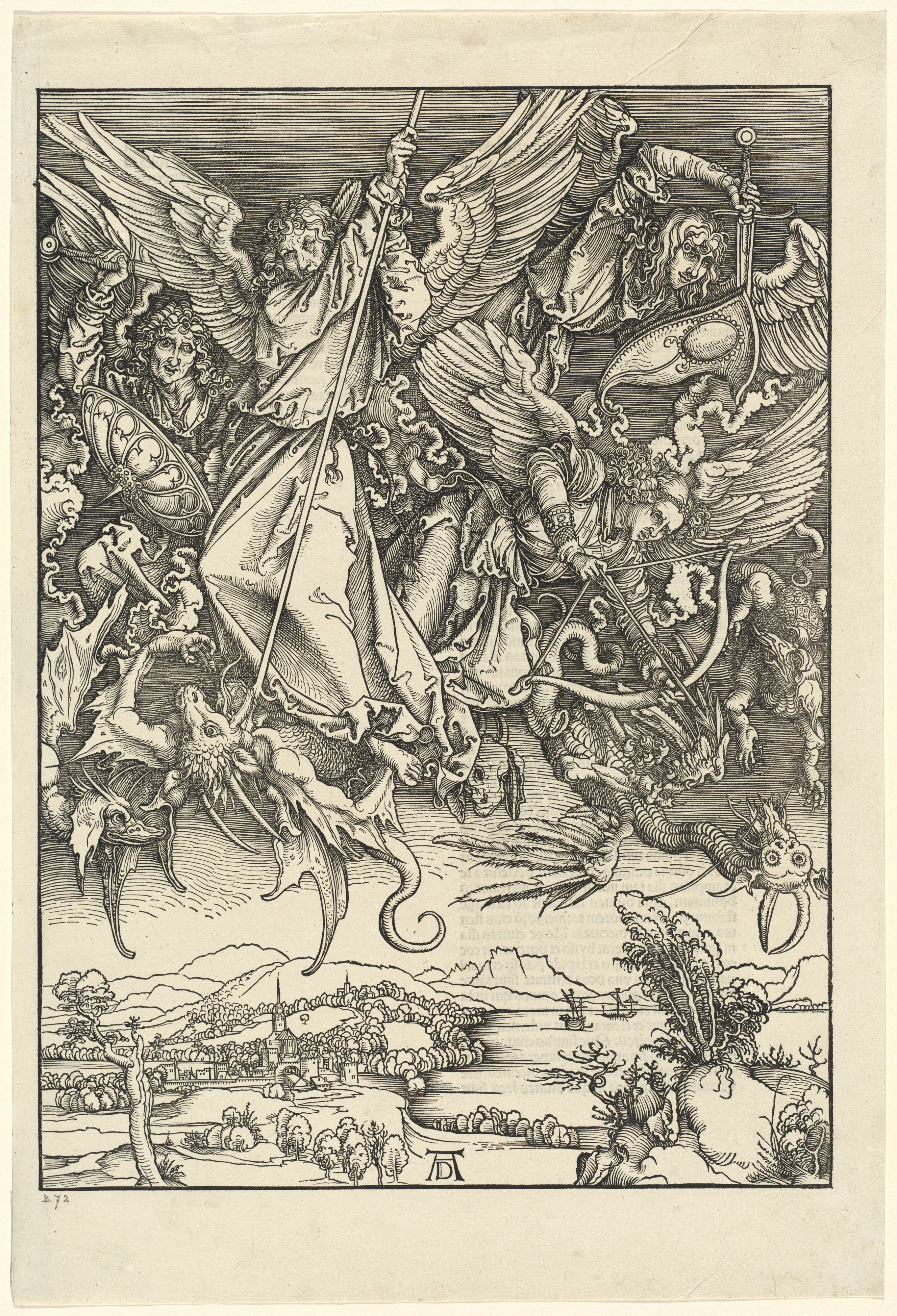
This is the companion sheet to the dragon above — two pages of the same book, published in 1498, and between them they are probably the most influential images ever made of this chapter. The thing everyone notices is the bottom third: below the fighting, a quiet landscape of fields and a town and a lake, going on as if nothing were happening.
Who is Michael, and why is he here?
The angel Michael is named in only three books of the Bible. He is in Daniel, as a "prince" who contends for God's people (Daniel 10:13, 10:21; 12:1). He is in Jude, disputing with the devil over the body of Moses (Jude 9). And he is here. That is the entire biblical dossier for one of the best-known angels in Western art — and Revelation 12 is the only place he leads a war.
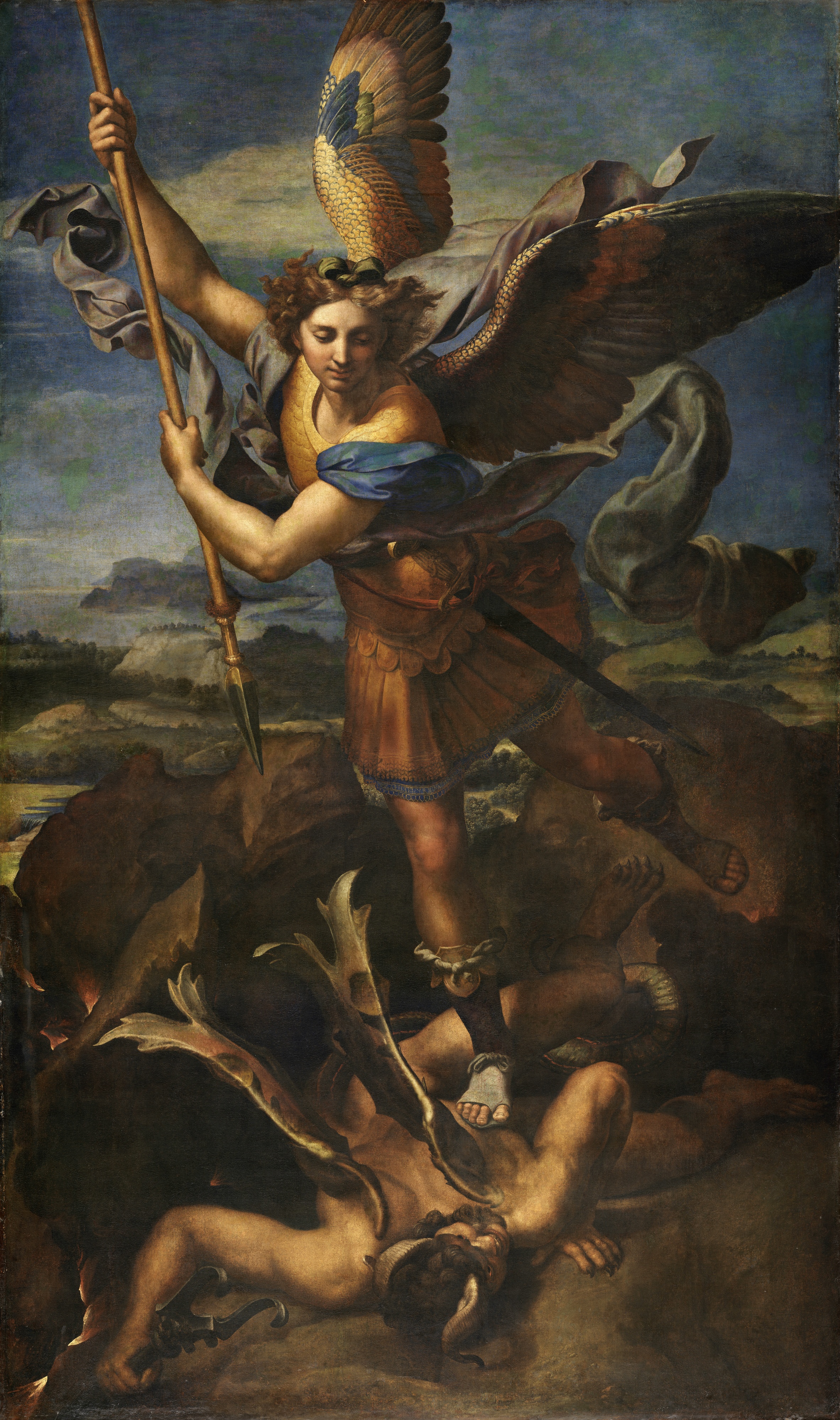
Which is why, from here on, this guide is mostly pictures of Michael. Painters have been repeating this one subject for five hundred years, and the interesting part is how differently it keeps coming out.
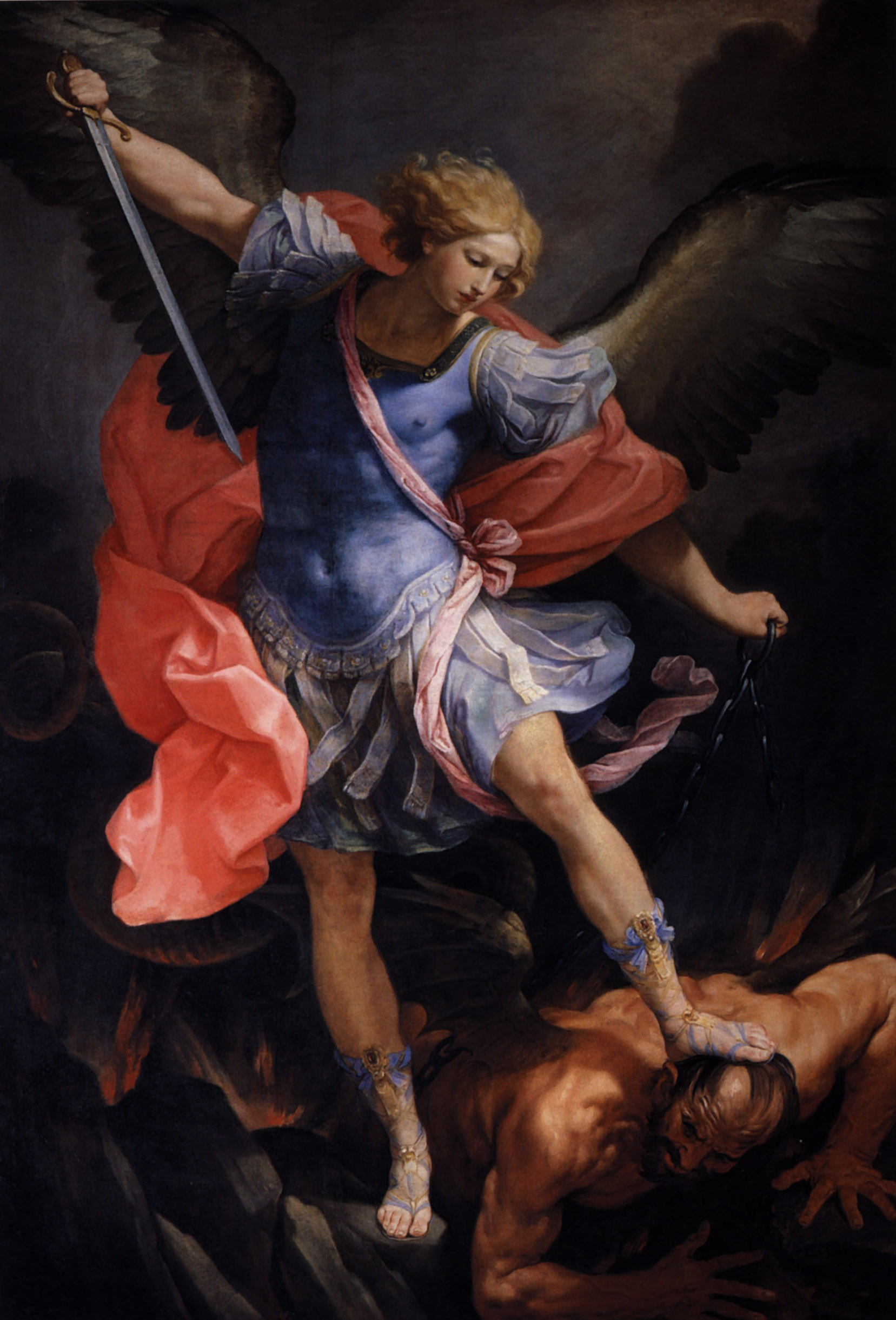
Guido Reni's version comes with a piece of Roman gossip: that the face he gave the defeated devil was the face of Cardinal Giovanni Battista Pamphilj, later Pope Innocent X, with whom the painter had quarrelled. It is a much-repeated legend, not a documented portrait.
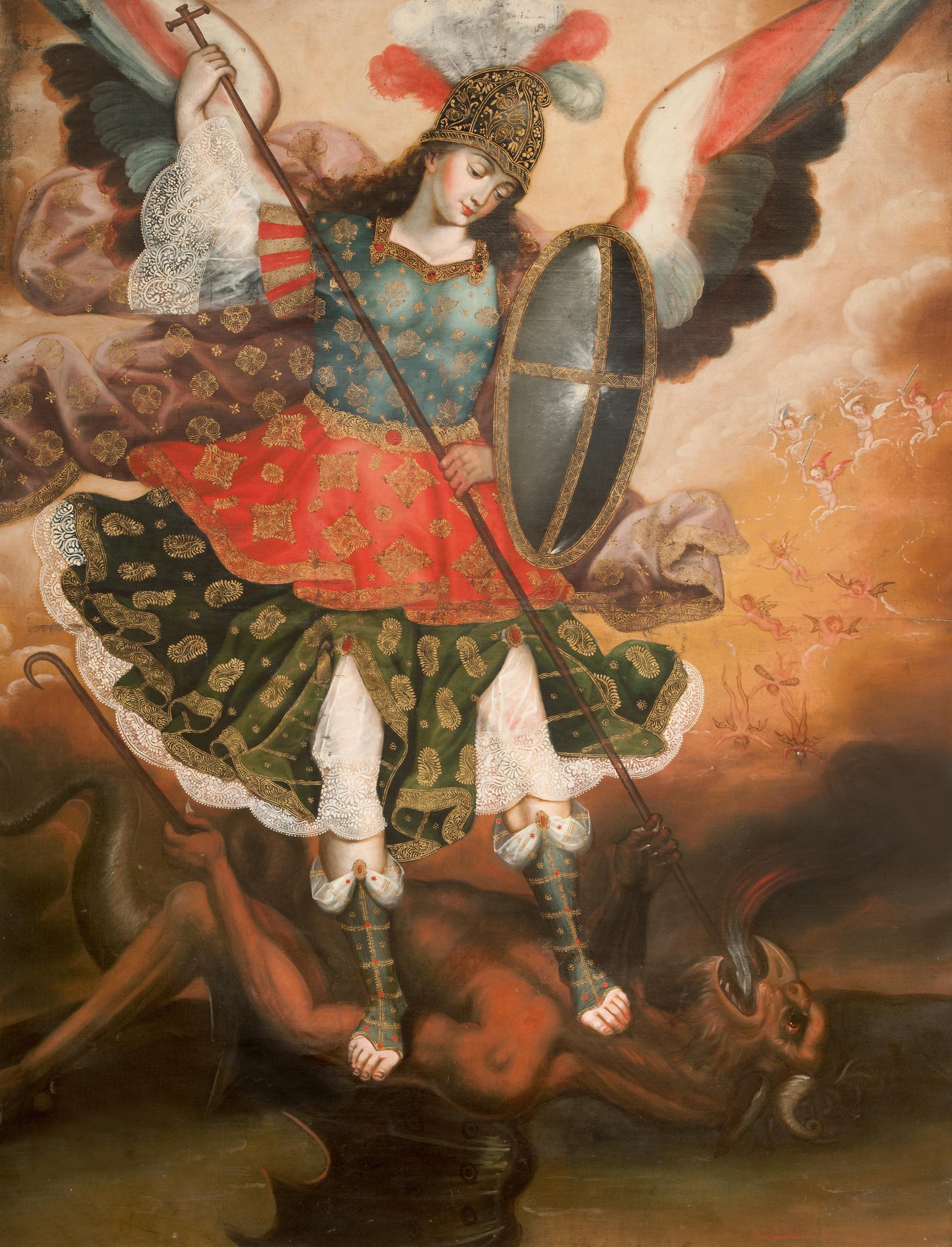
And the chapter did not stay in Europe. In colonial Peru, painters of the Cuzco School put Michael in gold brocade and lace, in a style that belongs to the Andes rather than to Italy.
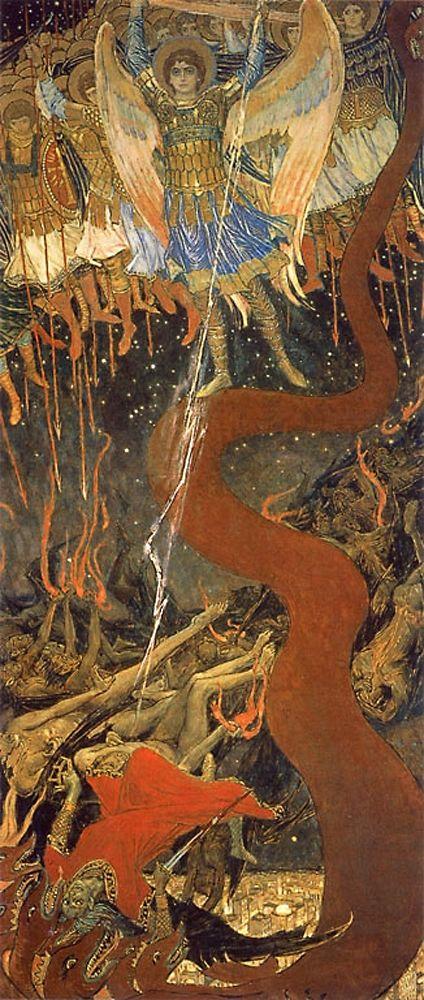
Viktor Vasnetsov, working out of the Russian icon tradition, gives the same subject a completely different temperature again.
Then the result, in a verse that is almost administrative:
But the dragon was not strong enough, and no longer was any place found in heaven for him and his angels.
Revelation 12:8 · BSB
Is the dragon Satan?
Yes — and this is one of the rare places where the Bible stops and says so outright:
And the great dragon was hurled down—that ancient serpent called the devil and Satan, the deceiver of the whole world. He was hurled to the earth, and his angels with him.
Revelation 12:9 · BSB
Four names in one sentence: the dragon, the ancient serpent, the devil, Satan. And "that ancient serpent" is the phrase Christian readers have long taken to link this monster to the talking snake in Eden — a connection Genesis 3 itself never makes, where the serpent is introduced simply as one of the animals God had made. If you have ever wondered where the equation of the two comes from, this is one of the passages behind it.
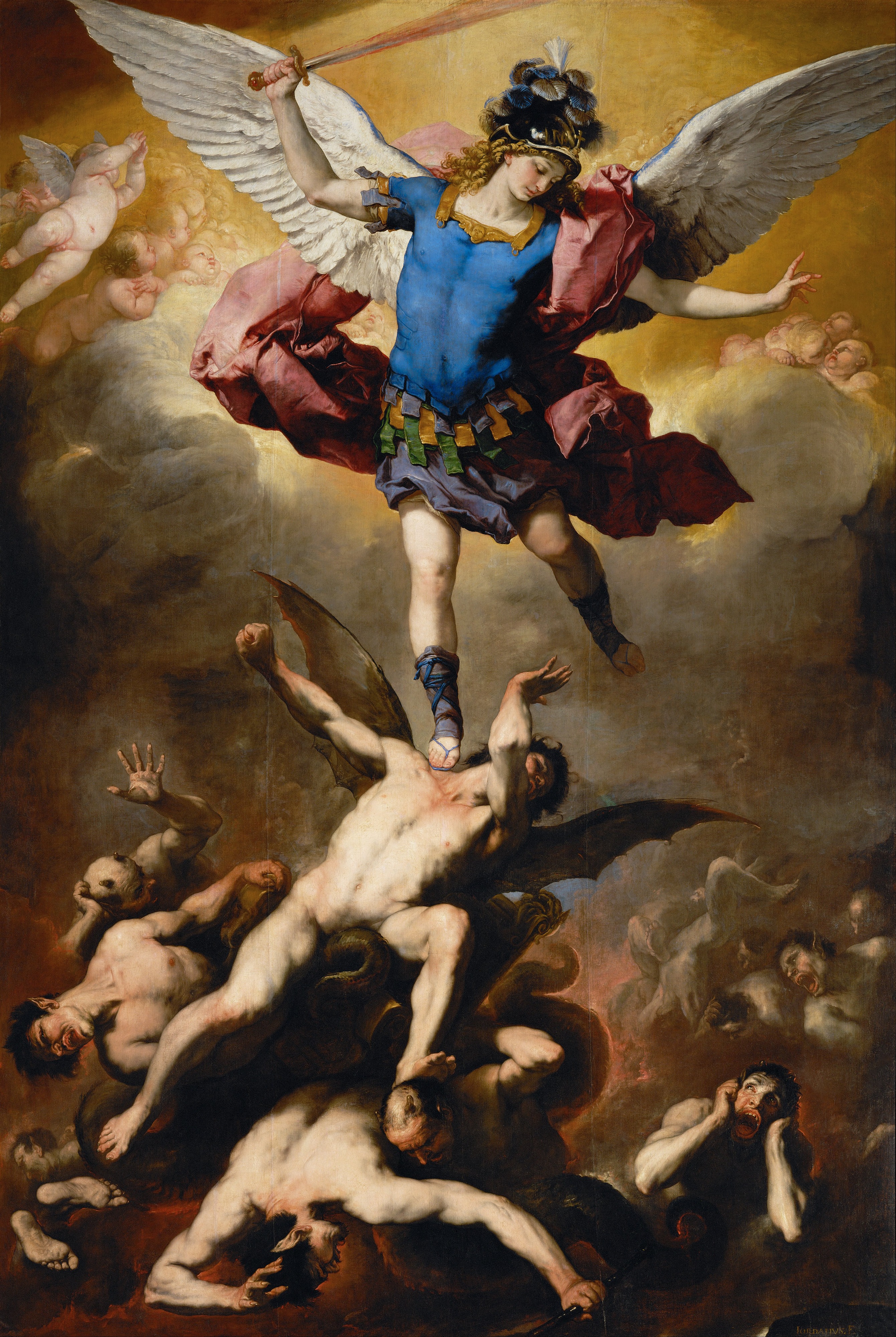
The Voice, and the Line Everyone Quotes (Revelation 12:10–12)
A voice in heaven explains what the battle meant, and it reaches for a courtroom word.
For the accuser of our brothers has been thrown down—he who accuses them day and night before our God.
Revelation 12:10 · BSB, excerpt
That is what the dragon had been doing up there: not tempting, not attacking — prosecuting. Standing in front of God, day and night, reading out the charges. The war ends with the prosecutor removed from the courtroom.
Then the most quoted sentence in the chapter:
They have conquered him by the blood of the Lamb and by the word of their testimony. And they did not love their lives so as to shy away from death.
Revelation 12:11 · BSB
Look at who wins, and how. Michael does the fighting in heaven; the victory on earth is credited to ordinary people, and their weapons are the blood of the Lamb and something they said.
And then the chapter's oddest piece of comfort:
But woe to the earth and the sea; with great fury the devil has come down to you, knowing he has only a short time.
Revelation 12:12 · BSB, excerpt
The reassurance and the warning arrive in the same breath. Things are about to get worse, and the reason they are getting worse is that the enemy is losing and knows it.
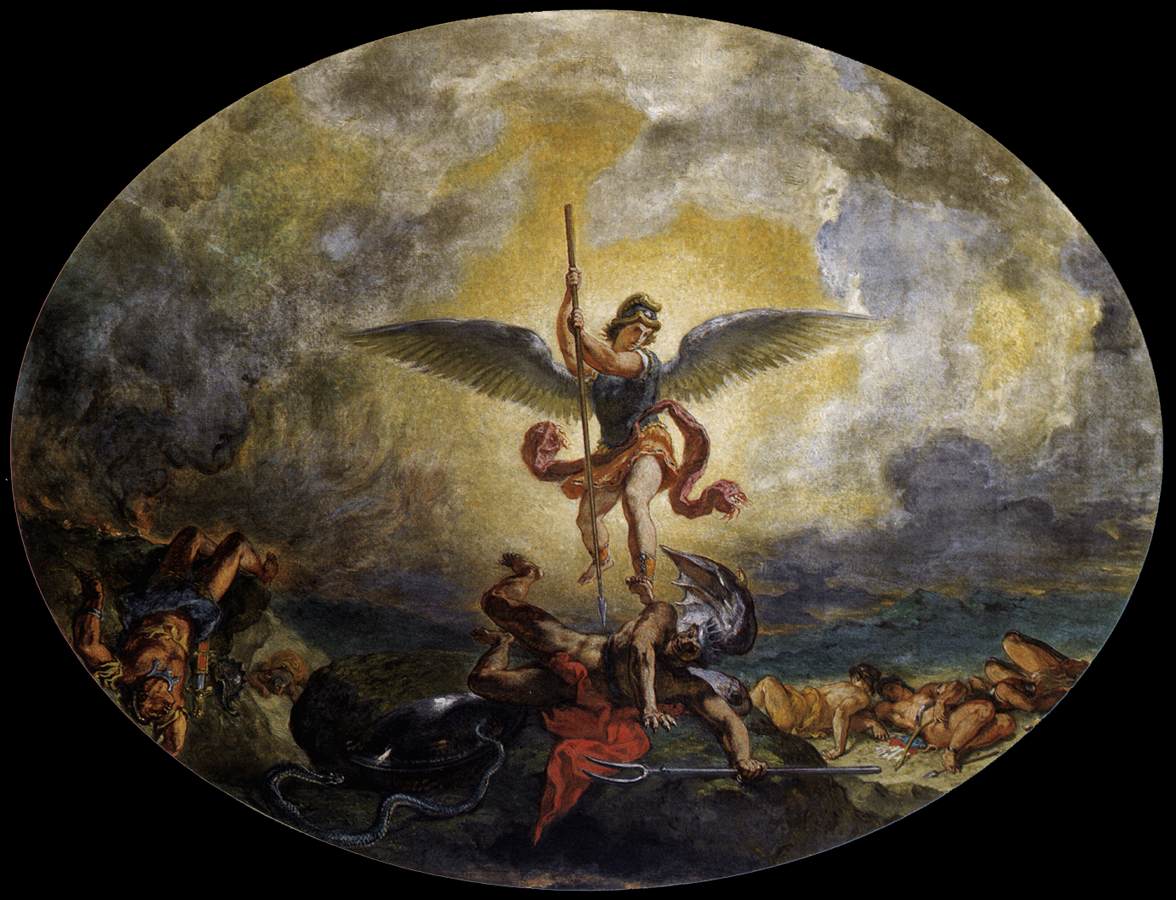
The Chase (Revelation 12:13–17)
Thrown out of heaven, the dragon goes looking for the woman. What follows plays like a chase sequence.
But the woman was given two wings of a great eagle to fly from the presence of the serpent to her place in the wilderness, where she was nourished for a time, and times, and half a time.
Revelation 12:14 · BSB
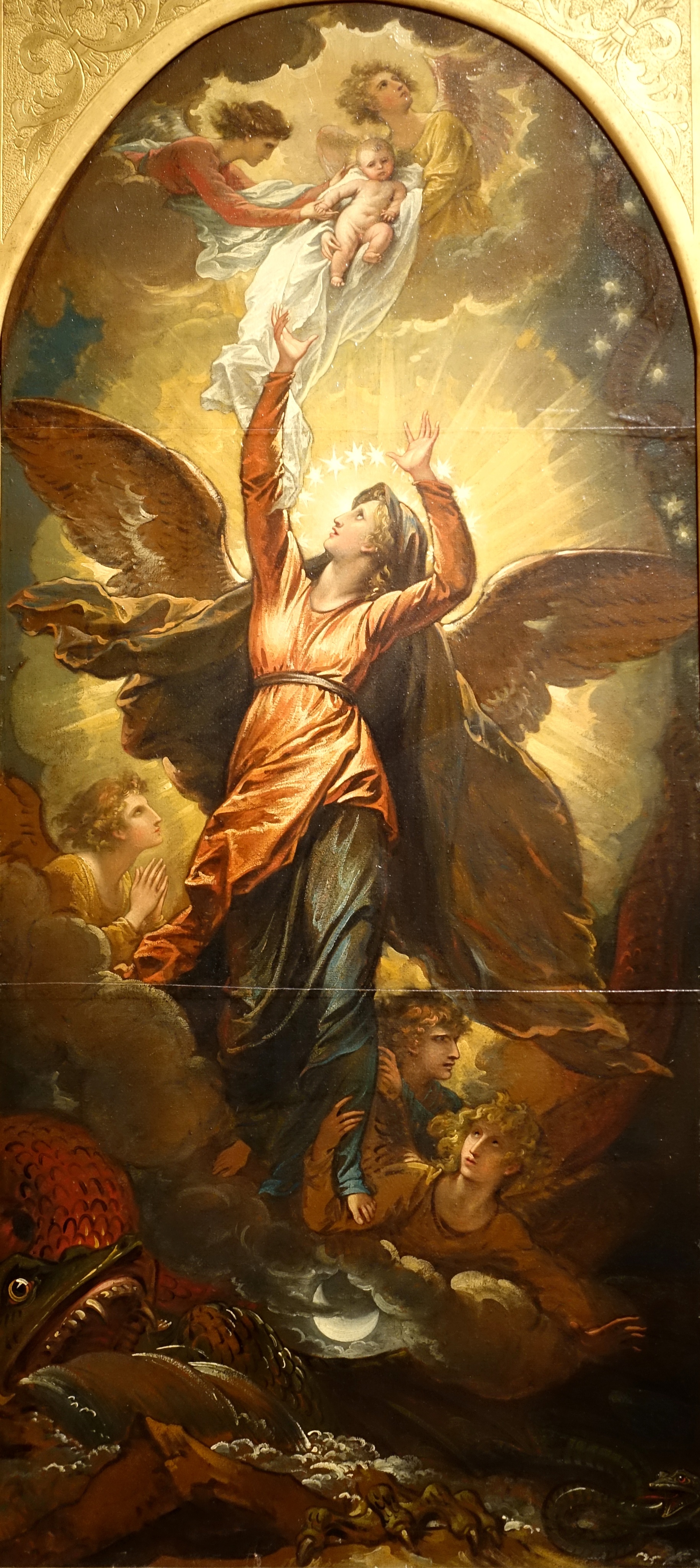
This is the one painting here that takes the chase head-on. West painted it for William Beckford's Fonthill Abbey, and he folds two verses into a single frame, the child going up to God in verse 5 and the mother getting her wings in verse 14. (Dürer had done the same thing on the woodcut above, giving her the wings nine verses before the text hands them over.)
Then the strangest weapon in the book, and the strangest rescue:
Then from his mouth the serpent spewed water like a river to overtake the woman and sweep her away in the torrent. But the earth helped the woman and opened its mouth to swallow up the river that the dragon had poured from his mouth.
Revelation 12:15–16 · BSB
The ground itself takes her side. Revelation has the earth react to God elsewhere — in 20:11 earth and heaven flee from his presence — but this is the one place it steps in and helps someone.
And the dragon changes target:
And the dragon was enraged at the woman and went to make war with the rest of her children, who keep the commandments of God and hold to the testimony of Jesus.
Revelation 12:17 · BSB, excerpt
"The rest of her children" is the phrase that turns the vision around and points it at the reader. Whoever the woman is, she has other children, and they are the ones the dragon goes after next.
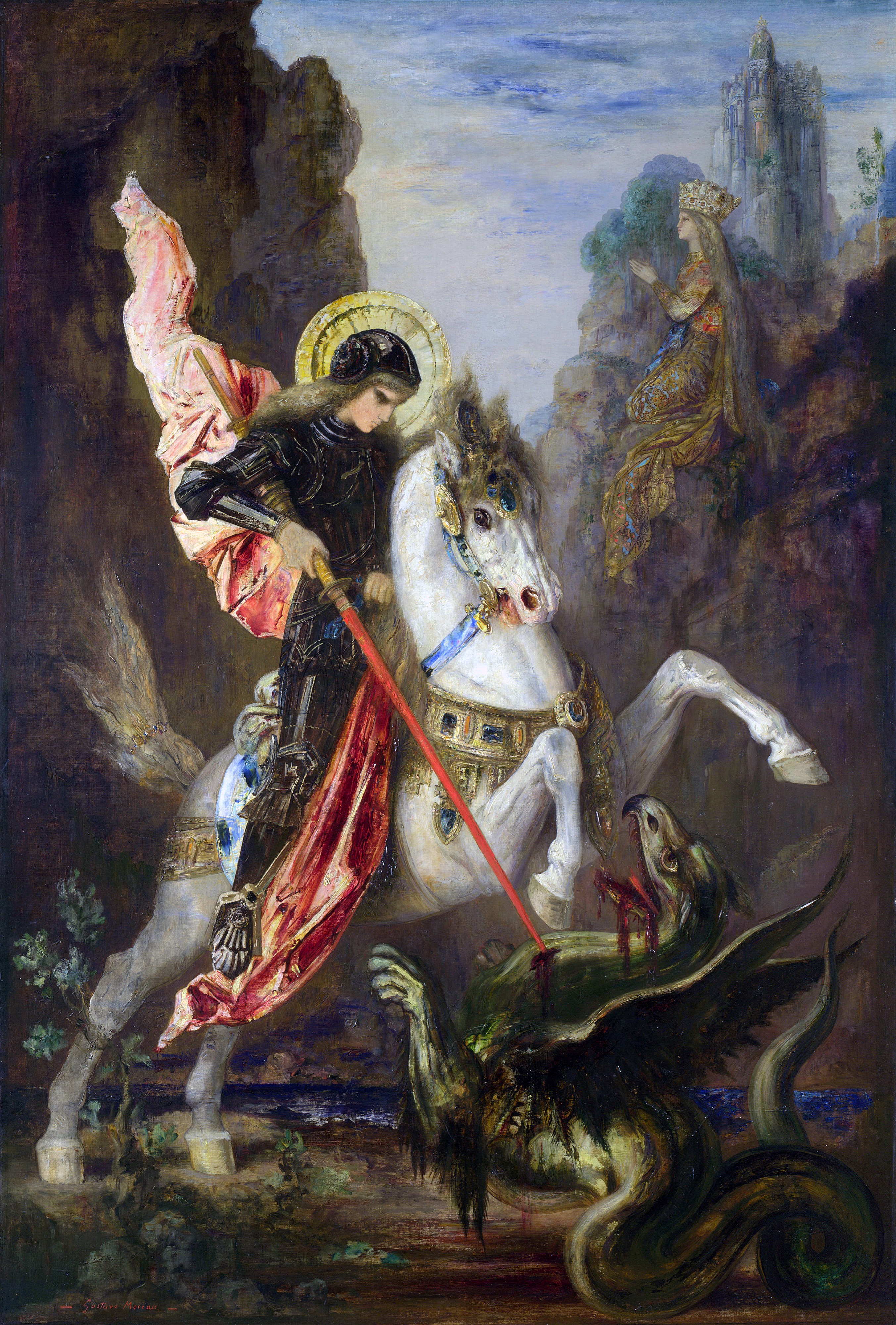
Why is it Michael fighting the dragon, and not St George?
Because St George is not in the Bible. The soldier-saint with the lance and the dragon is a legend that grew in the Eastern church and reached the West most famously through the thirteenth-century Golden Legend; no biblical account of him exists, with or without a dragon. Michael is the one Revelation 12 actually names. The two subjects look so alike that painters, print sellers and catalogues have blurred them for centuries — the usual giveaway is wings and a sword for Michael, a horse and a lance for George.
The Verses to Remember from Revelation 12
Ten lines to keep.
- The first sign: "a woman clothed in the sun, with the moon under her feet and a crown of twelve stars on her head." (12:1)
- The human half of it: "She was pregnant and crying out in the pain and agony of giving birth." (12:2)
- The second sign: "a huge red dragon with seven heads, ten horns, and seven royal crowns on his heads." (12:3)
- The tail: "His tail swept a third of the stars from the sky, hurling them to the earth." (12:4)
- Birth to throne in one line: "And her child was caught up to God and to His throne." (12:5)
- A place already prepared: "the woman fled into the wilderness, where God had prepared a place for her" (12:6)
- The war: "Michael and his angels fought against the dragon, and the dragon and his angels fought back." (12:7)
- The four names: "that ancient serpent called the devil and Satan, the deceiver of the whole world." (12:9)
- How it is won: "They have conquered him by the blood of the Lamb and by the word of their testimony." (12:11)
- Why it gets worse: "knowing he has only a short time." (12:12)
What Revelation 12 Is Actually Doing
Strip the special effects and the chapter has a simple shape: something enormous tries to destroy something small and new, and fails — repeatedly, and in every arena it tries. It fails in the sky, where the child is taken out of reach. It fails in heaven, where it loses the war and its job as prosecutor. It fails in the wilderness, where the ground swallows its weapon.
Then it goes after everybody else, which is the point at which the vision stops being a story about a woman and starts being a story about whoever is reading it.
It is worth noticing what the chapter does not do. It never promises the woman an easy time; she spends most of it in labour, in flight, or in the desert. What it promises is that the thing hunting her is on a clock.
Revelation 12 at a Glance
- Where we are: the middle of Revelation, between the seven trumpets and the beasts of chapter 13. The chapter interrupts the sequence to explain who the real opponent is.
- Cast: the woman, the dragon, the male child, Michael and his angels, a loud voice, and the earth.
- The six beats: the woman (12:1–2) · the dragon (12:3–4) · the birth and the flight (12:5–6) · the war (12:7–9) · the voice (12:10–12) · the chase (12:13–17).
- What it gave Western art: Michael with a sword standing on a defeated enemy, Mary on a crescent moon crowned with stars, and the seven-headed dragon.
- Famously not in it: St George, and any statement that the war in heaven happened before the world was made.
Read Revelation 12 with a Painting: A 4-Step Visio Divina Practice
Visio Divina is Latin for "divine seeing" — praying with a picture instead of only a passage.
- Look (Visio): Pick one painting above and stay with whatever your eye goes to first. Let it be a slow look.
- Meditate (Meditatio): Read the verse beside it twice. Which word catches?
- Pray (Oratio): Say one honest sentence to God. Verse 10 is a good place to start if you are being accused of something, by someone else or by yourself.
- Contemplate (Contemplatio): Sit quietly for one minute. Nothing has to happen.
Questions People Ask About Revelation 12
- Is the woman in Revelation 12 Mary?
- It is one of three long-standing readings. She is also widely read as Israel — the sun, moon and stars match Joseph's dream in Genesis 37:9, where they stand for his family — and as the church, since verse 17 refers to "the rest of her children." Catholic tradition has read her as Mary, the mother of the male child, and that reading shaped centuries of painting. Many readers hold more than one at once, on the grounds that John presents her as a sign.
- When did the war in heaven happen?
- Revelation does not date it. In the order of this chapter it comes after the male child is caught up to God, which has led many readers to connect it with the death and resurrection of Christ rather than with a rebellion before creation. Others place it at the beginning, and others in the future. The popular picture of Satan falling before the world was made draws on other passages and on later literature — Milton above all — more than on Revelation 12 itself.
- What do the dragon's seven heads and ten horns mean?
- Revelation does not explain them here. The same combination reappears on the beast in chapter 13 and is interpreted in chapter 17, where heads and horns are linked to kings and kingdoms — which is why many readers take them as a claim to political power. The detail that needs no interpretation is the crowns: the dragon is presenting himself as a ruler.
- What does "conquered him by the blood of the Lamb" mean?
- Verse 11 credits the victory over the accuser to two things: what the Lamb — Christ — has already done, and what ordinary believers say about it, "the word of their testimony." Given that verse 10 has just described the dragon as a prosecutor bringing charges, the imagery is legal: the case against them has been answered, and they are the ones who repeat the verdict.
- Is the dragon the same as the serpent in the Garden of Eden?
- Revelation 12:9 calls the dragon "that ancient serpent called the devil and Satan," a phrase Christian readers have long connected with Eden. Genesis 3 itself does not name the serpent Satan: there it is introduced as "more crafty than any beast of the field that the LORD God had made." The connection belongs to a reading of the two books together.
- What are the 1,260 days, the 42 months, and "a time, times, and half a time"?
- Three ways of expressing three and a half years in the book’s symbolic reckoning. Revelation uses 1,260 days in 11:3 and 12:6, 42 months in 11:2 and 13:5, and "a time, and times, and half a time" in 12:14. The phrasing of the last one comes from Daniel 7:25 and 12:7. Readers differ on whether the span is literal, symbolic, or both; the structural point is that it is bounded.
Keep Going
More chapters, same format: Luke 1 in Art · Luke 2 in Art · Luke 3 in Art
Stay with Michael: Saint Michael’s Prayer for Protection
If you want to sit with one of these images a little longer, you can restore it yourself. Open Guido Reni's Archangel Michael as a puzzle, piece by piece, with the Scripture and an invitation to reflect at the end.
Or get the Visio Divina app for a new painting, a new verse, and a new reflection every morning.
Continue in the open gallery