Luke 2 ends with a twelve-year-old going home to Nazareth. Luke 3 picks up about eighteen years later, in a desert, with a man in the wilderness shouting at people — and it ends with a long list of names.
In between is one of the most quoted passages in the Bible and one of the least read. Here is the whole chapter in plain language, with seven paintings, from El Greco to the ceiling of the Sistine Chapel. The verses worth remembering are set apart.
What Is Luke 3 About?
Luke 3 is about John the Baptist and the start of Jesus' public life: a precise date and a voice in the wilderness, a sermon that opens by calling the crowd a brood of vipers, three groups asking what they should actually do, John pointing past himself to someone stronger, Herod shutting him in prison, the baptism of Jesus and a voice from heaven, and a genealogy that runs backwards to Adam.
Tap any part to jump to it, with the paintings and the verses.
A Chapter That Starts with a Dateline (Luke 3:1–6)
Luke opens the chapter like a legal document. He names the Roman emperor, the governor of Judea, three regional rulers and two high priests — seven officials in two verses — just to fix the moment when "the word of God came to John son of Zechariah in the wilderness" (3:2).
It is a strange amount of paperwork for a story about a man in a desert. But it is Luke being Luke: he wants you to know this happened on a particular Tuesday, in a real empire, under named management.
Then he quotes Isaiah, and the tone changes completely.
“A voice of one calling in the wilderness, ‘Prepare the way for the Lord, make straight paths for Him.’”
Luke 3:4 · BSB, excerpt
“Every valley shall be filled in, and every mountain and hill made low. The crooked ways shall be made straight, and the rough ways smooth.”
Luke 3:5 · BSB, excerpt
Matthew and Mark quote the same passage but stop after the first line. Luke keeps going for two more verses, and the reason shows up in the last one — it is the sentence he wanted all along:
“And all humanity will see God’s salvation.”
Luke 3:6 · BSB, excerpt
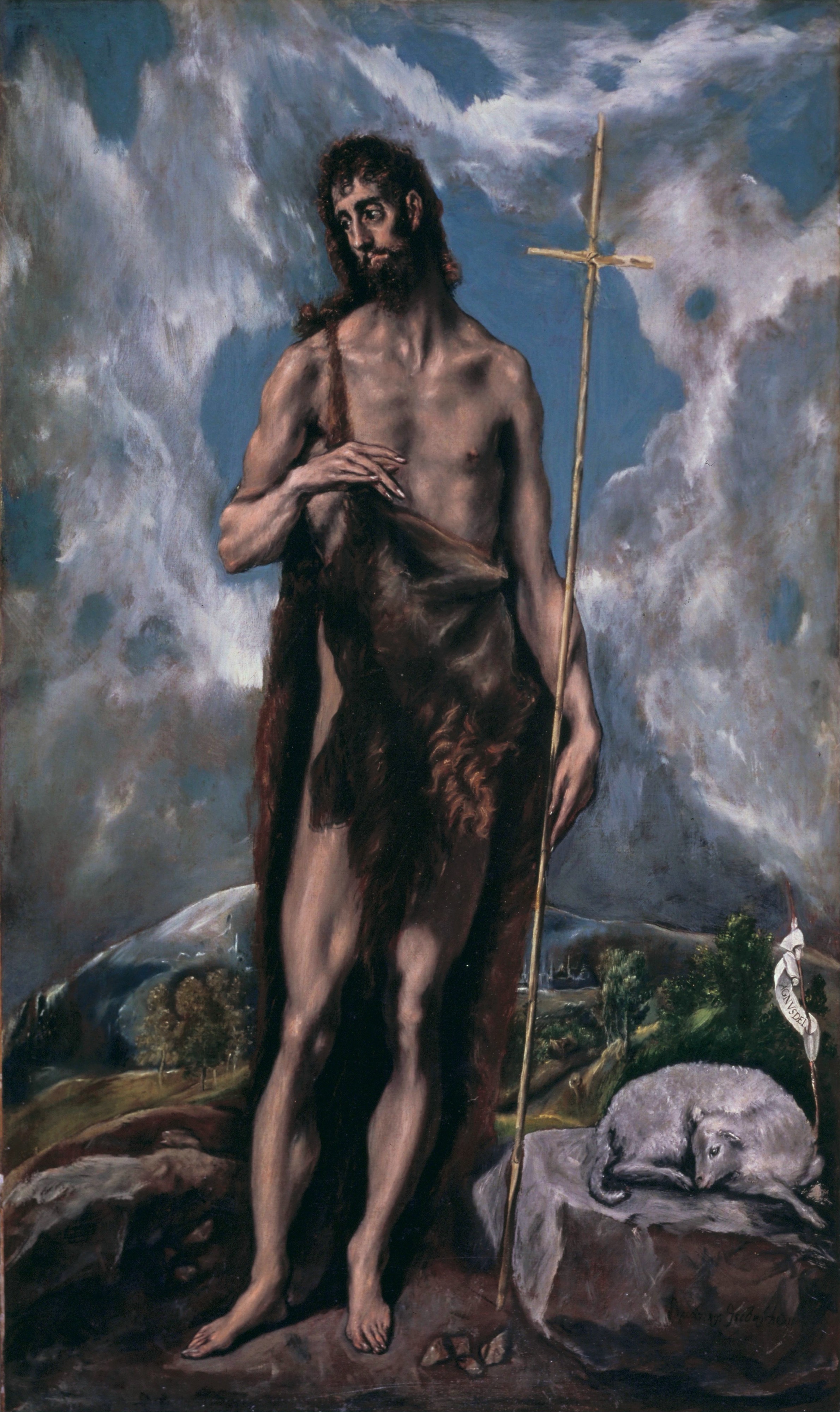
El Greco is the right painter to open with, because he can look startlingly modern. He stretched his figures and lit them from nowhere in particular. His work fell out of favour after his death, then found new admirers among nineteenth-century artists and the modern painters who followed them.
He Opens by Insulting the Audience (Luke 3:7–9)
Crowds come out to the desert to be baptized. Here is John's opening line to them:
“You brood of vipers, who warned you to flee from the coming wrath?”
Luke 3:7 · BSB, excerpt
Not a promising start to a ministry. And he keeps going: don't tell me about your ancestry, he says — "out of these stones God can raise up children for Abraham" (3:8). Then an image that has never lost its edge:
“The axe lies ready at the root of the trees.”
Luke 3:9 · BSB, excerpt
What he is attacking is not belief. It is the assumption that belonging to the right family settles the question. His demand is specific and awkward:
“Produce fruit, then, in keeping with repentance.”
Luke 3:8 · BSB, excerpt
Which raises the obvious question, and to Luke's credit, he lets the crowd ask it.
"What Then Should We Do?" (Luke 3:10–14)
This is the best-kept secret in the chapter. Three different groups ask John the same question, and his three answers are startlingly practical.
The crowds asked him, “What then should we do?”
Luke 3:10 · BSB
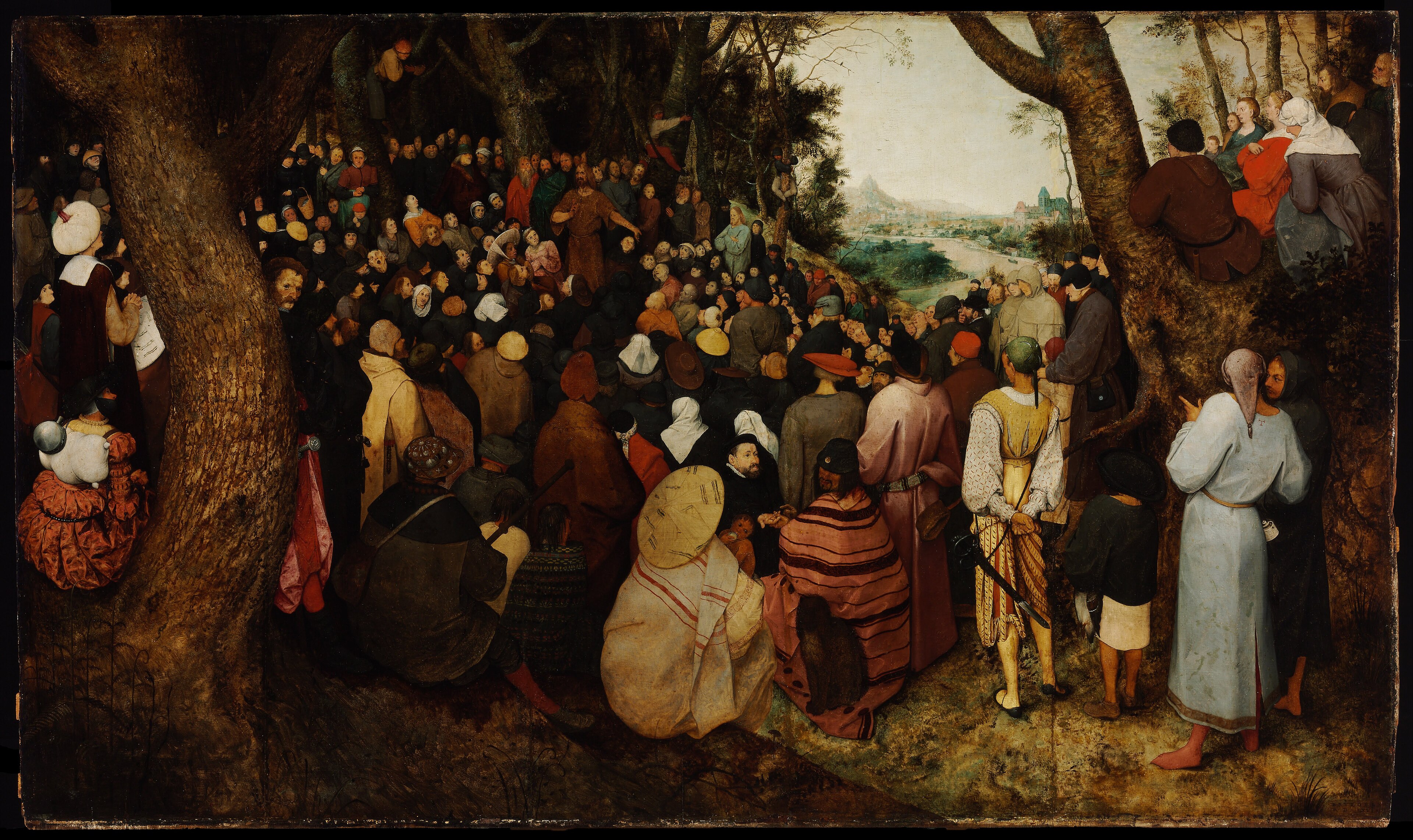
Bruegel gives the sermon an enormous mixed crowd — which is exactly what Luke describes: not a congregation, but whoever turned up.
The crowds ask first. The answer is about coats:
“Whoever has two tunics should share with him who has none, and whoever has food should do the same.”
Luke 3:11 · BSB, excerpt
Tax collectors ask next. Tax collection offered opportunities to demand more than was owed. John does not tell them to quit:
“Collect no more than you are authorized.”
Luke 3:13 · BSB, excerpt
Soldiers ask last, and get an equally practical answer:
“Do not take money by force or false accusation,” he said. “Be content with your wages.”
Luke 3:14 · BSB, excerpt
Read the three together and something jumps out: repentance takes a very practical form. Nobody is told to pray more, attend anything, or change jobs. They are told to stop cheating people and to share a coat.
The man who called them a brood of vipers thirty seconds ago turns out to want something very small and very difficult.
Water, and Something Else (Luke 3:15–18)
John is now popular enough that people start wondering in their hearts whether he is the Messiah himself (3:15). He shuts it down immediately, and the way he does it is one of his best-known sayings:
“I baptize you with water, but One more powerful than I will come, the straps of whose sandals I am not worthy to untie. He will baptize you with the Holy Spirit and with fire.”
Luke 3:16 · BSB, excerpt
John chooses a humble act of service — untying someone’s sandals — and says he is not worthy even of that.
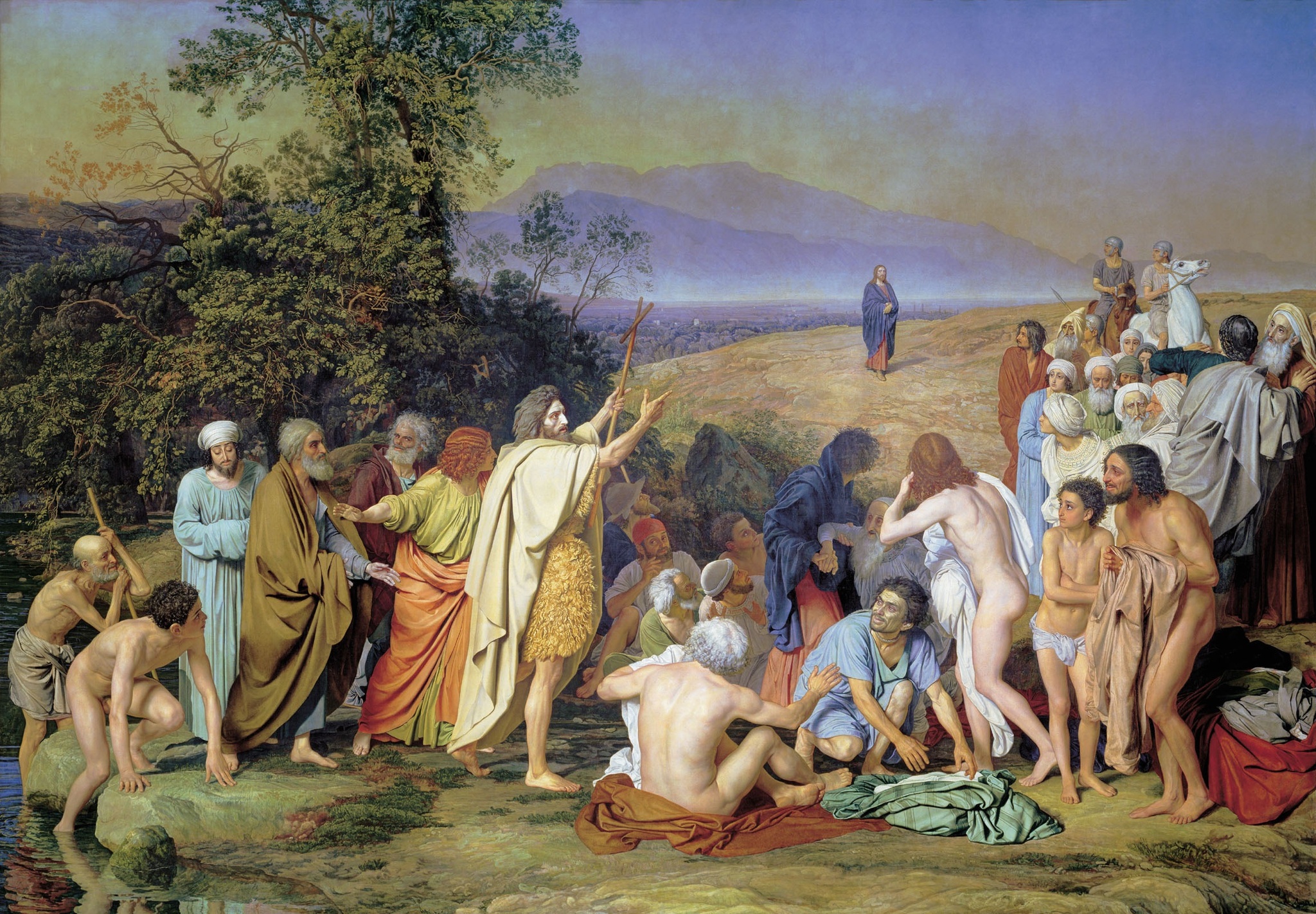
Alexander Ivanov spent twenty years on this painting — from 1837 to 1857 — and it is essentially this verse, enlarged: John at the Jordan, turning the crowd's attention away from himself toward a figure approaching in the distance. It now hangs in the Tretyakov Gallery in Moscow, and it is the size of a wall.
Luke Closes the Door Early (Luke 3:19–20)
Then, abruptly, Luke jumps ahead. John had criticised the local ruler Herod over his marriage and "all the evils he had done" (3:19), and Herod's response is given in one flat sentence:
Herod added this to them all: He locked John up in prison.
Luke 3:20 · BSB
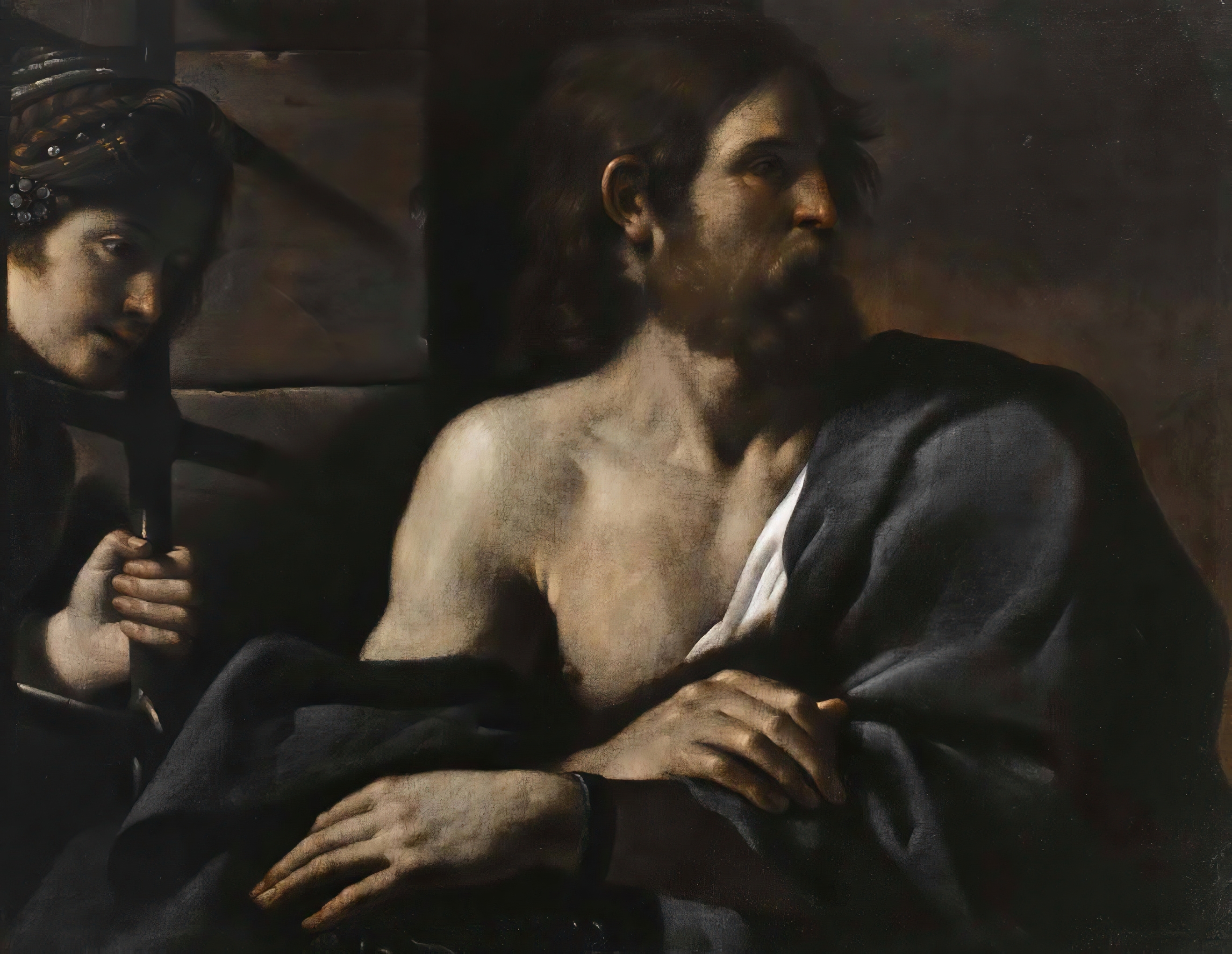
Luke stops at the prison door. He does not tell the dancing, birthday-party and platter episode found in Mark 6. Later, in Luke 9:9, Herod briefly says he had John beheaded. In Luke 3 the story of John simply ends with a lock.
And here is the oddity worth knowing about.
Does Luke say John baptized Jesus?
No — and the baptism is the next scene Luke tells. Luke puts John in prison in verse 20, and then in verse 21 writes: "When all the people were being baptized, Jesus was baptized too." The sentence is passive. No one is named as the baptizer. Matthew and Mark both say plainly that John did it; Luke, having just shut John in a cell, declines to say.
Some readers take this as Luke arranging his material rather than describing a sequence. What we can say for certain is narrower and stranger: in Luke's telling, the most famous baptism in history is described without a word about who performed it.
Heaven Opens Over an Ordinary Queue (Luke 3:21–22)
Notice how Luke stages the moment. Jesus is baptized along with the people.
When all the people were being baptized, Jesus was baptized too. And as He was praying, heaven was opened,
Luke 3:21 · BSB
Luke alone adds "as He was praying." In this Gospel, things tend to open when someone is praying.
“You are My beloved Son; in You I am well pleased.”
Luke 3:22 · BSB, excerpt
This is the first direct voice from heaven in Luke. Everything before it — the angels, the shepherds, Simeon, Anna — has been someone else's testimony about Jesus. Here the voice is direct, and it says nothing about what he is going to do. It says who he is, and that he is loved, before a single day of public work.
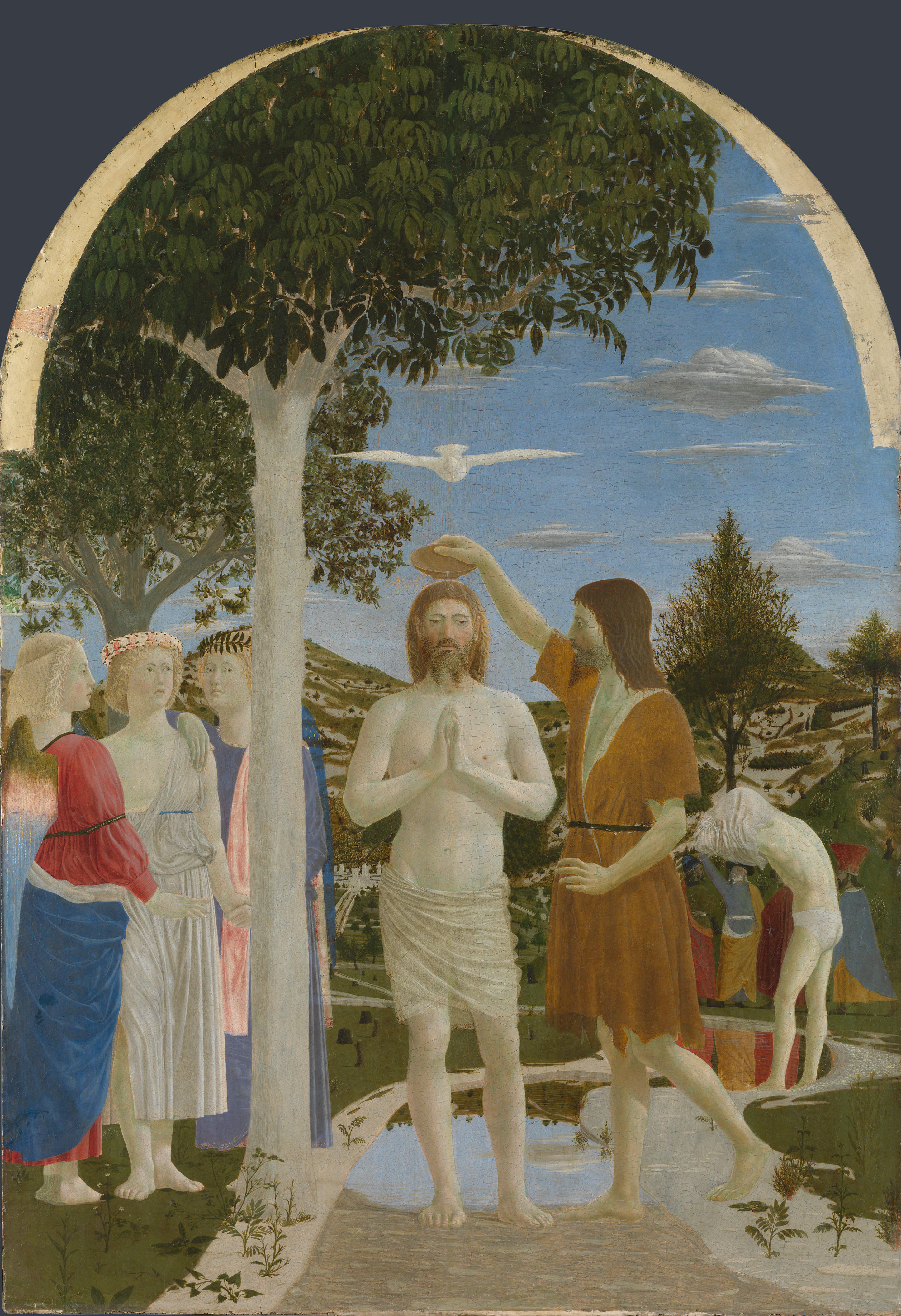
Piero della Francesca was as much a mathematician as a painter — he wrote treatises on perspective and geometry — and his baptism has the stillness of something measured rather than felt. It hangs in the National Gallery in London.
Seventy-Seven Names, Running Backwards (Luke 3:23–38)
Most people stop reading here. The chapter ends with a genealogy: Jesus "was about thirty years old when He began His ministry" (3:23), and then seventy-seven ancestral links, from Joseph to God.
Two things make it worth thirty seconds.
First, it runs the wrong way. Matthew's genealogy starts at Abraham and moves forward to Jesus. Luke starts at Jesus and moves backwards — past David, past Abraham, past Noah, all the way to the first man.
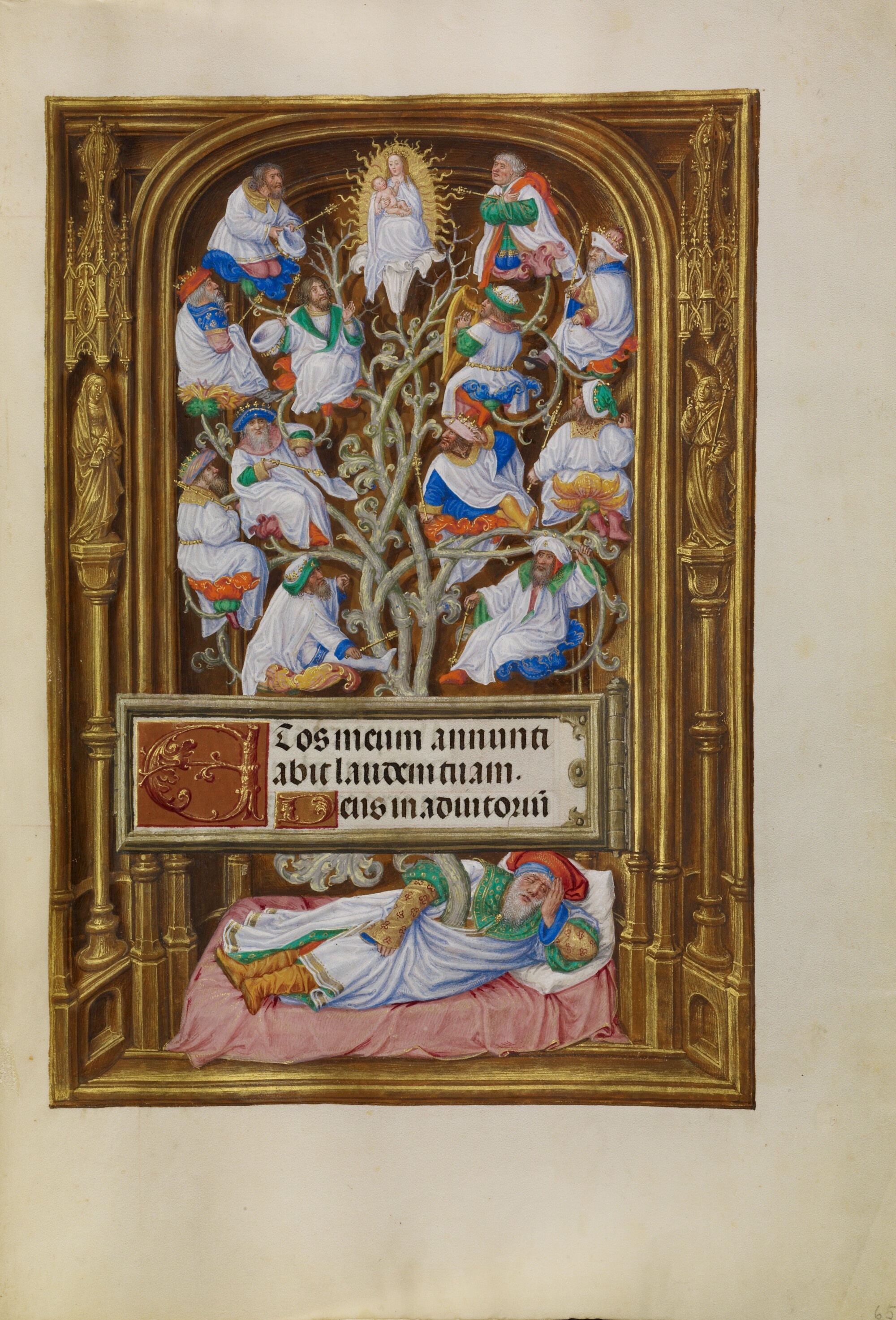
This is what a genealogy looked like when medieval painters tried to draw one: a family tree growing literally, as a tree, out of a sleeping ancestor.
Second, Luke does not stop at Adam. He adds one more link, and it is the point of the whole list:
the son of Adam, the son of God.
Luke 3:38 · BSB, excerpt
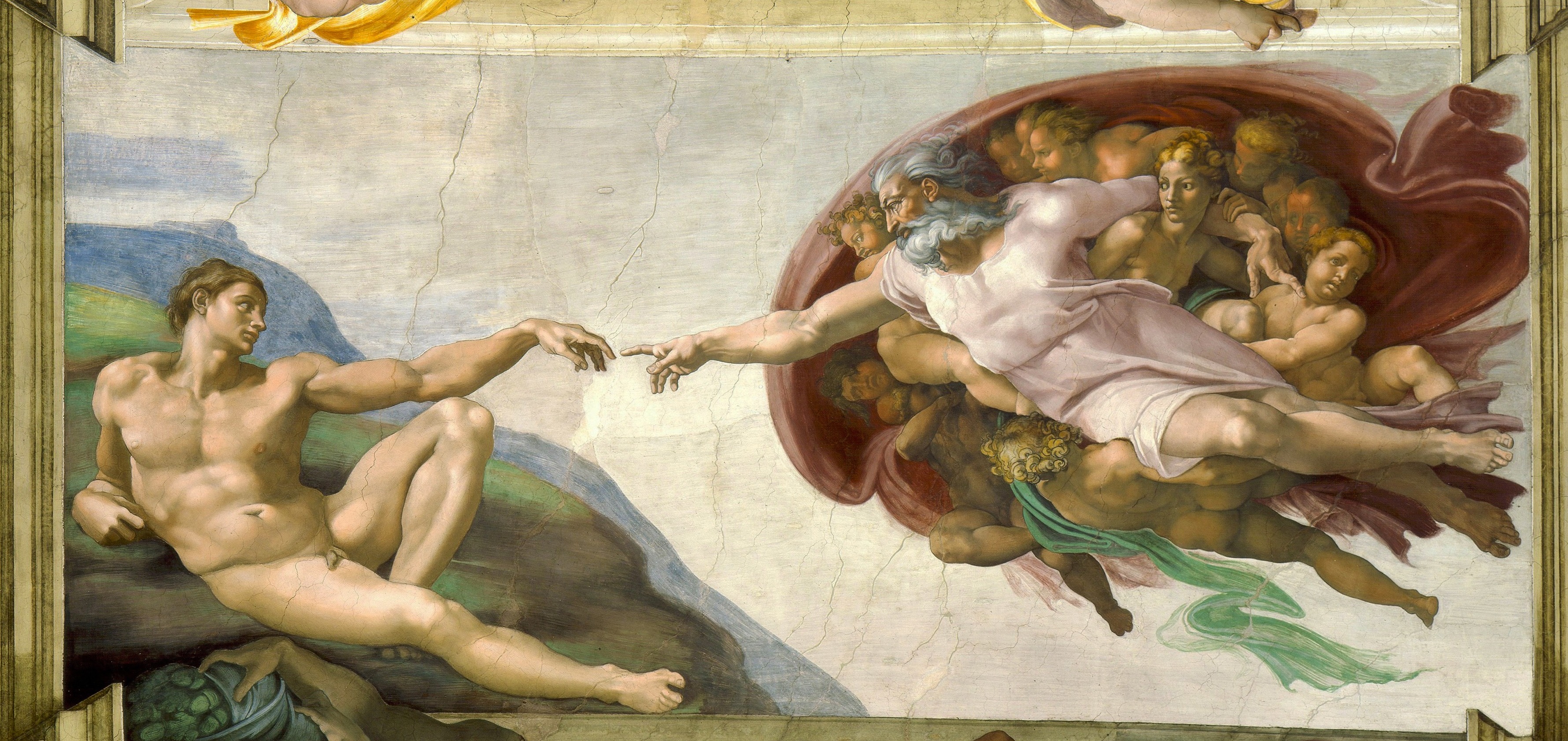
Matthew's genealogy proves that Jesus belongs to Israel. Luke's keeps going until it runs out of human beings, and then takes one more step. He has just heard a voice say You are My beloved Son — and he spends sixteen verses tracing that sonship back through every generation to the beginning.
It is a list of names that turns into an argument.
The Verses to Remember from Luke 3
- The voice: "A voice of one calling in the wilderness" (3:4)
- The levelling: "Every valley shall be filled in, and every mountain and hill made low." (3:5)
- Luke’s whole point: "And all humanity will see God’s salvation." (3:6)
- The opening line: "You brood of vipers, who warned you to flee from the coming wrath?" (3:7)
- The demand: "Produce fruit, then, in keeping with repentance." (3:8)
- The warning: "The axe lies ready at the root of the trees." (3:9)
- The question: "What then should we do?" (3:10)
- The answer: "Whoever has two tunics should share with him who has none." (3:11)
- John's place: "I baptize you with water, but One more powerful than I will come." (3:16)
- The voice from heaven: "You are My beloved Son; in You I am well pleased." (3:22)
What Luke 3 Is Actually Doing
The chapter is a hinge, and it turns on one idea: something that was for one people is about to be for everyone.
Luke signals it three times. He extends the Isaiah quotation until it reaches "all humanity." He has John dismiss ancestry as a qualification — God can raise children for Abraham out of rocks. And he ends the chapter by running Jesus' family line back past Abraham entirely, to Adam, who is everyone's ancestor, and then to God.
In between, three ordinary groups ask what to do about any of this, and the answer they get is: share your coat, and stop taking what is not yours.
Luke 3 at a Glance
- Where we are: roughly eighteen years after Luke 2, at the start of Jesus' public life.
- Who is new: John the Baptist as an adult preacher, Herod the tetrarch, and a crowd of tax collectors and soldiers.
- The five scenes: the dateline and the voice (3:1–6) · the sermon (3:7–9) · what should we do (3:10–14) · water and fire (3:15–18) · prison, baptism, genealogy (3:19–38).
- Famous lines found here: "Prepare the way for the Lord," "brood of vipers," "the axe lies ready at the root," and "You are My beloved Son."
- Easy to miss: Luke never names who baptized Jesus, and his genealogy runs backwards.
Read Luke 3 with a Painting: A 4-Step Visio Divina Practice
Visio Divina is Latin for "divine seeing" — praying with a picture instead of only a passage.
- Look (Visio): Pick one painting above and stay with whatever your eye goes to first. Let it be a slow look.
- Meditate (Meditatio): Read the verse beside it, twice. Which word catches?
- Pray (Oratio): Say one honest sentence. If you want a starting point, the crowd's question works: what then should I do?
- Contemplate (Contemplatio): Sit quietly for a minute. Nothing has to happen.
Questions People Ask About Luke 3
- Who was John the Baptist?
- A prophet, and Jesus' relative — Luke 1 makes their mothers kin. He preached in the wilderness around the Jordan, calling people to a baptism of repentance, and drew large crowds. He publicly criticised Herod the tetrarch and was imprisoned for it. He is the figure the Gospels use to mark the end of the old era and the start of Jesus' public life.
- What does "brood of vipers" mean?
- It is an insult, and a deliberate one. John says it to the crowds who came out to be baptized (Luke 3:7). The point is not their sincerity but their assumption: they believed descent from Abraham secured their standing, and John tells them that a family tree produces nothing by itself — "Produce fruit, then, in keeping with repentance" (3:8).
- What did John tell people to do?
- Three groups asked him and got three practical answers. The crowds: share your spare tunic and your food (3:11). Tax collectors: "Collect no more than you are authorized" (3:13). Soldiers: do not extort or make false accusations, and be content with your pay (3:14). All three answers put repentance into daily practice, and none tells anyone to change occupation.
- Why does Luke 3 begin with a list of rulers?
- To place the events in a named historical setting. Luke names Tiberius Caesar, Pontius Pilate, Herod, Philip, Lysanias, Annas and Caiaphas (3:1–2), beginning with the fifteenth year of Tiberius. Annas was a former high priest whose influence continued during Caiaphas’s tenure, so these are not simply seven overlapping terms of office. The detailed opening fits Luke's stated aim of setting things down in order (Luke 1:1–4).
- Does Luke say John baptized Jesus?
- No. Luke reports John's imprisonment in 3:19–20, then writes in 3:21 that "when all the people were being baptized, Jesus was baptized too" — a passive sentence with no baptizer named. Matthew and Mark both name John. Luke does not.
- Why is Luke's genealogy different from Matthew's?
- They run in opposite directions and reach different endpoints. Matthew begins with Abraham and moves forward to Jesus, establishing him within Israel's story. Luke begins with Jesus and moves backward through seventy-seven ancestral links in the BSB text, from Joseph past Abraham to Adam, and then to God (3:38) — a lineage that includes everyone. The two lists also differ between David and Joseph, which readers have explained in various ways since antiquity.
- What does "baptize with the Holy Spirit and with fire" mean?
- It is John's way of saying his own work is preliminary. Water is what he can do; the one coming after him will do something else (Luke 3:16). Fire in the next verse is connected with judgment — the chaff burned after threshing (3:17) — and Christians have also read it alongside Pentecost, where the Spirit appears as tongues of fire (Acts 2).
Keep Going
The chapter before this one: Luke 2 in Art
Get the Visio Divina app for a new painting, a new verse, and a new reflection every morning.
Continue in the open gallery