The angels are dancing. Mary is kneeling beside her baby. Down at the bottom, a little horned creature is trying to disappear beneath a rock.
Someone is having a terrible Christmas.
This is Sandro Botticelli’s Mystic Nativity, also called The Mystical Nativity. And yes, this is the Botticelli who painted The Birth of Venus. If you know him mainly for a goddess arriving on a seashell, the creatures in the basement may require a moment.
The devils in Botticelli’s Mystic Nativity represent evil in retreat. The painting brings together Jesus’ birth, the Book of Revelation and the hope of peace after upheaval. While angels and humans embrace, the demons flee into cracks in the earth. Their presence makes Christ’s victory visible.
Once you’ve spotted them, the picture becomes much easier to follow. Start at the bottom. The least dignified figures have the most useful clue.
Why are there devils in Botticelli’s Nativity?

Look near the lower right corner. A horned face peers out beside an embracing couple. Its eyes are wide, its hand is raised, and the available space under that rock looks increasingly attractive.
Across the picture, another small creature is disappearing headfirst into the ground. The people above it are rather busy hugging.
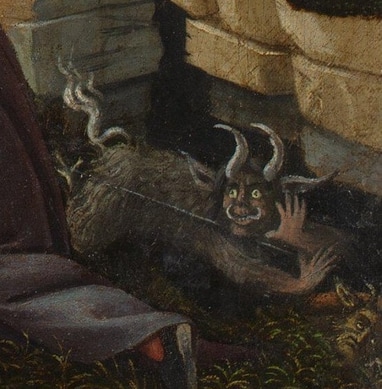
The direction matters. These creatures are retreating from a world in which heaven and humanity are being brought together. If you only notice that a Christmas painting contains demons, you miss the joke at their expense: they’re losing.
Botticelli gives them horns, wings, tails and weapons, then tucks them into the least comfortable parts of the composition. The angels have the sky. The devils are negotiating the cracks.
They also change how you read everything above them. Without the creatures, the picture might look like a particularly elaborate celebration. With them, joy has an opponent—and the opponent is running out of room.
The National Gallery connects their retreat with Christ’s return and the defeat of evil. A recent study of the painting’s damaged Greek inscription likewise emphasizes the devils’ movement down into the earth. We’ll get to that inscription. Botticelli has left us quite a note.
Sources: National Gallery; Monica Centanni and Paolo B. Cipolla, study of the inscription and demons.
The angels above: heaven has opened for dancing
Now follow the painting all the way up. Twelve angels circle a great opening of gold. Their feet hang in the blue air, their clothes ripple, and small crowns dangle from the branches they carry.
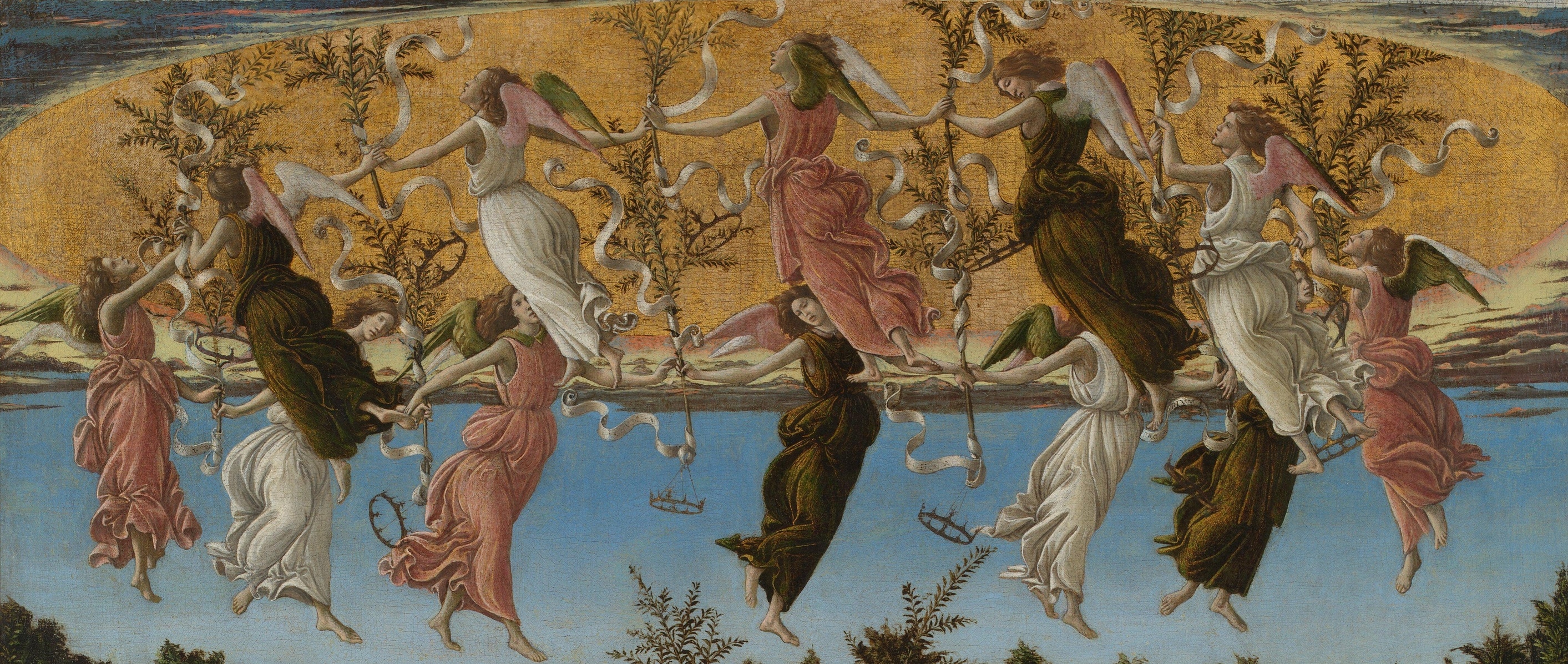
It’s a wonderfully impractical arrangement. Nobody has a floor, and everybody seems to know the steps.
The olive branches are signs of peace. The fluttering ribbons carry praises of Mary; some of their lettering is much easier to discuss in an art-history book than to read while standing in front of the canvas.
Notice the three angels on the roof, too. Their white, red and green clothes repeat colors from the heavenly circle. White, red and green are often read as faith, love and hope, though that may not exhaust Botticelli’s color scheme.
Sources: Robin Griffith-Jones, The Visual Commentary on Scripture; Rab Hatfield, “Botticelli’s Mystic Nativity, Savonarola and the Millennium,” especially p. 112.
The embraces below: peace gets an actual body
Between the dancers and the devils, three angels embrace three men. Faces press together. Arms wrap around shoulders. One pair seems to be lifting off the ground.
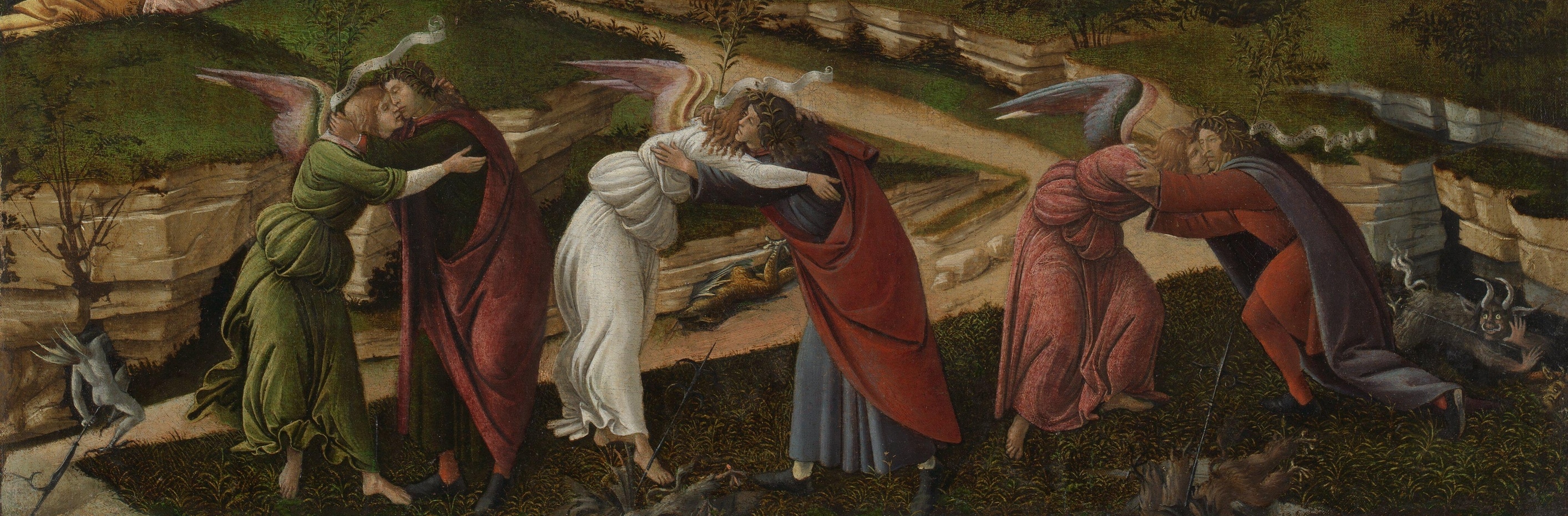
It’s a surprisingly affectionate foreground. These aren’t distant heavenly officials checking whether everyone has behaved. They’re holding people close.
The ribbons here recall the angels’ announcement in Luke’s Christmas story:
“Glory to God in the highest, and on earth peace to men on whom His favor rests!”
Luke 2:14 · BSB
In Luke, the words are spoken to shepherds. Botticelli gives that peace a visible gesture: an embrace between the human and the divine.
Sources: The Visual Commentary on Scripture, “Mercy and Truth are Met Together”; Luke 2:14, BSB.
Botticelli left a Greek inscription, and it doesn’t calm things down
There’s writing along the very top of the painting. From a distance, you could mistake it for a discreet finishing touch.
It mentions the Apocalypse.

Botticelli names himself Alessandro, dates the picture to the end of 1500, refers to the “troubles of Italy,” and connects those troubles with the Book of Revelation. There’s a period of three and a half years in which the devil is loose, followed by his defeat.
That is a substantial amount of information to put above a baby.
The inscription turns the painting into more than a scene from the distant past. Botticelli is looking at the upheaval of his own time through the language of biblical prophecy. The Nativity becomes a place to imagine how that upheaval might end.
Parts of the inscription are damaged, and scholars disagree about the missing words. Even its Bible references take some untangling: it points toward Revelation 11 and 12, while Satan’s binding appears in chapter 20. Botticelli has given us plenty to discuss, but no reliable countdown.
What you can see clearly is the hope: the devils’ freedom will not last forever.
Sources: Centanni and Cipolla on the damaged Greek text; The Visual Commentary on Scripture on Revelation 11, 12 and 20.
Savonarola and the Florence behind the painting
To understand this Christmas painting, we need to meet the preacher who had been telling Florence to repent.
Italy in the 1490s saw invading armies, while Florence endured political upheaval. Girolamo Savonarola, a Dominican friar, attacked corruption and luxury, warned of divine punishment and promised renewal. His influence grew after the Medici were expelled from Florence in 1494.
The city’s spiritual advice had become inseparable from its political crisis.
Savonarola was executed in 1498. Botticelli’s picture followed around 1500. Scholars have long connected its apocalyptic language and religious imagery with the friar’s preaching. His preaching helps explain the painting. Exactly how devoted Botticelli was to the man is harder to prove.
That distinction matters. “Botticelli heard a preacher, panicked and stopped being the painter of Venus” is an efficient story. It also makes a complicated artist suspiciously easy to explain.
Art historian Rab Hatfield traces specific details to Savonarola’s sermons, rather than treating the year 1500 as a complete explanation. The calendar alone doesn’t explain the picture.
Keep the turmoil in mind, then look again at the embraces. They become more moving when peace is something an artist’s city badly needs. This painting has room for anxiety, but it spends much of its energy imagining reconciliation.
Sources: National Gallery, Botticelli biography; Rab Hatfield’s study of Savonarola and the painting.
Why does Mary look so large?
Look back at the center. Mary is enormous beside the kneeling visitors. If she stood up, the little shelter would have a problem.
The scale gives her a different kind of importance from the people around her. Rather than making every figure obey the dimensions of an ordinary room, Botticelli lets sacred significance shape the picture.
You can see the same freedom in the whole arrangement. Gold opens above a forest. Angels gather on a thatched roof. Heavenly dancers circle over people with their feet on the earth.
It helps to read this as a vision you can move through. At the center is a mother bending toward a child who reaches up to her. Around that intimate exchange, Botticelli makes space for an immense hope.
And the baby is still recognizably a baby. With everything happening above and below, he has his arms up toward his mother. That small, familiar gesture holds the whole crowded painting together.
Is this scene actually in the Bible?
Matthew and Luke do not describe little devils fleeing under rocks at Jesus’ birth. The dancers, embraces and retreating creatures belong to Botticelli’s symbolic telling of the story.
He draws different parts of Christian belief into one image: the birth in the Gospels, the promise of peace, and Revelation’s vision of evil overcome. Christian Scripture elsewhere makes the connection between Christ’s coming and evil’s defeat explicit: 1 John 3:8 says the Son of God was revealed to destroy the devil’s works.
That doesn’t make the painting a photograph of Bethlehem. It makes it a meditation on what the birth means.
Even the title helps. Mystic Nativity is the familiar name under which we encounter this unusual vision; The Mystical Nativity is a common alternative. You haven’t wandered into a different Botticelli when you see the extra syllable.
Before you leave, look at the devils again
They’re what made you stop. Fair enough. A Christmas painting with creatures under the floor is a good reason to lean closer.
But look at how little command they have over the picture. They cannot stop the dance above them. They cannot separate the people being embraced. They don’t even get a comfortable place to stand.
The little face by the right-hand rock is still worth a second look. Just don’t let it persuade you that this is its painting.
Questions about Botticelli’s Mystic Nativity
- What is the meaning of Botticelli’s Mystic Nativity?
- It presents Christ’s birth as a vision of reconciliation between heaven and humanity, with evil retreating below. Its Greek inscription connects the image to Revelation and the troubles of Botticelli’s own Italy. The angels, embraces and fleeing devils make that larger hope visible.
- When was the Mystic Nativity painted: 1500 or 1501?
- The National Gallery dates it to 1500, following the date in its inscription. You’ll also see 1500–1501 or early 1501 because the old Florentine year began on March 25. A date near the end of Florentine 1500 could therefore fall in early 1501 by modern reckoning.
- How many angels are in the painting?
- There are twenty angels: twelve dancing above, three on the roof, two guiding the visitors, and three embracing men below. The twelve in the heavenly circle are only part of the gathering.
- Did Botticelli predict the end of the world in 1500?
- The painting connects contemporary upheaval with apocalyptic prophecy, but calling it a straightforward prediction that the world would end in 1500 goes beyond the evidence. The inscription is cryptic, and its chronology remains debated. The image itself emphasizes evil’s defeat and the hope of peace.
- Where is Botticelli’s Mystic Nativity?
- It belongs to the National Gallery in London, where its collection number is NG1034. The museum lists it as oil on canvas, measuring 108.6 × 74.9 cm. Check the museum’s current record if you’re planning a visit.
More details hiding in plain sight
If this has changed the way you look at Christmas pictures, follow the light in Why Does Baby Jesus Glow in Nativity Paintings?. For a painter whose biography supplies rather more trouble than the pictures need, try Caravaggio’s Bible Paintings.